Pharmacology & Therapeutics
Home A comprehensive guide to the pharmacologic regulation of angiotensin converting enzyme 2 (ACE2), the SARS-CoV-2 entry receptor
A comprehensive guide to the pharmacologic regulation of angiotensin converting enzyme 2 (ACE2), the SARS-CoV-2 entry receptor

Article Type: review-article Article History
Publisher: Elsevier Inc.
Abstract

The recent emergence of coronavirus disease-2019 (COVID-19) as a global pandemic has prompted scientists to address an urgent need for defining mechanisms of disease pathology and treatment. Severe acute respiratory syndrome coronavirus 2 (SARS-CoV-2), the causative agent for COVID-19, employs angiotensin converting enzyme 2 (ACE2) as its primary target for cell surface attachment and likely entry into the host cell. Thus, understanding factors that may regulate the expression and function of ACE2 in the healthy and diseased body is critical for clinical intervention. Over 66% of all adults in the United States are currently using a prescription drug and while earlier findings have focused on possible upregulation of ACE2 expression through the use of renin angiotensin system (RAS) inhibitors, mounting evidence suggests that various other widely administered drugs used in the treatment of hypertension, heart failure, diabetes mellitus, hyperlipidemias, coagulation disorders, and pulmonary disease may also present a varied risk for COVID-19. Specifically, we summarize mechanisms on how heparin, statins, steroids and phytochemicals, besides their established therapeutic effects, may also interfere with SARS-CoV-2 viral entry into cells. We also describe evidence on the effect of several vitamins, phytochemicals, and naturally occurring compounds on ACE2 expression and activity in various tissues and disease models. This comprehensive review aims to provide a timely compendium on the potential impact of commonly prescribed drugs and pharmacologically active compounds on COVID-19 pathology and risk through regulation of ACE2 and RAS signaling.

Keywords
Oz,Lorke,and Kabbani: A comprehensive guide to the pharmacologic regulation of angiotensin converting enzyme 2 (ACE2), the SARS-CoV-2 entry receptor

Introduction

The recent emergence of coronavirus disease-2019 (COVID-19) as a pandemic affecting millions of individuals has raised great concern throughout the world and has spurred an urgent need for treatments. In order to enter the host cell, the causative agent “severe acute respiratory syndrome coronavirus-2” (SARS-CoV-2) binds to angiotensin converting enzyme 2 (ACE2), which is widely expressed throughout the body, including lung alveolar epithelial cells, nasal and oral mucosal cells, vascular endothelium, and enterocytes of the small intestine (Hamming et al., 2004). Higher ACE2 expression is correlated with higher pseudotype SARS-CoV-2 and SARS-CoV viral infectivity (Hofmann et al., 2004; H. P. Jia et al., 2005; W. Li et al., 2007, Ou et al., 2020), suggesting that increased ACE2 levels may predispose individuals to SARS-CoV-2 transmission. Since ACE inhibitors (ACE-Inhs.) and Angiotensin 1-Receptor (AT1-R) blockers (ARBs) have been reported to increase ACE2 expression, concerns have been raised regarding the safety of these drugs in patients exposed to SARS-CoV-2. Thus, these concerns are mainly based on the hypothesis that such medications may raise the expression of ACE2 and increase the susceptibility of patients to SARS-CoV-2 (Peron & Nakaya, 2020). Because both an ACE inhibitor (lisinopril) and an AT1-R blocker (losartan) are among the 10 most commonly used drugs with a combined 155 million prescriptions per year in the USA alone (Zolk et al., 2020), patients receiving these drugs would represent a substantial group of people at risk. This article reviews the effects not only of ACE-Inhs. and ARBs, but also of other drugs on the expression and activity of ACE2. In addition, the pharmacological effects of these drugs and naturally occurring compounds are discussed in the context of COVID-19. Thus, the focus of this review is neither the treatment of COVID-19 nor the regulation of ACE2 in specific disease conditions, but the regulation of ACE2 by the many drugs, pharmacologically active compounds and naturally occurring substances used in society today.

ACE2, a homologue of ACE, was discovered two decades ago by two independently working research groups, Donoghue et al. (2000) and Tipnis et al. (2000). Like ACE, ACE2 is an integral membrane protein and zinc metallopeptidase with an amino acid sequence that is 42% identical to ACE. While ACE contains two catalytic domains, ACE2 has only one. Importantly, ACE-Inhs. belonging to the classic “pril” group used in the treatment of cardiovascular diseases do not affect the enzymatic functions of ACE2 (Donoghue et al., 2000; Tipnis et al., 2000). Structural and functional features and topographical characteristics of ACE2 have been reviewed earlier (Kuba, Imai, Ohto-Nakanishi, & Penninger, 2010; Turner, 2015). The major functional difference between ACE and ACE2 is that ACE produces Angiotensin II (Ang-II), whereas ACE2 degrades this peptide. Specifically, ACE2 functions as a carboxypeptidase removing a single C-terminal amino acid from the octapeptide Ang-II, generating the heptapeptide Angiotensin-(1-7) [Ang-(1-7)] or, much less efficiently, from the decapeptide Angiotensin I (Ang-I) forming the nonapeptide Angiotensin-(1-9) [Ang-(1-9)]. In contrast, ACE acts as a carboxydipeptidase (peptidyldipeptidase) removing the C-terminal dipeptide from Ang-I to form Ang-II. Furthermore, whereas ACE metabolizes bradykinin to [des-Arg9]-bradykinin, ACE2 degrades [des-Arg9]-bradykinin to pharmacologically inactive breakdown products (Tipnis et al., 2000). Other substrates for ACE2, at least in vitro, include apelin-13/17, neurotensin (1-11), dynorphin A (1-13), amyloid-β peptides, β-casomorphin-(1-7), and ghrelin (Turner, 2015; Vickers et al., 2002).

In most tissues, ACE2 is found in its membrane-bound form, which contains an extracellular segment anchored to the plasma membrane through a transmembrane domain. This enzymatically active N-terminal ecto-domain can be cleaved by a membrane-bound protease, also called secretase (or sheddase), and released into the surrounding extracellular space. Thus, some fraction of membrane bound ACE2 is shed into the circulation as soluble ACE2 and can be detected in plasma, cerebrospinal fluid, and urine samples. In its soluble form, however, ACE2 is found in very low concentrations in the circulation (Epelman et al., 2008; Rice et al., 2006). While serum ACE levels were reported to be 7 nM (Rice et al., 2006), the ACE2 concentration was found to be 200-fold lower (33 pM) in over 500 subjects. In recent years, it has become increasingly apparent that the proteolytic shedding of cell surface ACE2 is an important mechanism regulating its expression, functions, and soluble concentrations in biological fluids (J. Xu et al., 2017). The major protease mediating ectodomain shedding of ACE2 is a type I transmembrane protein belonging to the adamalysin subfamily of Zn-dependent metalloproteases (“A Disintegrin And Metalloprotease 17”; ADAM17). Since this protease also mediates extracellular domain shedding and activation of the proinflammatory cytokine TNF-α (Black et al., 1997; Moss et al., 1997), it is also known as “tumor necrosis factor-α (TNF-α) cleavage enzyme” (TACE) (Lambert et al., 2005; Patel et al., 2014). Pharmacological agents, e.g., rosiglitazone (Chodavarapu et al., 2013) and the vitamin D analog paricalcitol (Riera et al., 2016), as well as endogenous peptides, e.g., Ang-II (Patel et al., 2014) and insulin (Salem, Grobe, & Elased, 2014), regulate the activity of ADAM17. Several pathologies, such as hypertension, diabetes mellitus, renal failure (Chodavarapu et al., 2016; Salem, Grobe, & Elased, 2014; Somineni, Boivin, & Elased, 2014 J. Xu et al., 2016), and SARS-CoV infections (Haga et al., 2008) are associated with significant alterations in ADAM17 activity. Importantly, soluble ACE2 levels in circulation and biological fluids are the result of a dynamic process determined not only by cell surface expression, but also by ACE2 shedding. Notably, soluble circulating ACE2 appears to serve as a biomarker in renal and cardiovascular diseases, such as hypertension, heart failure, and diabetes mellitus (Anguiano, Riera, Pascual, & Soler, 2017).

ACE2, by converting Ang-I into Ang-(1-9), and Ang-II into Ang-(1-7), degrades Ang-I and Ang-II, thereby negatively regulating the renin-angiotensin system (RAS) and mitigating the deleterious effects of these peptides (Fig. 1 ). Thus, the enzymatic functions of ACE2 are of particular significance in pathological conditions where the RAS is overstimulated by Ang-I and Ang-II (Arendse et al., 2019; Chappell, 2016; Paz Ocaranza et al., 2020). Biological actions of Ang-(1-7) are mediated mainly by the Mas receptor (MasR), and a vast array of its effects are opposite to those attributed to Ang-II activation of the Ang-II type 1 receptor (AT1-R) (Arendse et al., 2019; Santos et al., 2018). Ang-(1-7) can be degraded to Ang-(1-5) by ACE (Chappell, 2016). In addition, Ang-(1-7) inhibits the enzymatic activity of ACE (Raffai, Khang, & Vanhoutte, 2014; Tom, de Vries, Saxena, & Danser, 2001). Thus, Ang-(1-7) acts both as substrate and as inhibitor of ACE. Ang-(1-9) has also shown beneficial biological effects via the AT2-R that result in cardioprotection, vasodilation, and decreased platelet aggregation; however, expression of AT2-Rs is low in adults (Arendse et al., 2019; Paz Ocaranza et al., 2020). Nevertheless, Ang-II binds with equal affinity (in the nM range) to AT1-Rs and AT2-Rs, and AT2-R density in tissues increases significantly in some physiological conditions, e.g., fetal development, pregnancy, and parturition, as well as in pathological conditions, e.g., inflammation, ischemia, diabetes, hypertension, and pulmonary fibrosis (Karnik et al., 2015; Kaschina, Namsolleck, & Unger, 2017; Sumners, Peluso, Haugaard, Bertelsen, & Steckelings, 2019). Activation of AT2-Rs usually counterbalances the effects of AT1-Rs and induces antihypertensive, antioxidative, anti-inflammatory, and anti-fibrotic effects (de Kloet, Steckelings, & Sumners, 2017; Karnik et al., 2015; Sumners, Peluso, Haugaard, Bertelsen, & Steckelings, 2019). Thus, the ACE2/Ang-(1-7)/MasR axis, along with AT2-Rs, has emerged as a physiological antagonist that counter-regulates the activity of the classical RAS pathway (Arendse et al., 2019; Chappell, 2016; Santos et al., 2018).

The renin angiotensin system (RAS). Classical RAS consists of angiotensin converting enzyme (ACE) breaking down Angiotensin (Ang)-I into Ang-II, both of which can bind to either the AT1 (angiotensin type 1) or the AT2 (angiotensin type 2) receptor. Non-classical RAS consists of ACE2 converting Ang-I into Ang-(1-9) and Ang-II into Ang-(1-7). Ang-(1-7) stimulates the Mas receptor. Bradykinin and [des-Arg9]-bradykinin are degraded by ACE and ACE2, respectively, into pharmacologically inactive peptides.
Fig. 1

The renin angiotensin system (RAS). Classical RAS consists of angiotensin converting enzyme (ACE) breaking down Angiotensin (Ang)-I into Ang-II, both of which can bind to either the AT1 (angiotensin type 1) or the AT2 (angiotensin type 2) receptor. Non-classical RAS consists of ACE2 converting Ang-I into Ang-(1-9) and Ang-II into Ang-(1-7). Ang-(1-7) stimulates the Mas receptor. Bradykinin and [des-Arg9]-bradykinin are degraded by ACE and ACE2, respectively, into pharmacologically inactive peptides.

As a major driver of the ACE/Ang-II/AT1-R axis, Ang-II downregulates ACE2 expression by activating AT1-R-mediated upregulation of “extracellular signal-regulated kinase“ (ERK)1/2 and p38 mitogen-activated protein (MAP) kinase in human tubular kidney cells (Koka et al., 2008), rat aortic vascular smooth muscle cells (Gallagher, Ferrario, & Tallant, 2008a), cardiomyocytes (Gallagher, Ferrario, & Tallant, 2008b), and catecholaminergic neurons (L. Xiao, Haack, & Zucker, 2013). In Neuro-2A cells transfected with ACE2, AT1-R activation by Ang-II leads to internalization and subsequent destruction of ACE2 in lysosomes (Deshotels, Xia, Sriramula, Lazartigues, & Filipeanu, 2014). In addition, Ang-II activation of the AT1-R promotes ADAM17-mediated proteolytic cleavage of ACE2 in COS7 cells (Mifune et al., 2005), cardiomyocytes (Patel et al., 2014) and hypothalamic neurons (Xia, Sriramula, Chhabra, & Lazartigues, 2013; J. Xu, Sriramula, et al., 2017). Furthermore, Ang-II stimulates phosphorylation of three MAP kinases, i.e., p38 kinase, ERK 1/2, and c-Jun N-terminal kinase (JNK) to mediate its actions. It also increases the production of transforming growth factor β 1 (TGF-β1), which further suppresses ACE2 expression (Chou, Chuang, Lu, & Guh, 2013; Su, Zimpelmann, & Burns, 2006) and promotes ADAM17 activation (Ohtsu et al., 2006). Thus, Ang-II-induced down regulation of ACE2 expression, eventually leads to impaired conversion of Ang-II to Ang-(1-7) and causes further accumulation of Ang-II and RAS-mediated detrimental effects in a positive feedback cycle. Similar to Ang-II, another vasoconstrictive peptide, Endothelin-1, also downregulates ACE2 transcription by activating p38 MAP kinase and ERK1/2 pathways in human bronchial epithelial cells (H. Zhang, Li, Zeng, Wu, & Ou, 2013) and rat cardiomyocytes (Gallagher, Ferrario, & Tallant, 2008b).

As opposed to Ang-II, Ang-(1-7) and atrial natriuretic peptide (ANP) do not affect ACE2 expression (Deshotels, Xia, Sriramula, Lazartigues, & Filipeanu, 2014). However, both peptides counteract Ang-II-AT1-R-mediated down regulation of ACE2 by activating MAP kinase phosphatase in rat aortic vascular smooth muscle cells (Gallagher, Ferrario, & Tallant, 2008a), astrocytes (Gallagher, Chappell, Ferrario, & Tallant, 2006), and cardiomyocytes (Gallagher et al., 2008b). In addition, Ang-(1-7) and ANP inhibit ADAM17 activity (X. Ma et al., 2016; Zhai et al., 2018). In summary, while Ang-II downregulates ACE2 expression initiating a positive feedback mechanism leading to further elevation of Ang-II, Ang-(1-7) activates the Mas receptor and counteracts these cellular actions of Ang-II.

In addition to the RAS, ACE2 is involved in the regulation of the kinin-kallikrein system (KKS). Effector peptides of the KKS, mainly bradykinin (BK) and its active metabolite [des-Arg9]-BK (DABK), recognize two pharmacologically distinct G protein-coupled receptors: the B1 receptor, whose main agonist is DABK, and the B2 receptor, whose ligand is BK (Rhaleb, Yang, & Carretero, 2011). The RAS enzymes ACE and ACE2 degrade BK and DABK, respectively (Fig. 1) (Donoghue et al., 2000; Vickers et al., 2002). In addition, Ang-(1-7) produced by ACE2 downregulates ACE activity (Tom, de Vries, Saxena, & Danser, 2001) and potentiates BK-induced vasodilatations (Raffai, Khang, & Vanhoutte, 2014). Thus, downregulation of ACE2 activity by disease conditions, such as lung injury and SARS-CoV infections, may increase DABK levels. Over-activation of B1 receptors can contribute to the pathogenesis of these diseases. In an endotoxin-induced lung inflammation model, the loss of ACE2 function leads to an accumulation of DABK, an activation of B1 receptors, and the release of proinflammatory chemokines from airway epithelia. Examples of released chemokines are C-X-C motif chemokine 1 and 5, macrophage inflammatory protein-2, and cytokines, e.g., TNF-α. In this model, neutrophil infiltration as well as lung inflammation and injury have been increased (C. P. Sodhi et al., 2018).

Cardiovascular drugs and ACE2

In clinical studies, commonly used antihypertensive medications, such as β-adrenergic receptor blockers (βARBs) and calcium channel blockers (CCBs), are not associated with changes in plasma or urine ACE2 levels (Furuhashi et al., 2015). Interestingly, the A1075 allele of the ACE2 gene has been associated with increased mortality in male patients with acute coronary syndrome in the absence of, but not in the presence of βARB treatment, suggesting a pharmacogenetic effect linking ACE2 and βARBs (Palmer et al., 2008).

βARBs

βARBs, mainly through β1 receptor-mediated inhibition of the sympathetic nervous system, negatively regulate the release of renin from juxtaglomerular cells in the kidney and are thereby involved in RAS regulation. The contribution of renal sympathetic activity on the ACE2/Ang-(1-7)/Mas receptor pathway of the RAS has been investigated in disease models. Renal denervation decreases blood pressure, cardiac and renal fibrosis, cardiomyopathy, and oxidative stress. It upregulates cardiac and renal ACE2 protein expression in isoproterenol-induced cardiomyopathy (Q. Liu et al., 2015), myocardial infarction (Feng et al., 2017) and hypertension models (W. Han et al., 2020; M. Wang et al., 2018). In a recent study, renal denervation improved cardiac function, decreased fibrosis, and upregulated hypothalamic ACE2 mRNA and protein expression in a heart failure model (W. J. Chen et al., 2019). In a rat model of type 2 diabetes mellitus with insulin resistance, renal denervation decreased plasma and renal tissue norepinephrine levels, improved vascular endothelial functions, and increased mRNA and protein expression of ACE2 in aortic endothelial cells. This effect was due to induction of autophagy via the “AMP-activated protein kinase” (AMPK) and “mammalian target of rapamycin” (mTOR) signaling pathways (Y. Wang, B. Rijal, et al., 2020), suggesting that ACE2 expression in different regions can be regulated by sympathetic activity. Following treatment with the non-selective β adrenoreceptor agonist isoproterenol, both increased (Nadu, Ferreira, Reudelhuber, Bader, & Santos, 2008) and decreased (Syed et al., 2016) cardiac ACE2 expression have been reported in hypertrophy models. Similarly, while, isoproterenol downregulated cardiac ACE2 expression in a myopathy model (Q. Liu et al., 2015), it upregulated cardiac ACE2 levels in a myocardial infarction model (Badae, El Naggar, & El Sayed, 2019). A recent study in rat salivary glands reported isoproterenol-induced downregulation of ACE2 mRNA expression in the parotid, but not in the sublingual and submandibular glands (Cano et al., 2019), suggesting that the effect of isoproterenol may vary between different tissues and disease models.

In spontaneously hypertensive (SH) rats, the βARB atenolol reduced the blood pressure to a similar extent as compared to hydralazine, a direct vasodilator, and olmesartan, an AT1-R blocker. However, atenolol and hydralazine showed no effect on ACE2 expression in both tissues (Igase, Strawn, Gallagher, Geary, & Ferrario, 2005), whereas olmesartan caused marked upregulation of ACE2 in aortic tissue, but had no effect on the carotid artery (Igase, Strawn, Gallagher, Geary, & Ferrario, 2005). Nebivolol, a βARB, did not decrease the blood pressure but reduced plasma renin concentration, cardiac Ang-II levels, oxidative stress, and fibrosis; cardiac ACE2 activity and mRNA levels remained essentially unchanged (Varagic et al., 2012). However, in another study on SH rats, the βARB propranolol alone or in combination with the AT1-R blocker losartan or the ACE-Inh. captopril decreased the blood pressure and markedly reduced ACE2 mRNA expression in the aorta (Lezama-Martinez et al., 2018). Of note, the βARB labetalol increased the maximal reaction rate and decreased the substrate specificity of ACE2 (Kulemina & Ostrov, 2011), suggesting that at least some βARBs can interact directly with ACE2. βARBs have also been shown to decrease proinflammatory cytokines, including IL-1β, IL-6, TNFα, IFNγ (Deten, Volz, Holzl, Briest, & Zimmer, 2003; Doo et al., 2001; Hajighasemi & Mirshafiey, 2016; Matsumura et al., 2002). Moreover, they reduce pulmonary edema (Rassler, 2012), inhibit NLRP3 inflammasome (Wong et al., 2018), and reduce the mortality and disease severity of acute respiratory distress syndrome (ARDS) (Al-Qadi & Kashyap, 2015; Noveanu et al., 2010) and chronic obstructive lung disease (COPD) (Nielsen, Pedersen, Sode, & Dahl, 2019), suggesting that βARBs may have beneficial effects on COVID-19. In addition to βARBs, ⍺1-AR antagonists have recently been shown to prevent cytokine responses and to increase the survival after inflammatory stimuli in mouse models (Staedtke et al., 2018). They also reduce morbidity and mortality in patients at risk for developing a cytokine storm syndrome (Vogelstein et al., 2020). Briefly, the sympathetic nervous system activates the RAS through βARs, βARBs inhibit renin release, and renal denervation upregulates cardiac, renal and hypothalamic ACE2 expression in various disease models. In addition, decreased reactive oxygen species (ROS) production, increased endothelial nitric oxide synthase (NOS) expression and NO formation can lead to upregulation of ACE2 expression (W. Han et al., 2020; Varagic et al., 2012). However, both increased and decreased ACE2 expression have been reported after application of the non-selective β adrenoreceptor agonist isoproterenol, and there is no consistent evidence that βARBs influence ACE2 expression or activity. In 221 hypertensive patients, no association between the use of βARBs and renal ACE2 gene expression was found (X. Jiang et al., 2020). In the context of COVID-19, a recent study with 880 COVID-19 patients reported that the use of βARBs was associated with a significantly better outcome (Pinto-Sietsma et al., 2020).

Calcium channel blockers

There are few studies investigating the effects of calcium channel blockers (CCBs) on ACE2 regulation. Amlodipine (an L-type CCB) and cilnidipine (an L- and N-type CCB), not alone but in combination with valsartan, decreased the blood pressure but did not change aortic ACE2 mRNA expression (Takai, Jin, Aritomi, Niinuma, & Miyazaki, 2013). In a mechanical stress model resulting in elevated ACE2 mRNA expression, Ang-II decreased ACE2 surface expression of pressurized human aortic endothelial cells, and nifedipine (an L-type CCB) reversed this effect (Iizuka, Kusunoki, Machida, & Hirafuji, 2009). Felodipine (an L-type CCB) decreased blood pressure, fibrosis and TGF-β1 expression; but no changes in renal ACE2 mRNA expression were observed in ischemic or non-ischemic hypertensive rats (S. Bai, Huang, Chen, Wang, & Ding, 2013). On the other hand, nimodipine treatment attenuated the reduction in brain ACE2 mRNA expression that occurs in ischemic brain tissue (Abdel-Fattah, Messiha, & Mansour, 2018). Similarly, amlodipine increased renal ACE2 levels in hypertensive rats (Onat & ŞAhna, 2018). In summary, data suggest that CCBs reverse reduced ACE2 expression in various disease models. Recently, in an analysis of 291 COVID-19 patients, the use of CCBs was not associated with increased disease severity or mortality rates (Fosbol et al., 2020). In cell culture experiments, CCBs of the dihydropyridine class, amlodipine, felodipine and nifedipine, at high concentrations (10-500 μM), were reported to limit the growth of SARS-CoV-2 in epithelial kidney (Vero E6) and epithelial lung (Calu-3) cells (Straus, Bidon, Tang, Whittaker, & Daniel, 2020).

Diuretics

The effects of most diuretic drugs on ACE2 are currently unknown. Among thiazide diuretics, hydrochlorothiazide increased cardiac ACE2 gene expression in normotensive but decreased it in hypertensive rats (Jessup, Brosnihan, Gallagher, Chappell, & Ferrario, 2008). However, mineralocorticoid receptor blockers (MRBs) have been reported to regulate ACE2 activity and expression in various disease models. In macrophages from heart failure patients, the MRB spironolactone reduced oxidative stress and lipid peroxide formation, accompanied by a markedly upregulated ACE2 expression, whereas aldosterone significantly reduced it (Keidar et al., 2005). Spironolactone also upregulated decreased ACE2 expression levels in aldosterone-treated cultured cardiomyocytes (Yamamuro et al., 2008) and kidney (Fukuda et al., 2011), as well as in kidneys of rats with obstructive jaundice (Kong et al., 2019), but not in human mesangial cells (Stoll, Yokota, Sanches Aragao, & Casarini, 2019). Eplerenone, another MRB, did not consistently reverse decreased ACE2 levels in rats with experimental heart failure (Karram et al., 2005) and in the hearts of hypertensive rats (Takeda et al., 2007), but completely reversed aldosterone- and high salt-induced down regulation of renal ACE2 expression (Bernardi et al., 2015). Similarly, eplerenone reversed the aldosterone-induced, p47-mediated downregulation of ACE2 expression in mouse macrophages, heart and kidney (Keidar et al., 2005). In addition, eplerenone was reported to inhibit ADAM17 activity in human monocytes (Satoh, Ishikawa, Minami, Akatsu, & Nakamura, 2006), which should potentially promote cell surface ACE2 activity. In line with this, in a diabetic nephropathy model, improvement of kidney pathology by spironolactone was associated with decreased serum ACE2 levels (Dong et al., 2019).

In summary, the majority of studies points to an increase in ACE2 expression after MRB treatment, mainly by counteracting aldosterone-induced down regulation of ACE2. In addition, mitigation of the deleterious effects of obesity on the RAS, possibly reducing obesity-related COVID-19 complications (Feraco et al., 2013; Vecchiola et al., 2020) and direct anti-inflammatory and antiviral effects of MRBs, could be beneficial in the treatment of pulmonary COVID-19 complications (Cadegiani, Wambier, & Goren, 2020). Importantly, MRBs such as spironolactone possess a significant anti-androgenic activity, which may be beneficial in the context of SARS-CoV-2 infection, by inhibiting the androgen-dependent expression of “Transmembrane protease, serine 2” (TMPRSS2), a transmembrane protease crucial for SARS-CoV-2 entry (Liaudet & Szabo, 2020). In addition, potassium canrenoate (the active metabolite of spironolactone) results in concentration (0.1-10 μM)-dependent reductions of the binding of the SARS-CoV-2 spike protein to the ACE2 receptor (Carino et al., 2020). Increased plasma aldosterone levels associated with disease severity in COVID-19 patients (Villard et al., 2020) suggest that MRBs may have beneficial effects in COVID-19. A recent study concluded that canrenone decreased all-cause mortality and improved the clinical outcome in a small cohort of 30 COVID-19 patients with diseases ranging from moderate to severe (M. Vicenzi et al., 2020). Another diuretic, furosemide, significantly decreased lipopolysaccharide-induced proinflammatory cytokine production in cell lines and potently inhibited IL-6 and TNF-α release (Z. Wang, Y. Wang, et al., 2020), suggesting its potential use in hypercytokinemic conditions in COVID-19.

Inhibitors of the renin-angiotensin system and ACE2

Blockers of AT1 receptors and ACE-Inhs. are the most commonly used drugs in the treatment of hypertension and cardiovascular diseases (Zolk et al., 2020). As mentioned earlier, ACE2 antagonizes the effects of Ang II. At the cellular level, Ang-II, mainly by acting on AT1 receptors, downregulates the expression of ACE2 (Ferrario, Ahmad, & Groban, 2020). Therefore, it can be expected that either the inhibition of Ang-II production by ACE-Inhs. or the blockade of AT1 receptors may lead to upregulation of ACE2 expression. In addition, activation of peroxisome proliferator-activated receptors (Harada et al., 2016; Horiuchi, Iwanami, & Mogi, 2012; Maquigussa et al., 2018; Michel, Foster, Brunner, & Liu, 2013; Z. Z. Zhang et al., 2013) and sirtuin 1 (SIRT1) (Strycharz et al., 2018) by AT1-R blockers (ARBs), such as telmisartan, losartan and irbesartan, may further contribute to the upregulation of ACE2 expression (Goltsman et al., 2019; Gupte et al., 2008; W. Zhang et al., 2014).

Animal and cell culture data

Detailed lists of experimental studies assessing the effects of ACE-Inhs. and ARBs on the expression or activity of ACE2 are provided in Table 1, Table 2 , respectively. Not surprisingly, the majority of experimental studies supports the assumption that RAS inhibition upregulates ACE2 activity and expression, although there appear to be some differential responses between ARBs versus ACE-Inhs., between drugs belonging to the same group of drugs, and between different tissues and species. For example, in normotensive Lewis and hypertensive mRen2.Lewis male rats, the ARB losartan markedly increased ACE2 activity in the heart (Ferrario et al., 2005; Ferrario et al., 2005); a similar increase in cardiac ACE2 activity was reported for the ARB eprosartan in rats with heart failure (Karram et al., 2005). The ACE-Inh. lisinopril, however, either failed to increase cardiac ACE2 activity (Lewis rats) or stimulated it to a lesser extent than losartan (in murine Ren2 renin transgenic rats), despite similar reductions in blood pressure (Ferrario, Jessup, Chappell, et al., 2005; Ferrario, Jessup, Gallagher, et al., 2005; Jessup et al., 2006). In the kidneys of both strains, losartan and lisinopril increased ACE2 activity (Ferrario, Jessup, Chappell, et al., 2005; Ferrario, Jessup, Gallagher, et al., 2005; Jessup et al., 2006), although to a lesser degree compared to the heart. On the other hand, it was found that the ACE-Inh. ramipril reduced cardiac ACE2 activity in a rat model of kidney injury (L. Burchill et al., 2008).

Table 1
Effects of angiotensin converting enzyme inhibitors (ACE-Inhs.) on the activity or expression of ACE2.
Pharmacological agent/classExperimental model /Tissue/SubjectEffectReference
Ramipril/ ACE-Inh.Male Sprague-Dawley rats/ Streptozocin induced diabetes modelIncreased renal ACE2 immunostaining and protein expression in diabetic rats. ACE2 expression decreased markedly in diabetic rats.Tikellis et al. (2003)
Ramipril/ ACE-Inh.Sprague–Dawley rats/ Myocardial ischemia induced by ligation of the left coronary arteryCardiac ACE2 mRNA expression and ACE2 activity increased by myocardial ischemia. Ramipril did not cause any change.Burrell et al. (2005)
Lisinopril/ ACE-Inh.Lewis rats/ HeartDecrease in plasma Ang II, increase in plasma Ang 1–7 and ACE2 mRNA, but not cardiac ACE2 ActivityFerrario, Jessup, Chappell, et al. (2005)
Lisinopril/ACE-Inh. Losartan/ARBLewis rats/ KidneyLisinopril or Losartan treatment were both associated with increases in ACE2 activity but used in combination, did not produce this effect.Ferrario, Jessup, Gallagher, et al. (2005)
Lisinopril/ACE-Inh.Lewis and hypertensive mRen2.Lewis ratsIncreased renal ACE2 mRNA expression in hypertensive but not in normotensive rats.Chappel and Ferrario (2006)
Enalapril/ACE-Inh.Sprague Dawley rats/ Coronary artery ligation in heartIncreased plasma and cardiac ACE2 activity, and cardiac ACE2 mRNA levels 8 weeks post-surgeryOcaranza et al. (2006)
Lisinopril/ACE-Inh.Transgenic Ren2 rats/ Heart and kidneyDecrease in plasma Ang II, increase in plasma Ang 1–7, cardiac and renal ACE2 mRNA and activityJessup et al. (2006)
Lisinopril/ ACE-Inh.Lewis rats/ KidneyNo change in kidney ACE2 mRNA, but increased ACE2 activityFerrario, Jessup, Gallagher, et al. (2005)
Lisinopril/ ACE-Inh.Wistar rats/ Dietary sodium restrictionRenal ACE2 activity was unchanged with lisinopril treatment in either groupHamming et al. (2008)
Perindopril/ ACE-Inh.Male C57BL/6 mice/ Streptozotocin induced diabetes modelDecreased renal ACE2 activity and mRNA expression in both control and diabetic miceTikellis et al. (2008)
Ramipril/ ACE-Inh.Sprague Dawley rats/ Acute kidney injury modelDecreased cardiac ACE2 activity and protein expressionL. Burchill et al. (2008)
Ramipril/ ACE-Inh.Sprague Dawley rats/ Kidney nephrectomy modelNo change in renal ACE2 activity. Increased with nephrectomyVelkoska, Dean, Burchill, Levidiotis, & Burrell (2010)
Perindopril/ ACE-Inh.Male Wistar rats and HSC-T6 cells/ CCl4-induced liver fibrosis modelIncreased ACE2 mRNA and protein expression in fibrotic liver. Perindopril alone no effect on HSC-T6 cellsM. L. Huang et al., 2010, Huang et al., 2020
Ramipril/ ACE-Inh.Sprague Dawley rats/ Kidney after subtotal nephrectomyRamipril had no effect on ACE2 in cardiac or renal tissue. Reduced ACE2 activity in renal cortex by nephrectomy was reversed by ramiprilBurrell et al. (2012)
Fosinopril/ ACE-Inh.Male Sprague-Dawley rats/ Coronary artery ligation induced disease modelNo change in cardiac ACE2 mRNA expressionY. Wang, C. Li, et al. (2012)
Ramipril/ ACE-Inh. + Valsartan/ ARBSprague Dawley rats/ Myocardial infarction modelACE2 expression was not altered but may have decreased in viable myocardium border or infarct zones, (unclear statistical analysis).L. J. Burchill et al. (2012)
Perindopril/ ACE-Inh. +Losartan/ ARBAkita Agt-Transgenic C57BL/6 mice/ Hypertension modelMarked increase in renal ACE2 mRNA and protein expression in hypertensive miceLo et al. (2012)
Enalapril/ ACE-Inh.Spontaneously Hypertensive rats/ HeartACE2 mRNA expression was increased but ACE2 protein expression did not change with ACE-Inh. treatmentZ. Yang et al. (2013)
Enalapril/ ACE-Inh.Male C57BL/6 mice/ High fat diet modelIncreased pancreatic ACE2 protein expressionFrantz, Crespo-Mascarenhas, Barreto-Vianna, Aguila, and Mandarim-de-Lacerda (2013)
Imidapril/ ACE-Inh.Broiler chickens/ Low temperature induced cardiac remodelingDecreased cardiac ACE2 mRNA expressionX. Q. Hao et al. (2013)
Imidapril/ ACE-Inh.Broiler chickens/ Low temperature induced pulmonary hypertension modelDecreased pulmonary ACE2 mRNA expressionX. Q. Hao et al. (2014)
Captopril/ ACE-Inh.Male Wistar rats/ Coronary artery occlusion induced myocardial infarction modelMarkedly decreased cardiac ACE2 mRNA and protein expression in infarcted heartFlores-Monroy, Ferrario, Valencia-Hernandez, Hernandez-Campos, & Martinez-Aguilar (2014)
Enalapril/ ACE-Inh. +Losartan/ ARBSprague Dawley rats/ Cardiac remodeling from aortic constrictionACE2 cardiac protein expression was increased (~3-fold) with both drugs in rats with cardiac remodeling; data were not provided for animals with sham surgery.Y. Zhang et al. (2014)
Captopril/ ACE-Inh.Mouse Lewis lung carcinoma cells/ Hypoxia modelIncreased ACE2 protein expression in hypoxic cells with markedly decreased ACE2 protein expression levelsL. Fan et al. (2014)
Perindopril/ ACE-Inh.Male Wistar rats/ Streptozotocin induced diabetes modelIncreased cardiac ACE2 protein expression in diabetic ratsP. P. Hao et al. (2015)
Captopril/ ACE-Inh.Male Sprague Dawley rats/ Lipopolysaccharide induced lung injury modelIncreased pulmonary ACE2 protein expression in controls and marked increase in injured lungsY. Li et al. (2015)
Captopril/ ACE-Inh.Landrace pigs/ porcine cardiac arrest modelNo change in serum ACE2H. L. Xiao et al. (2016)
Captopril/ ACE-Inh.Male Wistar rats/ Aortic coarctation-induced hypertension modelNo effect on cardiac ACE2 mRNA expression in sham and hypertentensive group.Ibarra-Lara et al. (2016)
Enalapril/ ACE-Inh.Swine/ cardiac arrest and resuscitation modelCompared to controls, enalapril did not alter myocardial ACE2 mRNA and protein expressionG. Wang, Zhang, Yuan, Wu, & Li et al. (2016)
Cilazapril/ ACE-Inh.Male Wistar rats/ Doxorubicin-induced cardiomyopathy modelNo change in cardiac ACE2 protein expression in doxorubicin treated ratsH. Ma et al. (2017)
Ramipril/ ACE-Inh.Male Sprague Dawley rats/ Subtotal nephrectomy induced kidney disease modelNo effect on cardiac ACE2 activity in subtotal nephrectomized ratsBurrell, Gayed, Griggs, Patel, & Velkoska (2017)
Captopril/ ACE-Inh.Female Wistar rats/ Ovariectomized rat model for osteoporosisIncreased bone ACE2 protein expression in osteoporotic rats. But no effect in control ratsAbuohashish, Ahmed, Sabry, Khattab, & Al-Rejaie (2017)
Captopril/ ACE-Inh.Land race pigs/Pulmonary embolism modelNo change in pulmonary ACE2 protein expressionH. L. Xiao et al. (2018)
Captopril/ ACE-Inh.Spontaneously hypertensive and Wistar Kyoto rats/ Aortic tissueMarkedly decreased aortic ACE2 mRNA expression in hypertensive rats with significantly upregulated ACE2 levelsLezama-Martinez et al. (2018)
Captopril/ ACE-Inh.Male Sprague-Dawley rats/ Focal cerebral ischemia modelIncreased brain ACE2 activity in controls and ischemic brainsTao et al. (2018)
Captopril/ ACE-Inh.Landrace pigs/ Acute pulmonary embolism modelNo change in cardiac ACE2 immunostaining and protein expressionH. L. Xiao et al. (2019)
Enalapril/ ACE-Inh.Male Wistar albino rats/ Isoproterenol induced myocardial infarct modelNo change in cardiac ACE2 concentration in infarcted cardiac tissueBadae, El Naggar, and El Sayed (2019)
Captopril/ ACE-Inh.Male Wistar rats/ SiO2 inhalation induced lung injury modelIncreased ACE2 protein expression in lung and pulmonary fibroblasts, also increased serum ACE2 levelB. N. Zhang et al. (2019)
Perindopril/ ACE-Inh.Female Sprague Dawley rats/ Hyperlipidemic Alzheimer disease modelReversed the decreased hippocampal ACE2 mRNA expression in rats with Alzheimer diseaseMessiha, Ali, Khattab, & Abo-Youssef (2020)
Enalapril/ ACE-Inh.Male Swiss mice/ Hyperlipidic diet-induced obesity modelHighly significant increase in hepatic ACE2 gene expressionMoraes et al. (2020)
Table 2
Effects of AT1 receptor blockers (ARBs) on the activity or expression of ACE2.
Losartan/ARB

Olmesartan/ARB
Lewis rats /Coronary artery ligation in heartIncrease in plasma Ang II, Ang 1–7 and ACE2 mRNA 28 days post surgeryIshiyama et al. (2004)
Eprosartan/ARBMale Wistar rats/ Aortocaval fistula induced heart failure modelHeart failure caused decreased cardiac ACE2 expression and enzyme activity was restored by eprosartanKarram et al. (2005)
Losartan/ ARBLewis rats/ HeartIncrease in plasma Ang II, Ang 1–7 levels, ACE2 mRNA and cardiac ACE2 activityFerrario, Jessup, Chappell, et al. (2005)
Olmesartan/ ARBSpontaneously hypertensive rats/ AortaMarkedly increased aortic ACE2 immunostaining and mRNA expression. But no effect on carotid arteryIgase et al. (2005)
Losartan/ ARBTransgenic Ren2 rats/ Heart and kidneyIncrease in plasma Ang II, Ang 1–7, cardiac and renal ACE2 mRNA and activityJessup et al. (2006)
Losartan/ ARBLewis and hypertensive mRen2.Lewis ratsIncreased renal ACE2 mRNA expression in hypertensive but not in normotensive rats.Chappel and Ferrario (2006)
Olmesartan/ ARBSpontaneously hypertensive rats and Wistar Kyoto rats/ HeartOlmesartan significantly increased the cardiac ACE2 expression level compared to that in Wistar Kyoto rats and SHRSP treated with a vehicleAgata et al. (2006)
Valsartan/ ARBMale transgenic Ren2 and Sprague-Dawley rats/ Hypertension modelIincreased renal ACE2 mRNA expression in Ren2 ratsWhaley-Connell et al. (2006)
Candesartan/ ARBDahl salt-sensitive hypertensive rats/ Hypertension modelIncreased cardiac ACE2 mRNA and protein expression in hypertensive ratsTakeda et al. (2007)
Losartan/ ARB3T3-L1 murine adipocytesNo change on the ACE2 mRNA expression.Gupte et al. (2008)
Olmesartan/ ARBMale spontaneously hypertensive rats/ Balloon induced carotid artery injuryIncreased carotid artery intima ACE2 immunostaining in injured group. But no effect in uninjured intimaIgase, Kohara, Nagai, Miki, & Ferrario (2008)
Losartan/ ARBTransgenic and hypertensive C57BL/6J miceNo change in brain ACE2 protein expression, but activity increased.Xia, Feng, Obr, Hickman, & Lazartigues (2009)
Telmisartan/ ARBC57BLKS/J mice/ KidneyFollowing 2 weeks administration, increased ACE2 protein levels, and ACE2 mRNA expressionSoler et al. (2009)
Olmesartan/ ARBMale Wistar rats/ Pressure-overload cardiac hypertrophy modelIncreased cardiac ACE2 mRNA expression in hypertrophic heartsKaiqiang, Minakawa, Fukui, Suzuki, & Fukuda (2009)
Losartan/ ARBMale Wistar rats/ Lipopolysaccharide induced septic shock modelIncreased lung ACE2 protein expressionHagiwara et al. (2009)
Losartan/ ARBMale Sprague-Dawley/ cigarette smoke induced pulmonary hypertension modelNo effect on ACE2 protin expression in pulmonary smooth muscle cell cultures, but increased ACE2 expression in smoke exposed lungs and cell cultures.S. X. Han et al. (2010)
Losartan/ ARBMale FVB/NJ mice/ Nephrectomy induced kidney disease modelNo effect on renal ACE2 avtivity and protein expression in nephrectomized ratsDilauro, Zimpelmann, Robertson, Genest, & Burns (2010)
Losartan/ ARBSprague Dawley rats/ cigarette smoke-induced lung damageACE2 expression was unchanged in control rats by either dose of losartan. Animals exposed to cigarette smoke had reduced ACE2, which losartan treatment restoredS. X. Han et al. (2010)
Losartan/ ARBMale C57BL/6 mice/ Fructose dietLosartan alone increased renal ACE2 protein expression but no effect on ACE2 activity; also reversed the increasing effect of fructoseSenador et al. (2010)
Losartan/ ARBSprague Dawley rats/ Acute Respiratory Distress Syndrome model in the lungRestored ACE2 activity decreased by the injury. ACE2 activity decreased in controlsWosten-van Asperen et al. (2011)
L-158,809/ ARBFischer 344 rats/ Dorsomedial medulla of the brainL-158,809 induced 2-fold increase in brain ACE2 mRNA expressionGilliam-Davis et al. (2011)
Losartan/ ARBMale Sprague-Dawley rats/ Lipopolysaccharide and mechanical ventilation induced lung injury modelsDecreased pulmonary ACE2 activity in only ventilated rats, increased activity in lung injured ratsWosten-van Asperen et al. (2011)
Candesartan/ ARBMale Lewis rats/ Fischer-to-Lewis renal transplantation modelDecreased serum ACE2 activityRusai et al. (2011)
Telmisartan/ ARBMale Lewis rats/ Experimental autoimmune myocarditis modelDecrease of ACE2 protein expression and immunoreactivity caused by myocarditis was partially reversed by telmisartanV. Sukumaran et al. (2011)
Olmesartan/ ARBTransgenic C57BL/6J mice overexpressing renin and angiotensinogenMarkedly increased cardiac ACE2 activity and mRNA expression after NOS inhibitionInaba et al. (2011)
Telmisartan/ ARBMale spontaneously hypertensive and male Wistar–Kyoto rats/Decreased ACE2 mRNA in aorta of hypertensive group was upregulated by telmisartanJ. C. Zhong et al. (2011)
Irbesartan/ ARBC57BL/6 mice/ AortaTreatment with irbesartan significantly augmented ACE2 protein levels and ACE2 mRNA expressionJin et al. (2012)
Olmesartan/ ARBC57BL/6J mice/ Vascular cuff injury modelIncreased vascular ACE2 mRNA expression in injured rats.Iwai et al. (2012)
Olmesartan/ ARBMale Lewis rats/ Cardiac myosin-induced dilated cardiomyopathy modelDecrease of myocardial ACE2 mRNA and protein expression in cardiomyopathy group was partially reversed by olmesartanV. Sukumaran et al. (2012)
Telmisartan/ ARBMale Lewis rats/ Autoimmune myocarditis cardiomyopathy modelIncreased cardiac ACE2 immunostaining and protein epression in cardiomyopathic ratsV. Sukumaran et al. (2012)
Telmisartan/ ARBMale Sprague-Dawley rats/ Bile duct ligation induced hepatic fibrosis modelIncreased liver ACE2 immunostaining, mRNA and protein expressionYi, Liu, Wen, & Yin (2012)
Losartan/ ARBAkita Agt-Transgenic C57BL/6 mice/ Hypertension modelMarked increase in renal ACE2 mRNA and protein expression in hypertensive miceLo et al. (2012)
Candesartan/ ARBMale Lewis rats/ Myosin induced cardiotoxicityIncreased cardiac ACE2 protein expressionArumugam et al. (2012)
Losartan/ ARBMale C57BL/6 mice/ High fat diet modelNo change in pancreatic ACE2 protein expressionFrantz et al. (2013)
Losartan/ ARBBalb/c, FVBN wild and Mas receptor knockout mice/ Adriamycin-induced nephropathy modelIncreased renal ACE2 protein expression in Adriamycin treated mice.Silveira et al. (2013)
Olmesartan/ ARBmRen2.Lewis hypertensive rats/ KidneyIncreased ACE2 mRNA and proteinVaragic et al. (2013)
Valsartan/ ARBMale Wistar-Kyoto and spontaneously hypertensive ratsIncreased aortic ACE2 mRNA expressionTakai, Jin, Aritomi, Niinuma, and Miyazaki (2013)
Losartan/ ARBMale Wistar rats/ Aaortic coarctation induced hypertrophy modelNo change in coronary ACE2 immunostaining.Souza et al. (2013)
Azilsartan/ ARBAT2 and Mas knockout mice, both on C57BL/6J

Background/ Vascular injury model
Increased vascular ACE2 mRNA expression in injured tissues from wild and knockout miceOhshima et al. (2014)
Irbesartan/ ARBC57BL/6 mice/HeartIncrease in cardiac ACE2 mRNA, Irbesartan prevented Ang II induced decrease in ACE2 protein levelsPatel et al. (2014)
Azilsartan, Olmesartan/ ARBTransgenic hRN/hANG-Tg miceDecrease of ACE2 mRNA expression in transgenic mice was attenuated by azilsartan but not olmesartanIwanami et al. (2014)
Losartan/ ARBMouse Lewis lung carcinoma cells/ Hypoxia modelIncreased ACE2 protein expression in hypoxic cells with markedly decreased ACE2 protein expression levelsL. Fan et al. (2014)
Losartan/ ARBMale Sprague–Dawley rats/ Cigarette smoke induced pulmonary hypertensionNo effect on lung ACE2 protein expression, but cigarette smoke decreased ACE2 protein expressionY. M. Yuan et al. (2015)
Losartan/ ARBMale New Zealand white rabbits/ High-cholesterol diet atherosclerosis modelACE2 activity, protein expression increased in aortic plaque. Losartan further increased these values.Y. H. Zhang et al. (2015)
Losartan/ ARBSpontaneously hypertensive ratsIncreased renal, but not cardiac ACE2 mRNA expression.Klimas et al. (2015)
Valsartan/ ARBMale Wistar rats/ Balloon-injured neointimal hyperplasia modelInjury induced ACE2 mRNA and protein expression was reversed by valsartanY. Li et al. (2016)
Olmesartan, Candesartan, Telmisartan, Losartan, Valsartan and Irbesartan/ ARBMale C57BL/6 mice/ Transverse aortic constriction induced heart failure modelHeart failure suppressed the ACE2 protein expression and all ARBs tested upregulated ACE2.X. Wang et al. (2016)
Telmisartan/ ARBMale Sprague-Dawley rats/ Angiotensin II induced hypertension modelReversed Ang-II-induced reduction in activity and immunostaining of cardiac ACE2F. Bai et al. (2016)
Candesartan/ ARBMale transgenic diabetic miceIncreased renal ACE2 protein expression in diabetic miceCallera et al. (2016)
Olmesartan/ ARBTransgenic and C57BL/6N mice/ Cardiac hypertrophy modelReversal of cardiac ACE2 mRNA expression decreased in cardiac hypertrophy modelTanno et al. (2016)
Losartan/ ARBMale C57BL/6 mice/ Unilateral ureteral obstruction modelIncreased renal ACE2 mRNA expressionde Jong et al. (2017)
Azilsartan/ ARBMale db/db mice/ Diabetic mice modelIncreased cardiac ACE2 protein expression in diabetic mice. No effect on non-diabetic miceVijayakumar Sukumaran, Tsuchimochi, Tatsumi, Shirai, & Pearson (2017)
Irbesartan/ ARBMale C57BL/6J mice/ Restraint stress modelIncrease of intestinal ACE2 immunostaining and mRNA expression that was suppressed by stress.Yisireyili et al. (2018)
Olmesartan/ ARBMale Golden Syrian hamsters/ Fluorouracil-induced mucositis modelACE2 mRNA expression upregulated by fluorouracil was reduced by olmesartanAraujo et al. (2018)
Losartan/ ARBSpontaneously hypertensive and Wistar Kyoto rats/ Aortic tissueMarkedly decreased aortic ACE2 mRNA expression in hypertensive rats with significantly upregulated ACE2 levelsLezama-Martinez et al. (2018)
Olmesartan/ ARBMale renin overexpressing, Ren-TG, and C57BL/6N mice/ Hypertension modelDecreased renal ACE2 mRNA and protein expression in hypertensive mice was reversed by olmesartanIchikawa et al. (2018)
Telmisartan/ ARBMale Wistar rats / Cerebral ischemia-reperfusion modelIncreased brain ACE2 mRNA expression of down regulated ACE2 in ischemic brain tissue.Abdel-Fattah, Messiha, and Mansour (2018)
Losartan, telmisartan / ARBC57BL/6 mice / High-fat obesity modelHigh-fat induced decrease of ACE2 mRNA expression was reversed by losartan and telmisartanGraus-Nunes et al. (2019)
Losartan / ARBMale albino rats / High fat high sucrose induced diabetes modelIncreased adipose tissue ACE2 protein expression diabetic ratsSabry et al. (2019)
Valsartan/ ARBFemale spontaneously hypertensive and Wistar-Kyoto ratsIncreased cardiac ACE2 mRNA and protein expressionY. Zhao et al. (2019)
Azilsartan/ ARBMale Wistar-Kyoto rats / Adenine-induced chronic renal failure modelNo significant change of renal ACE2 levels in immunostaining and immunoblotting analysis compared to vehicle groupKidoguchi et al. (2019)
Losartan / ARBMale Wistar rats / Losartanl treatment of salivary glandNo effect on ACE2 mRNA expression in parotid, sublingual and submandibular glandsCano et al. (2019)
Telmisartan/ ARBMale Wistar rats / Streptozotocin induced diabetes modelNo change in renal ACE2 protein level.Malek, Sharma, Sankrityayan, & Gaikwad (2019)
Telmisartan/ ARB

Captopril/ ACE-Inh. act
Male Sprague-Dawley rats / Pregabalin-Induced Heart FailurePregabalin induced suppression of cardiac ACE2 protein expression was completely reversed by telmisartan and captoprilAwwad, El-Ganainy, ElMallah, Khattab, & El-Khatib (2019)
Telmisartan/ ARBFemale Wistar rats / D-Galactose treated ovariectomised, Alzheimer modelIncreased hippocampal ACE2 protein expressionAbdelkader, Abd El-Latif, & Khattab (2020)

Interestingly, a recent study reported that renal ACE2 levels were decreased and pulmonary ACE2 levels remained unchanged in ACE knockout mice or in mice treated with ACE-Inhs. or ARBs (Jan Wysocki, Lores, Ye, Soler, & Batlle, 2020). In another recent study, treatments with the ACE-Inh. enalapril or the ARB losartan did not affect ACE2 mRNA expression in lung, ileum, kidney, and heart of normotensive healthy C57BL/6J mice (Congqing Wu et al., 2020). Similarly, treatment with the ACE-Inh. lisinopril (100 nM) did not alter ACE2 expression in A549 lung cancer cells (Bartova, Legartova, Krejci, & Arcidiacono, 2020). In another recent study on human alveolar adenocarcinoma (A549) and lung cancer (Calu-3) cell lines, Ang-I (10-1000 nM) and Ang-II (1-100 nM) did not alter ACE2 expression. Treatment with ARBs, such as losartan and valsartan, and ACE-Inhs., such as lisinopril and captopril, did not affect ACE2 expression in these pulmonary cells (Baba et al., 2020).

Human data

The results of clinical studies investigating the effects of therapeutic concentrations of ARBs and ACE-Inhs. on ACE2 levels in biopsy, plasma and urine samples are provided in Table 3 . The majority of these studies reports no effect of ACE-Inhs. and ARBs on samples obtained from patients with cardiovascular diseases. In a recent study on kidney biopsies of diabetic patients, the use of ARBs and ACE-Inhs. did not change ACE2 mRNA expression (R. E. Gilbert et al., 2020). However, in atrial biopsies from patients with cardiovascular diseases, treatment with ARBs and ACE-Inhs. significantly increased ACE2 mRNA expression (Lebek et al., 2020).

Table 3
Clinical studies investigating the effects of ARBs and ACE-Inhs. on biopsy, serum, and urine samples.
Pharmacological agent/classExperimental model /Tissue/SubjectEffectReference
ACE-Inh. undefined58 patients with renal diseaseNo change in immunolocalization of renal ACE2Lely, Hamming, van Goor, & Navis (2004)
ACE-Inh. and ARB undefinedPlasma ACE2 activity was assayed from 228 patients with heart failure.No association was found between ACEI/ARB use and ACE2 levels.Epelman et al. (2008)
ACE-Inh. and ARB undefined13 patients with diabetic nephropathyNo change in kidney ACE2 mRNA levels compared to controls. But ACE-Inh. or ARB was associated with increased renal ACE2 mRNA expression in control subjectsReich, Oudit, Penninger, Scholey, & Herzenberg (2008)
ACE-Inh. and ARB undefined113 patients with chronic systolic heart failureNo association was found between ACE-Inh. and ARB use and ACE2 levels.Epelman et al. (2009)
ACE-Inh. and ARB undefined859 patients with type 1 diabetes and 204 healthy control subjects.Mild increase in serum ACE2 was increased ~10 to 20% (higher in women) In diabetics using ACEIs, No association was found between ARB usage and ACE2 levels.Soro-Paavonen et al. (2012)
ACE-Inh. and ARB undefined113 kidney transplant patients. 45 patient using ACE-Inh. and ARBNo effect on serum ACE2 activitySoler et al. (2012)
ACE-Inh. and ARB undefined239 patient with chronic kidney diseaseNo effect on plasma ACE2 activityRoberts, Velkoska, Ierino, & Burrell (2013)
ACE-Inh. undefined95 patients with ST-elevation myocardial infarction.No association was found between ACE-Inh. and serum ACE2 levels.Ortiz-Perez et al. (2013)
ACE-Inh. and ARB undefined70 patients with acute decompensated heart failureBaseline or changes in serum ACE2 activity were not associated with the use of ACE-Inh. and ARBShao et al. (2013)
ACE-Inh. and ARB undefined46 patients/ intestinal biopsiesIncreased intestinal ACE2 mRNA levels in ACE-Inh. treatment group compared to controls. But no change in ARB groupVuille-dit-Bille et al. (2015)
ACE-Inh. and ARB undefined2004 chronic kidney patient.ARB, but not ACE-Inh. increased plasma ACE2 activity compared to non-treated patients.Anguiano et al. (2015)
ACE-Inh. and ARB undefined239 hypertensive patients, and 188 patients with heart failureNo association was found between ACE-Inh. and ARB use and serum ACE2 levelsUri et al. (2016)
ACE-Inh. and ARB undefined161 hypertensive patients.45 patients are treated with ACE-Inh. and ARBNo effect on serum ACE2 concentrationS. Li et al. (2017)
Captopril/ ACE-Inh. Losartan/ ARB71 patients with chronic kidney disease in hemodialysisBoth drugs did not change ACE2 mRNA expression in hemodialysis patients.Trojanowicz et al. (2017)
Lisinopril/ ACE-Inh.140 patients with essential hypertensionLower serum ACE2 levels in patients treated with LisinoprilHristova, Stanilova, & Miteva (2019)
ACE-Inh. and ARB undefined127 patients with aortic stenosisNo association was found between ACE-Inh. and ARB use and plasma ACE2 activityRamchand et al. (2020)
ACE-Inh. and ARB undefined88 patients with atrial fibrillation.No association was found between plasma ACE2 levels and ACEI/ARB use.Walters et al. (2017)
ACE-Inh. and ARB undefined79 patients with obstructive coronary artery disease.Plasma ACE2 levels had no association with use of ACE-Inh. and ARBRamchand, Patel, Srivastava, Farouque, and Burrell (2018)
ACE-Inh. and ARB undefined50 patients with diabetic nephropathy. All patients were treated with ACE-Inh. and/or ARBNo effect on urinary ACE2 mRNA expression compared to controlsG. Wang et al. (2008)
ACE-Inh. and ARB undefined190 patients with chronic kidney diseaseNo significant difference in urinary ACE2 compared to controlsMizuiri et al. (2011)
Olmesartan/ ARB31 type 2 diabetes patients with nephropathyIncreased urinary ACE2 levels independently of blood pressureAbe, Oikawa, Okada, & Soma (2015)
ACE-Inh. and ARB undefined152 patients with chronic kidney diseaseAssociated with increased urine ACE2 levelsAbe, Maruyama, Oikawa, Maruyama, Okada & Soma. (2015)
ACE-Inh. (enalapril)100 hypertensive patients.Olmesartan increased urinary ACE2. Enalapril, losartan, valsartan, candesartan, valsartan and telmisartan had no effect.Furuhashi et al. (2015)
ARB (losartan, valsartan, candesartan, valsartan and telmisartan, olmesartan).
ACE-Inh. and ARB undefined132 Type-2 Diabetic patients, 58 patients using ACE-Inh. and ARBElevated urinary ACE2 levels in diabetic hypertensive patients were significantly decreased by ACE-Inh. and ARBY. Liang et al. (2015)
ACE-Inh. and ARB undefined75 patients with Type-2 diabetesNo effect on urinary ACE2 levelsMariana et al. (2016)
ACE-Inh. and ARB undefined76 patients with and without chronic kidney diseaseNo change in urine ACE2 concentrationsJ. Wysocki et al. (2017)

Concerning plasma ACE2 levels, a recent study with 2,022 heart failure patients reported that neither the use of an ACE-Inh. nor of an ARB was associated with higher plasma ACE2 concentrations (Sama et al., 2020). In clinical studies involving patients with heart failure (Chirinos et al., 2020; Epelman et al., 2009; Sama et al., 2020), atrial fibrillation,(Walters et al., 2017), hypertension (Kuznetsova & Cauwenberghs, 2020), aortic stenosis (Ramchand et al., 2020), and coronary artery disease (Ramchand, Patel, Srivastava, Farouque, & Burrell, 2018), plasma ACE2 protein levels or ACE2 activities were not higher among patients who were taking ACE-Inhs. or ARBs than among untreated patients. In addition, in patients with genetic variants of the ACE gene, no association of genetically predicted serum ACE levels with lung ACE2 and TMPRSS2 expression or with plasma levels of ACE2 was found (Gill et al., 2020). In a recent study, serum ACE2 levels of 1,452 individuals on ACE-Inh. or ARB treatment remained unaffected compared to those not using these medications (Emilsson et al., 2020). Similarly, another recent study reported that plasma ACE2 activity remained unaltered in patients treated with ACE-Inhs. and ARBs (Kintscher et al., 2020). However, this study reported that plasma ACE2 activity was significantly increased in a small cohort of COVID-19 patients using ACE-Inhs. In line with this finding, ACE-Inh. and ARB treatment was associated with high plasma ACE2 levels in a large cohort of patients with atrial fibrillation (Wallentin et al., 2020).

In earlier human studies measuring plasma Ang-(1-7) levels as surrogate for ACE2 activity, while acute administration of ACE-Inhs. did not alter Ang-(1-7) levels (Campbell, Zeitz, Esler, & Horowitz, 2004; Luque et al., 1996), chronic use (6 months) of ACE-Inhs. increased Ang-(1-7) levels (Luque et al., 1996). Importantly, plasma ACE2 activity may not represent enzymatic activity at the tissue level, as Ang-II infusion into mice decreases myocardial ACE2 protein level and activity but increases plasma ACE2 activity (Patel et al., 2014). Interestingly, the antihypertensive effects of captopril (X. Fan et al., 2007), benazepril (Q. Chen et al., 2011; Y. Y. Chen et al., 2016), and imidapril (Y. Y. Chen et al., 2016) are reportedly associated with polymorphisms or variations in the ACE2 gene in a gender-specific manner; however serum ACE2 levels have not been reported in these studies.

In a longitudinal cohort study involving Japanese patients with hypertension, urinary ACE2 levels were higher among patients who received long-term treatment with the ARB olmesartan than among untreated control patients. However, this association was not observed with the ACE inhibitor enalapril or with other ARBs, such as losartan, candesartan, valsartan, and telmisartan (Furuhashi et al., 2015). Correlation analysis of cardiac tissue samples from 11 patients with heart failure did not show any significant relation between angiotensinase activity and prior use of ACE-Inhs. (Zisman et al., 2003). Notably, ACE2 mRNA expression remained unchanged in bronchial epithelial cells from a small cohort of patients with COPD using ACE-Inhs. (Higham & Singh, 2020). In a small cohort of 11 patients with kidney disease, a statistically significant increase in ACE2 expression with use of ACE-Inhs. or ARBs was detected in renal epithelial and endothelial cells, but the underlying diseases confounded the association (Subramanian et al., 2020). In another study, ACE2 expression slightly, but significantly decreased in nasal cilia of patients taking ACE-Inhs. and remained unchanged in patients using ARBs (Ivan T Lee et al., 2020). In 221 hypertensive patients, no association between ACE-Inhs. or ARBs and renal ACE2 gene expression was found (X. Jiang et al., 2020). In addition, in kidney biopsies from 49 diabetic patients, treatment with ARBs and ACE-Inhs. did not change ACE2 mRNA expression (R. E. Gilbert et al., 2020). A recent gene expression analysis of 1,051 lung tissue samples indicated that the use of ACE-Inhs. was associated with lower expression of ACE2 and of the SARS-Cov-2 activator TMPRSS2, while the use of ARBs was not associated with an increased expression of these genes (Milne, Yang, Timens, Bosse, & Sin, 2020). However, in 62 patients undergoing coronary artery bypass grafting, treatment with ARBs and ACE-Inhs. was independently associated with an increased myocardial ACE2 mRNA expression (Lebek et al., 2020). Importantly, in sino-nasal biopsies from patients, treatment with ACE-Inhs. or ARBs did not increase ACE2 expression in the cilia of the upper respiratory tract (I. T. Lee et al., 2020). Altogether, these clinical studies strongly suggest that treatment with ACE-Inhs. and ARBs is not associated with increased ACE2 expression.

Inhibitors of the renin-angiotensin system and COVID-19

In a propensity analysis of 12,594 patients tested for COVID-19, there was no association between any single medication class, including ACE-Inhs., ARBs, CCBs, βARBs, and thiazide diuretics, and an increased likelihood of a positive test. Moreover, none of these medications was associated with an increased risk of severe illness among patients who tested positive (Reynolds et al., 2020). In a population based retrospective study of 34,936-hypertensive adults, the use of antihypertensive drugs, including diuretics, CCBs, βARBs, ACE-Inhs. and ARBs, did not alter the risk of COVID-19 (Vila-Corcoles et al., 2020). Similarly, in a recent study analyzing 6,272 COVID-19 patients, no association between the use of ACE-Inhs. and ARBs (as well as CCBs and βARBs), and COVID-19 risk was found (Mancia, Rea, Ludergnani, Apolone, & Corrao, 2020). Equally, another propensity analysis of 18,472 patients tested for COVID-19 did not reveal any association between ACE-Inh. or ARB use and COVID-19 test positivity (Mehta et al., 2020). In a retrospective study with 4,480 COVID-19 patients, prior use of ACE-Inhs. and ARBs was not significantly associated with COVID-19 diagnosis among patients with hypertension or with severe disease conditions (Fosbol et al., 2020). In a large population study, patients using ARBs or CCBs had a lower risk of COVID-19 (J. Kim et al., 2020). Other studies also found no association between the use of ACE-Inhs., ARBs and an increased risk of testing positive for SARS-CoV-2 or a more severe outcome (Chang et al., 2020; De Spiegeleer et al., 2020; Son, Seo, & Yang, 2020). Instead, the use of ARB and ACE-Inhs. was associated with no risk (Dublin et al., 2020; Raisi-Estabragh et al., 2020) or a reduced risk of COVID-19, as determined by an 8.3 million cohort study (Hippisley-Cox et al., 2020).

In line with these findings, the clinical outcome of 136 diabetic and hypertensive COVID-19 patients using ACE-Inhs. or ARBs was not different from that of patients who do not use these drugs (Y. Chen, D. Yang, et al., 2020). In a study with 1,200 COVID-19 patients, no evidence for increased disease severity was found in hospitalized patients on chronic treatment with ACE-Inhs. or ARBs (Bean et al., 2020). Similarly, in 50 high-risk aged COVID-19 patients with cardiovascular disease, the ACE-Inh. ramipril had no impact on the incidence or the severity of the disease (Amat-Santos et al., 2020). In another recent study with 880 COVID-19 patients, no evidence for an adverse outcome was found in severely affected COVID-19 patients that had used ARBs prior to admission (Pinto-Sietsma et al., 2020). In 2,263 hypertensive COVID-19 patients, the use of ACE-Inhs. or ARBs was not associated with an altered risk of hospitalization or mortality. In analyses stratified by insurance group, the use of ACE-Inhs. lowered the risk of hospitalization by nearly 40% in the Medicare group, a phenomenon not observed in commercially insured patients (Khera et al., 2020). Similarly, in a case-population study of 1,139 COVID-19 patients, the risk of hospitalization among users of ACE-Inhs. or ARBs was not different from that of users of other antihypertensive drugs; and no increased risk of hospitalization was associated with the use of either ACE-Inhs. or ARBs (de Abajo et al., 2020). Equally, in 543 hypertensive COVID-19 patients, no association was found between disease severity and treatment with ARBs and ACE-Inhs. (Bravi et al., 2020). In a rather large multinational cohort, no clinically significantly increased risk of COVID-19 diagnosis or hospitalization was found in patients using ACE-Inhs. or ARBs (Morales et al., 2020). In addition, the use of ACE-Inhs. and ARBs did not affect mortality rates in small cohorts of COVID-19 patients (Amat-Santos et al., 2020; Iaccarino et al., 2020; Inciardi et al., 2020; Tedeschi et al., 2020). Another recent study of 5,179 COVID-19 patients in Korea concluded that prior use of ACE-Inhs. and ARBs was not independently associated with increased mortality rates (S. Y. Jung, Choi, You, & Kim, 2020). In small cohorts of hypertensive COVID-19 patients, the use of ACE-Inhs. and ARBs did not significantly change the clinical course, disease severity and mortality rates (Wang et al., 2020, Wang et al., 2020; Sardu et al., 2020; Jiuyang Xu et al., 2020). A retrograde analysis of 2,700 intensive care patients with severe sepsis and septic shock unrelated to COVID-19 indicates no difference in mortality rates between users of ACE-Inhs. or ARBs and non-users within the subgroup of patients with respiratory infections (Sunden-Cullberg, 2020). Also, previous treatment with ACE-Inhs. or ARBs had no effect on mortality, heart failure, requirement for hospitalization, or ICU admission in 210 patients with COVID-19 (López-Otero et al., 2020). In recent months, several clinical studies have reported that the use of ARBs and ACE-Inhs. does not affect disease progression and mortality rates in COVID-19 patients (Anzola et al., 2020; Bae et al., 2020; Braude et al., 2020; Cordeanu et al., 2020; H. Cui et al., 2020; Di Castelnuovo et al., 2020; Gormez et al., 2020; Hippisley-Cox et al., 2020; Kalra et al., 2020; Khan et al., 2020, Kim et al., 2020; Kocayigit et al., 2020; Lafaurie et al., 2020; J. Lee et al., 2020; Sardu et al., 2020; Soleimani et al., 2020, Taher et al., 2020; Trifirò et al., 2020, Wang et al., 2020). Altogether, these results indicate that the use of ACE-Inhs. or ARBs neither increases the COVID-19 risk, nor disease severity nor mortality rates.

In line with these findings, in 188 COVID-19 patients with hypertension, the use of ACE-Inhs. and ARBs was associated with a lower risk of all-cause mortality, compared with non-users (P. Zhang et al., 2020). In small cohorts of hypertensive COVID-19 patients, the use of ACE-Inhs. and ARBs significantly improved disease severity, immune response, laboratory findings and viral load (J. Meng et al., 2020; Pan et al., 2018; G. Yang et al., 2020). In 157 critically ill elderly COVID-19 patients, medication with ACE-Inhs. was associated with lower mortality rates (C. Jung et al., 2020). Similarly, the use of ACE-Inhs. and ARBs was associated with a reduced risk of COVID-19-related hospitalization for diabetic patients (de Abajo et al., 2020). COVID-19 patients continuing to receive ACE Inhs. or ARBs had a lower risk of mortality compared with those who discontinued at the time of hospitalization (Cannata et al., 2020; Lam et al., 2020). In 892 hypertensive COVID-19 patients, the use of ACE-Inhs. and ARBs was associated with significantly improved outcome and disease severity compared with non-use or the use of other antihypertensive drugs (H. K. Choi et al., 2020). In 249 hypertensive COVID-19 patients, medication with ACE-Inhs. significantly reduced the risk of severe disease and was associated with milder lung infiltrations, milder disease progress and shorter hospitalizations (Şenkal et al., 2020). Furthermore, recent additional studies also report that treatment with ARBs and ACE-Inhs. is associated with reduced disease severity and decreased mortality rates in COVID-19 patients (Adrish et al., 2020; C. Chen et al., 2020; R. Chen et al.; H. K. Choi et al., 2020; Genet et al., 2020; Matsuzawa et al., 2020; Megaly & Glogoza, 2020; X. Meng et al., 2020; Negreira-Caamaño et al., 2020; Palazzuoli et al., 2020; Yahyavi et al., 2020; Y. Yuan et al., 2020). Another recent study concluded that among patients with influenza or pneumonia, treatment with ARBs and ACE-Inhs. did not increase the risk of admission to the intensive care unit, but reduced the mortality (Christiansen et al., 2020). Briefly, all of the above results suggest that the use of ACE-Inhs. and ARBs does not increase disease pathology; on the contrary, these medications may have some beneficial effects on the clinical outcome of COVID-19.

However, recently some studies have appeared pointing to the opposite: in a retrospective cohort study of 268 COVID-19 patients, the long-term use of ACE-Inhs. and ARBs was independently associated with a higher risk of severe COVID-19 and a poor outcome (Liabeuf et al., 2020). In a large cohort of patients taking ACE-Inhs. or ARBs, the use of ACE-Inhs. was associated with increased rates of S. Aerus and gram-negative infections, while herpes zoster was more commonly associated with ARBs (Bidulka et al., 2020). In addition, the use of ACE-Inhs. and ARBs was associated with a higher risk of in-hospital mortality in 74 hypertensive patients with COVID-19 pneumonia (Selcuk et al., 2020). In 44 patients with severe COVID-19, the use of ACE-Inhs. and ARBs was associated with an increased risk of acute kidney injury, and an increase in urea nitrogen associated with these drugs was predictive of the development of acute respiratory failure (Oussalah et al., 2020). There is a report of four COVID-19 patients, in whom ACE-Inhs. or ARBs had to be stopped due to acute kidney injury (Chenna et al., 2020). In addition, the use of ACE-Inhs. was found to be associated with an increased incidence and higher mortality rates in 466 patients infected with human Coronavirus NL63 (Krvavac et al., 2020).

Inhibitors of the renin-angiotensin system and lung disease

Despite initial concerns, RAS inhibition was suggested to have beneficial effects for COVID-19 patients. The role of the RAS in the pathogenesis of acute lung injury appears to center around elevated Ang-II signaling through AT1 receptors. In small cohorts of COVID-19 (Liu et al., 2020, Wu et al., 2020) and H7N9 (F. Huang et al., 2014) infected patients, as well as children with respiratory syncytial virus (Gu et al., 2016), serum Ang-II levels were significantly higher in infected individuals than in non-infected individuals and were associated with viral load and lung injury. A retrospective review of 539 patients with viral pneumonia indicates that continuing in-hospital use of ACE-Inhs. or ARBs reduces the risk of pneumonia and mortality (Henry et al., 2018). Furthermore, in a meta-analysis of 37 studies, both ACE-Inhs. and ARBs were associated with a decrease in pneumonia-related mortality (Caldeira, Alarcao, Vaz-Carneiro, & Costa, 2012). Interestingly, patient populations that may benefit most were found to be those with a history of stroke and Asian patients. A retrospective cohort study with hospitalized pneumonia patients reported that prior and inpatient use of ACE-Inhs. and ARBs was associated with decreased mortality rates (Mortensen et al., 2012). Similarly, decreased mortality and better survival rates were reported in patients with ARDS taking ACE-Inhs. and ARBs, compared to those not using these medications (J. Kim et al., 2017). Analysis of a randomized control trial in patients with acute respiratory failure suggested that treatment with ACE-Inhs. and ARBs at discharge following an episode of acute respiratory failure was associated with a significant (44%) reduction in one-year mortality (Noveanu et al., 2010). More recently, preadmission use of ACE-Inhs. or ARBs was reported to be associated with a decreased risk of total hospital mortality (Hsieh, How, Hsieh, & Chen, 2020). In addition, losartan demonstrated beneficial effects in animal models of ventilator-associated lung injury (C. Chen et al., 2014; Jerng et al., 2007; S. Yao, Feng, Wu, Li, & Wang, 2008). Similarly, blockade of AT1 receptors attenuates lung injury in mice that have been administered the spike glycoprotein of SARS-CoV (Kuba et al., 2005). ARBs delay the onset of ARDS and decrease lung injury in rats challenged by Bordetella bronchiseptica (Raiden et al., 2002) or lipopolysaccharide (Wosten-van Asperen et al., 2011). Moreover, in a recent large population study, the use of ACE-Inhs. and ARBs was associated with either no effect on the incidence of influenza or a lower incidence, depending on the duration of use (Chung, Providencia, & Sofat, 2020). In summary, clinical and preclinical studies indicate that treatment with ACE-Inhs. or ARBs has beneficial effects in patients with ARDS, irrespective whether it is COVID-19 related or not.

Lung injury, fibrosis, and ACE2

A major complication of SARS-CoV-2 infection is the development of severe lung disease leading to pulmonary fibrosis. In the adult lung, the major source of ACE2 are the normally quiescent alveolar epithelial type II pneumocytes that, during lung fibrosis, proliferate actively and downregulate ACE2 expression (H. P. Jia et al., 2005; Uhal et al., 2013). In these cells, ACE2 expression can be further decreased by SARS-CoV-2 induced downregulation. Thus, it is plausible that a diminished ACE2/Ang-(1-7)/MasR axis and an unbalanced increase of the ACE/ Ang-II/AT1 receptor pathway can lead to pulmonary vasoconstriction. Together with inflammation (promoting the production of proinflammatory cytokines, such as IL-6, IL-8, TGF-β, and TNF-α by macrophages), oxidative organ damage, and increased collagen production, this can promote acute lung injury and subsequent fibrosis (Delpino & Quarleri, 2020; Wigén, Löfdahl, Bjermer, Elowsson-Rendin, & Westergren-Thorsson, 2020).

ACE2 decreases Ang-II levels by generating Ang-(1-7), which acts on the MasR and exerts vasodilatory, anti-inflammatory, antioxidative, and anti-fibrotic actions (J. Guo, Huang, Lin, & Lv, 2020). In patients with ARDS, a higher ratio of Ang-(1-7) to Ang-I among survivors was observed, compared to non-survivors (Reddy et al., 2019). In addition, treatment with Ang-(1-7) decreases lung injury and attenuates ARDS in rats with low Ang-(1-7) levels (Wosten-van Asperen et al., 2011), suggesting that the counter-regulation exerted by the ACE2/Ang-(1-7)/MasR axis may benefit patients with ARDS. In mice, losartan reduced mortality by blunting Ang-II-associated increases in soluble epoxide hydrolase, a promoter of lung injury (Tao et al., 2018). Activation of the Ang-(1-7)/ACE2/MasR axis inhibits pulmonary fibrosis (Meng et al., 2014; Meng et al., 2015) and protects from thrombosis (R. A. Fraga-Silva et al., 2012). Treatment with soluble ACE2 has been shown to reduce Ang-II levels and to increase Ang-(1-7) levels in a clinical trial of patients with ARDS (A. Khan et al., 2017). In line with these findings, recombinant soluble ACE2 attenuates the inflammatory response, increases oxygenation and protects from lung injury in animal models of ARDS (Imai et al., 2005; P. Yang et al., 2014; H. Zhang & Baker, 2017; Zou et al., 2014). Of note, meta-analyses of earlier results reported that ACE insertion/deletion polymorphism might contribute to disease mortality (Matsuda, Kishi, Jacob, Aziz, & Wang, 2012) and the susceptibility for ARDS (Deng et al., 2015). On the other hand, an earlier study could not find any association between ACE2 gene polymorphism and disease severity in ARDS patients (Chiu et al., 2004).

Altogether, a recent meta-analysis of clinical studies on ACE-Inhs. and ARBs concluded that high-certainty evidence suggests that ACE-Inh. or ARB use is not associated with more severe COVID-19 disease; and moderate-certainty evidence suggests no association between the use of these medications and positive SARS-CoV-2 test results among symptomatic patients. Whether these medications increase the risk for mild or asymptomatic disease or are beneficial in COVID-19 treatment remains uncertain (Kansagara et al., 2020, Tain et al., 2016).

Renin inhibitors, glycosides and ACE2

Renin inhibitors, such as aliskiren, inhibit the first and rate-limiting step of the RAS, namely the conversion of angiotensinogen to angiotensin I; they are used primarily for the treatment of essential hypertension. Aliskiren attenuated the blood pressure without affecting glucose metabolism, insulin resistance, and pancreatic β-cell mass, and did not alter pancreatic ACE2 protein expression in high fat-induced obese mice (Frantz, Crespo-Mascarenhas, Barreto-Vianna, Aguila, & Mandarim-de-Lacerda, 2013). In the offspring of rats maternally exposed to high fructose intake, aliskiren prevented hypertension and increased renal ACE2 expression in females, but not in males (Hsu et al., 2016). In another study, aliskiren significantly reduced gingival inflammation, excessive wound healing processes, and periodontal bone loss in diabetic rats with periodontal disease (Oliveira et al., 2019), accompanied by a marked downregulation of gingival ACE2 gene expression. In non-obese diabetic mice, aliskiren decreased blood pressure and serum renin activity, raised renal ACE2 gene but not protein expression and increased ACE2 activity (Riera et al., 2016). In a renal transplantation model, aliskiren decreased not only serum Ang-II, but also levels of the renoprotective Ang-(1-7), and decreased serum ACE2 activity (Rusai et al., 2011).

Commonly used cardiac or cardiotonic glycosides, such as digoxin and digitoxin, act mainly by inhibiting cardiac Na-K-ATPase. They are employed for the treatment of congestive heart failure and cardiac arrhythmias and have not been reported to affect ACE2 transcription or activity. Interestingly, cardiotonic glycosides, such as ouabain and the vertebrate-derived analogue bufalin, at low concentrations and independently of Na-K-ATPase inhibition, prevent the fusion and interfere with clathrin-mediated uptake of Middle East respiratory syndrome (MERS)-CoV, CoV-MHV, and CoV-FIP in cell lines through the α1-subunit of the Na-K-ATPase-mediated Src signaling pathway (Amarelle & Lecuona, 2018; Burkard et al., 2015). Similarly, cardiotonic glycosides, including digoxin, digitoxin, oleandrin, and ouabain, inhibited the replication of CoV-TEG, but not CoV-MHV, and protected from virus-induced apoptosis and cytopathic effects in ST cells (C. W. Yang et al., 2017) through the phosphoinositide 3-kinase-phosphoinositide-dependent kinase-1 (PI3K-PDK1) signaling pathway (C. W. Yang, Chang, Lee, Hsu, & Lee, 2018). Digitoxin, ouabain, and bufalin, at low μM concentrations, also reportedly inhibit the replication of the “porcine reproductive and respiratory syndrome virus”, which belongs to the order Nidovirales, remotely related to SARS-CoV (Karuppannan, Wu, Qiang, Chu, & Kwang, 2012). Recently, digitoxin (Ko, Jeon, Ryu, & Kim, 2020), digoxin and ouabain (Cho et al., 2020) were shown to have antiviral activity against SARS-CoV-2 with respective IC50 values of 43 nM and 24 nM. They were also reported to inhibit viral mRNA expression, copy number, and viral protein expression in Vero cells (Cho et al., 2020). In addition, digitoxin reportedly inhibits an influenza virus-induced cytokine storm and reduces pulmonary levels of proinflammatory cytokines in rodent models (Pollard, JC, & Pollard, 2020).

Anticoagulants, ACE2, and COVID-19

Commonly used anticoagulant and thrombolytic medications have not been reported to interact with the activity or expression of ACE2. Thrombolytic effects of ACE2 activation have been demonstrated (R. A. Fraga-Silva et al., 2012; Santos et al., 2018). Similarly, Ang-(1-7) produced by ACE2 shows antithrombotic effects in animal models (Rodrigo Araujo Fraga-Silva et al., 2011). While pharmacological activation of ACE2 by xanthene (XNT) reduces thrombus formation in the vena cava of hypertensive rats, ACE2 inhibition by DX600 promotes thrombosis (R. A. Fraga-Silva et al., 2012). In addition, XNT diminishes platelet attachment to damaged blood vessels, reduces thrombus size, and prolongs the time to complete occlusion of blood vessels in mice. Therefore, a decrease in antithrombotic ACE2 activity is associated with an increase in thromboses in hypertensive rats. Under pathological conditions, AT1 receptor activation by Ang-II has been shown to induce deleterious effects, such as vasoconstriction, oxidative stress, platelet aggregation and exacerbated thrombus formation (Celi, Cianchetti, Dell'Omo, & Pedrinelli, 2010; Santos et al., 2018). Therefore, a decreased vascular ACE2/Ang-(1-7)/Mas receptor pathway and unopposed ACE/Ang II/AT1 activity during viral invasion can promote coagulation and thrombo-embolic events. Furthermore, increased bradykinin levels, due to ACE2 deficiency, may promote thrombus formation, since knockout of the bradykinin receptor B2 can prevent thrombus formation in a murine model (Shariat-Madar et al., 2006).

Sepsis-induced coagulopathy, increased risk of thromboembolism and disseminated intravascular coagulation in COVID-19 patients (Thachil, 2020; Whyte, Morrow, Mitchell, Chowdary, & Mutch, 2020) have prompted the use of anticoagulants, mainly low-molecular weight heparins. Heparin, in addition to its anticoagulant effects, can also abrogate the adverse effects of the ACE/Ang II/AT1 axis in cardiomyocytes (Akimoto et al., 1996), mesenteric arteries (Xie-Zukauskas, Das, Short, Gutkind, & Ray, 2013), and other vascular structures (Dilley & Nataatmadja, 1998; J. S. Park, Kim, Won, Koh, & Kim, 1996) and counteract Ang-II-induced aldosterone stimulation (Azukizawa, Iwasaki, Kigoshi, Uchida, & Morimoto, 1988). In addition, heparin exhibits antiviral properties, mainly due to its structural analogy with heparan sulfate (HS), a highly negatively charged linear polysaccharide attached to membrane proteins and extracellular matrix proteoglycans. It has been reported that culture-adapted HCoV-OC43 (de Haan et al., 2008), mouse CoV (de Haan et al., 2005; Watanabe, Sawicki, & Taguchi, 2007), porcine CoV (Huan et al., 2015), and avian CoV (Madu et al., 2007) employ heparan-sulfate proteoglycans for adhesion or entry to susceptible cells. In addition, HCoV-NL63 (Milewska et al., 2014), SARS-CoV (Lang et al., 2011; E. Vicenzi et al., 2004), and SARS-CoV-2 (Clausen et al., 2020) use ACE2 as an entry receptor and utilize heparan sulfate proteoglycans as attachment receptors, and heparin acts as competitor preventing the binding of the spike protein to the host cell, thereby reducing the infection rate and mortality. Treatment with heparin lyases, which degrade cell surface heparan sulfates, drastically reduces the binding of SARS-CoV-2 spike protein to the cell surface (Clausen et al., 2020). In a recent study, it has been shown that heparin forms 1:1 complexes with the receptor-binding domain of the S1 protein and disrupts its binding to ACE2 (Y. Yang, Du, & Kaltashov, 2020). In the context of SARS-CoV-2, a growing body of evidence suggests that SARS-CoV-2 can bind the glycosaminoglycans HS and unfractionated heparin (UFH), dependent on their level of sulphation (W. Hao et al., 2020; Li et al., 2020, Mycroft-West et al., 2020; Tree et al., 2020). Initial binding to heparan sulphates was suggested to trigger conformational changes (Clausen et al., 2020; Mycroft-West et al., 2020) and to keep the spike protein within an ‘open’ conformation allowing for downstream binding and processing of ACE2 and host cell proteases, respectively (W. Hao et al., 2020). It was proposed that while the receptor-binding domain of the SARS-CoV-2 spike (S) protein confers sequence specificity for heparan sulphates expressed by target cells, an additional HS binding site in the S1/S2 proteolytic cleavage site enhances the avidity of binding to ACE2 (L. Liu et al., 2020). Recent studies suggest that multiple heparin and heparan sulfate binding sites are present on the SARS-CoV-2 spike protein; one at the S1/S2 furin cleavage site, and others at the S2 protein and within the receptor binding domain of S1 (Partridge et al., 2020). UFH and two low molecular weight heparins (dalteparin and enoxaparin) inhibited SARS-CoV-2 spike protein binding in RT4 carcinoma (Partridge, Green, & Monk, 2020), Vero (Mycroft-West et al., 2020; Tree et al., 2020) and HEK293T cell lines (Tandon et al., 2020). Importantly, the IC50 values for inhibition of S protein binding to ACE2 expressing cell lines for UFH, dalteparin and enoxaparin were 0.03 U/ml, 0.5 U/ml, and 0.07 U/ml, respectively, which are below their target prophylactic and therapeutic serum concentrations (Kwon et al., 2020; Partridge, Green, & Monk, 2020; Tree et al., 2020). Furthermore, non-anticoagulant complex sulphated polysaccharides (fucoidans), such as RPI-27 (EC50 = 83 nM) and trisulfated heparin (EC50 = 5 μM), potently inhibited SARS-CoV-2 infection in Vero cells (Kwon et al., 2020).

Recently, it was reported that the heparan sulfate mimetic pixatimod, a clinical-stage synthetic sulfated compound, binds directly to the S1 protein of SARS-CoV-2. It also inhibits its interaction with ACE2 and reduces viral infection in Vero E6 cells (Guimond et al., 2020). In addition to their interaction with the spike protein, the cell surface heparan sulfate proteoglycans (HSPGs) mediate SARS-CoV-2 endocytosis. Heparin and drugs that target this HSPG-dependent endocytosis, such as mitoxantrone and sunitinib, potently inhibit SARS-CoV-2 entry (Q. Zhang et al., 2020). Similarly, HSPGs modified by the 3-O-sulfotransferase isoform-3 preferentially increase spike glycoprotein-mediated cell-to-cell fusion. Competition with either fondaparinux, a 3-O-sulfated HS-binding oligopeptide, or a small synthetic non-sugar molecule blocked spike protein-mediated cell-to-cell fusion. Finally, the synthetic sulfated molecule inhibited (0.1-1 μM) fusion of pseudo SARS-CoV-2 with HEK-293T cells (Tiwari et al., 2020). Interestingly, HS-modifying bacteria in human microbial communities may regulate viral adhesion; and loss of these commensals may predispose individuals to infection (Martino et al., 2020).

Furthermore, heparin catalyzes the conformational change of serpins (serine protease inhibitors), such as antithrombin III, to accelerate inactivation of proteases, including factor Xa, trypsin (Huntington, 2005), and cathepsin L (Higgins, Fox, Kowalski, Nielsen, & Worrall, 2010), which are involved in the entry and replication of SARS-CoV (L. Du et al., 2007; Millet & Whittaker, 2015). In summary, antiviral, anti RAS, and anti-aldosterone effects, coupled with endothelial protective, antioxidative (Thachil, 2020) and antinflammatory (Costanzo et al., 2020) properties, are useful features of heparin, besides its anticoagulant effects, in the treatment of ARDS and prevention of COVID-19 related thromboembolic events (Whyte, Morrow, Mitchell, Chowdary, & Mutch, 2020). Potential beneficial effects of heparin in the treatment of COVID-19 are illustrated in Fig. 2 . Of note, while heparin does not affect ADAM17 expression (H. Cui et al., 2011), aspirin, although at relatively high concentrations, promotes ADAM17-mediated shedding (Aktas et al., 2005). Finally, aspirin, another anticoagulant, has been shown to activate SIRT1 (Aşcı et al., 2016; Y. R. Jung et al., 2015; Kamble, Selvarajan, Aluganti Narasimhulu, Nandave, & Parthasarathy, 2013), which is expressed next to the promotor region of the ACE2 gene; hence its activation is potentially associated with ACE2 upregulation (Clarke, Belyaev, Lambert, & Turner, 2014). In a recent study of 98 COVID-19 patients, the use of aspirin was associated with a decrease in mechanical ventilation, in intensive care unit admission, and in in-hospital mortality (Chow et al., 2020). A list of the effects of cardiovascular drugs on the activity and expression of ACE2 is provided in Table 4 .
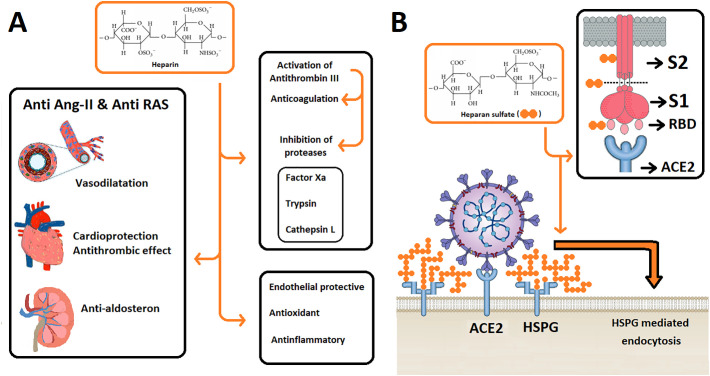
Potential beneficial effects of heparin in COVID-19 treatment. (A) Chemical structure of heparin (orange inbox) showing multiple sulphations of this compound. The anti Ang-II & Anti RAS effects of heparin also contribute to its antinflammatory and antioxidant actions. Activation of antithrombin III (serine protease inhibitor, serpin) by heparin leads to inactivation of several proteases, such as factor Xa, trypsin, and cathepsin L, which are involved in coagulation and viral replication. (B) Heparan sulfate (HS) (orange inbox; tandem filled orange circles indicate HS or heparin), a structural analog of heparin, binds to (1) S2 protein, (2) the S1/S2 region of S protein (near furin protease cut site) and (3) to the open state of the receptor binding domain (RBD) on the S1 segment of the SARS-CoV-2 spike. On the surface of the host cell, HS polymers are bound extensively to HS proteoglycans (HSPGs) and mediate HSPG-dependent endocytosis of SARS-CoV-2. Heparin competes with HS binding sites and inhibits S protein binding as well as endocytosis of the SARS-CoV-2. (For interpretation of the references to color in this figure legend, the reader is referred to the web version of this article.)
Fig. 2

Potential beneficial effects of heparin in COVID-19 treatment. (A) Chemical structure of heparin (orange inbox) showing multiple sulphations of this compound. The anti Ang-II & Anti RAS effects of heparin also contribute to its antinflammatory and antioxidant actions. Activation of antithrombin III (serine protease inhibitor, serpin) by heparin leads to inactivation of several proteases, such as factor Xa, trypsin, and cathepsin L, which are involved in coagulation and viral replication. (B) Heparan sulfate (HS) (orange inbox; tandem filled orange circles indicate HS or heparin), a structural analog of heparin, binds to (1) S2 protein, (2) the S1/S2 region of S protein (near furin protease cut site) and (3) to the open state of the receptor binding domain (RBD) on the S1 segment of the SARS-CoV-2 spike. On the surface of the host cell, HS polymers are bound extensively to HS proteoglycans (HSPGs) and mediate HSPG-dependent endocytosis of SARS-CoV-2. Heparin competes with HS binding sites and inhibits S protein binding as well as endocytosis of the SARS-CoV-2. (For interpretation of the references to color in this figure legend, the reader is referred to the web version of this article.)

Table 4
Effects of other cardiovascular drugs on the activity and expression of ACE2.
Pharmacological agent/classExperimental model /Tissue/SubjectEffectReference
Isoprenaline (isoproterenol)/ Non-selective β adrenoreceptor agonistMale Sprague-Dawley and TGR(A1–7)3292 rats/ Isoproterenol induced cardiac hypertrophy modelIncreased cardiac ACE2 mRNA expression in Sprague-Dawley ratsNadu, Ferreira, Reudelhuber, Bader, and Santos (2008)
Isoprenaline (isoproterenol)/ Non-selective β adrenoreceptor agonistMale Sprague-Dawley rats/ Isoproterenol induced cardiomyopathy modelDecreased cardiac ACE2 protein expressionQ. Liu et al. (2015)
Isoprenaline (isoproterenol)/ Non-selective β adrenoreceptor agonistMale Wistar rats/ Isoprenaline induced cardiac hypertrophy modelDecreased cardiac ACE2 mRNA expressionSyed et al. (2016)
Isoprenaline (isoproterenol)/ Non-selective β adrenoreceptor agonistMale Wistar albino rats/ Isoproterenol induced myocardial infarction modelIncreased cardiac ACE2 protein levelsBadae et al. (2019)
Isoprenaline (isoproterenol)/ Non-selective β adrenoreceptor agonistMale Wistar rats/ Isoproterenol treatment of salivary glandDecreased ACE2 mRNA expression in parotid gland, but no effect on sublingual and submandibular glandsCano et al. (2019)
Atenolol/ β1-receptor antagonistMale spontaneously hypertensive rats/arterial tissueNo effect on ACE2 immunostaining in carotid artery and aorta. Decreased ACE2 mRNA expression carotid arteryIgase et al. (2005)
Nebivolol/ β1-adrenoreceptor blockerMale spontaneously hypertensive rats/ High-salt diet modelIncreased cardiac ACE2 mRNA expression. No effect of ACE2 activity.Varagic et al. (2012)
Labetalol/ β1-adrenreceptor blockerHuman recombinant ACE2/ Enzyme kinetic assayIncreased maximal reaction rate of ACE2, but overall enzyme efficieny may not changeKulemina and Ostrov (2011)
Propranolol/β1-adrenreceptor blockerSpontaneously hypertensive and Wistar Kyoto rats/ Aortic tissueMarkedly decreased aortic ACE2 mRNA expression in hypertensive rats with significantly upregulated ACE2 levelsLezama-Martinez et al. (2018)
Hydrochlorothiazide/ DiureticSpontaneously hypertensive and Wistar Kyoto ratCardiac ACE2 activity and mRNA expression increased, but the activity decreased in hypertensive ratsJessup, Brosnihan, Gallagher, Chappell, and Ferrario (2008)
Nifedipine/ (L-type CCB)Human aortic endothelial cells/ mechanical stress modelIncreased ACE2 protein cell surface expressionIizuka, Kusunoki, Machida, and Hirafuji (2009)
Cilnidipine/ (L-type CCB)Male Wistar-Kyoto and spontaneously hypertensive rats/Hypertension modelBoth of these drugs did not affect aortic ACE2 mRNA expressionTakai et al. (2013)
Amlodipine/ (L-type CCB)
Felodipine/ (L-type CCB)Male Sprague Dawley/ Goldblatt hypertensive rat modelNo change in renal ACE2 mRNA expression in ischemic and non-ischemic kidneysS. Bai, Huang, Chen, Wang, and Ding (2013)
Nimodipine/ (L-type CCB)Male Wistar rats/ Cerebral ischemia-reperfusion modelIncreased brain ACE2 mRNA expression of down regulated ACE2 in ischemic brain tissue.Abdel-Fattah et al. (2018)
Amlodipine/ (L-type CCB)Rats/ Nitric oxide inhibition and salt induced hypertension modelIncreased renal ACE2 levelsOnat and ŞAhna (2018)
Aliskiren/ Renin antagonist, antihypertensiveMale Lewis rats/ Fischer-to-Lewis renal transplantation modelDecreased serum ACE2 activityRusai et al. (2011)
Aliskiren/ Renin antagonist, antihypertensiveMale C57BL/6 mice/ High fat diet modelNo change in pancreatic ACE2 protein expressionFrantz et al. (2013)
Aliskiren/ Renin antagonist, antihypertensiveSprague-Dawley rats/ maternal high fructose induced hypertension modelIncreased renal ACE2 protein expression in offspring of females exposed to high fructose intake.Hsu et al. (2016)
Aliskiren/ Renin antagonist, antihypertensiveFemale non obese diabetic/ ShiLtJ and NOR/LtJ miceNo effect on renal ACE2 activity, but increased ACE2 mRNA expression in kidney.Riera et al. (2016)
Aliskiren/ Renin antagonist, antihypertensiveMale Balb/c mice/ Streptozotocin-induced diabetes modelDecreased gingival tissue ACE2 mRNA expressionOliveira et al. (2019)
Ivabradine/ Pacemaker current inhibitor, Heart failure medicationDogs/ heart failure modelIncreased cardiac ACE2 activityR. C. Gupta, Want, Rastogi, Zhang, & Sabbah (2012)
Spironolactone/ MRBMale Wistar rats/ Aortocaval fistula induced heart failure modelHeart failure caused decreased cardiac ACE2 expression and enzyme activity was restored by eprosartanKarram et al. (2005)
Spironolactone/ MRBHeart failure patients/ Monocyte-derived macrophageIncrease in ACE2 activity and ACE2 mRNA expression one-month post therapyKeidar et al. (2005)
Spironolactone/ MRBMale Sprague-Dawley rats/ Diabetic nephropathy modelDecreased plasma ACE2 levelDong et al. (2019)
Spironolactone/ MRBMale Sprague-Dawley rats/ Obstructive jaundice modelDecreased renal ACE2 mRNA expression due to obstructive jaundice was reversed by spironolactoneKong et al. (2019)
Eplerenone/ MRBBalb/C mice/Heart and kidneyIncrease in cardiac ACE2 activity and ACE2 mRNA expression, but nonsignificant increase in the kidneysKeidar et al. (2005)
Eplerenone/ MRBWistar rats/ HeartPrevented aldosterone induced reduction in cardiac ACE2 mRNA expressionYamamuro et al. (2008)
Eplerenone/ MRBDahl salt-sensitive hypertensive rats/ Hypertension modelNo effect on cardiac ACE2 mRNA and protein expression in hypertensive ratsTakeda et al. (2007)
Eplerenone/ MRBMale Wistar rats/ Uninephrectomy and high salt induced kidney injury modelPartial reversal of aldosterone induced decrease of renal ACE2 expression in injured and high salt exposed kidneys.Bernardi et al. (2015)
Hydralazine/ Directly acting vasodilatorMale spontaneously hypertensive rats/ Hydralazine treatmentNo effect on ACE2 immunostaining mRNA expression in carotid artery and aortaIgase et al. (2005)
Hydralazine/ Directly acting vasodilatorTransgenic C57BL/6J mice overexpressing renin and angiotensinogenNo change in cardiac ACE2 activity and mRNA expression after NOS inhibitionInaba et al. (2011)
Hydralazine/ Directly acting vasodilatorTransgenic and C57BL/6N mice/ Cardiac hypertrophy modelNo change in cardiac ACE2 mRNA expressionTanno et al. (2016)
Hydralazine/ Directly acting vasodilatorMale renin overexpressing, Ren-TG, and C57BL/6N mice/ Hypertension modelNo effect on renal ACE2 mRNA and protein expression in hypertensive miceIchikawa et al. (2018)
Sacubitril+ Valsartan/ Neprilysin inhibitor+ARB/ Treatment of heart failureFemale spontaneously hypertensive and Wistar-Kyoto rats/ Hypertension modelReversal of decreased cardiac ACE2 mRNA and protein expression in hypertensive ratsY. Zhao et al. (2019)
Sildenafil/ Vasodilator used for erectile dysfunctionMale piglets/ Myocardial ischemia induced injury modelNo change in cardiac ACE2 immunostaining, protein and mRNA expression in ischemic pigletsG. Wang, Zhang, Yuan, Wu, & Li et al. (2015)

Antidiabetic drugs and ACE2

Thiazolidinediones, such as pioglitazone and rosiglitazone, agonists of peroxisome proliferator-activated receptor gamma, are used in the treatment of type 2 diabetes mellitus (T2DM) as insulin sensitizers with anti-inflammatory and anti-atherosclerotic effects. In rats with steatohepatitis induced by high fat diet, pioglitazone increased serum ACE2 levels and ACE2 mRNA expression in the liver (W. Zhang, C. Li et al., 2013), adipose tissue and skeletal muscle (W. Zhang et al., 2014) as well as 3T3-L1 adipocytes (Gupte et al., 2008). Rosiglitazone treatment improved cardiac and renal functions; enhanced atrial natriuretic peptide responses and markedly upregulated renal ACE2 gene transcription in rats with heart failure (Goltsman et al., 2019). Similarly, rosiglitazone increased vascular ACE2 expression in hypertensive, but not in normotensive rats (Sanchez-Aguilar et al., 2019). In transgenic diabetic mice, rosiglitazone downregulated renal ADAM17 expression, decreased ACE2 shedding and reduced urinary soluble ACE2, thereby increasing ACE2 protection of the kidneys without altering renal ACE2 expression (Alawi et al., 2020; Chodavarapu et al., 2013). Notably, although rosiglitazone induced an upregulation of ACE2 mRNA and protein expression in adipocytes of wild type mice, this ACE2 increase was markedly attenuated in adipocytes of fibroblast growth factor 21 (FGF21) knockout mice (Pan et al., 2018), suggesting that endogenous FGF21 in adipocytes modulates ACE2 expression in an autocrine manner. In a small cohort of patients, pioglitazone treatment improved glucose metabolism, reduced TNF-α expression and enzymatic activity of ADAM17 in skeletal muscle of T2DM patients (Tripathy et al., 2013).

Glucagon-like peptide 1 (GLP-1), a hormone produced in the distal ileum in response to food intake, activates GLP-1 receptors, increases insulin secretion, reduces glucagon release, and regulates glucose homeostasis. Long-acting GLP-1 receptor agonists, such as liraglutide and exendin-4, are used to treat T2DM. Exendin-4, a clinically used antidiabetic drug and GLP-1 receptor activator, improved pathological changes, decreased renal Ang-II, and completely restored down-regulation of renal ACE2 expression occurring after ureter obstruction (Le et al., 2016). In diabetic rats with reduced ACE2 levels, liraglutide induced marked upregulation of pulmonary ACE2 gene transcription (Romani-Perez et al., 2015). In another study, liraglutide increased pulmonary ACE2 expression in rats with in utero growth retardation (Fandino et al., 2018). Similarly, liraglutide completely reversed reduced hepatic ACE2 mRNA expression in mice with high-fat-induced liver disease through activation of the phosphatidylinositol-3-kinase (PI3K/Akt) signaling pathway in HepG2 cells (M. Yang et al., 2020). Liraglutide and another antidiabetic, linagliptin, a dipeptidyl peptidase-4 (DPP4) inhibitor, improved Ang-II-induced cardiovascular pathology, counteracted Ang-II-induced downregulation of Smad7, reduced collagen synthesis and cardiac fibrosis, and upregulated myocardial expression and activity of ACE2 (L. H. Zhang et al., 2015). The DPP4, independently of its enzymatic activity, functions as an entry receptor for the MERS coronavirus, and its co-expression with ACE2 has been shown in bronchial epithelial cells (Radzikowska et al., 2020). DPP4 inhibitors (gliptins), in addition to their antidiabetic actions, have anti-inflammatory effects, reduce cytokine overproduction, and have been suggested as treatment of COVID-19 (Solerte, Di Sabatino, Galli, & Fiorina, 2020). However, recent studies reported that gliptins had no significant effect on disease severity, mortality and clinical outcomes in diabetic COVID-19 patients (Y. Chen, D. Yang, et al., 2020; Fadini et al., 2020). In addition, using Mendelian randomization analysis, a large genome-wide association study has reported that increased ACE2 expression is associated with both type 1 and type 2 diabetes (Rao, Lau, & So, 2020).

The commonly prescribed oral antidiabetic drug metformin activates the AMP-activated protein kinase (AMPK) in vitro and in vivo (G. Zhou et al., 2001), resulting in an attenuation of hepatic glucose production and an enhancement of peripheral glucose uptake (G. Zhou et al., 2001). Metformin also increases AMPK-mediated phosphorylation of ACE2 at Ser680 in human endothelial cell lines, thereby upregulating cell surface ACE2 activity and expression via inhibition of the ubiquitination-related degradation of ACE2 (J. Zhang et al., 2018). Notably, metformin decreased pulmonary pressure and alleviated pulmonary artery damage in wild type but not in AMPK knock out mice (J. Zhang et al., 2018). However, in an earlier study in Huh7 cells, metformin had no effect, although activation of AMPK by the AMP mimic AICAR (5-amino-4-imidazolecarboxamide riboside) markedly upregulated ACE2 expression and activity (Clarke, Belyaev, Lambert, & Turner, 2014). Metformin does not affect renal ACE2 expression or ADAM17 activity, but reduces urinary ACE2 by improving glucose levels in diabetic rats (Somineni, Boivin, & Elased, 2014). Importantly, metformin activates SIRT1 (Cuyàs et al., 2018), which is expressed next to the promotor region of the ACE2 gene. Hence increased expression or enhanced functional activation of SIRT1 is associated with an increase in expression of ACE2 (Clarke et al., 2014). Drugs that increase endosomal pH values (such as chloroquine) are known to reduce viral replication. Metformin has been reported to inhibit the Na+/H+ exchanger and the vacuolar ATPase on endosomal membranes and to subsequently increase the endosomal pH (Jeongho Kim & You, 2017), which potentially interferes with viral replication. In addition, metformin has been shown to reverse established lung fibrosis in mouse models (Rangarajan et al., 2018), a desirable pharmacological effect in the treatment of lung injury caused by viral pneumonia. Metformin also preserves alveolar capillary permeability and decreases the severity of ventilator-induced lung injury in rabbits (Tsaknis et al., 2012). It also prolongs survival and attenuates pulmonary injury by reducing pulmonary inflammation, coagulation, and fibrosis in a rat model (X. Chen et al., 2015). Analysis of one small cohort of COVID-19 patients indicates that the use of metformin is associated with a reduced mortality (Crouse et al., 2020; Hariyanto & Kurniawan, 2020), whereas another one reports an increased disease progression (Y. Gao et al., 2020). Of note, it has recently been reported that cyclic sulfonamide derivatives are potent inhibitors (IC50 = 0.9-3.1 μM) of SARS-CoV-2 in Vero cells (Y. S. Shin et al., 2020).

Cholesterol reducing drugs and ACE2

Statins, also known as HMG-CoA reductase inhibitors, are a class of lipid-lowering drugs used for decreasing mortality in patients at high risk of cardiovascular disease. Currently, drugs of the statin group are the most common cholesterol-lowering medications. Rosuvastatin was shown to decrease cell proliferation and intimal pathology, and to upregulate aortic ACE2 transcription and protein expression in vascular injury models (Y. H. Li et al., 2013). On the other hand, pravastatin alone did not exert any protective effect on cardiovascular pathology and did not alter cardiac ACE2 expression, but significantly potentiated cardiovascular protective actions of insulin in diabetic rats (Min et al., 2018). Similarly, fluvastatin significantly enhanced the cardio-protective effects of insulin, improved cardiac function and restored cardiac ACE2 expression in diabetic rats (Y. H. Shin et al., 2017). In vascular smooth muscle cell cultures, atorvastatin did not alter ACE2 transcription, but reversed TNF-α induced downregulation of ACE2 expression (Suski et al., 2014). In another study on statins, atorvastatin improved the lipid disturbance, decreased atherosclerotic pathology and increased cardiac and renal ACE2 protein expression; but ACE2 mRNA expression increased only in cardiac tissue of atherosclerotic rabbits maintained on a high cholesterol diet (Tikoo et al., 2015). Notably, statins (Carloni & Balduini, 2020; G. Du et al., 2014; Ota et al., 2010) and antidiabetics, such as exenatide, liraglutide (Strycharz et al., 2018), and sitagliptin (Malvandi, Loretelli, Ben Nasr, Zuccotti, & Fiorina, 2019), activate SIRT1 and can potentially increase the expression of ACE2 (Clarke et al., 2014). In addition, atorvastatin was reported to downregulate ADAM17 activity in cultured neonatal rat cardiomyocytes (Y. Liao et al., 2008). However, methyl-β-cyclodextrin, a cholesterol depleting agent, and lovastatin stimulated ADAM17 (aka TACE) activity in L428 cells (von Tresckow et al., 2004), COS-7 cells and fibroblasts (Matthews et al., 2003). Conversely, cholesterol loading of retinal epithelial cells downregulated ADAM17 expression, suggesting that lowering cholesterol levels by statins may modulate cell surface ACE2 activity (J. Wang, Ohno-Matsui, & Morita, 2012). Statins are known to improve endothelial dysfunction (Katsiki, Banach, & Mikhailidis, 2020; Katsiki et al., 2018) and to decrease elevated inflammatory markers, e.g., C-reactive protein and interleukin-6. They exert anti-inflammatory and immunomodulatory effects (Pirro et al., 2019; Zeiser, 2018). By stabilizing atherosclerotic plaques, they prevent a viral-induced acute coronary syndrome and renal injury (Katsiki, Banach, & Mikhailidis, 2020; Mohammad et al., 2019). These pharmacological features, coupled with profibrinolytic and anticoagulant effects (Biedermann et al., 2018; Bifulco & Gazzerro, 2020), make statins a desirable treatment option for COVID-19-related pathologies (Rodrigues-Diez et al., 2020). Similarly, clofibrate, another lipid-lowering drug with a different mechanism of action, decreased cardiac oxidative stress and Ang-II, improved cardiac function and upregulated cardiac ACE2 protein expression in hypertensive rats with stressed ventricles (Ibarra-Lara et al., 2016).

Coronaviruses, including SARS-CoV (G. M. Li, Li, Yamate, Li, & Ikuta, 2007; Y. Lu, Liu, & Tam, 2008) and SARS-CoV-2 (H. Wang, Yuan, Pavel, & Hansen, 2020), have been reported to require lipid rafts for cellular entry. Cholesterol was reported to be involved in binding and altering the oligomeric status of the N-terminal fusion peptide of SARS-CoV, which is essential for virus entry into the host cell (Meher, Bhattacharjya, & Chakraborty, 2019), and also to interrupt cell-cell fusion induced by the virus (K. S. Choi, Aizaki, & Lai, 2005). It was shown that cholesterol reduction by methyl-β-cyclodextrin or mevastatin (H. Guo et al., 2017) disrupts lipid rafts that enable the binding of the virus to the host cell, thereby preventing its infection (Jeon & Lee, 2018; Y. Lu et al., 2008, Wang et al., 2020). Conversely, loading of cells with cholesterol (Hao Wang et al., 2020) or increasing the cholesterol concentration in extracellular solutions (C. Wei et al., 2020) increases viral entry. It appears that ACE2 and furin, a protease that cleaves the spike protein of SARS-CoV-2, are preferentially located in cholesterol-rich viral entry points that promote endocytic viral entry mechanisms and facilitate the efficient interaction of the spike protein with ACE2 (Glende et al., 2008; Hao Wang et al., 2020). Notably, a recent in vitro study investigating the SARS-CoV-2 protein-protein interactome identified the scavenger receptor BI (SR-BI), a cholesterol trafficking receptor, as a potential drug target (Gordon et al., 2020), and antagonists of SR-BI inhibited SARS-CoV-2 infectivity in Huh7 cell lines (C. Wei et al., 2020).

25-hydroxycholesterol (25HC) is the product of cholesterol oxidation by the enzyme cholesterol-25-hydroxylase (CH25H). Infection with SARS-CoV-2 has been shown to increase serum 25HC levels in mice and to induce the activity of CH25H in Caco-2 cells (Zu et al., 2020). Notably, 25HC significantly inhibited SARS-CoV-2 replication with an EC50 of 3.7 μM and reduced viral protein production in SARS-CoV-2-infected Vero cells. It also decreased the viral RNA load in both lung and trachea of infected mice (Zu et al., 2020). Another study also reported that the interferon-stimulated gene of CH25H is induced by SARS-CoV-2 infection in vitro and in COVID-19 patients (S. Wang et al., 2020). Furthermore, 25HC inhibited SARS-CoV-2 infection in lung epithelial cells and reduced viral entry in human lung organoids, presumably by preventing viral membrane fusion through activation of the ER-localized acyl-CoA:cholesterol acyltransferase, which leads to the depletion of cholesterol from the plasma membrane (S. Wang et al., 2020). Similar to 25HC, another cholesterol oxidation metabolite, 27-hydroxycholesterol, was shown to inhibit SARS-CoV-2 infection in Vero-E6 cells with an EC50 of 1.4 μM (Marcello et al., 2020). Interestingly, serum levels of 27-hydroxycholesterol were significantly decreased (50%) in SARS-CoV-2 infected patients, compared to the control group. In this context, high-density and low-density lipoprotein cholesterol and total cholesterol levels were reported to be significantly decreased in COVID-19 patients (Ressaire, Dudoignon, Moreno, Coutrot, & Dépret, 2020; G. Wang et al., 2020). Low cholesterol levels were correlated with a higher risk of developing severe events or longer recovery times in some studies (X. Ding et al., 2020; Ressaire, Dudoignon, Moreno, Coutrot, & Dépret, 2020; G. Wang et al., 2020), but not in another one (Tanaka et al., 2020).

It is well established that tissue cholesterol increases with age, and this accumulation is directly linked to disease pathologies, including atherosclerosis and inflammation. Remarkably, these diseases are highly comorbid with COVID-19 (Hao Wang et al., 2020). All these data support the potential use of statins to prevent or reverse host cell lipid raft alterations induced by COVID-19 infection, which could reduce both cell infection and viral replication. Thus, the pharmacological sequestration of cellular or viral cholesterol with statins has potential antiviral effects for preventing both virus attachment and internalization. Furthermore, fluvastatin decreased intracellular reactive oxygen species (ROS) by activating peroxiredoxin 1, a ROS scavenger, reduced proinflammatory responses in cultured cells and inhibited SARS-CoV-2 infection and replication in Vero E6 cells (H. Zhang et al., 2020). Pre-infection treatment with pravastatin reduced SARS-CoV-2 infection in Vero E6 cells (Mok et al., 2020). Finally, pretreatment with atorvastatin, pravastatin or fluvastatin impaired CD147 translocation to the cell surface, altered CD147 expression, structure and function by inhibiting protein isoprenylation and N-glycosylation in cultured monocytes (Sasidhar, Chevooru, Eickelberg, Hartung, & Neuhaus, 2017) and atherosclerotic plaques (X. Liang et al., 2017). CD147, also known as basigin, EMMPRIN or leukocyte activation antigen M6, is a receptor for the S protein of SARS-CoV and SARS-CoV-2 (K. Wang et al., 2020).

Lipid-lowering effects and some pleiotropic actions of statins, such as the downregulation of CD147 expression and function, disruption of lipid rafts, activation of autophagy, and attenuation of both the inflammatory response and the coagulation activation by these drugs, have been recently reviewed in the context of COVID-19 (Bifulco & Gazzerro, 2020; Katsiki et al., 2020; K. C. H. Lee, Sewa, & Phua, 2020; Radenkovic, Chawla, Pirro, Sahebkar, & Banach, 2020; Rodrigues-Diez et al., 2020). Noteworthy, the analysis of a randomized control trial in patients with acute respiratory failure suggested that treatment with statins at discharge following an episode of acute respiratory failure was associated with a significant reduction in one-year mortality (Noveanu et al., 2010). A retrospective cohort study with hospitalized pneumonia patients reported that prior and inpatient use of statins was associated with decreased mortality rates (Mortensen et al., 2012). However, in clinical studies with large cohorts of patients, statins were found to be ineffective in patients with ARDS (McAuley et al., 2014), sepsis-associated ARDS (Truwit et al., 2014), or ventilator-associated pneumonia (Papazian et al., 2013).

In older adults, a significant association between statin intake and the absence of symptoms during COVID-19 has been reported (De Spiegeleer et al., 2020). Notably, there are recent reports that the in-hospital use of statins reduced the mortality risk in 1,219 COVID-19 patients (X. J. Zhang et al., 2020) and in a small cohort of COVID-19 patients admitted to intensive care (Rodriguez-Nava et al., 2020). Furthermore, in a study with 151 hyperlipidemic COVID-19 patients, treatment with statins was independently associated with lower intensive care admission (Tan, Young, Lye, Chew, & Dalan, 2020). Similarly, a retrospective cohort study of 249 patients hospitalized with COVID-19 reports a significantly decreased risk of invasive mechanical ventilation in patients treated with statins (S. L. Song et al., 2020). In addition, in 170 hospitalized COVID-19 patients, the use of statins prior to admission was associated with a lower risk of developing severe COVID-19 and a faster time to recovery among patients without severe disease (Daniels et al., 2020). Similarly, in 983 diabetic COVID-19 patients, statin use was associated with reduced in-hospital mortality (Saeed et al., 2020). In addition, a lower SARS-CoV-2 infection-related mortality was observed in 581 patients treated with statins prior to hospitalization (Masana et al., 2020). However, another recent study with 2449 hospitalized COVID-19 patients with type 2 diabetes concluded that routine statin treatment is significantly associated with increased mortality (Cariou et al., 2020). The effects of antidiabetic and lipid-lowering drugs on the activity and expression of ACE2 are listed in Table 5 .

Table 5
Effects of antidiabetic and cholesterol lowering drugs on the activity and expression of ACE2.
Pharmacological agent/classExperimental model /Tissue/SubjectEffectReference
Rosiglitazone/ Antidiabetic drug3T3-L1 murine adipocytesIncreased ACE2 mRNA expressionGupte et al. (2008)
Rosiglitazone/ Antidiabetic drugMale diabetic miceDecreased urinary ACE2 activity due to decreased renal ACE2 sheddingChodavarapu et al. (2013)
Pioglitazone/ Antidiabetic drugMale Sprague-Dawley rats/ High fat diet-induced steatohepatitis modelIncreased serum ACE2 levels and hepatic ACE2 mRNA and protein expression in control and high fat diet groupW. Zhang, C. Li et al. (2013)
Pioglitazone/ Antidiabetic drugRats/ Streptozotocin-induced diabetes modelIncreased cardiac ACE2 protein expressionWeili et al. (2014)
Pioglitazone/ Antidiabetic drugMale Sprague-Dawley rats/ High fat diet-induced steatohepatitis modelIncreased ACE2 protein expression in liver, adipose tissue, and skeletal muscle in high fat diet groupW. Zhang et al. (2014)
Pioglitazone/ Antidiabetic drugMale Sprague-Dawley rats/ Streptozotocin-induced diabetes modelIncreased cardiac ACE2 immunostaining and mRNA expressionQiao et al. (2015)
Rosiglitazone/ Antidiabetic drugMale Wistar rats/ Aortic coarctation-induced hypertension modelIncreased ACE2 protein expressionM. S. Aguilar et al. (2018)
Pioglitazone/ Antidiabetic drugMale Sprague-Dawley rats/ Ischemia-reperfusion injury modelRenal ACE2 mRNA and protein expression was increased by injury and downregulated by alfacalcidolAli, Al-Shorbagy, Helmy, & El-Abhar (2018)
Rosiglitazone/ Antidiabetic drugMale Sprague-Dawley rats/ Congestive heart failure modelACE2 gene expression was upregulated by rosiglitazone in rats with heart failureGoltsman et al. (2019)
Rosiglitazone/ Antidiabetic drugMale Wistar rats/ Aortic coarctation-induced hypertension modelAortic ACE2 protein expression was upregulated in hypertensive rats.Sanchez-Aguilar et al. (2019)
Liraglutide/ Antidiabetic drugMale Sprague-Dawley rats/ Streptozotocin-induced diabetes modelPulmonary ACE2 mRNA expression was increased in control and diabetic groups.Romani-Perez et al. (2015)
Liraglutide, linagliptin / Antidiabetic drugsMale Sprague–Dawley rats/ Angiotensin II infusion modelCardiac ACE2 activity decreased by Angiotensin II was upregulated by these drugs.L. H. Zhang et al. (2015)
Exendin-4/ Antidiabetic drugBALB/c mice/ unilateral ureter obstruction modelIncreased renal ACE2 mRNA and protein expression. No effect on unobstructed kidney.Le et al. (2016)
Liraglutide/ Antidiabetic drugFemale Sprague-Dawley rats/ Maternal food restricted pupsLung ACE2 mRNA expression was increased in food restricted pups, but not in control groupFandino et al. (2018)
Liraglutide/ Antidiabetic drugMale C57BL/6J mice and HepG2 cell line/ High-fat-induced liver disease modelIncreased ACE2 mRNA and protein expression in liver and HepG2 cells.M. Yang et al. (2020)
AtorvastatinHoltzman rats/ Streptozotocin induced diabetes modelIncreased cardiac ACE2 mRNA expressionC. Aguilar, Ventura, & Rodriguez-Delfin (2011)
RosuvastatinMale Wistar rats/ Vascular balloon injury modelVascular ACE2 mRNA and protein expression was decreased by the injury and the effect was partially reversed by rosuvastatinY. H. Li et al. (2013)
AtorvastatinRat aortic vascular smooth muscle cellsDecrease of ACE2 mRNA expression by TNF-α was restored by atorvastatinSuski et al. (2014)
AtorvastatinNew Zealand White Rabbits/ High cholesterol diet, atherosclerosis modelIncreased cardiac and renal ACE2 protein expression and mRNA increased only in cardiac tissueTikoo et al. (2015)
ClofibrateMale Wistar rats/ Aortic coarctation-induced hypertension modelClofibrate upregulated cardiac ACE2 mRNA expression.Ibarra-Lara et al. (2016)
FluvastatinMale Lewis rats/ Streptozotocin-induced diabetes modelDecreased cardiac ACE2 protein expression in diabetic group was upregulated by fluvastatinY. H. Shin et al. (2017)
RosuvastatinRats/ Nitric oxide inhibition and salt induced hypertension modelIncreased renal ACE2 levelsOnat and ŞAhna (2018)
PravastatinMale Lewis rats/ Streptozotocin induced diabetes modelNo effect on cardiac ACE2 protein expression. Increase ACE2 expression in the presence of insulinMin et al. (2018)

Corticosteroids, non-steroid anti-inflammatory drugs, and ACE2

Glucocorticoids are mainly produced in the zona fasciculata of the adrenal cortex. When applied therapeutically, they have potent anti-inflammatory and immunosuppressive actions with additional metabolic and cardiovascular side effects, such as hypertension, hyperglycemia, and osteoporosis. Animals treated prenatally with glucocorticoids develop hypertension with decreased plasma ACE2 activity and diminished ACE2 expression in renal (P. C. Lu et al., 2016; Shaltout, Figueroa, Rose, Diz, & Chappell, 2009), cardiac (E. Kim et al., 2015), and placental (Ghadhanfar et al., 2017), but not adipose tissue (Massmann, Zhang, Seong, Kim, & Figueroa, 2017; H. R. Yu et al., 2018). This is associated with reduced Ang-(1-7) in the cerebrospinal fluid (Marshall et al., 2013). Maternal corticosterone exposure was reported to decrease renal ACE2 expression in females but to increase it in males (Cuffe, Burgess, O'Sullivan, Singh, & Moritz, 2016). Importantly, glucocorticoids, such as dexamethasone, potentiate Ang-II responses by upregulating the expression of AT1 receptors in cardiac (Xue, Patterson, Xiao, & Zhang, 2014) and vascular structures (Ullian, Walsh, & Morinelli, 1996). Interestingly, activation of the neutral amino acid transporter SLC6A19 (B0AT1), an accessory protein for ACE2 in the intestines, is regulated by the “serum and glucocorticoid inducible kinase” (SGK) isoforms 1-3 (Bohmer et al., 2010). Of note, budesonide, a glucocorticoid, activates ADAM17 in bronchial epithelial cells (Zijlstra et al., 2014). However, dexamethasone inhibited ADAM17 activity without affecting its expression level in lipopolysaccharide-activated RAW cells (Chuang et al., 2017).

Corticosteroid medications are commonly used in the treatment of several inflammatory pathologies, including asthma, inflammatory bowel disease (IBD), interstitial lung disease, ARDS, and systemic vasoplegic shock. The results of clinical studies attempting to correlate disease severity with ACE2 expression levels has not been conclusive. In IBD patients not using steroids, no significant change in ACE2 and TMPRSS2 gene expression was found in biopsy samples (Monteleone, Franze, & Laudisi, 2020). In another study, reduced ACE2 expression in biopsy samples from patients with Crohn’s disease was associated with inflammation and worse outcomes (Potdar et al., 2020). In 138 treatment naïve IBD patients, while ACE2 gene expression was decreased in the ileum, it was increased in colon samples (Krzysztof et al., 2020). In addition, in control patients, ACE2 expression was 25 times higher in the terminal ilium than in the colon, suggesting anatomical differences in ACE2 expression. In intestinal biopsies of IBD patients, treatment with glucocorticoids was associated with decreased ACE2 expression (Burgueno et al., 2020). Similarly, the use of corticosteroids, thiopurines and 5-aminosalicylate attenuated ACE2 and TMPRSS2 expression in inflamed colon and rectum (Suárez-Fariñas et al., 2020).

Clinical studies do not identify asthma as a risk factor of severe COVID-19-related illnesses (Z. Wu & McGoogan, 2020). Animal models indicate that ACE2 and Ang-(1-7) are protective in asthma (El-Hashim et al., 2012). In recent studies, ACE2 expression was not altered (Breidenbach et al., 2020; G. Li et al., 2020; Peters et al., 2020; Radzikowska et al., 2020) or reduced (Jackson et al., 2020; Kimura et al., 2020) in asthmatic patients; but increased expression of TMPRSS2, the enzyme facilitating SARS-CoV-2 entry into host cells, has been reported (Kimura et al., 2020; Radzikowska et al., 2020). However, in a large cohort study, increased ACE2 gene expression was reported in a sub-group of type 2 asthmatic patients (Camiolo, Gauthier, Kaminski, Ray, & Wenzel, 2020). Similarly, in bronchial brushings, biopsies and sputum-derived cells of patients with severe asthma, the gene expression of ACE2, TMPRSS2, and furin was positively correlated with asthma severity and glucocorticoid use (Kermani et al., 2020). However, in a recent study with 268 asthmatic patients, the use of glucocorticoids did not influence the gene expressions of ACE2, TMPRSS2, and furin in bronchial brushes and biopsy samples; and disease severity was not related to changes in these parameters (Bradding et al., 2020). In another study, the use of inhaled corticosteroids, but not of the synthetic corticosteroid triamcinolone acetonide, was associated with a lower expression of ACE2 and TMPRSS2 in asthmatic patients (Jackson et al., 2020). In patients with COPD, the administration of inhaled corticosteroids reduced sputum expression of ACE2 compared to controls (Finney et al., 2020). In this study, it was also shown that inhaled corticosteroids reduced ACE2 expression in airway epithelial cell cultures and mouse models, and the effect was reversed by interferon-β administration. Glucocorticoids, including hydrocortisone, prednisolone, dexamethasone, and methylprednisolone, significantly increased ACE2 protein expression in epithelial cell lines and reduced cytokine interleukin-6 production in human macrophages (Xiang et al., 2020). In bronchial epithelial cells from specimens of COPD patients, treatment with inhaled corticosteroids significantly decreased the expression of ACE2 and ADAM-17, and it was associated with decreased interferon type-1 gene expression (Stephen Milne et al., 2020).

In human epithelial cell cultures, the corticosteroid budesonide inhibits the replication of HCoV-229E, which uses aminopeptidase N as entry receptor (Yamaya et al., 2020). Recently, the glucocorticoid methylprednisolone was reported to increase the survival in a small cohort of COVID-19 positive ARDS patients (C. Wu et al., 2020). In earlier studies, methylprednisolone improved gastrointestinal pathology and accelerated recovery from HCoV infection (Rhoads, Macleod, & Hamilton, 1988), but it was also reported to promote the replication of HCoV-MHV-3 and to increase the mortality in mice (Fingerote, Leibowitz, Rao, & Levy, 1995). At clinically relevant concentrations, cortisone increases the replication of infectious bronchitis HCoV in tracheal organ cultures, whereas reproductive hormones, such as progesterone, estrogen, and testosterone, do not have this effect (Ambali & Jones, 1990). In a recent in vitro study, steroids (glycyrrhetinic, oleanolic acid) and bile acid derivatives inhibited binding of the SARS-CoV-2 spike protein to ACE2 (Carino et al., 2020). It was also reported that Ciclesonide, an inhaled corticosteroid, suppresses the replication of SARS-CoV-2 with an EC90 of 0.55 μM in human bronchial epithelial cells (Matsuyama et al., 2020).

During the previous SARS outbreak, it was reported that high-dose methyl prednisolone had beneficial effects (V. C. Cheng, Tang, Wu, Chu, & Yuen, 2004; Sung et al., 2004; Tsui, Kwok, Yuen, & Lai, 2003; Z. Zhao et al., 2003). However, a systematic analysis of clinical studies concludes that the results of corticosteroid therapies in SARS-CoV infections are inconclusive and that their application is not recommended (Stockman, Bellamy, & Garner, 2006). Furthermore, corticosteroid therapies reportedly decrease dendritic and T cells in the circulation (Z. Zhang et al., 2005), reduce cytokine releasing cells in the spleen (X. Zhang et al., 2008) and suppress cellular immune responses in the lungs (K. Jung et al., 2007). The use of high steroid doses is also associated with long lasting lipid disturbances (Q. Wu et al., 2017) and an increased risk of avascular necrosis (Sing, Tan, Wong, Cheung, & Cheung, 2020) in recovered SARS-CoV patients. During the recent COVID-19 outbreak, methylprednisolone therapies reportedly improved the clinical prognosis (Y. Wang, W. Jiang et al., 2020; F. Ye et al., 2020) or decreased the mortality rate in COVID-19 patients (Salton et al., 2020). Additional recent studies report that early, but not late phase (Mongardon et al., 2020), low-dose corticosteroids decrease mortality and improve COVID-19 clinical outcomes (Ji et al., 2020). However, another recent study indicates that corticosteroid use is associated with increased mortality and delayed SARS–CoV-2 coronavirus RNA clearance in 409 COVID-19 patients (J. Liu et al., 2020). While some of the meta-analyses conclude that the use of corticosteroids is associated with a higher rate of ARDS in COVID-19 patients (Z. Yang et al., 2020; J. J. Y. Zhang, Lee, Ang, Leo, & Young, 2020), a recent randomized study of several thousands of hospitalized COVID-19 patients reports that dexamethasone reduces the mortality among those receiving invasive mechanical ventilation or oxygen (Horby et al., 2020). In another study of 396 COVID-19 patients, the use of steroids significantly decreased in-hospital mortality (Fernandez Cruz et al., 2020), an observation that has been corroborated by several additional recent publications (Bani-Sadr et al., 2020; Chopra et al., 2020; Majmundar et al., 2020). Corticosteroid activation of glucocorticoid receptors has been suggested to suppress interleukin-6 release and mitigate multi-organ inflammation in some COVID-19 patients (Awasthi et al., 2020).

Non-steroid anti-inflammatory drugs (NSAIDs) inhibit the cyclooxygenase (COX)-dependent metabolism of arachidonic acid to prostaglandins. Treatments (50 μM, 48 hours) of arachidonic acid, octadecadienoic acid, and docosahexaenoic acid, but not eicosapentaenoic acid and stearic acid, significantly decreased ACE2 mRNA expression in porcine adipocytes (Tseng et al., 2010). Prostaglandins prevent hypertension and upregulate renal ACE2 protein expression in adult male rats exposed either prenatally to dexamethasone plus postnatally to high fat diet (P. C. Lu et al., 2016) or prenatally to high fructose intake (Tain, Lee, Wu, Leu, & Chan, 2016). Lipoxin A4, another product of arachidonic acid metabolism, attenuates lung injury and increases lung ACE2 levels and protein expression in a lipopolysaccharide-induced lung injury model (Q. F. Chen et al., 2018). Similarly, the lipoxin receptor agonist BML-111 also decreases lung and liver injuries, which are associated with increased ACE2 levels and protein expression in these tissues (Q. F. Chen et al., 2019; Hu et al., 2017). However, although pharmacological inhibition of soluble epoxide hydrolase, which metabolizes epoxyeicosatrienoic acids, improved disease pathology and increased epoxyeicosatrienoic acid levels, it did not reverse downregulation of cardiac ACE2 expression induced by high-fructose diet intake (Froogh et al., 2020). 20-Hydroxy-eicosatetraenoic acid (20-HETE), a cytochrome P450-derived arachidonic acid metabolite, increased blood pressure and vascular Ang-II expression. It also upregulated vascular ACE transcription without altering ACE2 expression (K. Sodhi et al., 2010). In addition, COX-2 and prostaglandin E2 (PGE2) activate ADAM17 (Al-Salihi et al., 2007). NSAIDs, through COX-independent mechanisms, promote shedding of L-selectin, a pro-inflammatory cell adhesion molecule, by activating ADAM17 and generating superoxide anions at the plasma membrane through NADPH-oxidase activation. They thereby interfere with neutrophil–endothelial cell adhesion (Dominguez-Luis et al., 2013; Gomez-Gaviro et al., 2002) and potentially decrease cell surface activity of ACE2.

Activation of both COX-1 and COX-2 mediates some of the Ang-II responses, such as hypertension, oxidative stress, and inflammation (Sriramula, Xia, Xu, & Lazartigues, 2015; R. Wu, Laplante, & de Champlain, 2005). Pharmacological inhibition or genetic deletion of COX-1 reduces the acute pressor effects of Ang-II in murine disease models (X. Cao et al., 2012; Z. Qi et al., 2002; Sriramula, Xia, Xu, & Lazartigues, 2015). COX-2 inhibition by rofecoxib and nimesulide attenuates Ang-II–induced oxidative stress, hypertension, and cardiac hypertrophy in rats (R. Wu, Laplante, & de Champlain, 2005). Thus, over-expression of ACE2 in the brain decreases blood pressure, oxidative stress and inflammation; it also down regulates COX expression in murine hypertension models (Sriramula et al., 2015). However, vasodilatatory and cardioprotective effects of Ang-(1-7) are also mediated by activation of COX, and these effects are inhibited by indomethacin, a non-selective COX inhibitor (X. Liao et al., 2011). Therefore, while some of the effects of NSAIDs potentiate Ang-II actions, others counteract Ang-II. Furthermore, all NSAIDs except ketoprofen, through COX-independent mechanisms, inhibit SIRT1 deacetylase (Dell'Omo et al., 2019), which counteracts upregulation of ACE2 by SIRT1 (Clarke et al., 2014). Importantly, SIRT1 expression was reported to be upregulated in the lungs of COVID-19 patients with comorbidities (Pinto et al., 2020).

Ibuprofen, a commonly used NSAID and non-selective COX inhibitor, attenuates cardiac fibrosis and upregulates cardiac ACE2 expression in streptozotocin-induced diabetic rats (Qiao et al., 2015). Other NSAIDs, including rofecoxib, meloxicam, celecoxib and flurbiprofen, at clinically relevant doses, were shown to induce modest increases in renal and cardiac ACE2 protein expression in adjuvant-induced arthritic rats (Asghar, Aghazadeh-Habashi, & Jamali, 2017).

The SARS-CoV has been shown to directly bind to the COX-2 promotor and to increase its expression (Yan et al., 2006). COX-2–dependent PGE2 was reported to attenuate the chronic antiviral lymphocyte response of unresolved viral infections (Schaeuble et al., 2019), suggesting that NSAIDs may have beneficial effects in the treatment of SARS-CoV-2 infection. However, two previous meta-analyses have shown that the use of NSAIDs, including ibuprofen, is associated with increased venous thromboembolism and increased risk of vascular events (T. Lee et al., 2016; Ungprasert, Srivali, Wijarnpreecha, Charoenpong, & Knight, 2015). NSAIDs increase the risk of thromboembolism (Schmidt et al., 2011), stimulate salt intake and enhance renal and pulmonary vasoconstriction (Cumhur Cure, Kucuk, & Cure, 2020; Harrington et al., 2008; Varga, Sabzwari, & Vargova, 2017), which are undesirable pharmacological actions in the treatment of COVID-19. In addition, observational studies suggest an association between pre-hospital NSAID exposure and a protracted and complicated course of pneumonia (Voiriot et al., 2019). Therefore, it has been recommended to use NSAIDs at the lowest effective dose for the shortest possible period, and, instead, in most cases, to use paracetamol (acetaminophen) as the first treatment option for fever or pain associated with infections (Zolk et al., 2020). Interestingly, indomethacin, a non-selective COX inhibitor, has antiviral effects with an EC50 of 5 μM for SARS-CoV, as demonstrated in human cell lines and by in vivo experiments (Amici et al., 2006). However, the effect of indomethacin is independent of COX inhibition, since high concentrations of aspirin do not have an antiviral activity. In clinical studies of small cohorts of COVID-19 patients, treatment with NSAIDs was associated with either adverse clinical outcomes (Jeong et al., 2020) or no effect on mortality rate (Abu Esba et al., 2020; Chandan et al., 2020; Lund et al., 2020) or a modest beneficial effect on survival rates (Bruce et al., 2020). The mechanisms of NSAID actions and their potential use in COVID-19 patients have recently been discussed (Cabbab & Manalo, 2020; Micallef, Soeiro, & Jonville-Béra, 2020). The effects of steroids, NSAIDs, and pharmacologically related compounds on ACE2 activity and expression are summarized in Table 6 .

Table 6
Effects of steroids and non-steroid anti-inflammatory drugs (NSAIDs) on the activity and expression of ACE2.
Pharmacological agent/classExperimental model /Tissue/SubjectEffectReference
Betamethasone/ Glucocorticoid steroidMale sheep/ Kidney and bloodReduction in serum ACE2 activity. In isolated proximal tubules, ACE2 activity and expression were 50% lower in the treated sheepShaltout, Figueroa, Rose, Diz, and Chappell (2009)
Betamethasone/ Glucocorticoid steroidSheep/ Prenatal betamethasone exposed offspring’sNo change in choroid plexus ACE2 activityMarshall et al. (2013)
Betamethasone/Glucocorticoid steroidFemale sheep/ Adipose tissueNo change in ACE2 mRNA expressionMassmann, Zhang, Seong, Kim, and Figueroa (2017)
Betamethasone/ Glucocorticoid steroidPreterm, and term piglets/ Heart and kidneyCardiac ACE2 expression was decreased in preterm piglets. Renal ACE2 expression was unaffectedE. Kim et al. (2015)
Dexamethasone/Glucocorticoid steroidSprague-Dawley rats/ Prenatal dexamethasone exposureNo change in renal ACE2 protein expressionP. C. Lu et al. (2016)
Dexamethasone/Glucocorticoid steroidSprague Dawley rats/ fetal tissueSuppression of ACE2 mRNA and protein expression in placental tissueGhadhanfar et al. (2017)
Dexamethasone/Glucocorticoid steroidSprague-Dawley female rats/ Adipose tissueNo change in ACE2 gene expressionH. R. Yu et al. (2018)
Ibuprofen/ NSAIDRats/ Streptozotocin-induced diabetes modelIncreased cardiac ACE2 protein expressionWeili et al. (2014)
Ibuprofen/ NSAIDMale Sprague-Dawley rats/ Streptozotocin-induced diabetes modelIncreased cardiac ACE2 immunostaining and mRNA expressionQiao et al. (2015)
Rofecoxib, meloxicam, celecoxib and flurbiprofen/ NSAIDMale Sprague-Dawley rats/ Adjuvant induced arthritis modelAll drugs increased cardiac and renal ACE2 protein expression arthritic rats with reduced ACE2 expression.Asghar, Aghazadeh-Habashi, and Jamali (2017)

Vitamins and ACE2

Activation of vitamin D receptors (VDR) by 1,25-dihydroxyvitamin D (calcitriol) or pharmacologic VDR agonists is important for the control of phosphate and calcium homeostasis and bone remodeling but could also have beneficial effects by reducing the risk of cardiovascular morbidity and mortality, diabetes, autoimmune diseases, and cancer. Vitamin D3 supplementation was shown to upregulate cardiac ACE2 gene expression in normotensive rats; whereas vitamin D3 deficiency had no effect on ACE2 expression (Machado, Ferro Aissa, Ribeiro, & Antunes, 2019). Similarly, vitamin D deficiency did not affect serum ACE2 levels in a transgenic hypertension model (Andersen et al., 2015). In spontaneously hypertensive rats with an overactive RAS, calcitriol decreased oxidative stress, markedly reduced Ang-II formation, and upregulated brain ACE2 expression (C. Cui et al., 2019). Interestingly, in these experiments, calcitriol also upregulated ACE2 expression in the brains of normotensive rats, as well as in cultured BV2 retroviral immortalized microglial cells. Calcitriol, an active metabolite of vitamin D3, inhibited Ang-II and renin expression, decreased vascular permeability and cell death, and reversed lipopolysaccharide-induced downregulation of ACE2 in pulmonary tissue and vascular endothelial cells (J. Xu et al., 2017). Similarly, calcitriol increased renal ACE2 expression in diabetic rats with compromised ACE2 activity and counteracted glucose-induced downregulation of ACE2 by inhibiting p38 MAPK and ERK phosphorylation in NRK-52E cells (M. Lin et al., 2016). In type I non-obese diabetic rats, paricalcitol, a synthetic vitamin D analog, decreased serum ACE2 activity, renal oxidative stress, and circulating H2O2 levels. Although renal ACE2 activity was not altered, renal ADAM17 was reduced by paricalcitol (Riera et al., 2016). Importantly, in this study, paricalcitol upregulated ACE2 mRNA expression in epithelial cell lines in a dose-dependent manner. In line with these findings, paricalcitol inhibits aldosterone-induced upregulation of the ADAM17/TGF-α/EGF receptor pathway in cultured tubular epithelial cells (Morgado-Pascual et al., 2015). Vitamin D has been shown to suppress ADAM17 expression in A431 cell lines (Arcidiacono, Yang, Fernandez, & Dusso, 2015) and in parathyroid cells (Dusso, Arcidiacono, Yang, & Tokumoto, 2010).

A recent study reports that vitamin D attenuates lung injury by stimulating epithelial repair, reducing epithelial cell apoptosis, and decreasing TGF-β levels (Zheng et al., 2020). In animal experiments, it has been demonstrated that vitamin D reduces disease severity of coronaviruses (J. Yang et al., 2019) by regulating autophagy, enhancing cathelicidin production and inhibiting intestinal mucosa interleukin (IL)-6 and IL-8 mRNA expression, thereby lessening the severity of damage (Yuk et al., 2009). Vitamin D reduces the susceptibility to acute lung injury by inhibiting renin and consequently Ang-II biosynthesis (Zittermann et al., 2018). In addition, vitamin D reportedly reduces disease severity and decreases the risk of respiratory tract infections in a large cohort of adults (Zittermann, Pilz, Hoffmann, & Marz, 2016). In line with these findings, a recent meta-analysis study indicates that the use of vitamin D is associated with a reduced risk of acute respiratory infections, and administration of daily doses of 400-1000 IU vitamin D for up to 12 months was found to have a protective effect (Jolliffe et al., 2020). In a randomized controlled trial of school children, daily vitamin D intake resulted in a 58% reduction of the relative risk of influenza A, compared to the placebo group (Urashima et al., 2010). Importantly, post-infection treatment with 10 μM calcitriol significantly reduced SARS-CoV-2 infection in Vero E6 and human epithelial cells (Mok et al., 2020). In several recent studies on small cohorts of COVID-19 patients, vitamin D deficiency has been identified as an independent risk factor for increased mortality or a higher rate of intensive care admission and disease severity (Abrishami et al., 2020; Arvinte, Singh, & Marik, 2020; Baktash et al., 2020, Brenner et al., 2020; Carpagnano et al., 2020; Hernández et al., 2020; Macaya et al., 2020; Munshi et al., 2020; Panagiotou et al., 2020; K. Ye et al., 2020). Vitamin D deficiency was also associated with increased SARS-CoV-2 positivity rates and infection (Kaufman, Niles, Kroll, Bi, & Holick, 2020; Merzon et al., 2020). Conversely, vitamin D supplements were reportedly associated with a less severe disease progress and faster recovery rates in COVID-19 patients (C. Annweiler et al., 2020; G. Annweiler et al., 2020; Rastogi et al., 2020; Tan et al., 2020, Tan et al., 2020). Vitamin D supplementation has recently been reviewed (Grant et al., 2020; Malek Mahdavi, 2020; Tay, Mahajan, & Thornton, 2020) with the conclusion that it is effective in boosting the immune system, strengthening the lung epithelial barrier, and preventing an excessive inflammatory response and viral infections.

All-trans retinoic acid (atRA), a biologically active metabolite of vitamin A, modulates gene transcription and exerts its other effects by binding to the retinoic acid receptor, and interfering with transcription factors. atRA reduced the blood pressure, attenuated myocardial damage, and significantly upregulated cardiac and renal ACE2 expression in spontaneously hypertensive rats (Zhong et al., 2004). However, chronic atRA treatment did not have an effect on the expression of ACE2 in non-hypertensive rats (Zhong et al., 2004), suggesting that atRA can potentially be used in the treatment of hypertension. atRA decreased oxidative stress and Ang-II production; it also upregulated mitogen-activated protein kinase phosphatase (MKP)-1, MKP-2 and cardiac ACE2 expression in rats with pressure overload-induced cardiac remodeling (Choudhary et al., 2008). In rats with glomerulosclerotic lesions, atRA reduced glomerular lesions and Ang-II expression; it also markedly upregulated renal ACE2 mRNA and protein expression (T. B. Zhou, Drummen, Jiang, Long, & Qin, 2013). Treatment with atRA decreased the formation of reactive oxygen species, Ang-II expression and reversed the downregulation of ACE2 expression due to hypoxia-induced injury in renal tubular epithelial cells (T. B. Zhou, Ou, Rong, & Drummen, 2014). Importantly, vitamins D (Strycharz et al., 2018), C (Aşcı et al., 2016; M.-Z. Qi et al., 2018), A (A. N. Shin et al., 2018), and B3 (Hong et al., 2018) have been shown to activate SIRT1, suggesting that they can upregulate ACE2 expression (Clarke et al., 2014). In addition, atRA upregulates mRNA expression (Flannery, Little, Caterson, & Hughes, 1999) and promotes activation as well as translocation of ADAM17 to the cytoplasm (Koryakina, Aeberhard, Kiefer, Hamburger, & Kuenzi, 2009), suggesting that atRA can potentially modulate ACE2 shedding through ADAM17 as well. Effects of vitamins on the activity and expression of ACE2 are presented in Table 7 .

Table 7
Effects of vitamins on the activity and expression of ACE2.
Pharmacological agent/classExperimental model /Tissue/ SubjectEffectReference
Calcitriol/1,25-dihydroxyvitamin DMale Wistar rats and NRK-52E cells / Streptozotocin induced diabetes modelIncreased ACE2 immunostaining and protein expression in kidney and NRK-52E cellsM. Lin et al. (2016)
Calcitriol/1,25-dihydroxyvitamin DMale Wistar rats and pulmonary microvascular endothelial cells/ Lipopolysaccharide -induced lung injury modelIncreased pulmonary ACE2 mRNA, immunostaining, and protein expressionJ. Xu, Yang, et al. (2017)
Alfacalcidol//active metabolite of Vitamin DSprague-Dawley rats/ Ischemia-reperfusion injury modelRenal ACE2 mRNA and protein expression was increased by injury and downregulated by alfacalcidolAli, Al-Shorbagy, Helmy, and El-Abhar (2018)
Paricalcitol/ Synthetic vitamin D analogFemale NOD/ ShiLtJ and NOR/LtJ mice and MTC cellsIncreased ACE2 immunostaining, mRNA and protein expression in kidney and MTC cells.Riera et al. (2016)
Calcitriol/1,25-dihydroxyvitamin DMale Spontaneously hypertensive rats and BV2 microglial cellsIncreased ACE2 mRNA and protein expression in brain and BV2 microglial cells.C. Cui et al. (2019)
All-trans retinoic acid/active metabolite of vitamin ASpontaneously hypertensive and Wistar-Kyoto rats/cardiac tissueIncreased ACE2 mRNA and protein expression in heart and kidneyZhong et al. (2004)
All-trans retinoic acid/active metabolite of vitamin AMale Wistar rats/ Uninephrectomy and adriamycin induced glomerulosclerosis ModelMarkedly increased renal ACE2 immunostaining, mRNA and protein expressionT. B. Zhou, Drummen, Jiang, Long, and Qin (2013)
All-trans retinoic acid/active metabolite of vitamin ANRK-52E rat renal proximal tubular epithelial cell line/ Hypoxia-induced Injury modelIncreased renal ACE2 mRNA and protein expressionT. B. Zhou, Ou, Rong, and Drummen (2014)
All-trans retinoic acid/active metabolite of vitamin AMale / Aortic constriction induced pressure modelIncreased cardiac ACE2 protein expressionChoudhary et al. (2008)

Antiviral agents and other drugs on ACE2

Due to the pivotal role of ACE2 as entry receptor of SARS-CoV2, the prevention of SARS-CoV-2 spike protein-ACE2 interaction and subsequent viral infectivity is an important antiviral treatment strategy. In earlier studies, soluble ACE2 was able to block the replication of SARS-CoV in HEK-293T cells (Wenhui Li et al., 2003). Recombinant soluble human ACE2 fused to the Fc region of the human immunoglobulin IgG1 to increase short half-life of soluble ACE2 (Iwanaga et al., 2020; Lei et al., 2020) and human recombinant soluble ACE2 (Monteil et al., 2020) have been shown to inhibit SARS-CoV-2 infection in cell lines, engineered human blood vessels and kidney organoids. Recently, peptides mimicking the N-terminal helix of the human ACE2 protein, which contains most of the contacting residues for the S protein-binding site, were shown to block infection of human pulmonary cells with SARS-CoV-2, with IC50 values in the range of 60-800 nM (Karoyan et al., 2020). Similarly, ACE2 peptides optimized to SARS-CoV-2 spike protein binding regions using protein-engineering methods potently bound to the spike protein with a 170-fold higher affinity than wild-type ACE2 and inhibited SARS-CoV-2 infection (IC50 of 28 ng/ml) in cell lines (Glasgow et al., 2020). In another set of experiments, a fusion protein consisting of ACE2 and an immunoglobulin Fc protein effectively blocked SARS-CoV-2 infection in HEK-293T cells with an IC50 of 4 μg/mL (Y. Li et al., 2020).

In an earlier study, a compound coined SSAA09E2 has been shown to block the binding of the SARS-CoV spike protein to ACE2 and to inhibit SARS-CoV infection in ACE2 expressing HEK-293T cells with an EC50 of 3.1 μM (Adedeji et al., 2013). Chloroquine and hydroxychloroquine, in addition to their pH elevating effects in endosomes, bind to ACE2 (N. Wang et al., 2020), impair the terminal glycosylation of ACE2 (Vincent et al., 2005) and inhibit SARS-CoV replication (Al-Bari, 2017; Keyaerts, Vijgen, Maes, Neyts, & Van Ranst, 2004). They also prevent the entrance of SARS CoV-2 spike protein into ACE2 expressing cell lines (N. Wang et al., 2020). Results from recent studies reveal that chloroquine and, more effectively, hydroxychloroquine also inhibit the replication of SARS-CoV-2 in simian Vero cells (X. Yao et al., 2020). TAPI-2, an inhibitor of TNF-α converting enzyme (ADAM17), blocks SARS-CoV S protein-induced shedding of ACE2 and inhibits SARS-CoV cell entry (Haga et al., 2010). Recently, ceftazidime, an antibiotic, was shown to inhibit SARS-CoV spike protein-ACE2 interaction and to prevent SARS-CoV-2 pseudovirus infection of ACE2-expressing HEK-293T cells (C. Lin et al., 2020). Finally, various antiviral compounds, such as emodin, baicalin and green tea extracts found in Chinese herbs, are reviewed in other chapters of this review.

Drugs used for cardiovascular diseases and diabetes, as described in earlier sections, significantly interact with ACE2, due to important roles of the ACE2/Ang-(1-7)/Mas receptor axis in the pathogenesis of these diseases. However, some anticancer agents, antibiotics, and other drugs also modulate the activity and expression of ACE2. For example, propofol, an intravenous anesthetic, activates the phosphatidyl-inositol 3-kinase (PI3K)/Akt signaling pathway and upregulates ACE2 expression in human pulmonary endothelial cells (L. Cao, Xu, Huang, & Wu, 2012). Similarly, propofol prevents Ang-II-induced apoptosis and oxidative stress, increases NOS phosphorylation, and upregulates ACE2 protein expression in human umbilical vein endothelial cells (L. Zhang et al., 2018). Some other drugs, such as certain anticancer agents and antibiotics, also reportedly affect ACE2 activity, and a list of these drugs and pharmacological agents is provided in Table 8 .

Table 8
Effects of other drugs and pharmacological agents on the activity and expression of ACE2.
Pharmacological agent/classExperimental model /Tissue/ SubjectEffectReference
Propofol/ Intravenous anestheticHuman pulmonary artery endothelial cellsIncreased ACE2 activity and mRNA expressionL. Cao et al. (2012)
Propofol/ Intravenous anestheticHuman umbilical vein endothelial cellIncreased ACE2 protein expressionL. Zhang et al. (2018)
Pregabalin/ Neuronal calcium channel inhibitor. Treatment of epilepsy, neuropathic pain, fibromyalgiaMale Sprague-Dawley rats/ Pregabalin-induced cardiotoxicityDecreased cardiac ACE2 protein expressionAwwad et al. (2020)
hValproic acid/ Sodium channel blocker, Treatment of epilepsy and bipolar disorderVascular endothelial cell culturesDecreased ACE2 mRNA expressionSingh and Singh (2020)
Bleomycin/ Anticancer drugC57BL/6J mice and male Wistar rats/ Bleomycin-induced lung fibrosis modelDecreased pulmonary ACE2 activity and protein expression.X. Li et al. (2008)
Bleomycin/ Anticancer drugMale Wistar rats/Bleomycin-induced lung fibrosis modelIncreased pulmonary ACE2 immunostaining, protein and mRNA expressionMeng et al. (2014)
Bleomycin/ Anticancer drugMale Sprague-Dawley rats/ Bleomycin-induced lung fibrosis modelDecreased pulmonary ACE2 immunostaining and mRNA expressionH. Wu et al. (2014)
Bleomycin/ Anticancer drugMale C57BL/6 mice/ Bleomycin-induced lung fibrosis modelDecreased pulmonary ACE2 immunostaining and mRNA expressionL. Wang, Wang, Yang, Guo, & Sun et al. (2015)
Doxorubicin/ Anticancer drugMale Wistar rats/ Doxorubicin-induced cardiomyopathy modelNo change in cardiac ACE2 protein expressionH. Ma et al. (2017)
Etanercept/ ImmunosuppressantMale Sprague-Dawley rats/ Ang-II induced hypertension modelIncreased brain ACE2 mRNA expression. No change in control rats.Sriramula, Cardinale, & Francis (2013)
Cyclosporine/ ImmunosuppressantHuman hepatoma HepG2 cell lineDecreased ACE2 expression through hepatic nuclear factor 4αNiehof and Borlak (2011)
Cisplatin, gemcitabine/ Anticancer drugsA549 lung cancer cell lineBoth drugs increased ACE2 protein expressionTeng et al. (2018)
Ceftriaxone/ AntibioticMale Wistar and OXYS rats/Increased ACE2 in hypothalamusTikhonova et al. (2018)
Pirfenidone/ Antifibrotic drugMale Sprague-Dawley rats/ Coronary artery ligation-induced myocardial infarction modelIncreased cardiac ACE2 protein expressionC. Li et al. (2017)
Ulinastatin/ Treatment of pancreatitisMale C57BL/6 mice/ Cerulean and lipopolysaccharide induced pancreatitis modelIncreased pancreatic ACE2 immunostaining, mRNA and protein expressionR. Liu et al. (2014b)
Hydroxyurea/ Sickle cell anemia drugC57BL/6 mice/ Sickle cell mice modelReversal of decreased ACE2 mRNA expression in the kidneys of the sickle cell micedos Santos et al. (2014)
Fasudil/ Rho-kinase inhibitor and used for the treatment of cerebral vasospasm.Male Sprague-Dawley rats/ Deoxycorticosterone-induced hypertension modelIncreased vascular ACE2 immunostaining and mRNA expressionOcaranza et al. (2011)
Fasudil/ Rho-kinase inhibitor and used for the treatment of cerebral vasospasm.Male Sprague-Dawley rats/ Hypoxia exposure of pulmonary artery smooth muscle cellsIncreased ACE2 protein expressionY. X. Wang, Liu, Zhang, Fu, & Li et al. (2016)
Fasudil (HA-1077) / Rho-kinase inhibitor and used for the treatment of cerebral vasospasm.Male Sprague-Dawley rats/ Pulmonary artery emboli model, Pulmonary artery endothelial cellsMarked increase in ACE2 mRNA and protein expression in cultured cells and pulmonary tissue from embolic ratsX. Xu et al. (2019)
Granulocyte colony stimulating factor/ Treatment of chemotherapy induced neutropeniaMale C57BL/6 mice/ Ang-II induced cardiac hypertrophy modelIncreased cardiac ACE2 protein expression in Ang-II treated group. But, no effect in control group.N. Jia et al. (2009)
Activated protein C/A serine protease used for treatment of severe sepsisMale Sprague-Dawley rats/ Lipopolysaccharide induced kidney injury modelIncreased renal ACE2 mRNA expression in injured kidneysA. Gupta et al. (2007)
Activated protein C/A serine protease used for treatment of severe sepsisSprague-Dawley rats/ Cecal ligation and puncture induced polymicrobial sepsis modelIncreased pulmonary ACE2 protein expressionRichardson et al. (2008)
Cinacalcet/1,25-dihydroxyvitamin D used for treatment of hyperparathyroidismMale Wistar rats/ Adenine diet induced kidney disease modelNo effect on renal ACE2 mRNA expressionTormanen et al. (2017)
TRV027/ Biased agonist of AT1 receptorMale spontaneously hypertensive and Wistar Kyoto ratsNo effect on ACE2 activity and protein expression in HEK-293T cellsCarvalho-Galvão et al. (2018)
Adenine/ purine baseMale Wistar rats/ Adenine diet induced kidney disease modelMarked decrease in renal ACE2 mRNA expressionTormanen et al. (2017)
Nanoparticles/ drug delivery vehicleC57BL/6 J mice/ Effects of different size nanoparticles on lung injury modelNanoparticle G5 decreased pulmonary ACE2 mRNA and protein expression.Sun et al. (2015)

Phytochemicals and naturally occurring substances and ACE2

In recent years, potential health and therapeutic benefits, nutritional values, and biological activities of phytochemicals, natural products and their bioactive compounds have been intensively studied. Among the vast number of these compounds, some phytochemicals can affect the activity and expression of ACE2.

Curcumin, a pigment extracted from the rhizomes of the turmeric plant Curcuma longa, exhibits diverse pharmacologic characteristics, such as anti-oxidant, anti-inflammatory, and anti-fibrotic properties. In rats subjected to Ang-II infusion, curcumin significantly decreased the arterial blood pressure, reduced AT1 receptor expression and upregulated the AT2 receptor. Along with these modulations, curcumin decreased the number of macrophages and myofibroblasts; it also inhibited collagen synthesis and tissue fibrosis, which were accompanied by reduced expression of TGF-β1 and phosphorylated-Smad2/3 (Pang et al., 2015). Importantly, curcumin upregulated ACE2 protein expression in cardiac tissue, suggesting beneficial effects of curcumin in cardiac fibrosis. In another study, treatment with a curcumin analog reduced serum creatinine, urea nitrogen and urine albumin; it decreased Ang-II, improved renal pathology and upregulated renal ACE2 protein and mRNA expression in diabetic rats (X. Xu, Cai, & Yu, 2018). In addition, curcumin and its amino acid conjugates upregulate ADAM17 expression in HEK-293 cells (Narasingappa et al., 2012), suggesting that curcumin can modulate ACE2 shedding. Curcumin, at a concentration of 20 μM, was found to inhibit SARS-CoV-induced cytopathogenic effects in Vero-E6 cells (Wen et al., 2007). Beneficial effects of curcumin in the context of COVID-19 have been reviewed recently (Zahedipour et al., 2020).

Embelin, a naturally occurring para-benzoquinone isolated from dried berries of false black pepper (Embelia ribes) plants with antioxidant, anti-inflammatory, antidiabetic, and analgesic effects, has been shown to inhibit ADAM17 expression and activity in cancer cell lines (Dhanjal et al., 2014), suggesting that embelin potentially upregulates ACE2 activity by inhibiting ADAM17 mediated shedding. Similarly, 4-Hydroxyisoleucine, a plant-derived antidiabetic compound extracted from the seeds of fenugreek (Trigonella foenum-graecum), has been shown to downregulate ADAM17 expression in 3T3-L1 adipocytes (F. Gao et al., 2015) and HepG2 cells (F. Gao et al., 2015).

Resveratrol, a stilbenoid and natural polyphenol that is found in high concentrations in the skins of red wine grapes (Vitis vinifera), in red wine and in sprouted peanuts (Arachis hypogaea), reportedly has beneficial cardiovascular and metabolic actions. Resveratrol decreased adipose tissue mass, improved insulin-sensitivity and glucose tolerance, lowered plasma levels of glucose and lipids and upregulated ACE2 mRNA expression through activation of SIRT1 in adipocyte cell cultures and adipose tissue from FVB/N mice fed on a high fat diet (Oliveira Andrade et al., 2014). The improved metabolic profile induced by resveratrol was associated with marked up-regulation of glucose transporter type 4 (GLUT4) in adipose tissue. GLUT4, a key protein in glucose metabolism, exerts its influence by stimulating protein AMP-activated protein kinase (AMPK) and phosphorylating forkhead/wingedhelix O (FoxO)1. Administration of resveratrol prevented the development of liver pathology in rats fed maternally and postnatally on a high fat diet. Antioxidant, anti-apoptotic, and lipid metabolism regulating actions of resveratrol are associated with upregulation of SIRT1, leptin and ACE2 mRNA and protein expression in the liver (Tiao et al., 2018). In thoracic aortas of aging rats, resveratrol reduced serum Ang-II, increased Ang-(1-7) levels, and upregulated protein expression of ACE2, along with expression of AT2 and Mas receptors (E. N. Kim et al., 2018). In apolipoprotein E-deficient mice fed on a high fat diet, resveratrol reduced the development of aortic aneurysms, elevated serum ACE2 levels and upregulated aortic tissue levels of ACE2 and SIRT1 activity, but decreased the phosphorylation of Akt and ERK1/2 (Moran et al., 2017). Since activation or increased expression of SIRT1 is associated with the induction of ACE2 expression (Clarke et al., 2014), activation of SIRT1 by phytochemicals, such as resveratrol (Borra, Smith, & Denu, 2005; E. N. Kim et al., 2018; Moran et al., 2017) and curcumin (Zendedel, Butler, Atkin, & Sahebkar, 2018), can potentially mediate ACE2 upregulation by these compounds. In addition, resveratrol has been shown to decrease inflammation and increase ADAM17 expression through SIRT1 activation in a colonic inflammation model (Sharma et al., 2014). It has also been demonstrated that resveratrol inhibits MERS-CoV infections (S. C. Lin et al., 2017), and some of its substituted derivatives possess antiviral activity against SARS-CoV (Y. Q. Li et al., 2006). Thus, resveratrol and its analogs may be effective against SARS-CoV-2 infection, too, as it was found to form highly stable bounds with the viral protein-ACE2 receptor complex in silico (Wahedi, Ahmad, & Abbasi, 2020). In a recent study, resveratrol showed an antiviral effect (IC50 = 66 μM), inhibiting SARS-CoV-2 replication and infection in Vero-E6 and human bronchial epithelial cells (Ellen ter et al., 2020). Another polyphenol. quercetin (IC50 = 4.5 μM) and its metabolites have been shown to inhibit the enzymatic activity of human ACE2 in a concentration-, time- and temperature-dependent manner (X. Liu, Raghuvanshi, Ceylan, & Bolling, 2020). Among other plant-based compounds, nicotianamine, isolated from soybean, was reported to be a potent inhibitor of human ACE2 activity with an IC50 of 84 nM (Takahashi, Yoshiya, Yoshizawa-Kumagaye, & Sugiyama, 2015). Recently, it was reported that organosulfur compounds, such as allyl disulfide and allyl trisulfide found in garlic, interact strongly with human ACE2 and the main protease PDB6LU7 of SARS-CoV (Thuy et al., 2020). GB-2, the formula from the Holy Heavenly Mother Peitian Temple in Puzi, Chiayi County, was widely used for the prophylaxis of SARS-CoV-2 infection in Taiwan. It was shown that GB-2 significantly decreased ACE2 protein and mRNA expression in HepG2 and HEK-293T cells in a concentration-dependent (10-250 μg/ml) manner (C. Y. Wu et al., 2020).

Biological activities of organic compounds used in Traditional Chinese medicine (TCM) have been the subject of considerable investigations, especially in the fields of cardiovascular and cancer research. Several commonly used TCM compounds have been reported to influence the activity and expression of ACE2. A detailed list of phytochemicals and naturally occurring substances is provided in Table 9 . The antiviral actions of these compounds on coronaviruses in general have been reviewed in detail recently (Islam et al., 2020; Mani et al., 2020). Astragaloside III, a triterpenoid saponin isolated from Astragali Radix, a widely used herb in TCM, has potent anti-inflammatory and anti-atherosclerotic effects. In endothelial cells, astragaloside III activates growth factor signaling through the p38 signaling pathway and upregulates ADAM17 (H. Wang et al., 2020), suggesting that cell surface ACE2 shedding can be modulated by astragaloside III. Similarly, paeoniflorin, another traditional Chinese medicine compound extracted from Paeoniae Radix, induces Src kinase dependent activation of ADAM17 in vascular endothelial cells (H. Wang et al., 2018). Tanshinones, a class of abietane diterpene phytochemicals isolated from Salvia miltiorrhiza, a well-known herb used in TCM, are known to have anti-inflammatory and anti-oxidant effects; they are used for the treatment of cardio- and cerebrovascular diseases (Z. Jiang, Gao, & Huang, 2019). Tanshinone IIA attenuates pulmonary fibrosis and lung injury; it also upregulates pulmonary ACE2 mRNA and protein expression (Y. Wang et al., 2018; H. Wu et al., 2014). Moreover, tanshinones inhibit SARS-CoV cysteine proteases, suggesting antiviral effects (J. Y. Park et al., 2012). In addition, abietane diterpenoids with a chemical structures similar to tanshinones, and labdane type diterpenoids potently inhibit SARS-CoV replication and virus-induced cytopathogenic effects in Vero-E6 cells with IC50 values ranging from 1.4 μM to 7.5 μM (Wen et al., 2007). Chemical components of the Lianhuaqingwen capsule, a commonly used antiviral TCM containing neochlorogenic acid, amygdalin, prunasin, forsythoside I, rutin, forsythoside A, and rhein, exhibited binding affinities to ACE2 with KD values ranging from 0.2 to 82.4 μmol/L, interrupted SARS-CoV-2 spike protein binding to ACE2 with different efficacies (X. Chen et al., 2020), inhibited SARS-CoV-2 replication in Vero-E6 cells and reduced pro-inflammatory cytokine expression in Huh-7 cells (Runfeng et al., 2020). Glycyrrhizin and its derivatives, active components of liquorice roots used in TCM, bind to ACE2 (KD of 4.4.μmol/L) and inhibit the interaction of SARS-CoV-2 spike protein with ACE2 (S. Yu et al., 2020). They also decrease the replication of SARS-CoV (Hoever et al., 2005) and SARS-CoV-2 in cell lines (X. Chen et al., 2020; S. Yu et al., 2020). Baicalin, a flavonoid isolated from the roots of Scutellaria baicalensis Georgi (Huang Qin) used in TCM, has anti-oxidative, anti-viral, anti-inflammatory, anti-HIV and anti-proliferative activities. Baicalin increased ACE2 mRNA and protein expression in human umbilical vein endothelial cells treated with Ang-II (X. Wei et al., 2015). Baicalin also showed an antiviral activity against SARS-CoV in fRhK4 and Vero-E6 cells (F. Chen et al., 2004). In addition, baicalin inhibited the replication of the porcine reproductive and respiratory syndrome virus, remotely related to SARS-CoV (Karuppannan, Wu, Qiang, Chu, & Kwang, 2012). It has been reported that green tea extracts, in a concentration range of 0.1to 0/8 mg/ml, are potent inhibitors of pseudotyped SARS-CoV and SARS CoV-2 infection by disrupting the binding of the spike protein to ACE2 (Joseph, T, Ajay, Das, & Raj, 2020). Emodin, another compound used in TCM, which can be isolated from rhubarb and buckthorn, reportedly inhibits the binding of SARS-CoV spike protein to ACE2 (Ho, Wu, Chen, Li, & Hsiang, 2007). Naringenin, a citrus fruit flavonoid, has been shown to inhibit SARS-CoV-2 infection in Vero-6 cells (Clementi et al., 2020), decrease the expression of the proinflammatory cytokines in Raw macrophage cells, and potentially bind to ACE2 (L. Cheng et al., 2020). In summary, several compounds used in TCM not only affect ACE2 expression, but also possess antiviral activities, which have been reviewed recently (Huang et al., 2020, Li et al., 2020). Elucidation of the full range of their pharmacological activities will not only benefit cardiovascular, diabetic, and cancer research, but may also aid in the development of new antiviral drugs.

Table 9
Effects of phytochemicals and naturally occurring compounds on the activity and expression of ACE2.
Pharmacological agent/classExperimental model /Tissue/ SubjectEffectReference
CurcuminMale Sprague Dawley rats/ Angiotensin II infusionIncreased myocardial ACE2 mRNA and protein expressionPang et al. (2015)
Curcumin analogWistar rats/ High-fat-high-sugar- streptozotocin induced diabetes modelIncreased renal ACE2 immunostaining and mRNA in diabetic miceX. Xu, Cai, and Yu (2018)
ResveratrolMale FVB/N mice/ High Fat induced obesity modelIncreased adipose tissue ACE2 mRNA expression.Oliveira Andrade et al. (2014)
Resveratrolapolipoprotein E-deficient C57BL/6 mice and human aortic smooth muscle cellsACE2 mRNA and protein expression was upregulated by resveratrol in all mice and cell models.Moran et al. (2017)
ResveratrolMale C57BL/6 mice/Increased aortic ACE2, immunostaining, protein and mRNA expression.E. N. Kim et al. (2018)
ResveratrolSprague–Dawley rats/ High fat induced liver disease modelIncreased liver ACE2 mRNA and protein expressionTiao et al. (2018)
QuercetinRecombinant Human ACE2 activity assayInhibition of ACE2 activityX. Liu et al. (2020)
β-casomorphin-7/ Opioid-like peptideMale Sprague-Dawley rats/ Streptozotocin induced diabetes modelIncreased renal ACE2 mRNA expression in ACE2 downregulated diabetic rats,W. Zhang, Miao, Wang, and Zhang (2013)
Geranium essential oilHT-29 cellsInhibition of ACE2 activity and protein and mRNA expressionSenthil Kumar et al. (2020)
Lemon essential oilHT-29 cellsInhibition of ACE2 activity and protein and mRNA expressionSenthil Kumar et al. (2020)
Caerulein/ Cholecystokinin analogMale C57BL/6 mice/ Caerulein and lipopolysaccharide induced pancreatitis modelMarked increase in pancreatic ACE2 mRNA, protein expression and immunostainingY. Wang, J. Wang, et al. (2012)
Cerulein/ Cholecystokinin analogMale C57BL/6, ACE2 knockout and ACE2 transgenic mice/ Caerulein and lipopolysaccharide induced pancreatitis modelMarked increase in pancreatic ACE2 mRNA and protein expression and immunostainingR. Liu et al. (2014a)
Cerulein/ Cholecystokinin analogRat pancreatic acinar AR42J cellsIncrease in ACE2 protein expression up to 6 hours, Decrease ACE2 at later time pointsJ. Wang et al. (2015)
Caerulein/ Cholecystokinin analogMale C57BL/6 mice/ Caerulein induced pancreatitis modelNo change in pancreatic and pulmonary ACE2 protein level but increased ACE2 activity in pancreatic tissueGaddam, Ang, Badiei, Chambers, & Bhatia (2015)
Taurine/ Naturally occurring organic compound and food additiveMale Wistar rats/ Stress induced hypertension modelIncreased adrenal gland ACE2 mRNA and protein expression. No effect on hypothalamus and pituitaryLv et al. (2015)
Esculetin/ Naturally occurring coumarin derivativeMale Wistar rats/ High fat and streptozotocin induced diabetes modelIncreased vascular ACE2 immunostainingKadakol et al. (2015)
Osthole (natural coumarine derivative)Male BALB/c mice/ lipopolysaccharide-induced acute lung injuryIncreased pulmonary ACE2 immunostaining, mRNA and protein expression in lung injury group.Shi et al. (2013)
Osthole (natural coumarine derivative)Male Sprague-Dawley rats/ Bleomycin induced pulmonary fibrosis modelIncreased pulmonary ACE2 immunostaining, mRNA and protein expression in fibrotic lung groupY. Hao & Liu et al. (2016)
Sini decoction/ Traditional Chinese medicineMale ICR mice / E. coli induced lung injury modelIncreased lung ACE2 protein expressionJ. Liu et al. (2018)
Sini decoction/ Traditional Chinese medicineMale ICR mice / Lipopolysaccharide induced lung injuryIncreased lung ACE2 immunostaining and protein expression in injured miceQ. Chen et al. (2019b)
Eucommia ulmoides Oliv/ Traditional Chinese medicineMale spontaneously hypertensive and Sprague Dawley ratsIncreased renal ACE2 mRNA and protein expression in hypertensive ratsZ. J. Ding et al. (2020)
Qishenyiqi / Traditional Chinese medicineMale Sprague-Dawley rats/ Coronary artery ligation induced disease modelIncreased cardiac ACE2 mRNA expressionY. Wang, C. Li, et al. (2012)
Puerarin (a natural hypertensive compound)Male Sprague Dawley/ Goldblatt hypertensive rat modelNo change in renal ACE2 mRNA expression in non-ischemic kidneysS. Bai et al. (2013)
Baicalin (flavonoid)Human umbilical vein endothelial cells/ Ang II treated cellsIncreased ACE2 mRNA and protein expression.X. Wei et al. (2015)
LRW (Pea derived natural peptide)A7r5 cell lineUpregulated ACE2 protein expressionX. Wang et al. (2020)
IRW (Egg-white derived natural peptide)Spontaneously hypertensive ratsUpregulation of mesenteric ACE2 gene expressionMajumder et al. (2015)
IRW (Egg-white derived natural peptide)Spontaneously hypertensive rats and A7r5 cell lineActivates human ACE2 in vitro. Increases ACE2 activity, mRNA expression in A7r5 cells, and in kidney and aorta of hypertensive rats.W. Liao, Bhullar, Chakrabarti, Davidge, & Wu (2018)
IRW (Egg-white derived natural peptide)Male spontaneously hypertensive ratsIncreased plasma ACE2 concentration and aortic ACE2 protein expressionW. Liao, Fan, Davidge, & Wu (2019)
Tanshinone IIA (Chinese herbal medicine)Male Sprague-Dawley rats/ Bleomycin induced pulmonary fibrosis modelIncreased pulmonary ACE2 immunostaining, mRNA and protein expression in rats with fibrotic lungsH. Wu et al. (2014)
Tanshinone IIA (Chinese herbal medicine)Male Sprague-Dawley rats/ Paraquat -induced lung injury modelIncreased pulmonary ACE2 immunostaining, mRNA and protein expression in rats with lung injuryY. Wang et al. (2018)
Naringenin (flavonoid)Male Sprague Dawley rats/ 2-kidney, 1-clip hypertension modelIncreased renal ACE2 immunostaining and mRNA expressionZ. Wang et al. (2019)
Ulmus wallichiana (multiple flavonoids)Male Wistar rats/ Isoprenaline induced cardiac hypertrophy modelIncreased cardiac ACE2 mRNA expressionSyed et al. (2016)
Rosmarinic acid (active ingredient of rosemary)Male Sprague Dawley rats / Coronary artery ligation induced myocardial injury modelIncreased cardiac ACE2 protein expressionQ. Liu et al. (2016)
Tsantan Sumtang (Tibetan medicine)Male Sprague Dawley rats / Hypoxia-induced pulmonary hypertension modelIncreased cardiac ACE2 immunostaining, mRNA and protein expressionDang et al. (2020)
Ficus deltoidei (Herbal medicine)Male spontaneously hypertensive ratsThreefold increase in serum ACE2 concentrationAzis et al. (2019)
Ginsenoside Rg3Male spontaneously hypertensive rats and C57BL/6 miceIncreased renal ACE2 immunostaining and mRNA expression in hypertensive groupsH. Liu et al. (2019)
Fugan Wan/ (Chinese herbal compound)Waster rats/ Dimethyl nitrosamine induced hepatic fibrosis modelIncreased liver ACE2 mRNA expressionS. Li, Zhao, Tao, and Liu (2020)
Red Liriope platyphylla extracts/ (Chinese herbal compound)Spontaneously hypertensive and Wistar Kyoto rats/ Hypertension modelIncrease in aortic ACE2 protein expressionY. J. Lee et al. (2015)
Tempol/ Superoxide dismutase mimetic, antioxidant dietary supplementMale Zucker rats/ Comparison of lean and obese ratsIncreased renal ACE2 mRNA and protein expression in obese rats. No effect in lean ratsLuo et al. (2015)
Tempol/ Superoxide dismutase mimetic, antioxidant dietary supplementSprague-Dawley rats/ High salt induced hypertension modelMarked increase of renal ACE2 immunostaining andG. Cao et al. (2017)
EthanolWistar rats/ Maternal ethanol induced kidney injury and primary metanephric mesenchyme cellsDecreased renal ACE2 mRNA expression in offspring and in cell culturesZhu et al. (2018)
Perchlorate/ Environmental contaminantHuman chroriocarcinomic trophoblastic cell line BeWoIncreased ACE mRNA and protein expressionla Pena et al. (2018)

Finally, the relationship between oxidative stress and ACE2 activity needs to be adressed briefly, since several naturally occurring compounds are known to have antioxidant properties, and ACE2 activity alleviates oxidative stress. Ang-II, as a known promoter of oxidative stress, increases the production of reactive oxygen species and superoxide levels; it also upregulates the expression and activity of enzymes involved in oxidative stress. ACE2, on the other hand, decreases oxidative stress by degrading Ang-II, and producing Ang-(1-7), which promotes antioxidant effects. Overexpression of catalase, a key antioxidant enzyme, decreases oxidative stress, hypertension, and renal fibrosis, normalizes renal functions, and upregulates renal ACE2 protein expression in diabetic Akita mice (Shi et al., 2013). Overexpression or pharmacological activation of ACE2 reduces oxidative stress, improves endothelial and vascular functions, increases Ang-(1-7) production, and promotes NOS phosphorylation (Y. Zhang et al., 2015). In another study, Ang II-induced hypertension, renal oxidative stress, and tubule-interstitial fibrosis were significantly reduced by treatment with recombinant human ACE2 (rhACE2) and, conversely, exacerbated in ACE2 knock out mice (J. Zhong et al., 2011). Similarly, in human smooth muscle cells, Ang-II induced superoxide generation and pro-inflammatory cytokine production. Activation of the JAK2–STAT3 and ERK1/2 signaling pathway was markedly reduced by rhACE2; conversely, they were aggravated by the ACE2 inhibitor DX600 (B. Song et al., 2013). Tempol, a superoxide dismutase mimetic, antioxidant and nutritional supplement, decreases high blood pressure in obese Zucker rats. In this animal model, it also reduces renal oxidative stress, improves renal functions and markedly upregulates renal ACE2 mRNA and protein expression (Luo et al., 2015). Tempol and another antioxidant, α-lipoic acid, reverse Ang-II- or deoxycorticosterone-induced down-regulation of ACE2 expression and upregulation of ADAM17 (de Queiroz, Xia, Filipeanu, Braga, & Lazartigues, 2015). Interestingly, α-lipoic acid treatment markedly downregulated the overexpression and the activity of ADAM17 in Neuro2A cells (de Queiroz, Xia, Filipeanu, Braga, & Lazartigues, 2015). Tempol upregulates renal ACE2 protein expression in both high salt intake and control rats (G. Cao et al., 2017). In cerebral arteries, tempol reduces vascular dysfunctions linked to increased oxidative stress promoted by genetic deficiency of ACE2 and aging (Peña Silva et al., 2012). Of note, tempol also decreases viral load, ameliorates encephalomyelitis and lessens the inflammation induced by CoV- MHV-59A (Tsuhako et al., 2010). Potential action mechanisms and the role of antioxidants in SARS-CoV-2 infection have been reviewed recently (Suhail et al., 2020).

Conclusions

In summary, ACE2 plays an important regulatory role in counteracting the deleterious effects of the Ang-II/ACE/AT1 receptor axis on cardiovascular and metabolic events. Thus, not surprisingly, a vast number of drugs, including some vasodilators, diuretics, steroids, NSAIDs, and some of the antidiabetic and cholesterol-lowering drugs, significantly affect the activity and expression of ACE2. In addition, some vitamins, phytochemicals, and various naturally occurring organic compounds employ the ACE2/Ang-(1-7)/Mas receptor axis to exert their beneficial effects. Considering the crucial role of ACE2 in coronavirus infections, potentially deleterious consequences of ACE2 upregulation by RAS inhibitors have been the subject of much recent debate, and, so far, evidence from clinical and epidemiological studies indicates that these drugs do not negatively affect the susceptibility and prognosis of COVID-19. It remains to be seen whether other drugs and pharmacologically active substances affect coronavirus susceptibility or disease prognosis.

Apparently, while some of the in vitro and in vivo experiments indicate no alterations, the majority of preclinical studies report a significant upregulation of ACE2 by RAS inhibitors in various tissues and organ preparations. Thus, there seem to be significant discrepancies between the results of these preclinical experiments and clinical studies. The following points can be considered to clarify some of these discrepancies. Peak plasma concentrations of ARBs at the daily adult therapeutic dose range are approximately 0.6 μM for losartan and 4.6 μM for valsartan. These values for ACE-Inhs., such as captopril, ramipiril, and lisinopril, are 3.4 μM, 0.1 μM, and 0.1 μM, respectively (Sriram & Insel, 2020), with considerably lower plasma concentrations attained during steady-state levels of maintenance therapies. In addition, typical treatment times for ACE-Inhs. and ARBs in animal studies are considerably shorter than clinical treatment durations for these drugs. Moreover, in the majority of these preclinical studies, concentrations were significantly higher than clinically advised. Thus, the data obtained from high-dose acute phase experiments may not be applicable to lower dose chronic phase experiments where receptor-dependent cellular adaptations can take place. Thus, experimental conditions in which mostly high drug concentrations are used for relatively short durations may not be comparable to the clinical use of these drugs, where lower maintenance concentrations are administered over several months or years. Numerous adaptation mechanisms, at the cellular, organ and organ-system levels, can develop, especially during long administration periods.

Importantly, in the majority of preclinical experiments, the regulatory actions of these drugs are described under disease situations. Thus, the reported effects on the expression or activity of ACE2 in animal studies could merely represent a normalization of ACE2 levels, rather than de novo expression of ACE2 in response to RAS inhibitors. Finally, often tissue-, species-, and gender–dependent effects of drugs can contribute to the observed pharmacological response. Therefore, vis-à-vis direct interpolation of preclinical data to clinical conditions may not be applicable for a given situation. For example, while rodents and humans share more than 80% sequence identity in their ACE2 protein, SARS-CoV cannot replicate through ACE2 in rodents (Gembardt et al., 2005; W. Li et al., 2004; McCray et al., 2007). Similarly, compounds efficiently activating ACE2 in humans can be ineffective in rodents or vice versa (Joshi, Balasubramanian, Vasam, & Jarajapu, 2016; Pedersen, Sriramula, Chhabra, Xia, & Lazartigues, 2011; Ye et al., 2012). Expression and activity of ACE2 shows significant variations among different cell types and organs. Expression of ACE2 in intestines and kidneys is more than two orders of magnitude higher than in lungs (Y. Chen, Guo, Pan, & Zhao, 2020; Hamming et al., 2004; Yiliang Wang et al., 2020). In fact, the activity of ACE2 in lungs is considerably low, and most of Ang-II conversion to Ang-(1-7) in pulmonary tissue is carried out through peptidases other than ACE2, whereas Ang-(1-7) formation in the kidney is mainly ACE2-dependent (Serfozo et al., 2020). It is unclear whether modest changes in ACE2 expression in lungs (< 2-fold, from most preclinical data) can impact the high infectivity of SARS-CoV-2 in host tissues (Sriram & Insel, 2020).

In addition, gender-dependent expression of the ACE2 gene, which is located on the X-chromosome, is suggested to impact the pathogenesis of diseases, such as hypertension (Ji et al., 2020) and COVID-19 (Klein et al., 2020). Moreover, the shedding process of ACE2 adds a further layer of complexity to the interpretation of ACE2 levels in biological fluids. Increased ACE2 levels in urine, cerebrospinal fluid, and plasma may in fact correspond to a decreased ACE2 activity at the tissue level (Anguiano, Riera, Pascual, & Soler, 2017; A. Gilbert et al., 2019; Palau, Pascual, Soler, & Riera, 2019; Úri et al., 2014). Nevertheless, both in vitro and in vivo experiments provide crucial information on the action mechanisms of drugs and guidance for further clinical studies. The knowledge of the pharmacological regulation of ACE2 by various drugs and compounds greatly helps to better understand how these molecules work at cellular and organ system levels.

As mentioned earlier, interruption of SARS-CoV-2 spike protein binding to ACE2 is a feasible treatment strategy against COVID-19. For this purpose, the application of soluble ACE2 fragments, ACE2 antibodies, recombinant ACE2, and Ang- (1-7) peptides have been proposed as alternative therapeutic approaches. Of note, pharmacological inhibition of ACE2 by MLN-4760 does not affect the interaction of SARS-CoV spike protein with ACE2 nor does it affect the SARS-CoV infection of HEK-293T cells expressing human ACE2 (W. Li et al., 2005). Furthermore, the SARS-CoV spike protein does not alter ACE2 activity (W. Li et al., 2005). Thus, not surprisingly, while some compounds that block spike protein binding to ACE2 do not inhibit the catalytic activity of ACE2 peptidase, some other compounds with strong inhibitory effects on the enzymatic activity of ACE2 have no antiviral actions (X. Chen et al., 2020). However, another ACE2 inhibitor, N-(2-aminoethyl)-1 aziridine-ethanamine, was found to be effective in blocking the SARS-CoV spike protein-mediated cell fusion (Huentelman et al., 2004), indicating an allosteric communication between the active site of ACE2 and its site of interaction with SARS-CoV spike protein. Furthermore, recently, binding of SARS-CoV-2 trimeric spike protein was shown to increase the proteolytic activity of ACE2 (J. Lu & Sun, 2020). Thus, it is conceivable that new drugs may be developed that bind to the active site of ACE2 and disrupt the interaction with the SARS-CoV-2 spike protein.

Declaration of competing interest

The authors declare that there are no conflicts of interest. I declare the above statement as corresponding author and on behalf of other authors.

References

    de Abajo F.J., Rodriguez-Martin S., Lerma V., Mejia-Abril G., Aguilar M., Garcia-Luque A., Group M.-A.C.s.. Use of renin-angiotensin-aldosterone system inhibitors and risk of COVID-19 requiring admission to hospital: A case-population study. Lancet395: 2020. 1705-1714 doi: 10.1016/S0140-6736(20)31030-8
    Abdel-Fattah M.M., Messiha B.A.S., Mansour A.M.. Modulation of brain ACE and ACE2 may be a promising protective strategy against cerebral ischemia/reperfusion injury: An experimental trial in rats. Naunyn-Schmiedeberg's Archives of Pharmacology391: 2018. 1003-1020 doi: 10.1007/s00210-018-1523-3
    Abdelkader N.F., Abd El-Latif A.M., Khattab M.M.. Telmisartan/17beta-estradiol mitigated cognitive deficit in an ovariectomized rat model of Alzheimer's disease: Modulation of ACE1/ACE2 and AT1/AT2 ratio. Life Sciences245: 2020. 117388 doi: 10.1016/j.lfs.2020.117388
    Abe M., Maruyama N., Oikawa O., Maruyama T., Okada K., Soma M.. Urinary ACE2 is associated with urinary L-FABP and albuminuria in patients with chronic kidney disease. Scand J Clin Lab Invest 2015 Sep:75(5): 2015. 421-427 doi: 10.3109/00365513.2015.1054871
    Abe M., Oikawa O., Okada K., Soma M.. Urinary angiotensin-converting enzyme 2 increases in diabetic nephropathy by angiotensin II type 1 receptor blocker olmesartan. Journal of the Renin-Angiotensin-Aldosterone System16: 2015. 159-164 doi: 10.1177/1470320314551443
    Abrishami A., Dalili N., Mohammadi Torbati P., Asgari R., Arab-Ahmadi M., Behnam B., Sanei-Taheri M.. Possible association of vitamin D status with lung involvement and outcome in patients with COVID-19: A retrospective study. European Journal of Nutrition2020. 1-9 doi: 10.1007/s00394-020-02411-0
    Abu Esba L.C., Alqahtani R.A., Thomas A., Shamas N., Alswaidan L., Mardawi G.. Ibuprofen and NSAID use in COVID-19 infected patients is not associated with worse outcomes: A prospective cohort study. Infectious Disease and Therapy2020. 1-16 doi: 10.1007/s40121-020-00363-w
    Abuohashish H.M., Ahmed M.M., Sabry D., Khattab M.M., Al-Rejaie S.S.. ACE-2/Ang1-7/Mas cascade mediates ACE inhibitor, captopril, protective effects in estrogen-deficient osteoporotic rats. Biomedicine & Pharmacotherapy92: 2017. 58-68 doi: 10.1016/j.biopha.2017.05.062
    Adedeji A.O., Severson W., Jonsson C., Singh K., Weiss S.R., Sarafianos S.G.. Novel inhibitors of severe acute respiratory syndrome coronavirus entry that act by three distinct mechanisms. Journal of Virology87: 2013. 8017-8028 doi: 10.1128/jvi.00998-13
    Adrish M., Chilimuri S., Sun H., Mantri N., Yugay A., Zahid M.. The association of renin-angiotensin-aldosterone system inhibitors with outcomes among a predominantly ethnic minority patient population hospitalized With COVID-19: The bronx experience. Cureus12: 2020. e10217 doi: 10.7759/cureus.10217
    Agata J., Ura N., Yoshida H., Shinshi Y., Sasaki H., Hyakkoku M., Shimamoto K.. Olmesartan is an angiotensin II receptor blocker with an inhibitory effect on angiotensin-converting enzyme. Hypertension Research29: 2006. 865-874 doi: 10.1291/hypres.29.865
    Aguilar C., Ventura F., Rodriguez-Delfin L.. Atorvastatin induced increase in homologous angiotensin I converting enzyme (ACE2) mRNA is associated to decreased fibrosis and decreased left ventricular hypertrophy in a rat model of diabetic cardiomyopathy. Revista Peruana de Medicina Experimental y Salud Pública28: 2011. 264-272 doi: 10.1590/s1726-46342011000200013
    Aguilar M.S., Aguilar-Navarro A., Ibarra-Lara L., Del Valle-Mondragón L., Rubio-Ruiz M., Ramirez-Ortega M., Sanchez-Mendoza A.. PPAR gamma stimulation by rosiglitazone decreases blood pressure and renal apoptosis in a rat hypertension model secondary to aortic coarctation. Journal of Hypertension36: 2018. e43 doi: 10.1097/01.hjh.0000539075.61733.23
    Akimoto H., Ito H., Tanaka M., Adachi S., Hata M., Lin M., Hiroe M.. Heparin and heparan sulfate block angiotensin II-induced hypertrophy in cultured neonatal rat cardiomyocytes. A possible role of intrinsic heparin-like molecules in regulation of cardiomyocyte hypertrophy. Circulation93: 1996. 810-816 doi: 10.1161/01.cir.93.4.810
    Aktas B., Pozgajova M., Bergmeier W., Sunnarborg S., Offermanns S., Lee D., Nieswandt B.. Aspirin induces platelet receptor shedding via ADAM17 (TACE). The Journal of Biological Chemistry280: 2005. 39716-39722 doi: 10.1074/jbc.M507762200
    Alawi L.F., Emberesh S.E., Owuor B.A., Chodavarapu H., Fadnavis R., El-Amouri S.S., Elased K.M.. Effect of hyperglycemia and rosiglitazone on renal and urinary neprilysin in db/db diabetic mice. Physiological Reports8: 2020. doi: 10.14814/phy2.14364
    Al-Bari M.A.A.. Targeting endosomal acidification by chloroquine analogs as a promising strategy for the treatment of emerging viral diseases. Pharmacology Research & Perspectives5: 2017. e00293 doi: 10.1002/prp2.293
    Ali R.M., Al-Shorbagy M.Y., Helmy M.W., El-Abhar H.S.. Role of Wnt4/beta-catenin, Ang II/TGFbeta, ACE2, NF-kappaB, and IL-18 in attenuating renal ischemia/reperfusion-induced injury in rats treated with Vit D and pioglitazone. European Journal of Pharmacology831: 2018. 68-76 doi: 10.1016/j.ejphar.2018.04.032
    Al-Qadi M.O., Kashyap R.. Effect of chronic beta blockers use on sepsis-related acute respiratory distress syndrome. A42. ARDS: RISK, TREATMENT, AND OUTCOMES, A1602-A1602. American Journal of Respiratory and Critical Care Medicine2015. doi: 10.1164/ajrccm-conference.2015.191.1_MeetingAbstracts.A1602
    Al-Salihi M.A., Ulmer S.C., Doan T., Nelson C.D., Crotty T., Prescott S.M., Topham M.K.. Cyclooxygenase-2 transactivates the epidermal growth factor receptor through specific E-prostanoid receptors and tumor necrosis factor-alpha converting enzyme. Cellular Signalling19: 2007. 1956-1963 doi: 10.1016/j.cellsig.2007.05.003
    Amarelle L., Lecuona E.. The antiviral effects of Na,K-ATPase inhibition: A minireview. International Journal of Molecular Sciences19: 2018. 2154 doi: 10.3390/ijms19082154
    Amat-Santos I.J., Santos-Martinez S., Lopez-Otero D., Nombela-Franco L., Gutierrez-Ibanes E., Del Valle R., San Roman J.A.. Ramipril in high risk patients with COVID-19. Journal of the American College of Cardiology76: 2020. 268-276 doi: 10.1016/j.jacc.2020.05.040
    Ambali A.G., Jones R.C.. The effects of three reproductive hormones and cortisone on the replication of avian infectious bronchitis virus in vitro. Revue Roumaine de Virologie41: 1990. 151-156
    Amici C., Di Caro A., Ciucci A., Chiappa L., Castilletti C., Martella V., Santoro M.G.. Indomethacin has a potent antiviral activity against SARS coronavirus. Antiviral Therapy11: 2006. 1021-1030
    Andersen L.B., Przybyl L., Haase N., von Versen-Hoynck F., Qadri F., Jorgensen J.S., Dechend R.. Vitamin D depletion aggravates hypertension and target-organ damage. Journal of the American Heart Association4: 2015. e001417 doi: 10.1161/JAHA.114.001417
    Anguiano L., Riera M., Pascual J., Soler M.J.. Circulating ACE2 in cardiovascular and kidney diseases. Current Medicinal Chemistry24: 2017. 3231-3241 doi: 10.2174/0929867324666170414162841
    Anguiano L., Riera M., Pascual J., Valdivielso J.M., Barrios C., Betriu A., Study, N . Circulating angiotensin-converting enzyme 2 activity in patients with chronic kidney disease without previous history of cardiovascular disease. Nephrology, Dialysis, Transplantation30: 2015. 1176-1185 doi: 10.1093/ndt/gfv025
    Annweiler C., Hanotte B., Grandin de l’Eprevier C., Sabatier J.-M., Lafaie L., Célarier T.. Vitamin D and survival in COVID-19 patients: A quasi-experimental study. The Journal of Steroid Biochemistry and Molecular Biology204: 2020. 105771 doi: 10.1016/j.jsbmb.2020.105771
    Annweiler G., Corvaisier M., Gautier J., Dubée V., Legrand E., Sacco G., Annweiler C.. Vitamin D supplementation associated to better survival in hospitalized frail elderly COVID-19 patients: The GERIA-COVID quasi-experimental study. Nutrients12: 2020. doi: 10.3390/nu12113377
    Anzola G.P., Bartolaminelli C., Gregorini G.A., Coazzoli C., Gatti F., Mora A., Savio M.C.. Neither ACEIs nor ARBs are associated with respiratory distress or mortality in COVID-19 results of a prospective study on a hospital-based cohort. Internal and Emergency Medicine15: 2020. 1477-1484 doi: 10.1007/s11739-020-02500-2
    Araujo A.A., Araujo L.S., Medeiros C., Leitao R.F.C., Brito G.A.C., Costa D., Araujo Junior R.F.. Protective effect of angiotensin II receptor blocker against oxidative stress and inflammation in an oral mucositis experimental model. Journal of Oral Pathology & Medicine47: 2018. 972-984 doi: 10.1111/jop.12775
    Arcidiacono M.V., Yang J., Fernandez E., Dusso A.. The induction of C/EBPbeta contributes to vitamin D inhibition of ADAM17 expression and parathyroid hyperplasia in kidney disease. Nephrology, Dialysis, Transplantation30: 2015. 423-433 doi: 10.1093/ndt/gfu311
    Arendse L.B., Danser A.H.J., Poglitsch M., Touyz R.M., Burnett J.C., Llorens-Cortes C., Sturrock E.D.. Novel therapeutic approaches targeting the renin-angiotensin system and associated peptides in hypertension and heart failure. Pharmacological Reviews71: 2019. 539-570 doi: 10.1124/pr.118.017129
    Arumugam S., Thandavarayan R.A., Palaniyandi S.S., Giridharan V.V., Arozal W., Sari F.R., Watanabe K.. Candesartan cilexetil protects from cardiac myosin induced cardiotoxicity via reduction of endoplasmic reticulum stress and apoptosis in rats: Involvement of ACE2-Ang (1-7)-mas axis. Toxicology291: 2012. 139-145 doi: 10.1016/j.tox.2011.11.008
    Arvinte C., Singh M., Marik P.E.. Serum levels of vitamin C and vitamin D in a cohort of critically Ill COVID-19 patients of a North American Community hospital intensive care unit in May 2020: A pilot study. Med Drug Discov8: 2020. 100064 doi: 10.1016/j.medidd.2020.100064
    Aşcı H., Saygın M., Yeşilot Ş., Topsakal Ş., Cankara F.N., Özmen Ö., Savran M.. Protective effects of aspirin and vitamin C against corn syrup consumption-induced cardiac damage through sirtuin-1 and HIF-1α pathway. Anatolian Journal of Cardiology16: 2016. 648-654 doi: 10.5152/AnatolJCardiol.2015.6418
    Asghar W., Aghazadeh-Habashi A., Jamali F.. Cardiovascular effect of inflammation and nonsteroidal anti-inflammatory drugs on renin-angiotensin system in experimental arthritis. Inflammopharmacology2017. doi: 10.1007/s10787-017-0344-1
    Awasthi S., Wagner T., Venkatakrishnan A., Puranik A., Hurchik M., Agarwal V., Soundararajan V.. Plasma IL-6 levels following corticosteroid therapy as an indicator of ICU length of stay in critically ill COVID-19 patients. medRxiv2020. doi: 10.1101/2020.07.02.20144733
    Awwad Z.M., El-Ganainy S.O., ElMallah A.I., Khattab M.M., El-Khatib A.S.. Telmisartan and captopril ameliorate pregabalin-induced heart failure in rats. Toxicology428: 2019. 152310 doi: 10.1016/j.tox.2019.152310
    Awwad Z.M., El-Ganainy S.O., ElMallah A.I., Khedr S.M., Khattab M.M., El-Khatib A.S.. Assessment of pregabalin-induced cardiotoxicity in rats: mechanistic role of angiotensin 1-7. Cardiovascular Toxicology20: 2020. 301-311 doi: 10.1007/s12012-019-09553-6
    Azis N.A., Agarwal R., Ismail N.M., Ismail N.H., Kamal M.S.A., Radjeni Z., Singh H.J.. Blood pressure lowering effect of Ficus deltoidea var kunstleri in spontaneously hypertensive rats: Possible involvement of renin-angiotensin-aldosterone system, endothelial function and anti-oxidant system. Molecular Biology Reports46: 2019. 2841-2849 doi: 10.1007/s11033-019-04730-w
    Azukizawa S., Iwasaki I., Kigoshi T., Uchida K., Morimoto S.. Effects of heparin treatments in vivo and in vitro on adrenal angiotensin II receptors and angiotensin II-induced aldosterone production in rats. Acta Endocrinologica119: 1988. 367-372 doi: 10.1530/acta.0.1190367
    Baba R., Oki K., Itcho K., Kobuke K., Nagano G., Ohno H., Hattori N.. Angiotensin-converting enzyme 2 expression is not induced by the renin-angiotensin system in the lung. ERJ Open Research6: 2020. doi: 10.1183/23120541.00402-2020
    Badae N.M., El Naggar A.S., El Sayed S.M.. Is the cardioprotective effect of the ACE2 activator diminazene aceturate more potent than the ACE inhibitor enalapril on acute myocardial infarction in rats?. Canadian Journal of Physiology and Pharmacology97: 2019. 638-646 doi: 10.1139/cjpp-2019-0078
    Bae D.J., Tehrani D.M., Rabadia S.V., Frost M., Parikh R.V., Calfon-Press M., Rafique A.M.. Angiotensin converting enzyme inhibitor and angiotensin II receptor blocker use among outpatients diagnosed with COVID-19. The American Journal of Cardiology132: 2020. 150-157 doi: 10.1016/j.amjcard.2020.07.007
    Bai F., Pang X.F., Zhang L.H., Wang N.P., McKallip R.J., Garner R.E., Zhao Z.Q.. Angiotensin II AT1 receptor alters ACE2 activity, eNOS expression and CD44-hyaluronan interaction in rats with hypertension and myocardial fibrosis. Life Sciences153: 2016. 141-152 doi: 10.1016/j.lfs.2016.04.013
    Bai S., Huang Z.G., Chen L., Wang J.T., Ding B.P.. Effects of felodipine combined with puerarin on ACE2-Ang (1-7)-Mas axis in renovascular hypertensive rat. Regulatory Peptides184: 2013. 54-61 doi: 10.1016/j.regpep.2013.03.005
Baktash, V., Hosack, T., Patel, N., Shah, S., Kandiah, P., Van Den Abbeele, K., Mandal, A. K. J., & Missouris, C. G. (2020). Vitamin D status and outcomes for hospitalised older patients with COVID-19. Postgraduate Medical Journal, 0, 1-6. doi: 10.1136/postgradmedj-2020-138712
    Bani-Sadr F., Hentzien M., Pascard M., N'Guyen Y., Servettaz A., Andreoletti L., Jolly D.. Corticosteroid therapy for patients with CoVID-19 pneumonia: A before-after study. International Journal of Antimicrobial Agents2020. doi: 10.1016/j.ijantimicag.2020.106077
    Bartova E., Legartova S., Krejci J., Arcidiacono O.A.. Cell differentiation and aging is accompanied by depletion of the ACE2 protein. Research Square2020. doi: 10.21203/rs.3.rs-39062/v1
    Bean D.M., Kraljevic Z., Searle T., Bendayan R., Kevin O.G., Pickles A., Dobson R.J.. ACE-inhibitors and angiotensin-2 receptor blockers are not associated with severe SARS-COVID19 infection in a multi-site UK acute Hospital Trust. European Journal of Heart Failure2020. doi: 10.1002/ejhf.1924
    Bernardi S., Toffoli B., Zennaro C., Bossi F., Losurdo P., Michelli A., Fabris B.. Aldosterone effects on glomerular structure and function. Journal of the Renin-Angiotensin-Aldosterone System16: 2015. 730-738 doi: 10.1177/1470320315595568
    Bidulka P., Iwagami M., Mansfield K., Kalogirou F., Wong A., Douglas I., Tomlinson L.. Comparisons of Staphylococcus aureus infection and other outcomes between users of angiotensin-converting-enzyme inhibitors and angiotensin II receptor blockers: Lessons for COVID-19 from a nationwide cohort study [version 1; peer review: 2 approved]. Wellcome Open Research5: 2020. doi: 10.12688/wellcomeopenres.15873.1
    Biedermann J.S., Kruip M., van der Meer F.J., Rosendaal F.R., Leebeek F.W.G., Cannegieter S.C., Lijfering W.M.. Rosuvastatin use improves measures of coagulation in patients with venous thrombosis. European Heart Journal39: 2018. 1740-1747 doi: 10.1093/eurheartj/ehy014
    Bifulco M., Gazzerro P.. Statin therapy in COVID-19 infection: Much more than a single pathway. European Heart Journal—Cardiovascular Pharmacotherapy2020. doi: 10.1093/ehjcvp/pvaa055
    Black R.A., Rauch C.T., Kozlosky C.J., Peschon J.J., Slack J.L., Wolfson M.F., Cerretti D.P.. A metalloproteinase disintegrin that releases tumour-necrosis factor-alpha from cells. Nature385: 1997. 729-733 doi: 10.1038/385729a0
    Bohmer C., Sopjani M., Klaus F., Lindner R., Laufer J., Jeyaraj S., Palmada M.. The serum and glucocorticoid inducible kinases SGK1-3 stimulate the neutral amino acid transporter SLC6A19. Cellular Physiology and Biochemistry25: 2010. 723-732 doi: 10.1159/000315092
    Borra M.T., Smith B.C., Denu J.M.. Mechanism of human SIRT1 activation by resveratrol. The Journal of Biological Chemistry280: 2005. 17187-17195 doi: 10.1074/jbc.m501250200
    Bradding P., Richardson M., Hinks T.S.C., Howarth P.H., Choy D.F., Arron J.R., Siddiqui S.. ACE2, TMPRSS2, and furin gene expression in the airways of people with asthma-implications for COVID-19. The Journal of Allergy and Clinical Immunology2020. doi: 10.1016/j.jaci.2020.05.013
    Braude P., Carter B., Short R., Vilches-Moraga A., Verduri A., Pearce L., Hewitt J.. The influence of ACE inhibitors and ARBs on hospital length of stay and survival in people with COVID-19. IJC Heart & Vasculature31: 2020. 100660 doi: 10.1016/j.ijcha.2020.100660
    Bravi F., Flacco M.E., Carradori T., Volta C.A., Cosenza G., De Togni A., Manzoli L.. Predictors of severe or lethal COVID-19, including Angiotensin Converting Enzyme inhibitors and Angiotensin II Receptor Blockers, in a sample of infected Italian citizens. PLoS One15: 2020. e0235248 doi: 10.1371/journal.pone.0235248
    Breidenbach J.D., Dube P., Ghosh S., Modyanov N.N., Malhotra D., Dworkin L.D., Kennedy D.J.. Impact of comorbidities on SARS-CoV-2 viral entry-related genes. bioRxiv2020. doi: 10.1101/2020.05.26.117440
    Brenner H., Holleczek B., Schöttker B.. Vitamin D insufficiency and deficiency and mortality from respiratory diseases in a cohort of older adults: potential for limiting the death toll during and beyond the COVID-19 pandemic?. Nutrients12: 2020. 2488 doi: 10.3390/nu12082488
    Bruce E., Barlow-Pay F., Short R., Vilches-Moraga A., Price A., McGovern A., Myint P.K.. Prior routine use of non-steroidal anti-inflammatory drugs (NSAIDs) and important outcomes in hospitalised patients with COVID-19. Journal of Clinical Medicine9: 2020. doi: 10.3390/jcm9082586
    Burchill L., Velkoska E., Dean R.G., Lew R.A., Smith A.I., Levidiotis V., Burrell L.M.. Acute kidney injury in the rat causes cardiac remodelling and increases angiotensin-converting enzyme 2 expression. Experimental Physiology93: 2008. 622-630 doi: 10.1113/expphysiol.2007.040386
    Burchill L.J., Velkoska E., Dean R.G., Griggs K., Patel S.K., Burrell L.M.. Combination renin-angiotensin system blockade and angiotensin-converting enzyme 2 in experimental myocardial infarction: Implications for future therapeutic directions. Clinical Science (London, England)123: 2012. 649-658 doi: 10.1042/CS20120162
    Burgueno J.F., Reich A., Hazime H., Quintero M.A., Fernandez I., Fritsch J., Abreu M.T.. Expression of SARS-CoV-2 entry molecules ACE2 and TMPRSS2 in the gut of patients With IBD. Inflammatory Bowel Diseases26: 2020. 797-808 doi: 10.1093/ibd/izaa085
    Burkard C., Verheije M.H., Haagmans B.L., van Kuppeveld F.J., Rottier P.J., Bosch B.J., de Haan C.A.. ATP1A1-mediated Src signaling inhibits coronavirus entry into host cells. Journal of Virology89: 2015. 4434-4448 doi: 10.1128/JVI.03274-14
    Burrell L.M., Burchill L., Dean R.G., Griggs K., Patel S.K., Velkoska E.. Chronic kidney disease: Cardiac and renal angiotensin-converting enzyme (ACE) 2 expression in rats after subtotal nephrectomy and the effect of ACE inhibition. Experimental Physiology97: 2012. 477-485 doi: 10.1113/expphysiol.2011.063156
    Burrell L.M., Gayed D., Griggs K., Patel S.K., Velkoska E.. Adverse cardiac effects of exogenous angiotensin 1-7 in rats with subtotal nephrectomy are prevented by ACE inhibition. PLoS One12: 2017. e0171975 doi: 10.1371/journal.pone.0171975
    Burrell L.M., Risvanis J., Kubota E., Dean R.G., MacDonald P.S., Lu S., Johnston C.I.. Myocardial infarction increases ACE2 expression in rat and humans. European Heart Journal26: 2005. 369-375 doi: 10.1093/eurheartj/ehi114
    Cabbab I.L.N., Manalo R.V.M.. Anti-inflammatory drugs and the renin-angiotensin-aldosterone system: Current knowledge and potential effects on early SARS-CoV-2 infection. Virus Research198190: 2020. doi: 10.1016/j.virusres.2020.198190
    Cadegiani F.A., Wambier C.G., Goren A.. Spironolactone: An anti-androgenic and anti-hypertensive drug that may provide protection against the novel coronavirus (SARS-CoV-2) induced acute respiratory distress syndrome (ARDS) in COVID-19. Frontiers in Medicine (Lausanne)7: 2020. 453 doi: 10.3389/fmed.2020.00453
    Caldeira D., Alarcao J., Vaz-Carneiro A., Costa J.. Risk of pneumonia associated with use of angiotensin converting enzyme inhibitors and angiotensin receptor blockers: Systematic review and meta-analysis. BMJ345: 2012. e4260 doi: 10.1136/bmj.e4260
    Callera G.E., Antunes T.T., Correa J.W., Moorman D., Gutsol A., He Y., Touyz R.M.. Differential renal effects of candesartan at high and ultra-high doses in diabetic mice-potential role of the ACE2/AT2R/Mas axis. Bioscience Reports36: 2016. doi: 10.1042/BSR20160344
    Camiolo M.J., Gauthier M., Kaminski N., Ray A., Wenzel S.E.. Expression of SARS-CoV-2 receptor ACE2 and coincident host response signature varies by asthma inflammatory phenotype. The Journal of Allergy and Clinical Immunology2020. doi: 10.1016/j.jaci.2020.05.051
    Campbell D.J., Zeitz C.J., Esler M.D., Horowitz J.D.. Evidence against a major role for angiotensin converting enzyme-related carboxypeptidase (ACE2) in angiotensin peptide metabolism in the human coronary circulation. Journal of Hypertension22: 2004. 1971-1976 doi: 10.1097/00004872-200410000-00020
    Cannata F., Chiarito M., Reimers B., Azzolini E., Ferrante G., My I., Stefanini G.G.. Continuation versus discontinuation of ACE inhibitors or angiotensin II receptor blockers in COVID-19: Effects on blood pressure control and mortality. European Heart Journal—Cardiovascular Pharmacotherapy2020. doi: 10.1093/ehjcvp/pvaa056
    Cano I.P., Dionisio T.J., Cestari T.M., Calvo A.M., Colombini-Ishikiriama B.L., Faria F.A.C., Santos C.F.. Losartan and isoproterenol promote alterations in the local renin-angiotensin system of rat salivary glands. PLoS One14: 2019. e0217030 doi: 10.1371/journal.pone.0217030
    Cao G., Della Penna S.L., Kouyoumdzian N.M., Choi M.R., Gorzalczany S., Fernandez B.E., Roson M.I.. Immunohistochemical expression of intrarenal renin angiotensin system components in response to tempol in rats fed a high salt diet. World Journal of Nephrology6: 2017. 29-40 doi: 10.5527/wjn.v6.i1.29
    Cao L., Xu L., Huang B., Wu L.. Propofol increases angiotensin-converting enzyme 2 expression in human pulmonary artery endothelial cells. Pharmacology90: 2012. 342-347 doi: 10.1159/000338754
    Cao X., Peterson J.R., Wang G., Anrather J., Young C.N., Guruju M.R., Davisson R.L.. Angiotensin II-dependent hypertension requires cyclooxygenase 1-derived prostaglandin E2 and EP1 receptor signaling in the subfornical organ of the brain. Hypertension59: 2012. 869-876 doi: 10.1161/HYPERTENSIONAHA.111.182071
    Carino A., Moraca F., Fiorillo B., Marchianò S., Sepe V., Biagioli M., Fiorucci S.. Hijacking SARS-Cov-2/ACE2 receptor interaction by natural and semi-synthetic steroidal agents acting on functional pockets on receptor binding region. bioRxiv2020. doi: 10.1101/2020.06.10.144964
    Cariou B., Goronflot T., Rimbert A., Boullu S., Le May C., Moulin P., Hadjadj S.. Routine use of statins and increased mortality related to COVID-19 in inpatients with type 2 diabetes: Results from the CORONADO study. Diabetes & Metabolism2020. doi: 10.1016/j.diabet.2020.10.001
    Carloni S., Balduini W.. Simvastatin preconditioning confers neuroprotection against hypoxia-ischemia induced brain damage in neonatal rats via autophagy and silent information regulator 1 (SIRT1) activation. Experimental Neurology324: 2020. 113117 doi: 10.1016/j.expneurol.2019.113117
    Carpagnano G.E., Di Lecce V., Quaranta V.N., Zito A., Buonamico E., Capozza E., Resta O.. Vitamin D deficiency as a predictor of poor prognosis in patients with acute respiratory failure due to COVID-19. Journal of Endocrinological Investigation2020. 1-7 doi: 10.1007/s40618-020-01370-x
    Carvalho-Galvão A., Ogunlade B., Xu J., Silva-Alves C.R.A., Mendes-Júnior L.G., Guimarães D.D., de França-Silva M.D.S.. Central administration of TRV027 improves baroreflex sensitivity and vascular reactivity in spontaneously hypertensive rats. Clinical Science (London, England)132: 2018. 1513-1527 doi: 10.1042/cs20180222
    Celi A., Cianchetti S., Dell'Omo G., Pedrinelli R.. Angiotensin II, tissue factor and the thrombotic paradox of hypertension. Expert Review of Cardiovascular Therapy8: 2010. 1723-1729 doi: 10.1586/erc.10.161
    Chandan J.S., Zemedikun D.T., Thayakaran R., Byne N., Dhalla S., Acosta-Mena D., Haroon S.. Non-steroidal anti-inflammatory drugs and susceptibility to COVID-19. Arthritis & Rheumatology2020. doi: 10.1002/art.41593
    Chang T.S., Ding Y., Freund M.K., Johnson R., Schwarz T., Yabu J.M., Pasaniuc B.. Prior diagnoses and medications as risk factors for COVID-19 in a Los Angeles Health System. medRxiv2020. doi: 10.1101/2020.07.03.20145581
    Chappel M.C., Ferrario C.M.. ACE and ACE2: Their role to balance the expression of angiotensin II and angiotensin-(1-7). Kidney International70: 2006. 8-10 doi: 10.1038/sj.ki.5000321
    Chappell M.C.. Biochemical evaluation of the renin-angiotensin system: The good, bad, and absolute?. American Journal of Physiology. Heart and Circulatory Physiology310: 2016. H137-H152 doi: 10.1152/ajpheart.00618.2015
    Chen C., Wang F., Chen P., Jiang J., Cui G., Zhou N., Wang D.W.. Mortality and pre-hospitalization use of renin-angiotensin system inhibitors in hypertensive COVID-19 patients. Journal of the American Heart Association9: 2020. e017736 doi: 10.1161/jaha.120.017736
    Chen C., Zhang Z., Li Z., Zhang F., Peng M., Chen Y., Wang Y.. Losartan attenuates microvascular permeability in mechanical ventilator-induced lung injury in diabetic mice. Molecular Biology Reports41: 2014. 809-814 doi: 10.1007/s11033-013-2920-9
    Chen F., Chan K.H., Jiang Y., Kao R.Y., Lu H.T., Fan K.W., Yuen K.Y.. In vitro susceptibility of 10 clinical isolates of SARS coronavirus to selected antiviral compounds. Journal of Clinical Virology31: 2004. 69-75 doi: 10.1016/j.jcv.2004.03.003
    Chen Q., Liu J., Wang W., Liu S., Yang X., Chen M., Huang F.. Sini decoction ameliorates sepsis-induced acute lung injury via regulating ACE2-Ang (1-7)-Mas axis and inhibiting the MAPK signaling pathway. Biomedicine & Pharmacotherapy115: 2019. 108971 doi: 10.1016/j.biopha.2019.108971
    Chen Q., Yu C.Q., Tang X., Chen D.F., Tian J., Cao Y., Lee L.M.. Interactions of renin-angiotensin system gene polymorphisms and antihypertensive effect of benazepril in Chinese population. Pharmacogenomics12: 2011. 735-743 doi: 10.2217/pgs.11.2
    Chen Q.F., Hao H., Kuang X.D., Hu Q.D., Huang Y.H., Zhou X.Y.. BML-111, a lipoxin receptor agonist, protects against acute injury via regulating the renin angiotensin-aldosterone system. Prostaglandins & Other Lipid Mediators140: 2019. 9-17 doi: 10.1016/j.prostaglandins.2018.11.001
    Chen Q.F., Kuang X.D., Yuan Q.F., Hao H., Zhang T., Huang Y.H., Zhou X.Y.. Lipoxin A4 attenuates LPS-induced acute lung injury via activation of the ACE2-Ang-(1-7)-Mas axis. Innate Immunity24: 2018. 285-296 doi: 10.1177/1753425918785008
Chen, R., Yang, J., Gao, X., Ding, X., Yang, Y., Shen, Y., He, C., Xiang, H., Ke, J., Yuan, F., Cheng, R., Lv, H., Li, P., Zhang, L., Liu, C., Tan, H., & Huang, L. Influence of blood pressure control and application of renin-angiotensin-aldosterone system inhibitors on the outcomes in COVID-19 patients with hypertension. The Journal of Clinical Hypertension, doi:10.1111/jch.14038
    Chen W.J., Liu H., Wang Z.H., Liu C., Fan J.Q., Wang Z.L., Yin Y.H.. The impact of renal denervation on the progression of heart failure in a canine model induced by right ventricular rapid pacing. Frontiers in Physiology10: 2019. 1625 doi: 10.3389/fphys.2019.01625
    Chen X., Walther F.J., Sengers R.M., Laghmani el H., Salam A., Folkerts G., Wagenaar G.T.. Metformin attenuates hyperoxia-induced lung injury in neonatal rats by reducing the inflammatory response. American Journal of Physiology. Lung Cellular and Molecular Physiology309: 2015. L262-L270 doi: 10.1152/ajplung.00389.2014
    Chen X., Wu Y., Chen C., Gu Y., Zhu C., Wang S., Wu C.. Identifying potential anti-COVID-19 pharmacological components of traditional Chinese medicine Lianhuaqingwen capsule based on human exposure and ACE2 biochromatography screening. Acta Pharmaceutica Sinica B2020. doi: 10.1016/j.apsb.2020.10.002
    Chen Y., Guo Y., Pan Y., Zhao Z.J.. Structure analysis of the receptor binding of 2019-nCoV. Biochemical and Biophysical Research Communications2020. doi: 10.1016/j.bbrc.2020.02.071
    Chen Y., Yang D., Cheng B., Chen J., Peng A., Yang C., Huang K.. Clinical characteristics and outcomes of patients with diabetes and COVID-19 in association with glucose-lowering medication. Diabetes Care43: 2020. 1399-1407 doi: 10.2337/dc20-0660
    Chen Y.Y., Liu D., Zhang P., Zhong J.C., Zhang C.J., Wu S.L., Yu H.M.. Impact of ACE2 gene polymorphism on antihypertensive efficacy of ACE inhibitors. Journal of Human Hypertension30: 2016. 766-771 doi: 10.1038/jhh.2016.24
    Cheng L., Zheng W., Li M., Huang J., Bao S., Xu Q., Ma Z.Citrus fruits are rich in flavonoids for immunoregulation and potential targeting ACE22020.
    Cheng V.C., Tang B.S., Wu A.K., Chu C.M., Yuen K.Y.. Medical treatment of viral pneumonia including SARS in immunocompetent adult. The Journal of Infection49: 2004. 262-273 doi: 10.1016/j.jinf.2004.07.010
    Chenna A., Konala V.M., Bose S., Roy S., Madhira B.R., Gayam V., Adapa S.. Acute kidney injury in a case series of patients with confirmed COVID-19 (coronavirus disease 2019): Role of angiotensin-converting enzyme 2 and renin-angiotensin system blockade. Case Reports in Nephrology2020: 2020. 8811931 doi: 10.1155/2020/8811931
    Chirinos J.A., Cohen J.B., Zhao L., Hanff T., Sweitzer N., Fang J., Cappola T.. Clinical and proteomic correlates of plasma ACE2 (angiotensin-converting enzyme 2) in human heart failure. Hypertension76: 2020. 1526-1536 doi: 10.1161/hypertensionaha.120.15829
    Chiu R.W., Tang N.L., Hui D.S., Chung G.T., Chim S.S., Chan K.C., Lo Y.M.. ACE2 gene polymorphisms do not affect outcome of severe acute respiratory syndrome. Clinical Chemistry50: 2004. 1683-1686 doi: 10.1373/clinchem.2004.035436
    Cho J., Lee Y.J., Kim J.H., Kim S.I., Kim S.S., Choi B.S., Choi J.H.. Antiviral activity of digoxin and ouabain against SARS-CoV-2 infection and its implication for COVID-19. Scientific Reports10: 2020. 16200 doi: 10.1038/s41598-020-72879-7
    Chodavarapu H., Chhabra K.H., Xia H., Shenoy V., Yue X., Lazartigues E.. High-fat diet-induced glucose dysregulation is independent of changes in islet ACE2 in mice. American Journal of Physiology. Regulatory, Integrative and Comparative Physiology311: 2016. R1223-R1233 doi: 10.1152/ajpregu.00362.2016
    Chodavarapu H., Grobe N., Somineni H.K., Salem E.S., Madhu M., Elased K.M.. Rosiglitazone treatment of type 2 diabetic db/db mice attenuates urinary albumin and angiotensin converting enzyme 2 excretion. PLoS One8: 2013. e62833 doi: 10.1371/journal.pone.0062833
    Choi H.K., Koo H.-J., Seok H., Jeon J.H., Choi W.S., Kim D.J., Han E.. ARB/ACEI use and severe COVID-19: A nationwide case-control study. medRxiv2020. doi: 10.1101/2020.06.12.20129916
    Choi K.S., Aizaki H., Lai M.M.. Murine coronavirus requires lipid rafts for virus entry and cell-cell fusion but not for virus release. Journal of Virology79: 2005. 9862-9871 doi: 10.1128/JVI.79.15.9862-9871.2005
    Chopra A., Chieng H.C., Austin A., Tiwari A., Mehta S., Nautiyal A., Jaitovich A.. Corticosteroid administration is associated with improved outcome in patients with severe acute respiratory syndrome coronavirus 2-related acute respiratory distress syndrome. Critical Care Explorations2: 2020. e0143 doi: 10.1097/cce.0000000000000143
    Chou C.H., Chuang L.Y., Lu C.Y., Guh J.Y.. Interaction between TGF-beta and ACE2-Ang-(1-7)-Mas pathway in high glucose-cultured NRK-52E cells. Molecular and Cellular Endocrinology366: 2013. 21-30 doi: 10.1016/j.mce.2012.11.004
    Choudhary R., Palm-Leis A., Scott R.C., Guleria R.S., Rachut E., Baker K.M., Pan J.. All-trans retinoic acid prevents development of cardiac remodeling in aortic banded rats by inhibiting the renin-angiotensin system. American Journal of Physiology. Heart and Circulatory Physiology294: 2008. H633-H644 doi: 10.1152/ajpheart.01301.2007
    Chow J.H., Khanna A.K., Kethireddy S., Yamane D., Levine A., Jackson A.M., Mazzeffi M.A.. Aspirin use is associated with decreased mechanical ventilation, ICU admission, and in-hospital mortality in hospitalized patients with COVID-19. Anesthesia and Analgesia2020. doi: 10.1213/ane.0000000000005292
    Christiansen C.F., Heide-Jørgensen U., Rasmussen T.B., Bodilsen J., Søgaard O.S., Maeng M., Thomsen R.W.. Renin-angiotensin system blockers and adverse outcomes of influenza and pneumonia: A Danish Cohort Study. Journal of the American Heart Association9: 2020. e017297 doi: 10.1161/jaha.120.017297
    Chuang T.Y., Cheng A.J., Chen I.T., Lan T.Y., Huang I.H., Shiau C.W., Kuo J.C.. Suppression of LPS-induced inflammatory responses by the hydroxyl groups of dexamethasone. Oncotarget8: 2017. 49735-49748 doi: 10.18632/oncotarget.17683
    Chung S.C., Providencia R., Sofat R.. Association between Angiotensin Blockade and Incidence of Influenza in the United Kingdom. The New England Journal of Medicine2020. doi: 10.1056/NEJMc2005396
    Clarke N.E., Belyaev N.D., Lambert D.W., Turner A.J.. Epigenetic regulation of angiotensin-converting enzyme 2 (ACE2) by SIRT1 under conditions of cell energy stress. Clinical Science (London, England)126: 2014. 507-516 doi: 10.1042/CS20130291
    Clausen T.M., Sandoval D.R., Spliid C.B., Pihl J., Painter C.D., Thacker B.E., Esko J.D.. SARS-CoV-2 infection depends on cellular heparan sulfate and ACE2. bioRxiv2020. doi: 10.1101/2020.07.14.201616
    Clementi N., Scagnolari C., D'Amore A., Palombi F., Criscuolo E., Frasca F., Filippini A.. Naringenin is a powerful inhibitor of SARS-CoV-2 infection in vitro. Pharmacological Research2020. doi: 10.1016/j.phrs.2020.105255
    Cordeanu E.M., Jambert L., Severac F., Lambach H., Tousch J., Heitz M., Stephan D.. Outcomes of COVID-19 hospitalized patients previously treated with renin-angiotensin system inhibitors. Journal of Clinical Medicine9: 2020. doi: 10.3390/jcm9113472
    Costanzo L., Palumbo F.P., Ardita G., Antignani P.L., Arosio E., Failla G.. Coagulopathy, thromboembolic complications, and the use of heparin in COVID-19 pneumonia. Journal of Vascular Surgery. Venous and Lymphatic Disorders2020. doi: 10.1016/j.jvsv.2020.05.018
    Crouse A., Grimes T., Li P., Might M., Ovalle F., Shalev A.. Metformin use is associated with reduced mortality in a diverse population with COVID-19 and diabetes. medRxiv2020. doi: 10.1101/2020.07.29.20164020
    Cuffe J.S., Burgess D.J., O'Sullivan L., Singh R.R., Moritz K.M.. Maternal corticosterone exposure in the mouse programs sex-specific renal adaptations in the renin-angiotensin-aldosterone system in 6-month offspring. Physiological Reports4: 2016. doi: 10.14814/phy2.12754
    Cui C., Xu P., Li G., Qiao Y., Han W., Geng C., Jiang P.. Vitamin D receptor activation regulates microglia polarization and oxidative stress in spontaneously hypertensive rats and angiotensin II-exposed microglial cells: Role of renin-angiotensin system. Redox Biology26: 2019. 101295 doi: 10.1016/j.redox.2019.101295
    Cui H., Hung A.C., Klaver D.W., Suzuki T., Freeman C., Narkowicz C., Small D.H.. Effects of heparin and enoxaparin on APP processing and Abeta production in primary cortical neurons from Tg2576 mice. PLoS One6: 2011. e23007 doi: 10.1371/journal.pone.0023007
    Cui H., Wu F., Fan Z., Cheng X., Cheng J., Fan M.. The effects of renin-angiotensin system inhibitors (RASI) in coronavirus disease (COVID-19) with hypertension: A retrospective, single-center trial. Medicina Clinica (English Edition)155: 2020. 295-298 doi: 10.1016/j.medcle.2020.06.007
    Cumhur Cure M., Kucuk A., Cure E.. NSAIDs may increase the risk of thrombosis and acute renal failure in patients with COVID-19 infection. Therapies2020. doi: 10.1016/j.therap.2020.06.012
    Cuyàs E., Verdura S., Llorach-Parés L., Fernández-Arroyo S., Joven J., Martin-Castillo B., Menendez J.A.. Metformin is a direct SIRT1-activating compound: Computational modeling and experimental validation. Frontiers in Endocrinology9: 2018. doi: 10.3389/fendo.2018.00657
    Dang Z., Su S., Jin G., Nan X., Ma L., Li Z., Ge R.. Tsantan Sumtang attenuated chronic hypoxia-induced right ventricular structure remodeling and fibrosis by equilibrating local ACE-AngII-AT1R/ACE2-Ang1-7-Mas axis in rat. Journal of Ethnopharmacology250: 2020. 112470 doi: 10.1016/j.jep.2019.112470
    Daniels L.B., Sitapati A.M., Zhang J., Zou J., Bui Q.M., Ren J., Messer K.. Relation of statin use prior to admission to severity and recovery among COVID-19 inpatients. The American Journal of Cardiology136: 2020. 149-155 doi: 10.1016/j.amjcard.2020.09.012
    De Spiegeleer A., Bronselaer A., Teo J.T., Byttebier G., De Tré G., Belmans L., De Spiegeleer B.. The effects of ARBs, ACEis, and statins on Clinical outcomes of COVID-19 infection among nursing home residents. Journal of the American Medical Directors Association21: 2020. doi: 10.1016/j.jamda.2020.06.018
    Dell'Omo G., Crescenti D., Vantaggiato C., Parravicini C., Borroni A.P., Rizzi N., Ciana P.. Inhibition of SIRT1 deacetylase and p53 activation uncouples the anti-inflammatory and chemopreventive actions of NSAIDs. British Journal of Cancer120: 2019. 537-546 doi: 10.1038/s41416-018-0372-7
    Delpino M.V., Quarleri J.. SARS-CoV-2 pathogenesis: Imbalance in the renin-angiotensin system favors lung fibrosis. Frontiers in Cellular and Infection Microbiology10: 2020. 340 doi: 10.3389/fcimb.2020.00340
    Deng X., Zhang S., Jin K., Li L., Gu W., Liu M., Zhou L.. Angiotensin-converting enzyme I/D polymorphism and acute respiratory distress syndrome. Journal of the Renin-Angiotensin-Aldosterone System16: 2015. 780-786 doi: 10.1177/1470320315576255
    Deshotels M.R., Xia H., Sriramula S., Lazartigues E., Filipeanu C.M.. Angiotensin II mediates angiotensin converting enzyme type 2 internalization and degradation through an angiotensin II type I receptor-dependent mechanism. Hypertension64: 2014. 1368-1375 doi: 10.1161/HYPERTENSIONAHA.114.03743
    Deten A., Volz H.C., Holzl A., Briest W., Zimmer H.G.. Effect of propranolol on cardiac cytokine expression after myocardial infarction in rats. Molecular and Cellular Biochemistry251: 2003. 127-137
    Dhanjal J.K., Nigam N., Sharma S., Chaudhary A., Kaul S.C., Grover A., Wadhwa R.. Embelin inhibits TNF-alpha converting enzyme and cancer cell metastasis: Molecular dynamics and experimental evidence. BMC Cancer14: 2014. 775 doi: 10.1186/1471-2407-14-775
    Di Castelnuovo A., Costanzo S., Antinori A., Berselli N., Blandi L., Bonaccio M., Iacoviello L.. RAAS inhibitors are not associated with mortality in COVID-19 patients: Findings from an observational multicenter study in Italy and a meta-analysis of 19 studies. Vascular Pharmacology2020. doi: 10.1016/j.vph.2020.106805
    Dilauro M., Zimpelmann J., Robertson S.J., Genest D., Burns K.D.. Effect of ACE2 and angiotensin-(1-7) in a mouse model of early chronic kidney disease. American Journal of Physiology. Renal Physiology298: 2010. F1523-F1532 doi: 10.1152/ajprenal.00426.2009
    Dilley R.J., Nataatmadja M.I.. Heparin inhibits mesenteric vascular hypertrophy in angiotensin II-infusion hypertension in rats. Cardiovascular Research38: 1998. 247-255 doi: 10.1016/s0008-6363(98)00004-2
    Ding X., Zhang J., Liu L., Yuan X., Zang X., Lu F., Liu Y.. High-density lipoprotein cholesterol as a factor affecting virus clearance in covid-19 patients. Respiratory Medicine175: 2020. 106218 doi: 10.1016/j.rmed.2020.106218
    Ding Z.J., Liang C., Wang X., Yao X., Yang R.H., Zhang Z.S., Li Q.. Antihypertensive activity of eucommia ulmoides oliv: Male flower extract in spontaneously hypertensive Rats. Evidence-based Complementary and Alternative Medicine2020: 2020. 6432173 doi: 10.1155/2020/6432173
    Dominguez-Luis M., Herrera-Garcia A., Arce-Franco M., Armas-Gonzalez E., Rodriguez-Pardo M., Lorenzo-Diaz F., Diaz-Gonzalez F.. Superoxide anion mediates the L-selectin down-regulation induced by non-steroidal anti-inflammatory drugs in human neutrophils. Biochemical Pharmacology85: 2013. 245-256 doi: 10.1016/j.bcp.2012.10.024
    Dong D., Fan T.T., Ji Y.S., Yu J.Y., Wu S., Zhang L.. Spironolactone alleviates diabetic nephropathy through promoting autophagy in podocytes. International Urology and Nephrology51: 2019. 755-764 doi: 10.1007/s11255-019-02074-9
    Donoghue M., Hsieh F., Baronas E., Godbout K., Gosselin M., Stagliano N., Acton S.. A novel angiotensin-converting enzyme-related carboxypeptidase (ACE2) converts angiotensin I to angiotensin 1-9. Circulation Research87: 2000. E1-E9 doi: 10.1161/01.res.87.5.e1
    Doo Y.C., Kim D.M., Oh D.J., Ryu K.H., Rhim C.Y., Lee Y.. Effect of beta blockers on expression of interleukin-6 and C-reactive protein in patients with unstable angina pectoris. The American Journal of Cardiology88: 2001. 422-424 doi: 10.1016/s0002-9149(01)01693-9
    dos Santos A.F., Almeida C.B., Brugnerotto A.F., Roversi F.M., Pallis F.R., Franco-Penteado C.F., Conran N.. Reduced plasma angiotensin II levels are reversed by hydroxyurea treatment in mice with sickle cell disease. Life Sciences117: 2014. 7-12 doi: 10.1016/j.lfs.2014.08.021
    Du G., Song Y., Zhang T., Ma L., Bian N., Chen X., Li Z.. Simvastatin attenuates TNFalphainduced apoptosis in endothelial progenitor cells via the upregulation of SIRT1. International Journal of Molecular Medicine34: 2014. 177-182 doi: 10.3892/ijmm.2014.1740
    Du L., Kao R.Y., Zhou Y., He Y., Zhao G., Wong C., Zheng B.J.. Cleavage of spike protein of SARS coronavirus by protease factor Xa is associated with viral infectivity. Biochemical and Biophysical Research Communications359: 2007. 174-179 doi: 10.1016/j.bbrc.2007.05.092
    Dublin S., Walker R.L., Floyd J.S., Shortreed S.M., Fuller S., Albertson-Junkans L.H., Harrington L.B., Greenwood-Hickman M.A., Green B.B., Psaty B.M.. Renin-angiotensin-aldosterone system inhibitors and COVID-19 infection or hospitalization: a cohort study. Am J Hypertens2020. doi: 10.1093/ajh/hpaa168
    Dusso A., Arcidiacono M.V., Yang J., Tokumoto M.. Vitamin D inhibition of TACE and prevention of renal osteodystrophy and cardiovascular mortality. The Journal of Steroid Biochemistry and Molecular Biology121: 2010. 193-198 doi: 10.1016/j.jsbmb.2010.03.064
    El-Hashim A.Z., Renno W.M., Raghupathy R., Abduo H.T., Akhtar S., Benter I.F.. Angiotensin-(1–7) inhibits allergic inflammation, via the MAS1 receptor, through suppression of ERK1/2- and NF-κB-dependent pathways. British Journal of Pharmacology166: 2012. 1964-1976 doi: 10.1111/j.1476-5381.2012.01905.x
    Ellen ter B.M., Dinesh Kumar N., Bouma E.M., Troost B., Pol van de D.P.I., Ende van der-Metselaar H.H., Smit J.M.. Resveratrol and pterostilbene potently inhibit SARS-CoV-2 infection in vitro. bioRxiv2020. doi: 10.1101/2020.09.24.285940
    Emilsson V., Gudmundsson E.F., Aspelund T., Jonsson B.G., Gudjonsson A., Launer L.J., Gudnason V.. Antihypertensive medication uses and serum ACE2 levels: ACEIs/ARBs treatment does not raise serum levels of ACE2. medRxiv2020. doi: 10.1101/2020.05.21.20108738
    Epelman S., Shrestha K., Troughton R.W., Francis G.S., Sen S., Klein A.L., Tang W.H.. Soluble angiotensin-converting enzyme 2 in human heart failure: Relation with myocardial function and clinical outcomes. Journal of Cardiac Failure15: 2009. 565-571 doi: 10.1016/j.cardfail.2009.01.014
    Epelman S., Tang W.H., Chen S.Y., Van Lente F., Francis G.S., Sen S.. Detection of soluble angiotensin-converting enzyme 2 in heart failure: Insights into the endogenous counter-regulatory pathway of the renin-angiotensin-aldosterone system. Journal of the American College of Cardiology52: 2008. 750-754 doi: 10.1016/j.jacc.2008.02.088
    Fadini G.P., Morieri M.L., Longato E., Bonora B.M., Pinelli S., Selmin E., Avogaro A.. Exposure to dipeptidyl-peptidase-4 inhibitors and COVID-19 among people with type 2 diabetes: A case-control study. Diabetes, Obesity & Metabolism2020. doi: 10.1111/dom.14097
    Fan L., Feng Y., Wan H.Y., Ni L., Qian Y.R., Guo Y., Li Q.Y.. Hypoxia induces dysregulation of local renin-angiotensin system in mouse Lewis lung carcinoma cells. Genetics and Molecular Research13: 2014. 10562-10573 doi: 10.4238/2014.December.12.19
    Fan X., Wang Y., Sun K., Zhang W., Yang X., Wang S., Side Effects, i. R. A. C . Polymorphisms of ACE2 gene are associated with essential hypertension and antihypertensive effects of Captopril in women. Clinical Pharmacology and Therapeutics82: 2007. 187-196 doi: 10.1038/sj.clpt.6100214
    Fandino J., Vaz A.A., Toba L., Romani-Perez M., Gonzalez-Matias L., Mallo F., Diz-Chaves Y.. Liraglutide enhances the activity of the ACE-2/Ang(1-7)/Mas receptor pathway in lungs of male pups from food-restricted mothers and prevents the reduction of SP-A. International Journal of Endocrinology2018: 2018. doi: 10.1155/2018/6920620
    Feng Q., Lu C., Wang L., Song L., Li C., Uppada R.C.. Effects of renal denervation on cardiac oxidative stress and local activity of the sympathetic nervous system and renin-angiotensin system in acute myocardial infracted dogs. BMC Cardiovascular Disorders17: 2017. 65 doi: 10.1186/s12872-017-0498-1
    Feraco A., Armani A., Mammi C., Fabbri A., Rosano G.M., Caprio M.. Role of mineralocorticoid receptor and renin-angiotensin-aldosterone system in adipocyte dysfunction and obesity. The Journal of Steroid Biochemistry and Molecular Biology137: 2013. 99-106 doi: 10.1016/j.jsbmb.2013.02.012
    Fernandez Cruz A., Ruiz-Antoran B., Munoz Gomez A., Sancho Lopez A., Mills Sanchez P., Centeno Soto G.A., Puerta de Hierro C.-S.G.. Impact of glucocorticoid treatment in Sars-Cov-2 infection mortality: A retrospective controlled cohort study. Antimicrobial Agents and Chemotherapy2020. doi: 10.1128/AAC.01168-20
    Ferrario C.M., Ahmad S., Groban L.. Mechanisms by which angiotensin-receptor blockers increase ACE2 levels. Nature Reviews. Cardiology17: 2020. 378 doi: 10.1038/s41569-020-0387-7
    Ferrario C.M., Jessup J., Chappell M.C., Averill D.B., Brosnihan K.B., Tallant E.A., Gallagher P.E.. Effect of angiotensin-converting enzyme inhibition and angiotensin II receptor blockers on cardiac angiotensin-converting enzyme 2. Circulation111: 2005. 2605-2610 doi: 10.1161/CIRCULATIONAHA.104.510461
    Ferrario C.M., Jessup J., Gallagher P.E., Averill D.B., Brosnihan K.B., Ann Tallant E., Chappell M.C.. Effects of renin-angiotensin system blockade on renal angiotensin-(1-7) forming enzymes and receptors. Kidney International68: 2005. 2189-2196 doi: 10.1111/j.1523-1755.2005.00675.x
    Fingerote R.J., Leibowitz J.L., Rao Y.S., Levy G.A.. Treatment of resistant A/J mice with methylprednisolone (MP) results in loss of resistance to murine hepatitis strain 3 (MHV-3) and induction of macrophage procoagulant activity (PCA). Advances in Experimental Medicine and Biology380: 1995. 89-94 doi: 10.1007/978-1-4615-1899-0_12
    Finney L.J., Glanville N., Farne H., Aniscenko J., Fenwick P., Kemp S.V., Singanayagam A.. Inhaled corticosteroids downregulate the SARS-CoV-2 receptor ACE2 in COPD through suppression of type I interferon. The Journal of Allergy and Clinical Immunology2020. doi: 10.1016/j.jaci.2020.09.034
    Flannery C.R., Little C.B., Caterson B., Hughes C.E.. Effects of culture conditions and exposure to catabolic stimulators (IL-1 and retinoic acid) on the expression of matrix metalloproteinases (MMPs) and disintegrin metalloproteinases (ADAMs) by articular cartilage chondrocytes. Matrix Biology18: 1999. 225-237 doi: 10.1016/s0945-053x(99)00024-4
    Flores-Monroy J., Ferrario C.M., Valencia-Hernandez I., Hernandez-Campos M.E., Martinez-Aguilar L.. Comparative effects of a novel angiotensin-converting enzyme inhibitor versus captopril on plasma angiotensins after myocardial infarction. Pharmacology94: 2014. 21-28 doi: 10.1159/000365093
    Fosbol E.L., Butt J.H., Ostergaard L., Andersson C., Selmer C., Kragholm K., Kober L.. Association of angiotensin-converting enzyme inhibitor or angiotensin receptor blocker use with COVID-19 diagnosis and mortality. JAMA2020. doi: 10.1001/jama.2020.11301
    Fraga-Silva R.A., Costa-Fraga F.P., Sousa F.B.D., Alenina N., Bader M., Sinisterra R.D., Santos R.A.S.. An orally active formulation of angiotensin-(1-7) produces an antithrombotic effect. Clinics66: 2011. 837-841
    Fraga-Silva R.A., Da Silva D.G., Montecucco F., Mach F., Stergiopulos N., da Silva R.F., Santos R.A.. The angiotensin-converting enzyme 2/angiotensin-(1-7)/Mas receptor axis: A potential target for treating thrombotic diseases. Thrombosis and Haemostasis108: 2012. 1089-1096 doi: 10.1160/TH12-06-0396
    Frantz E.D., Crespo-Mascarenhas C., Barreto-Vianna A.R., Aguila M.B., Mandarim-de-Lacerda C.A.. Renin-angiotensin system blockers protect pancreatic islets against diet-induced obesity and insulin resistance in mice. PLoS One8: 2013. e67192 doi: 10.1371/journal.pone.0067192
    Froogh G., Kandhi S., Duvvi R., Le Y., Weng Z., Alruwaili N., Huang A.. The contribution of chymase-dependent formation of ANG II to cardiac dysfunction in metabolic syndrome of young rats: Roles of fructose and EETs. American Journal of Physiology. Heart and Circulatory Physiology318: 2020. H985-H993 doi: 10.1152/ajpheart.00633.2019
    Fukuda S., Horimai C., Harada K., Wakamatsu T., Fukasawa H., Muto S., Hayashi M.. Aldosterone-induced kidney injury is mediated by NFkappaB activation. Clinical and Experimental Nephrology15: 2011. 41-49 doi: 10.1007/s10157-010-0373-1
    Furuhashi M., Moniwa N., Mita T., Fuseya T., Ishimura S., Ohno K., Miura T.. Urinary angiotensin-converting enzyme 2 in hypertensive patients may be increased by olmesartan, an angiotensin II receptor blocker. American Journal of Hypertension28: 2015. 15-21 doi: 10.1093/ajh/hpu086
    Gaddam R.R., Ang A.D., Badiei A., Chambers S.T., Bhatia M.. Alteration of the renin-angiotensin system in caerulein induced acute pancreatitis in the mouse. Pancreatology15: 2015. 647-653 doi: 10.1016/j.pan.2015.09.007
    Gallagher P.E., Chappell M.C., Ferrario C.M., Tallant E.A.. Distinct roles for ANG II and ANG-(1-7) in the regulation of angiotensin-converting enzyme 2 in rat astrocytes. American Journal of Physiology. Cell Physiology290: 2006. C420-C426 doi: 10.1152/ajpcell.00409.2004
    Gallagher P.E., Ferrario C.M., Tallant E.A.. MAP kinase/phosphatase pathway mediates the regulation of ACE2 by angiotensin peptides. American Journal of Physiology. Cell Physiology295: 2008. C1169-C1174 doi: 10.1152/ajpcell.00145.2008
    Gallagher P.E., Ferrario C.M., Tallant E.A.. Regulation of ACE2 in cardiac myocytes and fibroblasts. American Journal of Physiology. Heart and Circulatory Physiology295: 2008. H2373-H2379 doi: 10.1152/ajpheart.00426.2008
    Gao F., Du W., Zafar M.I., Shafqat R.A., Jian L., Cai Q., Lu F.. 4-Hydroxyisoleucine ameliorates an insulin resistant-like state in 3T3-L1 adipocytes by regulating TACE/TIMP3 expression. Drug Design, Development and Therapy9: 2015. 5727-5736 doi: 10.2147/DDDT.S92355
    Gao F., Jian L., Zafar M.I., Du W., Cai Q., Shafqat R.A., Lu F.. 4-Hydroxyisoleucine improves insulin resistance in HepG2 cells by decreasing TNF-alpha and regulating the expression of insulin signal transduction proteins. Molecular Medicine Reports12: 2015. 6555-6560 doi: 10.3892/mmr.2015.4298
    Gao Y., Liu T., Zhong W., Liu R., Zhou H., Huang W., Zhang W.. Risk of metformin in patients with type 2 diabetes with COVID-19: A preliminary retrospective report. Clinical and Translational Science2020. 1-5 doi: 10.1111/cts.12897
    Gembardt F., Sterner-Kock A., Imboden H., Spalteholz M., Reibitz F., Schultheiss H.P., Walther T.. Organ-specific distribution of ACE2 mRNA and correlating peptidase activity in rodents. Peptides26: 2005. 1270-1277 doi: 10.1016/j.peptides.2005.01.009
    Genet B., Vidal J.-S., Cohen A., Boully C., Beunardeau M., Marine Harlé L., Hanon O.. COVID-19 in-hospital mortality and use of renin-angiotensin system blockers in geriatrics patients. Journal of the American Medical Directors Association21: 2020. 1539-1545 doi: 10.1016/j.jamda.2020.09.004
    Ghadhanfar E., Alsalem A., Al-Kandari S., Naser J., Babiker F., Al-Bader M.. The role of ACE2, angiotensin-(1-7) and Mas1 receptor axis in glucocorticoid-induced intrauterine growth restriction. Reproductive Biology and Endocrinology15: 2017. 97 doi: 10.1186/s12958-017-0316-8
    Gilbert A., Liu J., Cheng G., An C., Deo K., Gorret A.M., Qin X.. A review of urinary angiotensin converting enzyme 2 in diabetes and diabetic nephropathy. Biochem Med (Zagreb)29: 2019. doi: 10.11613/BM.2019.010501
    Gilbert R.E., Caldwell L., Misra P.S., Chan K., Burns K.D., Wrana J.L., Yuen D.A.. Overexpression of the severe acute respiratory syndrome coronavirus-2 receptor, angiotensin-converting enzyme 2, in diabetic kidney disease: Implications for kidney injury in novel coronavirus disease 2019. Canadian Journal of Diabetes2020. doi: 10.1016/j.jcjd.2020.07.003
    Gill D., Arvanitis M., Carter P., Hernandez Cordero A.I., Jo B., Karhunen V., Burgess S.. ACE inhibition and cardiometabolic risk factors, lung ACE2 and TMPRSS2 gene expression, and plasma ACE2 levels: A Mendelian randomization study. medRxiv2020. doi: 10.1101/2020.04.10.20059121
    Gilliam-Davis S., Gallagher P.E., Payne V.S., Kasper S.O., Tommasi E.N., Westwood B.M., Diz D.I.. Long-term systemic angiotensin II type 1 receptor blockade regulates mRNA expression of dorsomedial medulla renin-angiotensin system components. Physiological Genomics43: 2011. 829-835 doi: 10.1152/physiolgenomics.00167.2010
    Glasgow A., Glasgow J., Limonta D., Solomon P., Lui I., Zhang Y., Wells J.A.. Engineered ACE2 receptor traps potently neutralize SARS-CoV-2. bioRxiv2020. doi: 10.1101/2020.07.31.231746
    Glende J., Schwegmann-Wessels C., Al-Falah M., Pfefferle S., Qu X., Deng H., Herrler G.. Importance of cholesterol-rich membrane microdomains in the interaction of the S protein of SARS-coronavirus with the cellular receptor angiotensin-converting enzyme 2. Virology381: 2008. 215-221 doi: 10.1016/j.virol.2008.08.026
    Goltsman I., Khoury E.E., Aronson D., Nativ O., Feuerstein G.Z., Winaver J., Abassi Z.. Rosiglitazone treatment restores renal responsiveness to atrial natriuretic peptide in rats with congestive heart failure. Journal of Cellular and Molecular Medicine23: 2019. 4779-4794 doi: 10.1111/jcmm.14366
    Gomez-Gaviro M.V., Gonzalez-Alvaro I., Dominguez-Jimenez C., Peschon J., Black R.A., Sanchez-Madrid F., Diaz-Gonzalez F.. Structure-function relationship and role of tumor necrosis factor-alpha-converting enzyme in the down-regulation of L-selectin by non-steroidal anti-inflammatory drugs. The Journal of Biological Chemistry277: 2002. 38212-38221 doi: 10.1074/jbc.M205142200
    Gordon D.E., Jang G.M., Bouhaddou M., Xu J., Obernier K., White K.M., Krogan N.J.. A SARS-CoV-2 protein interaction map reveals targets for drug repurposing. Nature2020. doi: 10.1038/s41586-020-2286-9
    Gormez S., Ekicibasi E., Degirmencioglu A., Paudel A., Erdim R., Gumusel H.K., Pamukcu B.. Association between renin–angiotensin–aldosterone system inhibitor treatment, neutrophil–lymphocyte ratio, D-Dimer and clinical severity of COVID-19 in hospitalized patients: A multicenter, observational study. Journal of Human Hypertension2020. doi: 10.1038/s41371-020-00405-3
    Grant W.B., Lahore H., McDonnell S.L., Baggerly C.A., French C.B., Aliano J.L., Bhattoa H.P.. Evidence that vitamin D supplementation could reduce risk of influenza and COVID-19 infections and deaths. Nutrients12: 2020. doi: 10.3390/nu12040988
    Graus-Nunes F., Santos F.O., Marinho T.S., Miranda C.S., Barbosa-da-Silva S., Souza-Mello V.. Beneficial effects of losartan or telmisartan on the local hepatic renin-angiotensin system to counter obesity in an experimental model. World Journal of Hepatology11: 2019. 359-369 doi: 10.4254/wjh.v11.i4.359
    Gu H., Xie Z., Li T., Zhang S., Lai C., Zhu P., Yang P.. Angiotensin-converting enzyme 2 inhibits lung injury induced by respiratory syncytial virus. Scientific Reports6: 2016. 19840 doi: 10.1038/srep19840
    Guimond S.E., Mycroft-West C.J., Gandhi N.S., Tree J.A., Buttigieg K.R., Coombes N., Turnbull J.E.. Pixatimod (PG545), a clinical-stage heparan sulfate mimetic, is a potent inhibitor of the SARS-CoV-2 virus. bioRxiv2020. doi: 10.1101/2020.06.24.169334
    Guo H., Huang M., Yuan Q., Wei Y., Gao Y., Mao L., Sun S.. The important role of lipid raft-mediated attachment in the infection of cultured cells by coronavirus infectious bronchitis virus beaudette strain. PLoS One12: 2017. e0170123 doi: 10.1371/journal.pone.0170123
    Guo J., Huang Z., Lin L., Lv J.. Coronavirus disease 2019 (COVID-19) and cardiovascular disease: A viewpoint on the potential influence of angiotensin-converting enzyme inhibitors/angiotensin receptor blockers on onset and severity of severe acute respiratory syndrome coronavirus 2 infection. Journal of the American Heart Association9: 2020. e016219 doi: 10.1161/JAHA.120.016219
    Gupta A., Rhodes G.J., Berg D.T., Gerlitz B., Molitoris B.A., Grinnell B.W.. Activated protein C ameliorates LPS-induced acute kidney injury and downregulates renal INOS and angiotensin 2. American Journal of Physiology. Renal Physiology293: 2007. F245-F254 doi: 10.1152/ajprenal.00477.2006
    Gupta R.C., Want M., Rastogi S., Zhang K., Sabbah H.N.. Long-term therapy with ivabradine increases ace-2 activity in left ventricular myocardium of dogs with chronic heart failure. Circulation Research111: 2012. doi: 10.1161/res.111.suppl_1.A309
    Gupte M., Boustany-Kari C.M., Bharadwaj K., Police S., Thatcher S., Gong M.C., Cassis L.A.. ACE2 is expressed in mouse adipocytes and regulated by a high-fat diet. American Journal of Physiology. Regulatory, Integrative and Comparative Physiology295: 2008. R781-R788 doi: 10.1152/ajpregu.00183.2008
    de Haan C.A., Haijema B.J., Schellen P., Wichgers Schreur P., te Lintelo E., Vennema H., Rottier P.J.. Cleavage of group 1 coronavirus spike proteins: How furin cleavage is traded off against heparan sulfate binding upon cell culture adaptation. Journal of Virology82: 2008. 6078-6083 doi: 10.1128/JVI.00074-08
    de Haan C.A., Li Z., te Lintelo E., Bosch B.J., Haijema B.J., Rottier P.J.. Murine coronavirus with an extended host range uses heparan sulfate as an entry receptor. Journal of Virology79: 2005. 14451-14456 doi: 10.1128/JVI.79.22.14451-14456.2005
    Haga S., Nagata N., Okamura T., Yamamoto N., Sata T., Yamamoto N., Ishizaka Y.. TACE antagonists blocking ACE2 shedding caused by the spike protein of SARS-CoV are candidate antiviral compounds. Antiviral Research85: 2010. 551-555 doi: 10.1016/j.antiviral.2009.12.001
    Haga S., Yamamoto N., Nakai-Murakami C., Osawa Y., Tokunaga K., Sata T., Ishizaka Y.. Modulation of TNF-alpha-converting enzyme by the spike protein of SARS-CoV and ACE2 induces TNF-alpha production and facilitates viral entry. Proceedings of the National Academy of Sciences of the United States of America105: 2008. 7809-7814 doi: 10.1073/pnas.0711241105
    Hagiwara S., Iwasaka H., Hidaka S., Hasegawa A., Koga H., Noguchi T.. Antagonist of the type-1 ANG II receptor prevents against LPS-induced septic shock in rats. Intensive Care Medicine35: 2009. 1471-1478 doi: 10.1007/s00134-009-1545-x
    Hajighasemi F., Mirshafiey A.. In vitro effects of propranolol on T helper type 1 cytokine profile in human leukemic T cells. Int J Hematol Oncol Stem Cell Res10: 2016. 99-105
    Hamming I., Timens W., Bulthuis M.L., Lely A.T., Navis G., van Goor H.. Tissue distribution of ACE2 protein, the functional receptor for SARS coronavirus. A first step in understanding SARS pathogenesis. The Journal of Pathology203: 2004. 631-637 doi: 10.1002/path.1570
    Hamming I., van Goor H., Turner A.J., Rushworth C.A., Michaud A.A., Corvol P., Navis G.. Differential regulation of renal angiotensin-converting enzyme (ACE) and ACE2 during ACE inhibition and dietary sodium restriction in healthy rats. Experimental Physiology93: 2008. 631-638 doi: 10.1113/expphysiol.2007.041855
    Han S.X., He G.M., Wang T., Chen L., Ning Y.Y., Luo F., Wen F.Q.. Losartan attenuates chronic cigarette smoke exposure-induced pulmonary arterial hypertension in rats: Possible involvement of angiotensin-converting enzyme-2. Toxicology and Applied Pharmacology245: 2010. 100-107 doi: 10.1016/j.taap.2010.02.009
    Han W., Wang M., Zhai X., Gan Q., Guan S., Qu X.. Chemical renal denervation-induced upregulation of the ACE2/Ang (1-7)/Mas axis attenuates blood pressure elevation in spontaneously hypertensive rats. Clinical and Experimental Hypertension42: 2020. 661-668 doi: 10.1080/10641963.2020.1772812
    Hao P.P., Yang J.M., Zhang M.X., Zhang K., Chen Y.G., Zhang C., Zhang Y.. Angiotensin-(1-7) treatment mitigates right ventricular fibrosis as a distinctive feature of diabetic cardiomyopathy. American Journal of Physiology. Heart and Circulatory Physiology308: 2015. H1007-H1019 doi: 10.1152/ajpheart.00563.2014
    Hao W., Ma B., Li Z., Wang X., Gao X., Li Y., Tan Z.. Binding of the SARS-CoV-2 spike protein to glycans. bioRxiv2020. doi: 10.1101/2020.05.17.100537
    Hao X.Q., Zhang S.Y., Cheng X.C., Li M., Sun T.W., Zhang J.L., Li L.. Imidapril inhibits right ventricular remodeling induced by low ambient temperature in broiler chickens. Poultry Science92: 2013. 1492-1497 doi: 10.3382/ps.2012-02671
    Hao X.Q., Zhang S.Y., Li M., Yang Z., Niu M.F., Sun T.W., Li J.. Imidapril provides a protective effect on pulmonary hypertension induced by low ambient temperature in broiler chickens. Journal of the Renin-Angiotensin-Aldosterone System15: 2014. 162-169 doi: 10.1177/1470320312466126
    Hao Y., Liu Y.. Osthole alleviates bleomycin-induced pulmonary fibrosis via modulating angiotensin-converting enzyme 2/angiotensin-(1-7) axis and decreasing inflammation responses in rats. Biological & Pharmaceutical Bulletin39: 2016. 457-465 doi: 10.1248/bpb.b15-00358
    Harada M., Kamijo Y., Nakajima T., Hashimoto K., Yamada Y., Shimojo H., Aoyama T.. Peroxisome proliferator-activated receptor alpha-dependent renoprotection of murine kidney by irbesartan. Clinical Science (London, England)130: 2016. 1969-1981 doi: 10.1042/CS20160343
    Hariyanto T.I., Kurniawan A.. Metformin use is associated with reduced mortality rate from coronavirus disease 2019 (COVID-19) infection. Obesity Medicine19: 2020. 100290 doi: 10.1016/j.obmed.2020.100290
    Harrington L.S., Lucas R., McMaster S.K., Moreno L., Scadding G., Warner T.D., Mitchell J.A.. COX-1, and not COX-2 activity, regulates airway function: Relevance to aspirin-sensitive asthma. The FASEB Journal22: 2008. 4005-4010 doi: 10.1096/fj.08-107979
    Henry C., Zaizafoun M., Stock E., Ghamande S., Arroliga A.C., White H.D.. Impact of angiotensin-converting enzyme inhibitors and statins on viral pneumonia. Proceedings (Baylor University Medical Center)31: 2018. 419-423 doi: 10.1080/08998280.2018.1499293
    Hernández J.L., Nan D., Fernandez-Ayala M., García-Unzueta M., Hernández-Hernández M.A., López-Hoyos M., Martínez-Taboada V.M.. Vitamin D status in hospitalized patients with SARS-CoV-2 infection. The Journal of Clinical Endocrinology and Metabolism2020. doi: 10.1210/clinem/dgaa733
    Higgins W.J., Fox D.M., Kowalski P.S., Nielsen J.E., Worrall D.M.. Heparin enhances serpin inhibition of the cysteine protease cathepsin L. The Journal of Biological Chemistry285: 2010. 3722-3729 doi: 10.1074/jbc.M109.037358
    Higham A., Singh D.. Increased ACE2 expression in the bronchial epithelium of COPD patients who are overweight. Obesity (Silver Spring)2020. doi: 10.1002/oby.22907
    Hippisley-Cox J., Young D., Coupland C., Channon K.M., Tan P.S., Harrison D.A., Watkinson P.J.. Risk of severe COVID-19 disease with ACE inhibitors and angiotensin receptor blockers: Cohort study including 8.3 million people. Heart106: 2020. 1503-1511 doi: 10.1136/heartjnl-2020-317393
    Ho T.Y., Wu S.L., Chen J.C., Li C.C., Hsiang C.Y.. Emodin blocks the SARS coronavirus spike protein and angiotensin-converting enzyme 2 interaction. Antiviral Research74: 2007. 92-101 doi: 10.1016/j.antiviral.2006.04.014
    Hoever G., Baltina L., Michaelis M., Kondratenko R., Baltina L., Tolstikov G.A., Cinatl J.. Antiviral activity of glycyrrhizic acid derivatives against SARS-coronavirus. Journal of Medicinal Chemistry48: 2005. 1256-1259 doi: 10.1021/jm0493008
    Hofmann H., Geier M., Marzi A., Krumbiegel M., Peipp M., Fey G.H., Pohlmann S.. Susceptibility to SARS coronavirus S protein-driven infection correlates with expression of angiotensin converting enzyme 2 and infection can be blocked by soluble receptor. Biochemical and Biophysical Research Communications319: 2004. 1216-1221 doi: 10.1016/j.bbrc.2004.05.114
    Hong G., Zheng D., Zhang L., Ni R., Wang G., Fan G.-C., Peng T.. Administration of nicotinamide riboside prevents oxidative stress and organ injury in sepsis. Free Radical Biology and Medicine123: 2018. 125-137 doi: 10.1016/j.freeradbiomed.2018.05.073
    Horby P., Lim W.S., Emberson J.R., Mafham M., Bell J.L., Linsell L., Landray M.J.. Dexamethasone in hospitalized patients with covid-19 – Preliminary report. The New England Journal of Medicine2020. doi: 10.1056/NEJMoa2021436
    Horiuchi M., Iwanami J., Mogi M.. Regulation of angiotensin II receptors beyond the classical pathway. Clinical Science (London, England)123: 2012. 193-203 doi: 10.1042/CS20110677
    Hristova M., Stanilova S., Miteva L.. Serum concentration of renin-angiotensin system components in association with ACE I/D polymorphism among hypertensive subjects in response to ACE inhibitor therapy. Clinical and Experimental Hypertension41: 2019. 662-669 doi: 10.1080/10641963.2018.1529782
    Hsieh M.S., How C.K., Hsieh V.C., Chen P.C.. Preadmission antihypertensive drug use and sepsis outcome: Impact of angiotensin-converting enzyme inhibitors (ACEIs) and angiotensin receptor blockers (ARBs). Shock53: 2020. 407-415 doi: 10.1097/SHK.0000000000001382
    Hsu C.N., Wu K.L., Lee W.C., Leu S., Chan J.Y., Tain Y.L.. Aliskiren administration during early postnatal life sex-specifically alleviates hypertension programmed by maternal high fructose consumption. Frontiers in Physiology7: 2016. 299 doi: 10.3389/fphys.2016.00299
    Hu Q., Hu Z., Chen Q., Huang Y., Mao Z., Xu F., Zhou X.. BML-111 equilibrated ACE-AngII-AT1R and ACE2-Ang-(1-7)-Mas axis to protect hepatic fibrosis in rats. Prostaglandins & Other Lipid Mediators131: 2017. 75-82 doi: 10.1016/j.prostaglandins.2017.08.008
    Huan C.C., Wang Y., Ni B., Wang R., Huang L., Ren X.F., Mao X.. Porcine epidemic diarrhea virus uses cell-surface heparan sulfate as an attachment factor. Archives of Virology160: 2015. 1621-1628 doi: 10.1007/s00705-015-2408-0
    Huang F., Guo J., Zou Z., Liu J., Cao B., Zhang S., Li L.. Angiotensin II plasma levels are linked to disease severity and predict fatal outcomes in H7N9-infected patients. Nature Communications5: 2014. 3595 doi: 10.1038/ncomms4595
    Huang F., Li Y., Leung E.L., Liu X., Liu K., Wang Q., Luo L.. A review of therapeutic agents and Chinese herbal medicines against SARS-COV-2 (COVID-19). Pharmacological Research158: 2020. 104929 doi: 10.1016/j.phrs.2020.104929
    Huang M.L., Li X., Meng Y., Xiao B., Ma Q., Ying S.S., Zhang Z.S.. Upregulation of angiotensin-converting enzyme (ACE) 2 in hepatic fibrosis by ACE inhibitors. Clinical and Experimental Pharmacology & Physiology37: 2010. e1-e6 doi: 10.1111/j.1440-1681.2009.05302.x
    Huang Y.F., Bai C., He F., Xie Y., Zhou H.. Review on the potential action mechanisms of Chinese medicines in treating Coronavirus Disease 2019 (COVID-19). Pharmacological Research158: 2020. 104939 doi: 10.1016/j.phrs.2020.104939
    Huang Z., Cao J., Yao Y., Jin X., Luo Z., Xue Y., Ge J.. The effect of RAS blockers on the clinical characteristics of COVID-19 patients with hypertension. Annals of Translational Medicine8: 2020. doi: 10.21037/atm.2020.03.229
    Huentelman M.J., Zubcevic J., Hernández Prada J.A., Xiao X., Dimitrov D.S., Raizada M.K., Ostrov D.A.. Structure-based discovery of a novel angiotensin-converting enzyme 2 inhibitor. Hypertension44: 2004. 903-906 doi: 10.1161/01.Hyp.0000146120.29648.36
    Huntington J.A.Heparin activation of serpinsGarg H.G., Linhardt R.G., Hales C.A.Chemistry and biology of heparin and heparan sulfate2005. Elsevier LtdAmsterdam367-398
    Iaccarino G., Grassi G., Borghi C., Ferri C., Salvetti M., Volpe M., Viale P.. Age and multimorbidity predict death among COVID-19 patients. Hypertension76: 2020. 366-372 doi: 10.1161/HYPERTENSIONAHA.120.15324
    Ibarra-Lara L., Del Valle-Mondragon L., Soria-Castro E., Torres-Narvaez J.C., Perez-Severiano F., Sanchez-Aguilar M., Sanchez-Mendoza A.. Peroxisome proliferator-activated receptor-alpha stimulation by clofibrate favors an antioxidant and vasodilator environment in a stressed left ventricle. Pharmacological Reports68: 2016. 692-702 doi: 10.1016/j.pharep.2016.03.002
    Ichikawa H., Narita I., Narita M., Tanno T., Yokono Y., Kimura Y., Tomita H.. Blood pressure-independent effect of olmesartan on albuminuria in mice overexpressing renin. International Heart Journal59: 2018. 1445-1453 doi: 10.1536/ihj.17-582
    Igase M., Kohara K., Nagai T., Miki T., Ferrario C.M.. Increased expression of angiotensin converting enzyme 2 in conjunction with reduction of neointima by angiotensin II type 1 receptor blockade. Hypertension Research31: 2008. 553-559 doi: 10.1291/hypres.31.553
    Igase M., Strawn W.B., Gallagher P.E., Geary R.L., Ferrario C.M.. Angiotensin II AT1 receptors regulate ACE2 and angiotensin-(1-7) expression in the aorta of spontaneously hypertensive rats. American Journal of Physiology. Heart and Circulatory Physiology289: 2005. H1013-H1019 doi: 10.1152/ajpheart.00068.2005
    Iizuka K., Kusunoki A., Machida T., Hirafuji M.. Angiotensin II reduces membranous angiotensin-converting enzyme 2 in pressurized human aortic endothelial cells. Journal of the Renin-Angiotensin-Aldosterone System10: 2009. 210-215 doi: 10.1177/1470320309343710
    Imai Y., Kuba K., Rao S., Huan Y., Guo F., Guan B., Penninger J.M.. Angiotensin-converting enzyme 2 protects from severe acute lung failure. Nature436: 2005. 112-116 doi: 10.1038/nature03712
    Inaba S., Iwai M., Furuno M., Kanno H., Senba I., Okayama H., Horiuchi M.. Role of angiotensin-converting enzyme 2 in cardiac hypertrophy induced by nitric oxide synthase inhibition. Journal of Hypertension29: 2011. 2236-2245 doi: 10.1097/HJH.0b013e32834bbb4d
    Inciardi R.M., Adamo M., Lupi L., Cani D.S., Di Pasquale M., Tomasoni D., Metra M.. Characteristics and outcomes of patients hospitalized for COVID-19 and cardiac disease in Northern Italy. European Heart Journal41: 2020. 1821-1829 doi: 10.1093/eurheartj/ehaa388
    Ishiyama Y., Gallagher P.E., Averill D.B., Tallant E.A., Brosnihan K.B., Ferrario C.M.. Upregulation of angiotensin-converting enzyme 2 after myocardial infarction by blockade of angiotensin II receptors. Hypertension43: 2004. 970-976 doi: 10.1161/01.HYP.0000124667.34652.1a
    Islam M.T., Sarkar C., El-Kersh D.M., Jamaddar S., Uddin S.J., Shilpi J.A., Mubarak M.S.. Natural products and their derivatives against coronavirus: A review of the non-clinical and pre-clinical data. Phytotherapy Research2020. doi: 10.1002/ptr.6700
    Iwai M., Nakaoka H., Senba I., Kanno H., Moritani T., Horiuchi M.. Possible involvement of angiotensin-converting enzyme 2 and Mas activation in inhibitory effects of angiotensin II Type 1 receptor blockade on vascular remodeling. Hypertension60: 2012. 137-144 doi: 10.1161/HYPERTENSIONAHA.112.191452
    Iwanaga N., Cooper L., Rong L., Beddingfield B., Crabtree J., Tripp R.A., Kolls J.K.. Novel ACE2-IgG1 fusions with improved activity against SARS-CoV2. bioRxiv2020. doi: 10.1101/2020.06.15.152157
    Iwanami J., Mogi M., Tsukuda K., Wang X.L., Nakaoka H., Ohshima K., Horiuchi M.. Role of angiotensin-converting enzyme 2/angiotensin-(1-7)/Mas axis in the hypotensive effect of azilsartan. Hypertension Research37: 2014. 616-620 doi: 10.1038/hr.2014.49
    Jackson D.J., Busse W.W., Bacharier L.B., Kattan M., O'Connor G.T., Wood R.A., Altman M.C.. Association of respiratory allergy, asthma, and expression of the SARS-CoV-2 receptor ACE2. The Journal of Allergy and Clinical Immunology2020. doi: 10.1016/j.jaci.2020.04.009
    Jeon J.H., Lee C.. Cholesterol is important for the entry process of porcine deltacoronavirus. Archives of Virology163: 2018. 3119-3124 doi: 10.1007/s00705-018-3967-7
    Jeong H.E., Lee H., Shin H.J., Choe Y.J., Filion K.B., Shin J.-Y.. Association between nonsteroidal antiinflammatory drug use and adverse clinical outcomes among adults hospitalized with coronavirus 2019 in South Korea: A nationwide study. Clinical Infectious Diseases2020. doi: 10.1093/cid/ciaa1056
    Jerng J.S., Hsu Y.C., Wu H.D., Pan H.Z., Wang H.C., Shun C.T., Yang P.C.. Role of the renin-angiotensin system in ventilator-induced lung injury: An in vivo study in a rat model. Thorax62: 2007. 527-535 doi: 10.1136/thx.2006.061945
    Jessup J.A., Brosnihan K.B., Gallagher P.E., Chappell M.C., Ferrario C.M.. Differential effect of low dose thiazides on the Renin Angiotensin system in genetically hypertensive and normotensive rats. Journal of the American Society of Hypertension2: 2008. 106-115 doi: 10.1016/j.jash.2007.10.005
    Jessup J.A., Gallagher P.E., Averill D.B., Brosnihan K.B., Tallant E.A., Chappell M.C., Ferrario C.M.. Effect of angiotensin II blockade on a new congenic model of hypertension derived from transgenic Ren-2 rats. American Journal of Physiology. Heart and Circulatory Physiology291: 2006. H2166-H2172 doi: 10.1152/ajpheart.00061.2006
    Ji H., de Souza A.M.A., Bajaj B., Zheng W., Wu X., Speth R.C., Sandberg K.. Sex-specific modulation of blood pressure and the renin-angiotensin system by ACE (angiotensin-converting enzyme) 2. Hypertension76: 2020. 478-487 doi: 10.1161/HYPERTENSIONAHA.120.15276
    Jia H.P., Look D.C., Shi L., Hickey M., Pewe L., Netland J., McCray P.B.. ACE2 receptor expression and severe acute respiratory syndrome coronavirus infection depend on differentiation of human airway epithelia. Journal of Virology79: 2005. 14614-14621 doi: 10.1128/JVI.79.23.14614-14621.2005
    Jia N., Dong P., Huang Q., Jin W., Zhang J., Dai Q., Liu S.. Cardioprotective effects of granulocyte colony-stimulating factor in angiotensin II-induced cardiac remodelling. Clinical and Experimental Pharmacology & Physiology36: 2009. 262-266 doi: 10.1111/j.1440-1681.2008.05052.x
    Jiang X., Eales J.M., Scannali D., Nazgiewicz A., Prestes P., Maier M., Tomaszewski M.. Hypertension and renin-angiotensin system blockers are not associated with expression of Angiotensin Converting Enzyme 2 (ACE2) in the kidney. medRxiv2020. doi: 10.1101/2020.05.19.20106781
    Jiang Z., Gao W., Huang L.. Tanshinones, critical pharmacological components in Salvia miltiorrhiza. Frontiers in Pharmacology10: 2019. 202 doi: 10.3389/fphar.2019.00202
    Jin H.Y., Song B., Oudit G.Y., Davidge S.T., Yu H.M., Jiang Y.Y., Zhong J.C.. ACE2 deficiency enhances angiotensin II-mediated aortic profilin-1 expression, inflammation and peroxynitrite production. PLoS One7: 2012. e38502 doi: 10.1371/journal.pone.0038502
    Jolliffe D., Camargo C.A., Sluyter J., Aglipay M., Aloia J., Bergman P., Martineau A.R.. Vitamin D supplementation to prevent acute respiratory infections: Systematic review and meta-analysis of aggregate data from randomised controlled trials. medRxiv2020. doi: 10.1101/2020.07.14.20152728
    de Jong M.A., Mirkovic K., Mencke R., Hoenderop J.G., Bindels R.J., Vervloet M.G., Consortium N.. Fibroblast growth factor 23 modifies the pharmacological effects of angiotensin receptor blockade in experimental renal fibrosis. Nephrology, Dialysis, Transplantation32: 2017. 73-80 doi: 10.1093/ndt/gfw105
    Joseph J.T.K., Ajay A., Das V.R.A., Raj V.S.. Green tea and Spirulina extracts inhibit SARS, MERS, and SARS-2 spike pseudotyped virus entry in vitro. bioRxiv2020. doi: 10.1101/2020.06.20.162701
    Joshi S., Balasubramanian N., Vasam G., Jarajapu Y.P.. Angiotensin converting enzyme versus angiotensin converting enzyme-2 selectivity of MLN-4760 and DX600 in human and murine bone marrow-derived cells. European Journal of Pharmacology774: 2016. 25-33 doi: 10.1016/j.ejphar.2016.01.007
    Jung C., Bruno R.R., Wernly B., Joannidis M., Oeyen S., Zafeiridis T., group, o. b. o. t. C. s . Inhibitors of the renin–angiotensin–aldosterone system and COVID-19 in critically ill elderly patients. European Heart Journal - Cardiovascular Pharmacotherapy2020. doi: 10.1093/ehjcvp/pvaa083
    Jung K., Alekseev K.P., Zhang X., Cheon D.S., Vlasova A.N., Saif L.J.. Altered pathogenesis of porcine respiratory coronavirus in pigs due to immunosuppressive effects of dexamethasone: Implications for corticosteroid use in treatment of severe acute respiratory syndrome coronavirus. Journal of Virology81: 2007. 13681-13693 doi: 10.1128/JVI.01702-07
    Jung S.Y., Choi J.C., You S.H., Kim W.Y.. Association of renin-angiotensin-aldosterone system inhibitors with COVID-19-related outcomes in Korea: A nationwide population-based cohort study. Clinical Infectious Diseases2020. doi: 10.1093/cid/ciaa624
    Jung Y.R., Kim E.J., Choi H.J., Park J.J., Kim H.S., Lee Y.J., Lee M.. Aspirin targets SIRT1 and AMPK to induce senescence of colorectal carcinoma cells. Molecular Pharmacology88: 2015. 708-719 doi: 10.1124/mol.115.098616
    Kadakol A., Malek V., Goru S.K., Pandey A., Bagal S., Gaikwad A.B.. Esculetin attenuates alterations in Ang II and acetylcholine mediated vascular reactivity associated with hyperinsulinemia and hyperglycemia. Biochemical and Biophysical Research Communications461: 2015. 342-347 doi: 10.1016/j.bbrc.2015.04.036
    Kaiqiang J., Minakawa M., Fukui K., Suzuki Y., Fukuda I.. Olmesartan improves left ventricular function in pressure-overload hypertrophied rat heart by blocking angiotensin II receptor with synergic effects of upregulation of angiotensin converting enzyme 2. Therapeutic Advances in Cardiovascular Disease3: 2009. 103-111 doi: 10.1177/1753944708098691
    Kalra A., Hawkins E.S., Nowacki A.S., Jain V., Milinovich A., Saef J., Mehta N.. Angiotensin-converting enzyme inhibitors versus angiotensin II receptor blockers: A comparison of outcomes in patients with COVID-19. Circulation. Cardiovascular Quality and Outcomes13: 2020. e007115 doi: 10.1161/circoutcomes.120.007115
    Kamble P., Selvarajan K., Aluganti Narasimhulu C., Nandave M., Parthasarathy S.. Aspirin may promote mitochondrial biogenesis via the production of hydrogen peroxide and the induction of Sirtuin1/PGC-1α genes. European Journal of Pharmacology699: 2013. 55-61 doi: 10.1016/j.ejphar.2012.11.051
    Kansagara D., Mackey K., Vela K.. Update alert: Risks and impact of angiotensin-converting enzyme inhibitors or angiotensin-receptor blockers on SARS-CoV-2 infection in adults. Annals of Internal Medicine2020. doi: 10.7326/L20-0887
    Karnik S.S., Unal H., Kemp J.R., Tirupula K.C., Eguchi S., Vanderheyden P.M.L., Thomas W.G.. International union of basic and clinical pharmacology. XCIX. Angiotensin receptors: Interpreters of pathophysiological angiotensinergic stimuli. Pharmacological Reviews67: 2015. 754-819 doi: 10.1124/pr.114.010454
    Karoyan P., Vieillard V., Odile E., Denis A., Gómez-Morales L., Grondin P., Lequin O.. An hACE2 peptide mimic blocks SARS-CoV-2 pulmonary cell infection. bioRxiv2020. doi: 10.1101/2020.08.24.264077
    Karram T., Abbasi A., Keidar S., Golomb E., Hochberg I., Winaver J., Abassi Z.. Effects of spironolactone and eprosartan on cardiac remodeling and angiotensin-converting enzyme isoforms in rats with experimental heart failure. American Journal of Physiology. Heart and Circulatory Physiology289: 2005. H1351-H1358 doi: 10.1152/ajpheart.01186.2004
    Karuppannan A.K., Wu K.X., Qiang J., Chu J.J., Kwang J.. Natural compounds inhibiting the replication of Porcine reproductive and respiratory syndrome virus. Antiviral Research94: 2012. 188-194 doi: 10.1016/j.antiviral.2012.03.008
    Kaschina E., Namsolleck P., Unger T.. AT2 receptors in cardiovascular and renal diseases. Pharmacological Research125: 2017. 39-47 doi: 10.1016/j.phrs.2017.07.008
    Katsiki N., Banach M., Mikhailidis D.P.. Lipid-lowering therapy and renin-angiotensin-aldosterone system inhibitors in the era of the COVID-19 pandemic. Archives of Medical Science16: 2020. 485-489 doi: 10.5114/aoms.2020.94503
    Katsiki N., Reiner Z., Tedeschi Reiner E., Al-Rasadi K., Pirro M., Mikhailidis D.P., Sahebkar A.. Improvement of endothelial function by pitavastatin: A meta-analysis. Expert Opinion on Pharmacotherapy19: 2018. 279-286 doi: 10.1080/14656566.2018.1428560
    Kaufman H.W., Niles J.K., Kroll M.H., Bi C., Holick M.F.. SARS-CoV-2 positivity rates associated with circulating 25-hydroxyvitamin D levels. PLoS One15: 2020. e0239252 doi: 10.1371/journal.pone.0239252
    Keidar S., Gamliel-Lazarovich A., Kaplan M., Pavlotzky E., Hamoud S., Hayek T., Abassi Z.. Mineralocorticoid receptor blocker increases angiotensin-converting enzyme 2 activity in congestive heart failure patients. Circulation Research97: 2005. 946-953 doi: 10.1161/01.RES.0000187500.24964.7A
    Kermani N., Song W.-j., Lunt A., Badi Y., Versi A., GUO Y., Chung K.F.. Airway expression of SARS-CoV-2 receptor, ACE2, and proteases, TMPRSS2 and furin, in severe asthma. medRxiv2020. doi: 10.1101/2020.06.29.20142091
    Keyaerts E., Vijgen L., Maes P., Neyts J., Van Ranst M.. In vitro inhibition of severe acute respiratory syndrome coronavirus by chloroquine. Biochemical and Biophysical Research Communications323: 2004. 264-268 doi: 10.1016/j.bbrc.2004.08.085
    Khan A., Benthin C., Zeno B., Albertson T.E., Boyd J., Christie J.D., Lazaar A.L.. A pilot clinical trial of recombinant human angiotensin-converting enzyme 2 in acute respiratory distress syndrome. Critical Care21: 2017. 234 doi: 10.1186/s13054-017-1823-x
    Khan K.S., Reed-Embleton H., Lewis J., Bain P., Mahmud S.. Angiotensin converting enzyme inhibitors do not increase the risk of poor outcomes in COVID-19 disease. A multi-centre observational study. Scottish Medical Journal65: 2020. 149-153 doi: 10.1177/0036933020951926
    Khera R., Clark C., Lu Y., Guo Y., Ren S., Truax B., Krumholz H.M.. Association of angiotensin-converting enzyme inhibitors and angiotensin receptor blockers with the risk of hospitalization and death in hypertensive patients with coronavirus disease-19. medRxiv2020. doi: 10.1101/2020.05.17.20104943
    Kidoguchi S., Sugano N., Takane K., Takahashi Y., Morisawa N., Yarita M., Yokoo T.. Azilsartan causes natriuresis due to its sympatholytic action in kidney disease. Hypertension Research42: 2019. 1507-1517 doi: 10.1038/s41440-019-0271-1
    Kim E., Eiby Y., Lumbers E., Boyce A., Gibson K., Lingwood B.. Expression of genes of the cardiac and renal renin-angiotensin systems in preterm piglets: Is this system a suitable target for therapeutic intervention?. Therapeutic Advances in Cardiovascular Disease9: 2015. 285-296 doi: 10.1177/1753944715578615
    Kim E.N., Kim M.Y., Lim J.H., Kim Y., Shin S.J., Park C.W., Choi B.S.. The protective effect of resveratrol on vascular aging by modulation of the renin-angiotensin system. Atherosclerosis270: 2018. 123-131 doi: 10.1016/j.atherosclerosis.2018.01.043
    Kim J., Choi S.M., Lee J., Park Y.S., Lee C.H., Yim J.J., Lee S.M.. Effect of renin-angiotensin system blockage in patients with acute respiratory distress syndrome: A retrospective case control study. Korean Journal of Critical Care Medicine32: 2017. 154-163 doi: 10.4266/kjccm.2016.00976
    Kim J., Kim D.W., Kim K.-i., Kim H.B., Kim J.-H., Lee Y.-G., Cheong H.-K.. Compliance of antihypertensive medication and risk of coronavirus disease 2019: A cohort study using big data from the korean national health insurance service. Journal of Korean Medical Science35: 2020.
    Kim J., You Y.-J.. Regulation of organelle function by metformin. IUBMB Life69: 2017. 459-469 doi: 10.1002/iub.1633
    Kim J.H., Baek Y.-H., Lee H., Choe Y.J., Shin H.J., Shin J.-Y.. Clinical outcomes from COVID-19 following use of angiotensin-converting enzyme inhibitors or angiotensin-receptor blockers among patients with hypertension in South Korea: A nationwide study. medRxiv2020. doi: 10.1101/2020.07.29.20164822
    Kimura H., Francisco D., Conway M., Martinez F.D., Vercelli D., Polverino F., Kraft M.. Type 2 inflammation modulates ACE2 and TMPRSS2 in airway epithelial cells. The Journal of Allergy and Clinical Immunology2020. doi: 10.1016/j.jaci.2020.05.004
    Kintscher U., Slagman A., Domenig O., Röhle R., Konietschke F., Poglitsch M., Möckel M.. Plasma angiotensin peptide profiling and ACE (angiotensin-converting enzyme)-2 activity in COVID-19 patients treated with pharmacological blockers of the renin-angiotensin system. Hypertension76: 2020. e34-e36 doi: 10.1161/hypertensionaha.120.15841
    Klein S.L., Dhakal S., Ursin R.L., Deshpande S., Sandberg K., Mauvais-Jarvis F.. Biological sex impacts COVID-19 outcomes. PLoS Pathogens16: 2020. e1008570 doi: 10.1371/journal.ppat.1008570
    Klimas J., Olvedy M., Ochodnicka-Mackovicova K., Kruzliak P., Cacanyiova S., Kristek F., Ochodnicky P.. Perinatally administered losartan augments renal ACE2 expression but not cardiac or renal Mas receptor in spontaneously hypertensive rats. Journal of Cellular and Molecular Medicine19: 2015. 1965-1974 doi: 10.1111/jcmm.12573
    de Kloet A.D., Steckelings U.M., Sumners C.. Protective angiotensin type 2 receptors in the brain and hypertension. Current Hypertension Reports19: 2017. 46 doi: 10.1007/s11906-017-0746-x
    Ko M., Jeon S., Ryu W.S., Kim S.. Comparative analysis of antiviral efficacy of FDA-approved drugs against SARS-CoV-2 in human lung cells. Journal of Medical Virology2020. doi: 10.1002/jmv.26397
    Kocayigit I., Kocayigit H., Yaylaci S., Can Y., Erdem A.F., Karabay O.. Impact of antihypertensive agents on clinical course and in-hospital mortality: Analysis of 169 hypertensive patients hospitalized for COVID-19. Revista da Associação Médica Brasileira (1992)66: Suppl. 22020. 71-76 doi: 10.1590/1806-9282.66.S2.71
    Koka V., Huang X.R., Chung A.C., Wang W., Truong L.D., Lan H.Y.. Angiotensin II up-regulates angiotensin I-converting enzyme (ACE), but down-regulates ACE2 via the AT1-ERK/p38 MAP kinase pathway. The American Journal of Pathology172: 2008. 1174-1183 doi: 10.2353/ajpath.2008.070762
    Kong E.L., Zhang J.M., An N., Tao Y., Yu W.F., Wu F.X.. Spironolactone rescues renal dysfunction in obstructive jaundice rats by upregulating ACE2 expression. Journal of Cell Communication and Signaling13: 2019. 17-26 doi: 10.1007/s12079-018-0466-2
    Koryakina A., Aeberhard J., Kiefer S., Hamburger M., Kuenzi P.. Regulation of secretases by all-trans-retinoic acid. The FEBS Journal276: 2009. 2645-2655 doi: 10.1111/j.1742-4658.2009.06992.x
    Krvavac A., Patel T.P., Karle E.M., Epstein N.B., Reznikov E.A., Gates L.G., Holliday Z.M.. Increased incidence, morbidity, and mortality in human coronavirus NL63 associated with ACE inhibitor therapy and implication in SARS-CoV-2 (COVID-19). Missouri Medicine117: 2020. 346-354
    Krzysztof N.J., Christoffer L.J., Rahul K., Ricanek P., Jonas H., Jack S.. Age, inflammation and disease location are critical determinants of intestinal expression of SARS-CoV-2 receptor ACE2 and TMPRSS2 in inflammatory bowel disease. Gastroenterology2020. doi: 10.1053/j.gastro.2020.05.030
    Kuba K., Imai Y., Ohto-Nakanishi T., Penninger J.M.. Trilogy of ACE2: A peptidase in the renin-angiotensin system, a SARS receptor, and a partner for amino acid transporters. Pharmacology & Therapeutics128: 2010. 119-128 doi: 10.1016/j.pharmthera.2010.06.003
    Kuba K., Imai Y., Rao S., Gao H., Guo F., Guan B., Penninger J.M.. A crucial role of angiotensin converting enzyme 2 (ACE2) in SARS coronavirus-induced lung injury. Nature Medicine11: 2005. 875-879 doi: 10.1038/nm1267
    Kulemina L.V., Ostrov D.A.. Prediction of off-target effects on angiotensin-converting enzyme 2. Journal of Biomolecular Screening16: 2011. 878-885 doi: 10.1177/1087057111413919
    Kuznetsova T., Cauwenberghs N.. Determinants of circulating angiotensin-converting enzyme 2 protein levels in the general population. European Journal of Internal Medicine2020. doi: 10.1016/j.ejim.2020.10.012
    Kwon P.S., Oh H., Kwon S.-J., Jin W., Zhang F., Fraser K., Dordick J.S.. Sulfated polysaccharides effectively inhibit SARS-CoV-2 in vitro. Cell Discovery6: 2020. 50 doi: 10.1038/s41421-020-00192-8
    Lafaurie M., Martin-Blondel G., Delobel P., Charpentier S., Sommet A., Moulis G.. Outcome of patients hospitalized for COVID-19 and exposure to angiotensin-converting enzyme inhibitors and angiotensin-receptor blockers in France: Results of the ACE-CoV study. Fundamental & Clinical Pharmacology2020. doi: 10.1111/fcp.12613
    Lam K.W., Chow K.W., Vo J., Hou W., Li H., Richman P.S., Duong T.Q.. Continued in-hospital ACE inhibitor and ARB Use in hypertensive COVID-19 patients is associated with positive clinical outcomes. The Journal of Infectious Diseases2020. doi: 10.1093/infdis/jiaa447
    Lambert D.W., Yarski M., Warner F.J., Thornhill P., Parkin E.T., Smith A.I., Turner A.J.. Tumor necrosis factor-alpha convertase (ADAM17) mediates regulated ectodomain shedding of the severe-acute respiratory syndrome-coronavirus (SARS-CoV) receptor, angiotensin-converting enzyme-2 (ACE2). The Journal of Biological Chemistry280: 2005. 30113-30119 doi: 10.1074/jbc.M505111200
    Lang J., Yang N., Deng J., Liu K., Yang P., Zhang G., Jiang C.. Inhibition of SARS pseudovirus cell entry by lactoferrin binding to heparan sulfate proteoglycans. PLoS One6: 2011. e23710 doi: 10.1371/journal.pone.0023710
    Le Y., Zheng Z., Xue J., Cheng M., Guan M., Xue Y.. Effects of exendin-4 on the intrarenal renin-angiotensin system and interstitial fibrosis in unilateral ureteral obstruction mice: Exendin-4 and unilateral ureteral obstruction. Journal of the Renin-Angiotensin-Aldosterone System17: 2016. doi: 10.1177/1470320316677918
    Lebek S., Tafelmeier M., Messmann R., Provaznik Z., Schmid C., Maier L.S., Wagner S.. Angiotensin-converting enzyme inhibitor/angiotensin II receptor blocker treatment and haemodynamic factors are associated with increased cardiac mRNA expression of angiotensin-converting enzyme 2 in patients with cardiovascular disease. European Journal of Heart Failure2020. doi: 10.1002/ejhf.2020
    Lee I.T., Nakayama T., Wu C.T., Goltsev Y., Jiang S., Gall P.A., Jackson P.K.. ACE2 localizes to the respiratory cilia and is not increased by ACE inhibitors or ARBs. Nature Communications11: 2020. 5453 doi: 10.1038/s41467-020-19145-6
    Lee I.T., Nakayama T., Wu C.-T., Goltsev Y., Jiang S., Gall P.A., Jackson P.K.. Robust ACE2 protein expression localizes to the motile cilia of the respiratory tract epithelia and is not increased by ACE inhibitors or angiotensin receptor blockers. medRxiv2020. doi: 10.1101/2020.05.08.20092866
    Lee J., Jo S.J., Cho Y., Lee J.H., Oh I.Y., Park J.J., Choi D.J.. Effects of renin-angiotensin system blockers on the risk and outcomes of SARS-CoV-2 infection in patients with hypertension. The Korean Journal of Internal Medicine2020. doi: 10.3904/kjim.2020.390
    Lee K.C.H., Sewa D.W., Phua G.C.. Potential role of statins in COVID-19. International Journal of Infectious Diseases2020. doi: 10.1016/j.ijid.2020.05.115
    Lee T., Lu N., Felson D.T., Choi H.K., Dalal D.S., Zhang Y., Dubreuil M.. Use of non-steroidal anti-inflammatory drugs correlates with the risk of venous thromboembolism in knee osteoarthritis patients: A UK population-based case-control study. Rheumatology (Oxford)55: 2016. 1099-1105 doi: 10.1093/rheumatology/kew036
    Lee Y.J., Koh E.K., Kim J.E., Go J., Song S.H., Seong J.E., Hwang D.Y.. Beneficial effects of ethanol extracts of Red Liriope platyphylla on vascular dysfunction in the aorta of spontaneously hypertensive rats. Laboratory Animal Research31: 2015. 13-23 doi: 10.5625/lar.2015.31.1.13
    Lei C., Qian K., Li T., Zhang S., Fu W., Ding M., Hu S.. Neutralization of SARS-CoV-2 spike pseudotyped virus by recombinant ACE2-Ig. Nature Communications11: 2020. doi: 10.1038/s41467-020-16048-4
    Lely A.T., Hamming I., van Goor H., Navis G.J.. Renal ACE2 expression in human kidney disease. The Journal of Pathology204: 2004. 587-593 doi: 10.1002/path.1670
    Lezama-Martinez D., Flores-Monroy J., Fonseca-Coronado S., Hernandez-Campos M.E., Valencia-Hernandez I., Martinez-Aguilar L.. Combined antihypertensive therapies that increase expression of cardioprotective biomarkers associated with the renin-angiotensin and Kallikrein-Kinin systems. Journal of Cardiovascular Pharmacology72: 2018. 291-295 doi: 10.1097/FJC.0000000000000629
    Li C., Han R., Kang L., Wang J., Gao Y., Li Y., Tian J.. Pirfenidone controls the feedback loop of the AT1R/p38 MAPK/renin-angiotensin system axis by regulating liver X receptor-alpha in myocardial infarction-induced cardiac fibrosis. Scientific Reports7: 2017. 40523 doi: 10.1038/srep40523
    Li C., Wang L., Ren L.. Antiviral mechanisms of candidate chemical medicines and traditional Chinese medicines for SARS-CoV-2 infection. Virus Research286: 2020. 198073 doi: 10.1016/j.virusres.2020.198073
    Li G., He X., Zhang L., Ran Q., Wang J., Xiong A., Chang C.. Assessing ACE2 expression patterns in lung tissues in the pathogenesis of COVID-19. Journal of Autoimmunity102463: 2020. doi: 10.1016/j.jaut.2020.102463
    Li G.M., Li Y.G., Yamate M., Li S.M., Ikuta K.. Lipid rafts play an important role in the early stage of severe acute respiratory syndrome-coronavirus life cycle. Microbes and Infection9: 2007. 96-102 doi: 10.1016/j.micinf.2006.10.015
    Li J., Wang X., Chen J., Zhang H., Deng A.. Association of renin-angiotensin system inhibitors with severity or risk of death in patients with hypertension hospitalized for coronavirus disease 2019 (COVID-19) infection in Wuhan, China. JAMA Cardiology2020. doi: 10.1001/jamacardio.2020.1624
    Li S., Wang Z., Yang X., Hu B., Huang Y., Fan S.. Association between circulating angiotensin-converting enzyme 2 and cardiac remodeling in hypertensive patients. Peptides90: 2017. 63-68 doi: 10.1016/j.peptides.2017.02.007
    Li S., Zhao W., Tao Y., Liu C.. Fugan Wan alleviates hepatic fibrosis by inhibiting ACE/Ang II/AT-1R signaling pathway and enhancing ACE2/Ang 1-7/Mas signaling pathway in hepatic fibrosis rat models. American Journal of Translational Research12: 2020. 592-601
    Li W., Greenough T.C., Moore M.J., Vasilieva N., Somasundaran M., Sullivan J.L., Choe H.. Efficient replication of severe acute respiratory syndrome coronavirus in mouse cells is limited by murine angiotensin-converting enzyme 2. Journal of Virology78: 2004. 11429-11433 doi: 10.1128/JVI.78.20.11429-11433.2004
    Li W., Moore M.J., Vasilieva N., Sui J., Wong S.K., Berne M.A., Farzan M.. Angiotensin-converting enzyme 2 is a functional receptor for the SARS coronavirus. Nature426: 2003. 450-454 doi: 10.1038/nature02145
    Li W., Sui J., Huang I.C., Kuhn J.H., Radoshitzky S.R., Marasco W.A., Farzan M.. The S proteins of human coronavirus NL63 and severe acute respiratory syndrome coronavirus bind overlapping regions of ACE2. Virology367: 2007. 367-374 doi: 10.1016/j.virol.2007.04.035
    Li W., Zhang C., Sui J., Kuhn J.H., Moore M.J., Luo S., Farzan M.. Receptor and viral determinants of SARS-coronavirus adaptation to human ACE2. The EMBO Journal24: 2005. 1634-1643 doi: 10.1038/sj.emboj.7600640
    Li X., Molina-Molina M., Abdul-Hafez A., Uhal V., Xaubet A., Uhal B.D.. Angiotensin converting enzyme-2 is protective but downregulated in human and experimental lung fibrosis. American Journal of Physiology. Lung Cellular and Molecular Physiology295: 2008. L178-L185 doi: 10.1152/ajplung.00009.2008
    Li Y., Cai S., Wang Q., Zhou J., Hou B., Yu H., Liu X.. Valsartan attenuates intimal hyperplasia in balloon-injured rat aortic arteries through modulating the angiotensin-converting enzyme 2-angiotensin-(1-7)-Mas receptor axis. Archives of Biochemistry and Biophysics598: 2016. 11-17 doi: 10.1016/j.abb.2016.03.028
    Li Y., Wang H., Tang X., Fang S., Ma D., Du C., Zhong G.. SARS-CoV-2 and three related coronaviruses utilize multiple ACE2 orthologs and are potently blocked by an improved ACE2-Ig. Journal of Virology94: 2020. doi: 10.1128/jvi.01283-20
    Li Y., Zeng Z., Li Y., Huang W., Zhou M., Zhang X., Jiang W.. Angiotensin-converting enzyme inhibition attenuates lipopolysaccharide-induced lung injury by regulating the balance between angiotensin-converting enzyme and angiotensin-converting enzyme 2 and inhibiting mitogen-activated protein kinase activation. Shock43: 2015. 395-404 doi: 10.1097/SHK.0000000000000302
    Li Y.H., Wang Q.X., Zhou J.W., Chu X.M., Man Y.L., Liu P., An Y.. Effects of rosuvastatin on expression of angiotensin-converting enzyme 2 after vascular balloon injury in rats. Journal of Geriatric Cardiology10: 2013. 151-158 doi: 10.3969/j.issn.1671-5411.2013.02.009
    Li Y.Q., Li Z.L., Zhao W.J., Wen R.X., Meng Q.W., Zeng Y.. Synthesis of stilbene derivatives with inhibition of SARS coronavirus replication. European Journal of Medicinal Chemistry41: 2006. 1084-1089 doi: 10.1016/j.ejmech.2006.03.024
    Liabeuf S., Moragny J., Bennis Y., Batteux B., Brochot E., Schmit J.L., Gras-Champel V.. Association between renin-angiotensin system inhibitors and COVID-19 complications. European Heart Journal—Cardiovascular Pharmacotherapy2020. doi: 10.1093/ehjcvp/pvaa062
    Liang X., Yang L.X., Guo R., Shi Y., Hou X., Yang Z., Liu H.. Atorvastatin attenuates plaque vulnerability by downregulation of EMMPRIN expression via COX-2/PGE2 pathway. Experimental and Therapeutic Medicine13: 2017. 835-844 doi: 10.3892/etm.2017.4062
    Liang Y., Deng H., Bi S., Cui Z.A.L., Zheng D., Wang Y.. Urinary angiotensin converting enzyme 2 increases in patients with type 2 diabetic mellitus. Kidney & Blood Pressure Research40: 2015. 101-110 doi: 10.1159/000368486
    Liao W., Bhullar K.S., Chakrabarti S., Davidge S.T., Wu J.. Egg white-derived tripeptide IRW (Ile-Arg-Trp) is an activator of angiotensin converting enzyme 2. Journal of Agricultural and Food Chemistry66: 2018. 11330-11336 doi: 10.1021/acs.jafc.8b03501
    Liao W., Fan H., Davidge S.T., Wu J.. Egg white-derived antihypertensive peptide IRW (Ile-Arg-Trp) reduces blood pressure in spontaneously hypertensive rats via the ACE2/Ang (1-7)/Mas receptor axis. Molecular Nutrition & Food Research63: 2019. e1900063 doi: 10.1002/mnfr.201900063
    Liao X., Wang L., Yang C., He J., Wang X., Guo R., Ma H.. Cyclooxygenase mediates cardioprotection of angiotensin-(1-7) against ischemia/reperfusion-induced injury through the inhibition of oxidative stress. Molecular Medicine Reports4: 2011. 1145-1150 doi: 10.3892/mmr.2011.570
    Liao Y., Zhao H., Ogai A., Kato H., Asakura M., Kim J., Kitakaze M.. Atorvastatin slows the progression of cardiac remodeling in mice with pressure overload and inhibits epidermal growth factor receptor activation. Hypertension Research31: 2008. 335-344 doi: 10.1291/hypres.31.335
    Liaudet L., Szabo C.. Blocking mineralocorticoid receptor with spironolactone may have a wide range of therapeutic actions in severe COVID-19 disease. Critical Care24: 2020. 318 doi: 10.1186/s13054-020-03055-6
    Lin C., Li Y., Yuan M., Huang M., Liu C., Du H., Chen J.. Ceftazidime is a potential drug to inhibit SARS-CoV-2 infection in vitro by blocking spike protein-ACE2 interaction. bioRxiv2020. doi: 10.1101/2020.09.14.295956
    Lin M., Gao P., Zhao T., He L., Li M., Li Y., Wu X.. Calcitriol regulates angiotensin-converting enzyme and angiotensin converting-enzyme 2 in diabetic kidney disease. Molecular Biology Reports43: 2016. 397-406 doi: 10.1007/s11033-016-3971-5
    Lin S.C., Ho C.T., Chuo W.H., Li S., Wang T.T., Lin C.C.. Effective inhibition of MERS-CoV infection by resveratrol. BMC Infectious Diseases17: 2017. 144 doi: 10.1186/s12879-017-2253-8
    Liu H., Jiang Y., Li M., Yu X., Sui D., Fu L.. Ginsenoside Rg3 attenuates angiotensin II-mediated renal injury in rats and mice by upregulating angiotensin-converting enzyme 2 in the renal tissue. Evidence-based Complementary and Alternative Medicine2019: 2019. doi: 10.1155/2019/6741057
    Liu J., Chen Q., Liu S., Yang X., Zhang Y., Huang F.. Sini decoction alleviates E. coli induced acute lung injury in mice via equilibrating ACE-AngII-AT1R and ACE2-Ang-(1-7)-Mas axis. Life Sciences208: 2018. 139-148 doi: 10.1016/j.lfs.2018.07.013
    Liu J., Zhang S., Dong X., Li Z., Xu Q., Feng H., Chen D.. Corticosteroid treatment in severe COVID-19 patients with acute respiratory distress syndrome. The Journal of Clinical Investigation2020. doi: 10.1172/jci140617
    Liu L., Chopra P., Li X., Wolfert M.A., Tompkins S.M., Boons G.-J.. SARS-CoV-2 spike protein binds heparan sulfate in a length- and sequence-dependent manner. bioRxiv2020. doi: 10.1101/2020.05.10.087288
    Liu Q., Tian J., Xu Y., Li C., Meng X., Fu F.. Protective effect of RA on myocardial infarction-induced cardiac fibrosis via AT1R/p38 MAPK pathway signaling and modulation of the ACE2/ACE ratio. Journal of Agricultural and Food Chemistry64: 2016. 6716-6722 doi: 10.1021/acs.jafc.6b03001
    Liu Q., Zhang Q., Wang K., Wang S., Lu D., Li Z., Shan Q.. Renal denervation findings on cardiac and renal fibrosis in rats with isoproterenol induced cardiomyopathy. Scientific Reports5: 2015. 18582 doi: 10.1038/srep18582
    Liu R., Qi H., Wang J., Wang Y., Cui L., Wen Y., Yin C.. Angiotensin-converting enzyme (ACE and ACE2) imbalance correlates with the severity of cerulein-induced acute pancreatitis in mice. Experimental Physiology99: 2014. 651-663 doi: 10.1113/expphysiol.2013.074815
    Liu R., Qi H., Wang J., Wang Y., Cui L., Wen Y., Yin C.. Ulinastatin activates the renin-angiotensin system to ameliorate the pathophysiology of severe acute pancreatitis. Journal of Gastroenterology and Hepatology29: 2014. 1328-1337 doi: 10.1111/jgh.12584
    Liu X., Raghuvanshi R., Ceylan F.D., Bolling B.W.. Quercetin and its metabolites inhibit recombinant human angiotensin-converting enzyme 2 (ACE2) activity. Journal of Agricultural and Food Chemistry2020. doi: 10.1021/acs.jafc.0c05064
    Liu Y., Yang Y., Zhang C., Huang F., Wang F., Yuan J., Liu L.. Clinical and biochemical indexes from 2019-nCoV infected patients linked to viral loads and lung injury. Science China. Life Sciences63: 2020. 364-374 doi: 10.1007/s11427-020-1643-8
    Lo C.S., Liu F., Shi Y., Maachi H., Chenier I., Godin N., Chan J.S.. Dual RAS blockade normalizes angiotensin-converting enzyme-2 expression and prevents hypertension and tubular apoptosis in Akita angiotensinogen-transgenic mice. American Journal of Physiology. Renal Physiology302: 2012. F840-F852 doi: 10.1152/ajprenal.00340.2011
    López-Otero D., López-Pais J., Cacho-Antonio C.E., Antúnez-Muiños P.J., González-Ferreiro T., Pérez-Poza M., González-Juanatey J.R.. Impact of angiotensin-converting enzyme inhibitors and angiotensin receptor blockers on COVID-19 in a western population. CARDIOVID registry. Revista Española de Cardiología (English Edition)2020. doi: 10.1016/j.rec.2020.05.018
    Lu J., Sun P.D.. High affinity binding of SARS-CoV-2 spike protein enhances ACE2 carboxypeptidase activity. The Journal of Biological Chemistry2020. doi: 10.1074/jbc.RA120.015303
    Lu P.C., Sheen J.M., Yu H.R., Lin Y.J., Chen C.C., Tiao M.M., Tain Y.L.. Early postnatal treatment with soluble epoxide hydrolase inhibitor or 15-deoxy-Delta(12,14)-prostagandin J2 prevents prenatal dexamethasone and postnatal high saturated fat diet induced programmed hypertension in adult rat offspring. Prostaglandins & Other Lipid Mediators124: 2016. 1-8 doi: 10.1016/j.prostaglandins.2016.05.005
    Lu Y., Liu D.X., Tam J.P.. Lipid rafts are involved in SARS-CoV entry into Vero E6 cells. Biochemical and Biophysical Research Communications369: 2008. 344-349 doi: 10.1016/j.bbrc.2008.02.023
    Lund L.C., Kristensen K.B., Reilev M., Christensen S., Thomsen R.W., Christiansen C.F., Pottegård A.. Adverse outcomes and mortality in users of non-steroidal anti-inflammatory drugs who tested positive for SARS-CoV-2: A Danish nationwide cohort study. PLoS Medicine17: 2020. e1003308 doi: 10.1371/journal.pmed.1003308
    Luo H., Wang X., Chen C., Wang J., Zou X., Li C., Zeng C.. Oxidative stress causes imbalance of renal renin angiotensin system (RAS) components and hypertension in obese Zucker rats. Journal of the American Heart Association4: 2015. doi: 10.1161/JAHA.114.001559
    Luque M., Martin P., Martell N., Fernandez C., Brosnihan K.B., Ferrario C.M.. Effects of captopril related to increased levels of prostacyclin and angiotensin-(1-7) in essential hypertension. Journal of Hypertension14: 1996. 799-805 doi: 10.1097/00004872-199606000-00017
    Lv Q., Dong G., Cao S., Wu G., Feng Y., Mei L., Hu J.. Effects of taurine on blood index of hypothalamic pituitary adrenal (HPA) axis of stress-induced hypertensive rat. Advances in Experimental Medicine and Biology803: 2015. 613-621 doi: 10.1007/978-3-319-15126-7_49
    Ma H., Kong J., Wang Y.L., Li J.L., Hei N.H., Cao X.R., Dong B.. Angiotensin-converting enzyme 2 overexpression protects against doxorubicin-induced cardiomyopathy by multiple mechanisms in rats. Oncotarget8: 2017. 24548-24563 doi: 10.18632/oncotarget.15595
    Ma X., Xu D., Ai Y., Zhao S., Zhang L., Ming G., Liu Z.. Angiotensin-(1-7)/Mas signaling inhibits lipopolysaccharide-induced ADAM17 shedding activity and apoptosis in alveolar epithelial cells. Pharmacology97: 2016. 63-71 doi: 10.1159/000441606
    Macaya F., Espejo Paeres C., Valls A., Fernández-Ortiz A., González Del Castillo J., Martín-Sánchez F.J., Rubio Herrera M.. Interaction between age and vitamin D deficiency in severe COVID-19 infection. Nutrición Hospitalaria37: 2020. 1039-1042 doi: 10.20960/nh.03193
    Machado C.D.S., Ferro Aissa A., Ribeiro D.L., Antunes L.M.G.. Vitamin D supplementation alters the expression of genes associated with hypertension and did not induce DNA damage in rats. Journal of Toxicology and Environmental Health. Part A82: 2019. 299-313 doi: 10.1080/15287394.2019.1592044
    Madu I.G., Chu V.C., Lee H., Regan A.D., Bauman B.E., Whittaker G.R.. Heparan sulfate is a selective attachment factor for the avian coronavirus infectious bronchitis virus Beaudette. Avian Diseases51: 2007. 45-51 doi: 10.1637/0005-2086(2007)051[0045:HSIASA]2.0.CO;2
    Majmundar M., Kansara T., Lenik J.M., Park H., Ghosh K., Doshi R., Habtes I.. Efficacy of corticosteroids in non-intensive care unit patients with COVID-19 pneumonia from the New York Metropolitan region. medRxiv2020. doi: 10.1101/2020.07.02.20145565
    Majumder K., Liang G., Chen Y., Guan L., Davidge S.T., Wu J.. Egg ovotransferrin-derived ACE inhibitory peptide IRW increases ACE2 but decreases proinflammatory genes expression in mesenteric artery of spontaneously hypertensive rats. Molecular Nutrition & Food Research59: 2015. 1735-1744 doi: 10.1002/mnfr.201500050
    Malek Mahdavi A.. A brief review of interplay between vitamin D and angiotensin-converting enzyme 2: Implications for a potential treatment for COVID-19. Reviews in Medical Virology2020. doi: 10.1002/rmv.2119
    Malek V., Sharma N., Sankrityayan H., Gaikwad A.B.. Concurrent neprilysin inhibition and renin-angiotensin system modulations prevented diabetic nephropathy. Life Sciences221: 2019. 159-167 doi: 10.1016/j.lfs.2019.02.027
    Malvandi A.M., Loretelli C., Ben Nasr M., Zuccotti G.V., Fiorina P.. Sitagliptin favorably modulates immune-relevant pathways in human beta cells. Pharmacological Research148: 2019. 104405 doi: 10.1016/j.phrs.2019.104405
    Mancia G., Rea F., Ludergnani M., Apolone G., Corrao G.. Renin-angiotensin-aldosterone system blockers and the risk of covid-19. The New England Journal of Medicine382: 2020. 2431-2440 doi: 10.1056/NEJMoa2006923
    Mani J.S., Johnson J.B., Steel J.C., Broszczak D.A., Neilsen P.M., Walsh K.B., Naiker M.. Natural product-derived phytochemicals as potential agents against coronaviruses: A review. Virus Research284: 2020. 197989 doi: 10.1016/j.virusres.2020.197989
    Maquigussa E., Paterno J.C., de Oliveira Pokorny G.H., da Silva Perez M., Varela V.A., da Silva Novaes A., Boim M.A.. Klotho and PPAR gamma activation mediate the renoprotective effect of losartan in the 5/6 nephrectomy model. Frontiers in Physiology9: 2018. 1033 doi: 10.3389/fphys.2018.01033
    Marcello A., Civra A., Milan Bonotto R., Nascimento Alves L., Rajasekharan S., Giacobone C., Leoni V.. The cholesterol metabolite 27-hydroxycholesterol inhibits SARS-CoV-2 and is markedly decreased in COVID-19 patients. Redox Biology36: 2020. 101682 doi: 10.1016/j.redox.2020.101682
    Mariana C.P., Ramona P.A., Ioana B.C., Diana M., Claudia R.C., Stefan V.D., Maria K.I.. Urinary angiotensin converting enzyme 2 is strongly related to urinary nephrin in type 2 diabetes patients. International Urology and Nephrology48: 2016. 1491-1497 doi: 10.1007/s11255-016-1334-8
    Marshall A.C., Shaltout H.A., Pirro N.T., Rose J.C., Diz D.I., Chappell M.C.. Antenatal betamethasone exposure is associated with lower ANG-(1-7) and increased ACE in the CSF of adult sheep. American Journal of Physiology. Regulatory, Integrative and Comparative Physiology305: 2013. R679-R688 doi: 10.1152/ajpregu.00321.2013
    Martino C., Kellman B.P., Sandoval D.R., Clausen T.M., Marotz C.A., Song S.J., Knight R.. Bacterial modification of the host glycosaminoglycan heparan sulfate modulates SARS-CoV-2 infectivity. bioRxiv2020. doi: 10.1101/2020.08.17.238444
    Masana L., Correig E., Rodríguez-Borjabad C., Anoro E., Arroyo J.A., Jericó C., group, T. S.-X. r . Effect of statin therapy on Sars-Cov-2 infection-related mortality in hospitalized patients. European Heart Journal - Cardiovascular Pharmacotherapy2020. doi: 10.1093/ehjcvp/pvaa128
    Massmann G.A., Zhang J., Seong W.J., Kim M., Figueroa J.P.. Sex-dependent effects of antenatal glucocorticoids on insulin sensitivity in adult sheep: Role of the adipose tissue renin angiotensin system. American Journal of Physiology. Regulatory, Integrative and Comparative Physiology312: 2017. R1029-R1038 doi: 10.1152/ajpregu.00181.2016
    Matsuda A., Kishi T., Jacob A., Aziz M., Wang P.. Association between insertion/deletion polymorphism in angiotensin-converting enzyme gene and acute lung injury/acute respiratory distress syndrome: A meta-analysis. BMC Medical Genetics13: 2012. 76 doi: 10.1186/1471-2350-13-76
    Matsumura T., Tsushima K., Ohtaki E., Misu K., Tohbaru T., Asano R., Hosoda S.. Effects of carvedilol on plasma levels of interleukin-6 and tumor necrosis factor-alpha in nine patients with dilated cardiomyopathy. Journal of Cardiology39: 2002. 253-257
    Matsuyama S., Kawase M., Nao N., Shirato K., Ujike M., Kamitani W., Fukushi S.. The inhaled steroid ciclesonide blocks SARS-CoV-2 RNA replication by targeting the viral replication-transcription complex in cultured cells. Journal of Virology2020. doi: 10.1128/jvi.01648-20
    Matsuzawa Y., Ogawa H., Kimura K., Konishi M., Kirigaya J., Fukui K., Tamura K.. Renin-angiotensin system inhibitors and the severity of coronavirus disease 2019 in Kanagawa, Japan: A retrospective cohort study. Hypertension Research43: 2020. 1257-1266 doi: 10.1038/s41440-020-00535-8
    Matthews V., Schuster B., Schutze S., Bussmeyer I., Ludwig A., Hundhausen C., Rose-John S.. Cellular cholesterol depletion triggers shedding of the human interleukin-6 receptor by ADAM10 and ADAM17 (TACE). The Journal of Biological Chemistry278: 2003. 38829-38839 doi: 10.1074/jbc.M210584200
    McAuley D.F., Laffey J.G., O'Kane C.M., Perkins G.D., Mullan B., Trinder T.J., Irish Critical Care Trials, G . Simvastatin in the acute respiratory distress syndrome. The New England Journal of Medicine371: 2014. 1695-1703 doi: 10.1056/NEJMoa1403285
    McCray P.B., Pewe L., Wohlford-Lenane C., Hickey M., Manzel L., Shi L., Perlman S.. Lethal infection of K18-hACE2 mice infected with severe acute respiratory syndrome coronavirus. Journal of Virology81: 2007. 813-821 doi: 10.1128/JVI.02012-06
    Megaly M., Glogoza M.. Renin-angiotensin system antagonists are associated with lower mortality in hypertensive patients with COVID-19. Scottish Medical Journal65: 2020. 123-126 doi: 10.1177/0036933020949219
    Meher G., Bhattacharjya S., Chakraborty H.. Membrane cholesterol modulates oligomeric status and peptide-membrane interaction of severe acute respiratory syndrome coronavirus fusion peptide. The Journal of Physical Chemistry. B123: 2019. 10654-10662 doi: 10.1021/acs.jpcb.9b08455
    Mehta N., Kalra A., Nowacki A.S., Anjewierden S., Han Z., Bhat P., Chung M.K.. Association of use of angiotensin-converting enzyme inhibitors and angiotensin II receptor blockers with testing positive for coronavirus disease 2019 (COVID-19). JAMA Cardiology2020. doi: 10.1001/jamacardio.2020.1855
    Meng J., Xiao G., Zhang J., He X., Ou M., Bi J., Zhang G.. Renin-angiotensin system inhibitors improve the clinical outcomes of COVID-19 patients with hypertension. Emerging Microbes & Infections9: 2020. 757-760 doi: 10.1080/22221751.2020.1746200
    Meng X., Liu Y., Wei C., Zhang K., Zhang Y., Zhong M., Zhang Y.. Angiotensin converting enzyme inhibitors and angiotensin receptor blockers improved the outcome of patients with severe COVID-19 and hypertension. Science China. Life Sciences2020. 1-4 doi: 10.1007/s11427-020-1813-0
    Meng Y., Li T., Zhou G.S., Chen Y., Yu C.H., Pang M.X., Li X.. The angiotensin-converting enzyme 2/angiotensin (1-7)/Mas axis protects against lung fibroblast migration and lung fibrosis by inhibiting the NOX4-derived ROS-mediated RhoA/Rho kinase pathway. Antioxidants & Redox Signaling22: 2015. 241-258 doi: 10.1089/ars.2013.5818
    Meng Y., Yu C.H., Li W., Li T., Luo W., Huang S., Li X.. Angiotensin-converting enzyme 2/angiotensin-(1-7)/Mas axis protects against lung fibrosis by inhibiting the MAPK/NF-kappaB pathway. American Journal of Respiratory Cell and Molecular Biology50: 2014. 723-736 doi: 10.1165/rcmb.2012-0451OC
    Merzon E., Tworowski D., Gorohovski A., Vinker S., Golan Cohen A., Green I., Frenkel Morgenstern M.. Low plasma 25(OH) vitamin D3 level is associated with increased risk of COVID-19 infection: An Israeli population-based study. medRxiv2020. doi: 10.1101/2020.07.01.20144329
    Messiha B.A.S., Ali M.R.A., Khattab M.M., Abo-Youssef A.M.. Perindopril ameliorates experimental Alzheimer's disease progression: Role of amyloid beta degradation, central estrogen receptor and hyperlipidemic-lipid raft signaling. Inflammopharmacology2020. doi: 10.1007/s10787-020-00724-4
    Micallef J., Soeiro T., Jonville-Béra A.P.. Non-steroidal anti-inflammatory drugs, pharmacology, and COVID-19 infection. Therapie75: 2020. 355-362 doi: 10.1016/j.therap.2020.05.003
    Michel M.C., Foster C., Brunner H.R., Liu L.. A systematic comparison of the properties of clinically used angiotensin II type 1 receptor antagonists. Pharmacological Reviews65: 2013. 809-848 doi: 10.1124/pr.112.007278
    Mifune M., Ohtsu H., Suzuki H., Nakashima H., Brailoiu E., Dun N.J., Eguchi S.. G protein coupling and second messenger generation are indispensable for metalloprotease-dependent, heparin-binding epidermal growth factor shedding through angiotensin II type-1 receptor. The Journal of Biological Chemistry280: 2005. 26592-26599 doi: 10.1074/jbc.M502906200
    Milewska A., Zarebski M., Nowak P., Stozek K., Potempa J., Pyrc K.. Human coronavirus NL63 utilizes heparan sulfate proteoglycans for attachment to target cells. Journal of Virology88: 2014. 13221-13230 doi: 10.1128/JVI.02078-14
    Millet J.K., Whittaker G.R.. Host cell proteases: Critical determinants of coronavirus tropism and pathogenesis. Virus Research202: 2015. 120-134 doi: 10.1016/j.virusres.2014.11.021
    Milne S., Li X., Yang C.X., Hernandez Cordero A.I., Leitao Filho F.S., Yang C.W.T., Sin D.D.. Inhaled corticosteroids downregulate SARS-CoV-2-related gene expression in COPD: Results from a RCT. medRxiv2020. doi: 10.1101/2020.08.19.20178368
    Milne S., Yang C.X., Timens W., Bosse Y., Sin D.D.. SARS-CoV-2 receptor ACE2 gene expression and RAAS inhibitors. The Lancet Respiratory Medicine8: 2020. e50-e51 doi: 10.1016/S2213-2600(20)30224-1
    Min J.J., Shin B.S., Lee J.H., Jeon Y., Ryu D.K., Kim S., Shin Y.H.. Effects of Pravastatin on Type 1 Diabetic Rat Heart with or without Blood Glycemic Control. Journal Diabetes Research2018: 2018. doi: 10.1155/2018/1067853
    Mizuiri S., Aoki T., Hemmi H., Arita M., Sakai K., Aikawa A.. Urinary angiotensin-converting enzyme 2 in patients with CKD. Nephrology (Carlton)16: 2011. 567-572 doi: 10.1111/j.1440-1797.2011.01467.x
    Mohammad S., Nguyen H., Nguyen M., Abdel-Rasoul M., Nguyen V., Nguyen C.D., Kitzmiller J.P.. Pleiotropic effects of statins: untapped potential for statin pharmacotherapy. Current Vascular Pharmacology17: 2019. 239-261 doi: 10.2174/1570161116666180723120608
    Mok C.K., Ng Y.L., Ahidjo B.A., Hua Lee R.C., Choy Loe M.W., Liu J., Hann Chu J.J.. Calcitriol, the active form of vitamin D, is a promising candidate for COVID-19 prophylaxis. bioRxiv2020. doi: 10.1101/2020.06.21.162396
    Mongardon N., Piagnerelli M., Grimaldi D., Perrot B., Lascarrou J.-B., Aissaoui N., investigators, C. s. g . Impact of late administration of corticosteroids in COVID-19 ARDS. Intensive Care Medicine2020. doi: 10.1007/s00134-020-06311-z
    Monteil V., Kwon H., Prado P., Hagelkrüys A., Wimmer R.A., Stahl M., Penninger J.M.. Inhibition of SARS-CoV-2 infections in engineered human tissues using clinical-grade soluble human ACE2. Cell181: 2020. doi: 10.1016/j.cell.2020.04.004
    Monteleone G., Franze E., Laudisi F.. Expression of receptors for SARS-CoV-2 in the gut of patients with inflammatory bowel disease. Gut Liver2020. doi: 10.5009/gnl20112
    Moraes D.S., Lelis D.F., Andrade J.M.O., Meyer L., Guimarães A.L.S., De Paula A.M.B., Santos S.H.S.. Enalapril improves obesity associated liver injury ameliorating systemic metabolic markers by modulating Angiotensin Converting Enzymes ACE/ACE2 expression in high-fat feed mice. Prostaglandins & Other Lipid Mediators152: 2020. 106501 doi: 10.1016/j.prostaglandins.2020.106501
    Morales D.R., Conover M.M., You S.C., Pratt N., Kostka K., Duarte Salles T., Suchard M.A.. Renin-angiotensin system blockers and susceptibility to COVID-19: A multinational open science cohort study. medRxiv2020. doi: 10.1101/2020.06.11.20125849
    Moran C.S., Biros E., Krishna S.M., Wang Y., Tikellis C., Morton S.K., Golledge J.. Resveratrol inhibits growth of experimental abdominal aortic aneurysm associated with upregulation of angiotensin-converting enzyme 2. Arteriosclerosis, Thrombosis, and Vascular Biology37: 2017. 2195-2203 doi: 10.1161/ATVBAHA.117.310129
    Morgado-Pascual J.L., Rayego-Mateos S., Valdivielso J.M., Ortiz A., Egido J., Ruiz-Ortega M.. Paricalcitol inhibits aldosterone-induced proinflammatory factors by modulating epidermal growth factor receptor pathway in cultured tubular epithelial cells. BioMed Research International2015: 2015. doi: 10.1155/2015/783538
    Mortensen E.M., Nakashima B., Cornell J., Copeland L.A., Pugh M.J., Anzueto A., Fine M.J.. Population-based study of statins, angiotensin II receptor blockers, and angiotensin-converting enzyme inhibitors on pneumonia-related outcomes. Clinical Infectious Diseases55: 2012. 1466-1473 doi: 10.1093/cid/cis733
    Moss M.L., Jin S.L., Milla M.E., Bickett D.M., Burkhart W., Carter H.L., Chen W.J., Clay W.C., Didsbury J.R., Hassler D., Hoffman C.R., Kost T.A., Lambert M.H., Leesnitzer M.A., McCauley P., McGeehan G., Mitchell J., Moyer M., Pahel G., Rocque W., Overton L.K., Schoenen F., Seaton T., Su J.L., Becherer J.D.. Cloning of a disintegrin metalloproteinase that processes precursor tumour-necrosis factor-alpha. Nature385: 1997. 733-736 doi: 10.1038/385733a0
    Munshi R., Hussein M.H., Toraih E.A., Elshazli R.M., Jardak C., Sultana N., Duchesne J.. Vitamin D insufficiency as a potential culprit in critical COVID-19 patients. Journal of Medical Virology2020. doi: 10.1002/jmv.26360
    Mycroft-West C.J., Su D., Pagani I., Rudd T.R., Elli S., Guimond S.E., Skidmore M.A.. Heparin inhibits cellular invasion by SARS-CoV-2: Structural dependence of the interaction of the surface protein (spike) S1 receptor binding domain with heparin. bioRxiv2020. doi: 10.1101/2020.04.28.066761
    Nadu A.P., Ferreira A.J., Reudelhuber T.L., Bader M., Santos R.A.. Reduced isoproterenol-induced renin-angiotensin changes and extracellular matrix deposition in hearts of TGR(A1-7)3292 rats. Journal of the American Society of Hypertension2: 2008. 341-348 doi: 10.1016/j.jash.2008.04.012
    Narasingappa R.B., Javagal M.R., Pullabhatla S., Htoo H.H., Rao J.K., Hernandez J.F., Vincent B.. Activation of alpha-secretase by curcumin-aminoacid conjugates. Biochemical and Biophysical Research Communications424: 2012. 691-696 doi: 10.1016/j.bbrc.2012.07.010
    Negreira-Caamaño M., Piqueras-Flores J., Martínez-DelRio J., Nieto-Sandoval-Martin-DeLaSierra P., Aguila-Gordo D., Mateo-Gomez C., Negreira-Caamaño M.. Impact of treatment with renin-angiotensin system inhibitors on clinical outcomes in hypertensive patients hospitalized with COVID-19. High Blood Press Cardiovasc Prev2020. 1-8 doi: 10.1007/s40292-020-00409-7
    Niehof M., Borlak J.. HNF4alpha dysfunction as a molecular rational for cyclosporine induced hypertension. PLoS One6: 2011. e16319 doi: 10.1371/journal.pone.0016319
    Nielsen A.O., Pedersen L., Sode B.F., Dahl M.. beta-blocker therapy and risk of chronic obstructive pulmonary disease – A danish nationwide study of 1.3 million individuals. EClinicalMedicine7: 2019. 21-26 doi: 10.1016/j.eclinm.2019.01.004
    Noveanu M., Breidthardt T., Reichlin T., Gayat E., Potocki M., Pargger H., Mueller C.. Effect of oral beta-blocker on short and long-term mortality in patients with acute respiratory failure: Results from the BASEL-II-ICU study. Critical Care14: 2010. R198 doi: 10.1186/cc9317
    Ocaranza M.P., Godoy I., Jalil J.E., Varas M., Collantes P., Pinto M., Lavandero S.. Enalapril attenuates downregulation of Angiotensin-converting enzyme 2 in the late phase of ventricular dysfunction in myocardial infarcted rat. Hypertension48: 2006. 572-578 doi: 10.1161/01.HYP.0000237862.94083.45
    Ocaranza M.P., Rivera P., Novoa U., Pinto M., Gonzalez L., Chiong M., Jalil J.E.. Rho kinase inhibition activates the homologous angiotensin-converting enzyme-angiotensin-(1-9) axis in experimental hypertension. Journal of Hypertension29: 2011. 706-715 doi: 10.1097/HJH.0b013e3283440665
    Ohshima K., Mogi M., Nakaoka H., Iwanami J., Min L.J., Kanno H., Horiuchi M.. Possible role of angiotensin-converting enzyme 2 and activation of angiotensin II type 2 receptor by angiotensin-(1-7) in improvement of vascular remodeling by angiotensin II type 1 receptor blockade. Hypertension63: 2014. e53-e59 doi: 10.1161/HYPERTENSIONAHA.113.02426
    Ohtsu H., Dempsey P.J., Frank G.D., Brailoiu E., Higuchi S., Suzuki H., Eguchi S.. ADAM17 mediates epidermal growth factor receptor transactivation and vascular smooth muscle cell hypertrophy induced by angiotensin II. Arteriosclerosis, Thrombosis, and Vascular Biology26: 2006. e133-e137 doi: 10.1161/01.ATV.0000236203.90331.d0
    Oliveira Andrade J.M., Paraiso A.F., Garcia Z.M., Ferreira A.V., Sinisterra R.D., Sousa F.B., Santos S.H.. Cross talk between angiotensin-(1-7)/Mas axis and sirtuins in adipose tissue and metabolism of high-fat feed mice. Peptides55: 2014. 158-165 doi: 10.1016/j.peptides.2014.03.006
    Oliveira S.H.P., Brito V.G.B., Frasnelli S.C.T., Ribeiro B.D.S., Ferreira M.N., Queiroz D.P., Santos C.F.. Aliskiren attenuates the inflammatory response and wound healing process in diabetic mice with periodontal disease. Frontiers in Pharmacology10: 2019. 708 doi: 10.3389/fphar.2019.00708
    Onat E., ŞAhna E.. Effects of rosuvastatin and amlodipine on reninangiotensin system of kidney in NOS inhibition and salt diet induced hypertension. Journal of Cellular Neuroscience & Oxidative Stress10: 2018. 693-694
    Ortiz-Perez J.T., Riera M., Bosch X., De Caralt T.M., Perea R.J., Pascual J., Soler M.J.. Role of circulating angiotensin converting enzyme 2 in left ventricular remodeling following myocardial infarction: A prospective controlled study. PLoS One8: 2013. e61695 doi: 10.1371/journal.pone.0061695
    Ota H., Eto M., Kano M.R., Kahyo T., Setou M., Ogawa S., Ouchi Y.. Induction of endothelial nitric oxide synthase, SIRT1, and catalase by statins inhibits endothelial senescence through the Akt pathway. Arteriosclerosis, Thrombosis, and Vascular Biology30: 2010. 2205-2211 doi: 10.1161/ATVBAHA.110.210500
    Ou X., Liu Y., Lei X., Li P., Ren L., Guo R., Chen T., Hu J., Xiang Z., Mu Z., Chen X., Chen J., Hu K., Jin Q., Wang J., Qian Z.. Characterization of spike glycoprotein of SARS-CoV-2 on virus entry and its immune cross-reactivity with SARS-CoV. Nat Commun11: 16202020. doi: 10.1038/s41467-020-15562-9
    Oussalah A., Gleye S., Clerc Urmes I., Laugel E., Callet J., Barbé F., Guéant J.-L.. Long-term ACE inhibitor/ARB use is associated with severe renal dysfunction and acute kidney injury in patients with severe COVID-19: Results from a referral center cohort in the Northeast of France. Clinical Infectious Diseases2020. doi: 10.1093/cid/ciaa677
    Palau V., Pascual J., Soler M.J., Riera M.. Role of ADAM17 in kidney disease. American Journal of Physiology. Renal Physiology317: 2019. F333-F342 doi: 10.1152/ajprenal.00625.2018
    Palazzuoli A., Mancone M., De Ferrari G.M., Forleo G., Secco G.G., Ruocco G.M., McCullough P.A.. Antecedent administration of angiotensin-converting enzyme inhibitors or angiotensin II receptor antagonists and survival after hospitalization for COVID-19 syndrome. Journal of the American Heart Association2020. doi: 10.1161/jaha.120.017364
    Palmer B.R., Jarvis M.D., Pilbrow A.P., Ellis K.L., Frampton C.M., Skelton L., Cameron V.A.. Angiotensin-converting enzyme 2 A1075G polymorphism is associated with survival in an acute coronary syndromes cohort. American Heart Journal156: 2008. 752-758 doi: 10.1016/j.ahj.2008.06.013
    Pan X., Shao Y., Wu F., Wang Y., Xiong R., Zheng J., Lin Z.. FGF21 prevents angiotensin II-induced hypertension and vascular dysfunction by activation of ACE2/angiotensin-(1-7) axis in mice. Cell Metabolism27: 1323-13372018. e1325 doi: 10.1016/j.cmet.2018.04.002
    Panagiotou G., Tee S.A., Ihsan Y., Athar W., Marchitelli G., Kelly D., Quinton R.. Low serum 25-hydroxyvitamin D (25[OH]D) levels in patients hospitalised with COVID-19 are associated with greater disease severity. Clinical Endocrinology93: 2020. 508-511 doi: 10.1111/cen.14276
    Pang X.F., Zhang L.H., Bai F., Wang N.P., Garner R.E., McKallip R.J., Zhao Z.Q.. Attenuation of myocardial fibrosis with curcumin is mediated by modulating expression of angiotensin II AT1/AT2 receptors and ACE2 in rats. Drug Design, Development and Therapy9: 2015. 6043-6054 doi: 10.2147/DDDT.S95333
    Papazian L., Roch A., Charles P.E., Penot-Ragon C., Perrin G., Roulier P., Group, S. V. S . Effect of statin therapy on mortality in patients with ventilator-associated pneumonia: A randomized clinical trial. JAMA310: 2013. 1692-1700 doi: 10.1001/jama.2013.280031
    Park J.S., Kim S.N., Won J.M., Koh Y.B., Kim I.C.. Synergistic inhibitory effect of angiotensin-converting enzyme inhibitor and heparin on intimal hyperplasia after rat aorta injury. Angiology47: 1996. 9-14 doi: 10.1177/000331979604700102
    Park J.Y., Kim J.H., Kim Y.M., Jeong H.J., Kim D.W., Park K.H., Ryu Y.B.. Tanshinones as selective and slow-binding inhibitors for SARS-CoV cysteine proteases. Bioorganic & Medicinal Chemistry20: 2012. 5928-5935 doi: 10.1016/j.bmc.2012.07.038
    Partridge L.J., Green L.R., Monk P.N.. Unfractionated heparin potently inhibits the binding of SARS-CoV-2 spike protein to a human cell line. bioRxiv2020. doi: 10.1101/2020.05.21.107870
    Partridge L.J., Urwin L., Nicklin M.J.H., James D.C., Green L.R., Monk P.N.. ACE2-independent interaction of SARS-CoV-2 spike protein to human epithelial cells can be inhibited by unfractionated heparin. bioRxiv2020. doi: 10.1101/2020.05.21.107870
    Patel V.B., Clarke N., Wang Z., Fan D., Parajuli N., Basu R., Oudit G.Y.. Angiotensin II induced proteolytic cleavage of myocardial ACE2 is mediated by TACE/ADAM-17: A positive feedback mechanism in the RAS. Journal of Molecular and Cellular Cardiology66: 2014. 167-176 doi: 10.1016/j.yjmcc.2013.11.017
    Paz Ocaranza M., Riquelme J.A., Garcia L., Jalil J.E., Chiong M., Santos R.A.S., Lavandero S.. Counter-regulatory renin-angiotensin system in cardiovascular disease. Nature Reviews. Cardiology17: 2020. 116-129 doi: 10.1038/s41569-019-0244-8
    Pedersen K.B., Sriramula S., Chhabra K.H., Xia H., Lazartigues E.. Species-specific inhibitor sensitivity of angiotensin-converting enzyme 2 (ACE2) and its implication for ACE2 activity assays. American Journal of Physiology. Regulatory, Integrative and Comparative Physiology301: 2011. R1293-R1299 doi: 10.1152/ajpregu.00339.2011
    la Pena S., Isela S.R., Zendy O.V., Monica N.M., Irene X.R., Omar A.H.. Changes in trophoblasts gene expression in response to perchlorate exposition. Toxicology In Vitro50: 2018. 328-335 doi: 10.1016/j.tiv.2018.04.006
    Peña Silva R.A., Chu Y., Miller J.D., Mitchell I.J., Penninger J.M., Faraci F.M., Heistad D.D.. Impact of ACE2 deficiency and oxidative stress on cerebrovascular function with aging. Stroke43: 2012. 3358-3363 doi: 10.1161/strokeaha.112.667063
    Peron J.P.S., Nakaya H.. Susceptibility of the elderly to SARS-CoV-2 infection: ACE-2 overexpression, shedding, and antibody-dependent enhancement (ADE). Clinics (São Paulo, Brazil)75: 2020. e1912 doi: 10.6061/clinics/2020/e1912
    Peters M.C., Sajuthi S., Deford P., Christenson S., Rios C.L., Montgomery M.T., Fahy J.V.. COVID-19-related genes in sputum cells in asthma. Relationship to demographic features and corticosteroids. American Journal of Respiratory and Critical Care Medicine202: 2020. 83-90 doi: 10.1164/rccm.202003-0821OC
    Pinto B.G.G., Oliveira A.E.R., Singh Y., Jimenez L., Goncalves A.N.A., Ogava R.L.T., Nakaya H.I.. ACE2 Expression is increased in the lungs of patients with comorbidities associated with severe COVID-19. The Journal of Infectious Diseases2020. doi: 10.1093/infdis/jiaa332
    Pinto-Sietsma S.J., Flossdorf M., Buchholz V.R., Offerhaus J., Bleijendaal H., Beudel M., Schunkert H.. Antihypertensive drugs in COVID-19 infection. European Heart Journal—Cardiovascular Pharmacotherapy2020. doi: 10.1093/ehjcvp/pvaa058
    Pirro M., Simental-Mendia L.E., Bianconi V., Watts G.F., Banach M., Sahebkar A.. Effect of statin therapy on arterial wall inflammation based on 18F-FDG PET/CT: A systematic review and meta-analysis of interventional studies. Journal of Clinical Medicine8: 2019. doi: 10.3390/jcm8010118
    Pollard B.S., Pollard B.S., Pollard J.R.. Classical drug digitoxin inhibits influenza cytokine storm, with implications for covid-19 therapy. In Vivo34: 2020. 3723-3730 doi: 10.21873/invivo.12221
    Potdar A.A., Dube S., Naito T., Botwin G., Haritunians T., Li D., McGovern D.P.B.. Reduced expression of COVID-19 host receptor, ACE2 is associated with small bowel inflammation, more severe disease, and response to anti-TNF therapy in Crohn′s disease. medRxiv2020. doi: 10.1101/2020.04.19.20070995
    Qi M.-Z., Yao Y., Xie R.-L., Sun S.-L., Sun W.-W., Wang J.-L., Mao E.-Q.. Intravenous Vitamin C attenuates hemorrhagic shock-related renal injury through the induction of SIRT1 in rats. Biochemical and Biophysical Research Communications501: 2018. 358-364 doi: 10.1016/j.bbrc.2018.04.111
    Qi Z., Hao C.M., Langenbach R.I., Breyer R.M., Redha R., Morrow J.D., Breyer M.D.. Opposite effects of cyclooxygenase-1 and -2 activity on the pressor response to angiotensin II. The Journal of Clinical Investigation110: 2002. 61-69 doi: 10.1172/JCI14752
    Qiao W., Wang C., Chen B., Zhang F., Liu Y., Lu Q., Yin X.. Ibuprofen attenuates cardiac fibrosis in streptozotocin-induced diabetic rats. Cardiology131: 2015. 97-106 doi: 10.1159/000375362
    de Queiroz T.M., Xia H., Filipeanu C.M., Braga V.A., Lazartigues E.. alpha-Lipoic acid reduces neurogenic hypertension by blunting oxidative stress-mediated increase in ADAM17. American Journal of Physiology. Heart and Circulatory Physiology309: 2015. H926-H934 doi: 10.1152/ajpheart.00259.2015
    Radenkovic D., Chawla S., Pirro M., Sahebkar A., Banach M.. Cholesterol in relation to COVID-19: Should we care about It?. Journal of Clinical Medicine9: 2020. doi: 10.3390/jcm9061909
    Radzikowska U., Ding M., Tan G., Zhakparov D., Peng Y., Wawrzyniak P., Sokolowska M.. Distribution of ACE2, CD147, CD26 and other SARS-CoV-2 associated molecules in tissues and immune cells in health and in asthma, COPD, obesity, hypertension, and COVID-19 risk factors. Allergy2020. doi: 10.1111/all.14429
    Raffai G., Khang G., Vanhoutte P.M.. Angiotensin-(1-7) augments endothelium-dependent relaxations of porcine coronary arteries to bradykinin by inhibiting angiotensin-converting enzyme 1. Journal of Cardiovascular Pharmacology63: 2014. 453-460 doi: 10.1097/fjc.0000000000000069
    Raiden S., Nahmod K., Nahmod V., Semeniuk G., Pereira Y., Alvarez C., Geffner J.R.. Nonpeptide antagonists of AT1 receptor for angiotensin II delay the onset of acute respiratory distress syndrome. The Journal of Pharmacology and Experimental Therapeutics303: 2002. 45-51 doi: 10.1124/jpet.102.037382
    Raisi-Estabragh Z., McCracken C., Ardissino M., Bethell M.S., Cooper J., Cooper C., Petersen S.E.. Renin-angiotensin-aldosterone system blockers are not associated with coronavirus disease 2019 (COVID-19) hospitalization: Study of 1,439 UK Biobank cases. Frontiers in Cardiovascular Medicine7: 2020. 138 doi: 10.3389/fcvm.2020.00138
    Ramchand J., Patel S.K., Kearney L.G., Matalanis G., Farouque O., Srivastava P.M., Burrell L.M.. Plasma ACE2 activity predicts mortality in aortic stenosis and is associated with severe myocardial fibrosis. JACC: Cardiovascular Imaging13: 2020. 655-664 doi: 10.1016/j.jcmg.2019.09.005
    Ramchand J., Patel S.K., Srivastava P.M., Farouque O., Burrell L.M.. Elevated plasma angiotensin converting enzyme 2 activity is an independent predictor of major adverse cardiac events in patients with obstructive coronary artery disease. PLoS One13: 2018. e0198144 doi: 10.1371/journal.pone.0198144
    Rangarajan S., Bone N.B., Zmijewska A.A., Jiang S., Park D.W., Bernard K., Zmijewski J.W.. Metformin reverses established lung fibrosis in a bleomycin model. Nature Medicine24: 2018. 1121-1127 doi: 10.1038/s41591-018-0087-6
    Rao S., Lau A., So H.C.. Exploring diseases/traits and blood proteins causally related to expression of ACE2, the putative receptor of SARS-CoV-2: A mendelian randomization analysis highlights tentative relevance of diabetes-related traits. Diabetes Care43: 2020. 1416-1426 doi: 10.2337/dc20-0643
    Rassler B.. Contribution of alpha - and beta – Adrenergic mechanisms to the development of pulmonary edema. Scientifica (Cairo)2012: 2012. 829504 doi: 10.6064/2012/829504
    Rastogi A., Bhansali A., Khare N., Suri V., Yaddanapudi N., Sachdeva N., Malhotra P.. Short term, high-dose vitamin D supplementation for COVID-19 disease: A randomised, placebo-controlled, study (SHADE study). Postgraduate Medical Journal2020. doi: 10.1136/postgradmedj-2020-139065
    Reddy R., Asante I., Liu S., Parikh P., Liebler J., Borok Z., Louie S.G.. Circulating angiotensin peptides levels in Acute Respiratory Distress Syndrome correlate with clinical outcomes: A pilot study. PLoS One14: 2019. e0213096 doi: 10.1371/journal.pone.0213096
    Reich H.N., Oudit G.Y., Penninger J.M., Scholey J.W., Herzenberg A.M.. Decreased glomerular and tubular expression of ACE2 in patients with type 2 diabetes and kidney disease. Kidney International74: 2008. 1610-1616 doi: 10.1038/ki.2008.497
    Ressaire Q., Dudoignon E., Moreno N., Coutrot M., Dépret F.. Low total cholesterol blood level is correlated with pulmonary severity in COVID-19 critical ill patients. Anaesthesia, Critical Care & Pain Medicine2020. doi: 10.1016/j.accpm.2020.07.015
    Reynolds H.R., Adhikari S., Pulgarin C., Troxel A.B., Iturrate E., Johnson S.B., Hochman J.S.. Renin-angiotensin-aldosterone system inhibitors and risk of covid-19. The New England Journal of Medicine382: 2020. 2441-2448 doi: 10.1056/NEJMoa2008975
    Rhaleb N.E., Yang X.P., Carretero O.A.. The kallikrein-kinin system as a regulator of cardiovascular and renal function. Comprehensive Physiology1: 2011. 971-993 doi: 10.1002/cphy.c100053
    Rhoads J.M., Macleod R.J., Hamilton J.R.. Effect of glucocorticoid on piglet jejunal mucosa during acute viral enteritis. Pediatric Research23: 1988. 279-282 doi: 10.1203/00006450-198803000-00010
    Rice G.I., Jones A.L., Grant P.J., Carter A.M., Turner A.J., Hooper N.M.. Circulating activities of angiotensin-converting enzyme, its homolog, angiotensin-converting enzyme 2, and neprilysin in a family study. Hypertension48: 2006. 914-920 doi: 10.1161/01.HYP.0000244543.91937.79
    Richardson M.A., Gupta A., O'Brien L.A., Berg D.T., Gerlitz B., Syed S., Grinnell B.W.. Treatment of sepsis-induced acquired protein C deficiency reverses Angiotensin-converting enzyme-2 inhibition and decreases pulmonary inflammatory response. The Journal of Pharmacology and Experimental Therapeutics325: 2008. 17-26 doi: 10.1124/jpet.107.130609
    Riera M., Anguiano L., Clotet S., Roca-Ho H., Rebull M., Pascual J., Soler M.J.. Paricalcitol modulates ACE2 shedding and renal ADAM17 in NOD mice beyond proteinuria. American Journal of Physiology. Renal Physiology310: 2016. F534-F546 doi: 10.1152/ajprenal.00082.2015
    Roberts M.A., Velkoska E., Ierino F.L., Burrell L.M.. Angiotensin-converting enzyme 2 activity in patients with chronic kidney disease. Nephrology, Dialysis, Transplantation28: 2013. 2287-2294 doi: 10.1093/ndt/gft038
    Rodrigues-Diez R.R., Tejera-Munoz A., Marquez-Exposito L., Rayego-Mateos S., Sanchez L.S., Marchant V., Ruiz-Ortega M.. Statins: Could an old friend help the fight against COVID-19?. British Journal of Pharmacology2020. doi: 10.1111/bph.15166
    Rodriguez-Nava G., Trelles-Garcia D.P., Yanez-Bello M.A., Chung C.W., Trelles-Garcia V.P., Friedman H.J.. Atorvastatin associated with decreased hazard for death in COVID-19 patients admitted to an ICU: A retrospective cohort study. Critical Care24: 2020. 429 doi: 10.1186/s13054-020-03154-4
    Romani-Perez M., Outeirino-Iglesias V., Moya C.M., Santisteban P., Gonzalez-Matias L.C., Vigo E., Mallo F.. Activation of the GLP-1 receptor by liraglutide increases ACE2 expression, reversing right ventricle hypertrophy, and improving the production of SP-A and SP-B in the lungs of type 1 diabetes rats. Endocrinology156: 2015. 3559-3569 doi: 10.1210/en.2014-1685
    Runfeng L., Yunlong H., Jicheng H., Weiqi P., Qinhai M., Yongxia S., Zifeng Y.. Lianhuaqingwen exerts anti-viral and anti-inflammatory activity against novel coronavirus (SARS-CoV-2). Pharmacological Research156: 2020. 104761 doi: 10.1016/j.phrs.2020.104761
    Rusai K., Schmaderer C., Hermans J.J., Lutz J., Heemann U., Baumann M.. Direct renin inhibition in a rat model of chronic allograft injury. Transplantation92: 2011. 999-1004 doi: 10.1097/TP.0b013e318230c05b
    Sabry M.M., Mahmoud M.M., Shoukry H.S., Rashed L., Kamar S.S., Ahmed M.M.. Interactive effects of apelin, renin-angiotensin system and nitric oxide in treatment of obesity-induced type 2 diabetes mellitus in male albino rats. Archives of Physiology and Biochemistry125: 2019. 244-254 doi: 10.1080/13813455.2018.1453521
    Saeed O., Castagna F., Agalliu I., Xue X., Patel S.R., Rochlani Y., Jorde U.P.. Statin use and in-hospital mortality in diabetics with COVID-19. Journal of the American Heart Association2020. doi: 10.1161/jaha.120.018475
    Salem E.S., Grobe N., Elased K.M.. Insulin treatment attenuates renal ADAM17 and ACE2 shedding in diabetic Akita mice. American Journal of Physiology. Renal Physiology306: 2014. F629-F639 doi: 10.1152/ajprenal.00516.2013
    Salton F., Confalonieri P., Santus P., Harari S., Scala R., Lanini S., Confalonieri M.. Prolonged low-dose methylprednisolone in patients with severe COVID-19 pneumonia. medRxiv2020. doi: 10.1101/2020.06.17.20134031
    Sama I.E., Ravera A., Santema B.T., van Goor H., Ter Maaten J.M., Cleland J.G.F., Voors A.A.. Circulating plasma concentrations of angiotensin-converting enzyme 2 in men and women with heart failure and effects of renin-angiotensin-aldosterone inhibitors. European Heart Journal41: 2020. 1810-1817 doi: 10.1093/eurheartj/ehaa373
    Sanchez-Aguilar M., Ibarra-Lara L., Del Valle-Mondragon L., Rubio-Ruiz M.E., Aguilar-Navarro A.G., Zamorano-Carrillo A., Sanchez-Mendoza A.. Rosiglitazone, a ligand to PPARgamma, improves blood pressure and vascular function through renin-angiotensin system regulation. PPAR Research2019: 2019. 1371758 doi: 10.1155/2019/1371758
    Santos R.A.S., Sampaio W.O., Alzamora A.C., Motta-Santos D., Alenina N., Bader M., Campagnole-Santos M.J.. The ACE2/angiotensin-(1-7)/MAS axis of the renin-angiotensin system: Focus on angiotensin-(1-7). Physiological Reviews98: 2018. 505-553 doi: 10.1152/physrev.00023.2016
    Sardu C., Maggi P., Messina V., Iuliano P., Sardu A., Iovinella V., Marfella R.. Could anti-hypertensive drug therapy affect the clinical prognosis of hypertensive patients with COVID-19 infection? Data from centers of Southern Italy. Journal of the American Heart Association9: 2020. e016948 doi: 10.1161/jaha.120.016948
    Sasidhar M.V., Chevooru S.K., Eickelberg O., Hartung H.P., Neuhaus O.. Downregulation of monocytic differentiation via modulation of CD147 by 3-hydroxy-3-methylglutaryl coenzyme A reductase inhibitors. PLoS One12: 2017. e0189701 doi: 10.1371/journal.pone.0189701
    Satoh M., Ishikawa Y., Minami Y., Akatsu T., Nakamura M.. Eplerenone inhibits tumour necrosis factor alpha shedding process by tumour necrosis factor alpha converting enzyme in monocytes from patients with congestive heart failure. Heart92: 2006. 979-980 doi: 10.1136/hrt.2005.071829
    Schaeuble K., Cannelle H., Favre S., Huang H.-Y., Oberle S.G., Speiser D.E., Luther S.A.. Attenuation of chronic antiviral T-cell responses through constitutive COX2-dependent prostanoid synthesis by lymph node fibroblasts. PLoS Biology17: 2019. e3000072 doi: 10.1371/journal.pbio.3000072
    Schmidt M., Christiansen C.F., Horváth-Puhó E., Glynn R.J., Rothman K.J., Sørensen H.T.. Non-steroidal anti-inflammatory drug use and risk of venous thromboembolism. Journal of Thrombosis and Haemostasis9: 2011. 1326-1333 doi: 10.1111/j.1538-7836.2011.04354.x
    Selcuk M., Cinar T., Keskin M., Cicek V., Kilic S., Kenan B., Orhan A.L.. Is the use of ACE inb/ARBs associated with higher in-hospital mortality in Covid-19 pneumonia patients?. Clinical and Experimental Hypertension2020. 1-5 doi: 10.1080/10641963.2020.1783549
    Senador D., Key M., Brosnihan K.B., Irigoyen M.C., Elased K.M., Morris M.. Cardiovascular interactions between losartan and fructose in mice. Journal of Cardiovascular Pharmacology and Therapeutics15: 2010. 68-77 doi: 10.1177/1074248409351409
    Şenkal N., Meral R., Medetalibeyoğlu A., Konyaoğlu H., Kose M., Tukek T.. Association between chronic ACE inhibitor exposure and decreased odds of severe disease in patients with COVID-19. Anatolian Journal of Cardiology24: 2020. 21-29 doi: 10.14744/AnatolJCardiol.2020.57431
    Senthil Kumar K.J., Gokila Vani M., Wang C.S., Chen C.C., Chen Y.C., Lu L.P., Wang S.Y.. Geranium and lemon essential oils and their active compounds downregulate angiotensin-converting enzyme 2 (ACE2), a SARS-CoV-2 spike receptor-binding domain, in epithelial cells. Plants (Basel)9: 2020. doi: 10.3390/plants9060770
    Serfozo P., Wysocki J., Gulua G., Schulze A., Ye M., Liu P., Batlle D.. Ang II (angiotensin II) conversion to angiotensin-(1-7) in the circulation is POP (prolyloligopeptidase)-dependent and ACE2 (angiotensin-converting enzyme 2)-independent. Hypertension75: 2020. 173-182 doi: 10.1161/HYPERTENSIONAHA.119.14071
    Shaltout H.A., Figueroa J.P., Rose J.C., Diz D.I., Chappell M.C.. Alterations in circulatory and renal angiotensin-converting enzyme and angiotensin-converting enzyme 2 in fetal programmed hypertension. Hypertension53: 2009. 404-408 doi: 10.1161/HYPERTENSIONAHA.108.124339
    Shao Z., Shrestha K., Borowski A.G., Kennedy D.J., Epelman S., Thomas J.D., Tang W.H.. Increasing serum soluble angiotensin-converting enzyme 2 activity after intensive medical therapy is associated with better prognosis in acute decompensated heart failure. Journal of Cardiac Failure19: 2013. 605-610 doi: 10.1016/j.cardfail.2013.06.296
    Shariat-Madar Z., Mahdi F., Warnock M., Homeister J.W., Srikanth S., Krijanovski Y., Schmaier A.H.. Bradykinin B2 receptor knockout mice are protected from thrombosis by increased nitric oxide and prostacyclin. Blood108: 2006. 192-199 doi: 10.1182/blood-2006-01-0094
    Sharma M., Mohapatra J., Wagh A., Patel H.M., Pandey D., Kadam S., Jain M.R.. Involvement of TACE in colon inflammation: A novel mechanism of regulation via SIRT-1 activation. Cytokine66: 2014. 30-39 doi: 10.1016/j.cyto.2013.12.010
    Shi Y., Lo C.S., Chenier I., Maachi H., Filep J.G., Ingelfinger J.R., Chan J.S.. Overexpression of catalase prevents hypertension and tubulointerstitial fibrosis and normalization of renal angiotensin-converting enzyme-2 expression in Akita mice. American Journal of Physiology. Renal Physiology304: 2013. F1335-F1346 doi: 10.1152/ajprenal.00405.2012
    Shi Y., Zhang B., Chen X.J., Xu D.Q., Wang Y.X., Dong H.Y., Li Z.C.. Osthole protects lipopolysaccharide-induced acute lung injury in mice by preventing down-regulation of angiotensin-converting enzyme 2. European Journal of Pharmaceutical Sciences48: 2013. 819-824 doi: 10.1016/j.ejps.2012.12.031
    Shin A.N., Han L., Dasgupta C., Huang L., Yang S., Zhang L.. SIRT1 increases cardiomyocyte binucleation in the heart development. Oncotarget9: 2018.
    Shin Y.H., Min J.J., Lee J.H., Kim E.H., Kim G.E., Kim M.H., Ahn H.J.. The effect of fluvastatin on cardiac fibrosis and angiotensin-converting enzyme-2 expression in glucose-controlled diabetic rat hearts. Heart and Vessels32: 2017. 618-627 doi: 10.1007/s00380-016-0936-5
    Shin Y.S., Lee J.Y., Noh S., Kwak Y., Jeon S., Kwon S., Park C.M.. Discovery of cyclic sulfonamide derivatives as potent inhibitors of SARS-CoV-2. Bioorganic & Medicinal Chemistry Letters2020. doi: 10.1016/j.bmcl.2020.127667
    Silveira K.D., Barroso L.C., Vieira A.T., Cisalpino D., Lima C.X., Bader M., Teixeira M.M.. Beneficial effects of the activation of the angiotensin-(1-7) MAS receptor in a murine model of adriamycin-induced nephropathy. PLoS One8: 2013. e66082 doi: 10.1371/journal.pone.0066082
    Sing C.-W., Tan K.C.B., Wong I.C.K., Cheung B.M.Y., Cheung C.-L.. Long-term outcome of short-course high-dose glucocorticoids for SARS: A 17-year follow-up in SARS survivors. Clinical Infectious Diseases2020. doi: 10.1093/cid/ciaa992
    Sodhi C.P., Wohlford-Lenane C., Yamaguchi Y., Prindle T., Fulton W.B., Wang S., Jia H.. Attenuation of pulmonary ACE2 activity impairs inactivation of des-Arg(9) bradykinin/BKB1R axis and facilitates LPS-induced neutrophil infiltration. American Journal of Physiology. Lung Cellular and Molecular Physiology314: 2018. L17-l31 doi: 10.1152/ajplung.00498.2016
    Sodhi K., Wu C.C., Cheng J., Gotlinger K., Inoue K., Goli M., Schwartzman M.L.. CYP4A2-induced hypertension is 20-hydroxyeicosatetraenoic acid- and angiotensin II-dependent. Hypertension56: 2010. 871-878 doi: 10.1161/HYPERTENSIONAHA.110.154559
    Soleimani A., Kazemian S., Karbalai Saleh S., Aminorroaya A., Shajari Z., Hadadi A., Ashraf H.. Effects of angiotensin receptor blockers (ARBs) on in-hospital outcomes of patients with hypertension and confirmed or clinically suspected COVID-19. American Journal of Hypertension2020. doi: 10.1093/ajh/hpaa149
    Soler M.J., Riera M., Crespo M., Mir M., Marquez E., Pascual M.J., Pascual J.. Circulating angiotensin-converting enzyme 2 activity in kidney transplantation: A longitudinal pilot study. Nephron. Clinical Practice121: 2012. c144-c150 doi: 10.1159/000345508
    Soler M.J., Ye M., Wysocki J., William J., Lloveras J., Batlle D.. Localization of ACE2 in the renal vasculature: Amplification by angiotensin II type 1 receptor blockade using telmisartan. American Journal of Physiology. Renal Physiology296: 2009. F398-F405 doi: 10.1152/ajprenal.90488.2008
    Solerte S.B., Di Sabatino A., Galli M., Fiorina P.. Dipeptidyl peptidase-4 (DPP4) inhibition in COVID-19. Acta Diabetologica57: 2020. 779-783 doi: 10.1007/s00592-020-01539-z
    Somineni H.K., Boivin G.P., Elased K.M.. Daily exercise training protects against albuminuria and angiotensin converting enzyme 2 shedding in db/db diabetic mice. The Journal of Endocrinology221: 2014. 235-251 doi: 10.1530/JOE-13-0532
    Son M., Seo J., Yang S.. Association Between Renin-Angiotensin-Aldosterone System Inhibitors and COVID-19 Infection in South Korea. Hypertension, 0. Hypertensionaha2020. doi: 10.1161/HYPERTENSIONAHA.120.15464
    Song B., Jin H., Yu X., Zhang Z., Yu H., Ye J., Zhong J.C.. Angiotensin-converting enzyme 2 attenuates oxidative stress and VSMC proliferation via the JAK2/STAT3/SOCS3 and profilin-1/MAPK signaling pathways. Regulatory Peptides185: 2013. 44-51 doi: 10.1016/j.regpep.2013.06.007
    Song S.L., Hays S.B., Panton C.E., Mylona E.K., Kalligeros M., Shehadeh F., Mylonakis E.. Statin use is associated with decreased risk of invasive mechanical ventilation in COVID-19 patients: A preliminary study. Pathogens9: 2020. doi: 10.3390/pathogens9090759
    Soro-Paavonen A., Gordin D., Forsblom C., Rosengard-Barlund M., Waden J., Thorn L., FinnDiane Study G.. Circulating ACE2 activity is increased in patients with type 1 diabetes and vascular complications. Journal of Hypertension30: 2012. 375-383 doi: 10.1097/HJH.0b013e32834f04b6
    Souza A.P., Sobrinho D.B., Almeida J.F., Alves G.M., Macedo L.M., Porto J.E., Castro C.H.. Angiotensin II type 1 receptor blockade restores angiotensin-(1-7)-induced coronary vasodilation in hypertrophic rat hearts. Clinical Science (London, England)125: 2013. 449-459 doi: 10.1042/CS20120519
    Sriram K., Insel P.A.. Risks of ACE inhibitor and ARB usage in COVID-19: Evaluating the evidence. Clinical Pharmacology & Therapeutics108: 2020. 236-241 doi: 10.1002/cpt.1863
    Sriramula S., Cardinale J.P., Francis J.. Inhibition of TNF in the brain reverses alterations in RAS components and attenuates angiotensin II-induced hypertension. PLoS One8: 2013. e63847 doi: 10.1371/journal.pone.0063847
    Sriramula S., Xia H., Xu P., Lazartigues E.. Brain-targeted angiotensin-converting enzyme 2 overexpression attenuates neurogenic hypertension by inhibiting cyclooxygenase-mediated inflammation. Hypertension65: 2015. 577-586 doi: 10.1161/HYPERTENSIONAHA.114.04691
    Staedtke V., Bai R.Y., Kim K., Darvas M., Davila M.L., Riggins G.J., Zhou S.. Disruption of a self-amplifying catecholamine loop reduces cytokine release syndrome. Nature564: 2018. 273-277 doi: 10.1038/s41586-018-0774-y
    Stockman L.J., Bellamy R., Garner P.. SARS: Systematic review of treatment effects. PLoS Medicine3: 2006. e343 doi: 10.1371/journal.pmed.0030343
    Stoll D., Yokota R., Sanches Aragao D., Casarini D.E.. Both aldosterone and spironolactone can modulate the intracellular ACE/ANG II/AT1 and ACE2/ANG (1-7)/MAS receptor axes in human mesangial cells. Physiological Reports7: 2019. doi: 10.14814/phy2.14105
    Straus M.R., Bidon M., Tang T., Whittaker G.R., Daniel S.. FDA approved calcium channel blockers inhibit SARS CoV 2 infectivity in epithelial lung cells. bioRxiv2020. doi: 10.1101/2020.07.21.214577
    Strycharz J., Rygielska Z., Swiderska E., Drzewoski J., Szemraj J., Szmigiero L., Sliwinska A.. SIRT1 as a therapeutic target in diabetic complications. Current Medicinal Chemistry25: 2018. 1002-1035 doi: 10.2174/0929867324666171107103114
    Su Z., Zimpelmann J., Burns K.D.. Angiotensin-(1-7) inhibits angiotensin II-stimulated phosphorylation of MAP kinases in proximal tubular cells. Kidney International69: 2006. 2212-2218 doi: 10.1038/sj.ki.5001509
    Suárez-Fariñas M., Tokuyama M., Wei G., Huang R., Livanos A., Jha D., Mehandru S.. Intestinal inflammation modulates the expression of ACE2 and TMPRSS2 and potentially overlaps with the pathogenesis of SARS-CoV-2 related disease. bioRxiv2020. doi: 10.1101/2020.05.21.109124
    Subramanian A., Vernon K.A., Slyper M., Waldman J., Luecken M.D., Gosik K., Greka A.. RAAS blockade, kidney disease, and expression of ACE2, the entry receptor for SARS-CoV-2, in kidney epithelial and endothelial cells. bioRxiv2020. doi: 10.1101/2020.06.23.167098
    Suhail S., Zajac J., Fossum C., Lowater H., McCracken C., Severson N., Hati S.. Role of oxidative stress on SARS-CoV (SARS) and SARS-CoV-2 (COVID-19) infection: A review. The Protein Journal2020. 1-13 doi: 10.1007/s10930-020-09935-8
    Sukumaran V., Tsuchimochi H., Tatsumi E., Shirai M., Pearson J.T.. Azilsartan ameliorates diabetic cardiomyopathy in young db/db mice through the modulation of ACE-2/ANG 1–7/Mas receptor cascade. Biochemical Pharmacology144: 2017. 90-99 doi: 10.1016/j.bcp.2017.07.022
    Sukumaran V., Veeraveedu P.T., Gurusamy N., Lakshmanan A.P., Yamaguchi K., Ma M., Watanabe K.. Telmisartan acts through the modulation of ACE-2/ANG 1-7/mas receptor in rats with dilated cardiomyopathy induced by experimental autoimmune myocarditis. Life Sciences90: 2012. 289-300 doi: 10.1016/j.lfs.2011.11.018
    Sukumaran V., Veeraveedu P.T., Gurusamy N., Yamaguchi K., Lakshmanan A.P., Ma M., Watanabe K.. Cardioprotective effects of telmisartan against heart failure in rats induced by experimental autoimmune myocarditis through the modulation of angiotensin-converting enzyme-2/angiotensin 1-7/mas receptor axis. International Journal of Biological Sciences7: 2011. 1077-1092 doi: 10.7150/ijbs.7.1077
    Sukumaran V., Veeraveedu P.T., Lakshmanan A.P., Gurusamy N., Yamaguchi K., Ma M., Watanabe K.. Olmesartan medoxomil treatment potently improves cardiac myosin-induced dilated cardiomyopathy via the modulation of ACE-2 and ANG 1-7 mas receptor. Free Radical Research46: 2012. 850-860 doi: 10.3109/10715762.2012.684878
    Sumners C., Peluso A.A., Haugaard A.H., Bertelsen J.B., Steckelings U.M.. Anti-fibrotic mechanisms of angiotensin AT(2) -receptor stimulation. Acta Physiologica (Oxford, England)227: 2019. doi: 10.1111/apha.13280
    Sun Y., Guo F., Zou Z., Li C., Hong X., Zhao Y., Jiang C.. Cationic nanoparticles directly bind angiotensin-converting enzyme 2 and induce acute lung injury in mice. Particle and Fibre Toxicology12: 2015. 4 doi: 10.1186/s12989-015-0080-x
    Sunden-Cullberg J.. Chronic use of angiotensin-converting enzyme inhibitors and angiotensin II receptor blockers is high among intensive care unit patients with non-COVID-19 sepsis but carries a moderately increased risk of death. Hypertension75: 2020. e15-e16 doi: 10.1161/HYPERTENSIONAHA.120.15178
    Sung J.J., Wu A., Joynt G.M., Yuen K.Y., Lee N., Chan P.K., Hui D.S.. Severe acute respiratory syndrome: Report of treatment and outcome after a major outbreak. Thorax59: 2004. 414-420 doi: 10.1136/thx.2003.014076
    Suski M., Gebska A., Olszanecki R., Stachowicz A., Uracz D., Madej J., Korbut R.. Influence of atorvastatin on angiotensin I metabolism in resting and TNF-alpha -activated rat vascular smooth muscle cells. Journal of the Renin-Angiotensin-Aldosterone System15: 2014. 378-383 doi: 10.1177/1470320313475907
    Syed A.A., Lahiri S., Mohan D., Valicherla G.R., Gupta A.P., Kumar S., Gayen J.R.. Cardioprotective effect of ulmus wallichiana planchon in beta-adrenergic agonist induced cardiac hypertrophy. Frontiers in Pharmacology7: 2016. 510 doi: 10.3389/fphar.2016.00510
    Taher A., Alalwan A.A., Naser N., Alsegai O., Alaradi A.. Acute kidney injury in COVID-19 pneumonia: A Single-Center Experience in Bahrain. Cureus12: 2020. e9693 doi: 10.7759/cureus.9693
    Tain Y.L., Lee W.C., Wu K.L.H., Leu S., Chan J.Y.H.. Targeting arachidonic acid pathway to prevent programmed hypertension in maternal fructose-fed male adult rat offspring. The Journal of Nutritional Biochemistry38: 2016. 86-92 doi: 10.1016/j.jnutbio.2016.08.006
    Takahashi S., Yoshiya T., Yoshizawa-Kumagaye K., Sugiyama T.. Nicotianamine is a novel angiotensin-converting enzyme 2 inhibitor in soybean. Biomedical Research36: 2015. 219-224 doi: 10.2220/biomedres.36.219
    Takai S., Jin D., Aritomi S., Niinuma K., Miyazaki M.. Powerful vascular protection by combining cilnidipine with valsartan in stroke-prone, spontaneously hypertensive rats. Hypertension Research36: 2013. 342-348 doi: 10.1038/hr.2012.187
    Takeda Y., Zhu A., Yoneda T., Usukura M., Takata H., Yamagishi M.. Effects of aldosterone and angiotensin II receptor blockade on cardiac angiotensinogen and angiotensin-converting enzyme 2 expression in Dahl salt-sensitive hypertensive rats. American Journal of Hypertension20: 2007. 1119-1124 doi: 10.1016/j.amjhyper.2007.05.008
    Tan C.W., Ho L.P., Kalimuddin S., Cherng B.P.Z., Teh Y.E., Thien S.Y., Ng H.J.. Cohort study to evaluate the effect of vitamin D, magnesium, and vitamin B12 in combination on progression to severe outcomes in older patients with coronavirus (COVID-19). Nutrition79-80: 2020. 111017 doi: 10.1016/j.nut.2020.111017
    Tan W.Y.T., Young B.E., Lye D.C., Chew D.E.K., Dalan R.. Statin use is associated with lower disease severity in COVID-19 infection. Scientific Reports10: 2020. 17458 doi: 10.1038/s41598-020-74492-0
    Tanaka S., De Tymowski C., Assadi M., Zappella N., Jean-Baptiste S., Robert T., Montravers P.. Lipoprotein concentrations over time in the intensive care unit COVID-19 patients: Results from the ApoCOVID study. PLoS One15: 2020. e0239573 doi: 10.1371/journal.pone.0239573
    Tandon R., Sharp J.S., Zhang F., Pomin V.H., Ashpole N.M., Mitra D., Linhardt R.J.. Effective inhibition of SARS-CoV-2 entry by heparin and enoxaparin derivatives. bioRxiv2020. doi: 10.1101/2020.06.08.140236
    Tanno T., Tomita H., Narita I., Kinjo T., Nishizaki K., Ichikawa H., Okumura K.. Olmesartan inhibits cardiac hypertrophy in mice overexpressing renin independently of blood pressure: Its beneficial effects on ACE2/Ang(1-7)/Mas axis and NADPH oxidase expression. Journal of Cardiovascular Pharmacology67: 2016. 503-509 doi: 10.1097/fjc.0000000000000374
    Tao W., Li P.S., Xu G., Luo Y., Shu Y.S., Tao Y.Z., Yang L.Q.. Soluble epoxide hydrolase plays a vital role in angiotensin II-induced lung injury in mice. Shock50: 2018. 589-594 doi: 10.1097/SHK.0000000000001067
    Tay J.Q., Mahajan A.L., Thornton M.J.. Vitamin D supplementation could potentially reduce risk of COVID-19 infections and deaths. Authorea2020. doi: 10.22541/au.158981291.19939657
    Tedeschi S., Giannella M., Bartoletti M., Trapani F., Tadolini M., Borghi C., Viale P.. Clinical impact of renin-angiotensin system inhibitors on in-hospital mortality of patients with hypertension hospitalized for COVID-19. Clinical Infectious Diseases2020. doi: 10.1093/cid/ciaa492
    Teng J.P., Yang Z.Y., Zhu Y.M., Ni D., Zhu Z.J., Li X.Q.. Gemcitabine and cisplatin for treatment of lung cancer in vitro and vivo. European Review for Medical and Pharmacological Sciences22: 2018. 3819-3825 doi: 10.26355/eurrev_201806_15266
    Thachil J.. The versatile heparin in COVID-19. Journal of Thrombosis and Haemostasis18: 2020. 1020-1022 doi: 10.1111/jth.14821
    Thuy B.T.P., My T.T.A., Hai N.T.T., Hieu L.T., Hoa T.T., Thi Phuong Loan H., Nhung N.T.A.. Investigation into SARS-CoV-2 resistance of compounds in garlic essential oil. ACS Omega5: 2020. 8312-8320 doi: 10.1021/acsomega.0c00772
    Tiao M.M., Lin Y.J., Yu H.R., Sheen J.M., Lin I.C., Lai Y.J., Tsai C.C.. Resveratrol ameliorates maternal and post-weaning high-fat diet-induced nonalcoholic fatty liver disease via renin-angiotensin system. Lipids in Health and Disease17: 2018. 178 doi: 10.1186/s12944-018-0824-3
    Tikellis C., Bialkowski K., Pete J., Sheehy K., Su Q., Johnston C., Thomas M.C.. ACE2 deficiency modifies renoprotection afforded by ACE inhibition in experimental diabetes. Diabetes57: 2008. 1018-1025 doi: 10.2337/db07-1212
    Tikellis C., Johnston C.I., Forbes J.M., Burns W.C., Burrell L.M., Risvanis J., Cooper M.E.. Characterization of renal angiotensin-converting enzyme 2 in diabetic nephropathy. Hypertension41: 2003. 392-397 doi: 10.1161/01.HYP.0000060689.38912.CB
    Tikhonova M.A., Amstislavskaya T.G., Belichenko V.M., Fedoseeva L.A., Kovalenko S.P., Pisareva E.E., Aftanas L.I.. Modulation of the expression of genes related to the system of amyloid-beta metabolism in the brain as a novel mechanism of ceftriaxone neuroprotective properties. BMC Neuroscience19: 2018. 13 doi: 10.1186/s12868-018-0412-5
    Tikoo K., Patel G., Kumar S., Karpe P.A., Sanghavi M., Malek V., Srinivasan K.. Tissue specific up regulation of ACE2 in rabbit model of atherosclerosis by atorvastatin: Role of epigenetic histone modifications. Biochemical Pharmacology93: 2015. 343-351 doi: 10.1016/j.bcp.2014.11.013
    Tipnis S.R., Hooper N.M., Hyde R., Karran E., Christie G., Turner A.J.. A human homolog of angiotensin-converting enzyme. Cloning and functional expression as a captopril-insensitive carboxypeptidase. The Journal of Biological Chemistry275: 2000. 33238-33243 doi: 10.1074/jbc.M002615200
    Tiwari V., Tandon R., Sankaranarayanan N.V., Beer J.C., Kohlmeir E.K., Swanson-Mungerson M., Desai U.R.. Preferential recognition and antagonism of SARS-CoV-2 spike glycoprotein binding to 3- O -sulfated heparan sulfate. bioRxiv2020. doi: 10.1101/2020.10.08.331751
    Tom B., de Vries R., Saxena P.R., Danser A.H.. Bradykinin potentiation by angiotensin-(1-7) and ACE inhibitors correlates with ACE C- and N-domain blockade. Hypertension38: 2001. 95-99 doi: 10.1161/01.hyp.38.1.95
    Tormanen S., Porsti I., Lakkisto P., Tikkanen I., Niemela O., Paavonen T., Eraranta A.. Endothelin A receptor blocker and calcimimetic in the adenine rat model of chronic renal insufficiency. BMC Nephrology18: 2017. 323 doi: 10.1186/s12882-017-0742-z
    Tree J., Turnbull J., Buttigieg K., Elmore M., Coombes N., Hogwood J., Carroll M.. Unfractionated heparin inhibits live wild-type SARS-CoV-2 cell infectivity at therapeutically relevant concentrations. Authorea2020. doi: 10.22541/au.159526747.71750127
    von Tresckow B., Kallen K.J., von Strandmann E.P., Borchmann P., Lange H., Engert A., Hansen H.P.. Depletion of cellular cholesterol and lipid rafts increases shedding of CD30. Journal of Immunology172: 2004. 4324-4331 doi: 10.4049/jimmunol.172.7.4324
    Trifirò G., Massari M., Da Cas R., Menniti Ippolito F., Sultana J., Crisafulli S., Spila Alegiani S.. Renin-angiotensin-aldosterone system inhibitors and risk of death in patients hospitalised with COVID-19: A retrospective italian cohort study of 43,000 patients. Drug Safety2020. 1-12 doi: 10.1007/s40264-020-00994-5
    Tripathy D., Daniele G., Fiorentino T.V., Perez-Cadena Z., Chavez-Velasquez A., Kamath S., Folli F.. Pioglitazone improves glucose metabolism and modulates skeletal muscle TIMP-3-TACE dyad in type 2 diabetes mellitus: A randomised, double-blind, placebo-controlled, mechanistic study. Diabetologia56: 2013. 2153-2163 doi: 10.1007/s00125-013-2976-z
    Trojanowicz B., Ulrich C., Kohler F., Bode V., Seibert E., Fiedler R., Girndt M.. Monocytic angiotensin-converting enzyme 2 relates to atherosclerosis in patients with chronic kidney disease. Nephrology, Dialysis, Transplantation32: 2017. 287-298 doi: 10.1093/ndt/gfw206
    Truwit J.D., Bernard G.R., Steingrub J., Matthay M.A., Liu K.D., Albertson T.E., Thompson B.T.. Rosuvastatin for sepsis-associated acute respiratory distress syndrome. The New England Journal of Medicine370: 2014. 2191-2200 doi: 10.1056/NEJMoa1401520
    Tsaknis G., Siempos I.I., Kopterides P., Maniatis N.A., Magkou C., Kardara M., Armaganidis A.. Metformin attenuates ventilator-induced lung injury. Critical Care16: 2012. R134 doi: 10.1186/cc11439
    Tseng Y.W., Wang P.H., Lee H.S., Liu B.H., Mersmann H.J., Lin E.C., Ding S.T.. Regulation of the expression of angiotensin-converting enzyme 2 by polyunsaturated fatty acids in porcine adipocytes. Journal of Animal Science88: 2010. 3563-3567 doi: 10.2527/jas.2010-2905
    Tsuhako M.H., Augusto O., Linares E., Chadi G., Giorgio S., Pereira C.A.. Tempol ameliorates murine viral encephalomyelitis by preserving the blood-brain barrier, reducing viral load, and lessening inflammation. Free Radical Biology & Medicine48: 2010. 704-712 doi: 10.1016/j.freeradbiomed.2009.12.013
    Tsui P.T., Kwok M.L., Yuen H., Lai S.T.. Severe acute respiratory syndrome: Clinical outcome and prognostic correlates. Emerging Infectious Diseases9: 2003. 1064-1069 doi: 10.3201/eid0909.030362
    Turner A.J.ACE2 cell biology, regulation, and physiological functionsUnger T., Steckelings U.M., dos Santos R.A.S.The protective arm of the renin angiotensin system: Functional aspects and therapeutic implications2015. Elsevier Inc.Amsterdam185-189
    Uhal B.D., Dang M., Dang V., Llatos R., Cano E., Abdul-Hafez A., Molina-Molina M.. Cell cycle dependence of ACE-2 explains downregulation in idiopathic pulmonary fibrosis. The European Respiratory Journal42: 2013. 198-210 doi: 10.1183/09031936.00015612
    Ullian M.E., Walsh L.G., Morinelli T.A.. Potentiation of angiotensin II action by corticosteroids in vascular tissue. Cardiovascular Research32: 1996. 266-273 doi: 10.1016/0008-6363(96)00053-3
    Ungprasert P., Srivali N., Wijarnpreecha K., Charoenpong P., Knight E.L.. Non-steroidal anti-inflammatory drugs and risk of venous thromboembolism: A systematic review and meta-analysis. Rheumatology (Oxford)54: 2015. 736-742 doi: 10.1093/rheumatology/keu408
    Urashima M., Segawa T., Okazaki M., Kurihara M., Wada Y., Ida H.. Randomized trial of vitamin D supplementation to prevent seasonal influenza A in schoolchildren. The American Journal of Clinical Nutrition91: 2010. 1255-1260 doi: 10.3945/ajcn.2009.29094
    Uri K., Fagyas M., Kertesz A., Borbely A., Jenei C., Bene O., Lizanecz E.. Circulating ACE2 activity correlates with cardiovascular disease development. Journal of the Renin-Angiotensin-Aldosterone System17: 2016. doi: 10.1177/1470320316668435
    Úri K., Fagyas M., Mányiné Siket I., Kertész A., Csanádi Z., Sándorfi G., Lizanecz E.. New perspectives in the renin-angiotensin-aldosterone system (RAAS) IV: Circulating ACE2 as a biomarker of systolic dysfunction in human hypertension and heart failure. PLoS One9: 2014. e87845 doi: 10.1371/journal.pone.0087845
    Varagic J., Ahmad S., VonCannon J.L., Moniwa N., Brosnihan K.B., Wysocki J., Ferrario C.M.. Predominance of AT(1) blockade over mas-mediated angiotensin-(1-7) mechanisms in the regulation of blood pressure and renin-angiotensin system in mRen2.Lewis rats. American Journal of Hypertension26: 2013. 583-590 doi: 10.1093/ajh/hps090
    Varagic J., Ahmad S., Voncannon J.L., Moniwa N., Simington S.W., Brosnihan B.K., Ferrario C.M.. Nebivolol reduces cardiac angiotensin II, associated oxidative stress and fibrosis but not arterial pressure in salt-loaded spontaneously hypertensive rats. Journal of Hypertension30: 2012. 1766-1774 doi: 10.1097/HJH.0b013e328356766f
    Varga Z., Sabzwari S.R.A., Vargova V.. Cardiovascular risk of nonsteroidal anti-inflammatory drugs: An under-recognized public health issue. Cureus9: 2017. e1144 doi: 10.7759/cureus.1144
    Vecchiola A., Fuentes C.A., Solar I., Lagos C.F., Opazo M.C., Muñoz-Durango N., Fardella C.E.. Eplerenone implantation improved adipose dysfunction averting RAAS activation and cell division. Front Endocrinol (Lausanne)11: 2020. 223 doi: 10.3389/fendo.2020.00223
    Velkoska E., Dean R.G., Burchill L., Levidiotis V., Burrell L.M.. Reduction in renal ACE2 expression in subtotal nephrectomy in rats is ameliorated with ACE inhibition. Clinical Science (London, England)118: 2010. 269-279 doi: 10.1042/CS20090318
    Vicenzi E., Canducci F., Pinna D., Mancini N., Carletti S., Lazzarin A., Clementi M.. Coronaviridae and SARS-associated coronavirus strain HSR1. Emerging Infectious Diseases10: 2004. 413-418 doi: 10.3201/eid1003.030683
    Vicenzi M., Ruscica M., Iodice S., Rota I., Ratti A., Di Cosola R., Blasi F.. The efficacy of the mineralcorticoid receptor antagonist canrenone in COVID-19 patients. Journal of Clinical Medicine9: 2020. doi: 10.3390/jcm9092943
    Vickers C., Hales P., Kaushik V., Dick L., Gavin J., Tang J., Tummino P.. Hydrolysis of biological peptides by human angiotensin-converting enzyme-related carboxypeptidase. The Journal of Biological Chemistry277: 2002. 14838-14843 doi: 10.1074/jbc.M200581200
    Vila-Corcoles A., Satue-Gracia E., Ochoa-Gondar O., Torrente-Fraga C., Gomez-Bertomeu F., Vila-Rovira A., Basora-Gallisa J.. Use of distinct anti-hypertensive drugs and risk for COVID-19 among hypertensive people: A population-based cohort study in Southern Catalonia, Spain. The Journal of Clinical Hypertension2020. doi: 10.1111/jch.13948
    Villard O., Morquin D., Molinari N., Raingeard I., Nagot N., Cristol J.P., Guilpain P.. The plasmatic aldosterone and C-reactive protein levels, and the severity of Covid-19: The Dyhor-19 study. Journal of Clinical Medicine9: 2020. doi: 10.3390/jcm9072315
    Vincent M.J., Bergeron E., Benjannet S., Erickson B.R., Rollin P.E., Ksiazek T.G., Nichol S.T.. Chloroquine is a potent inhibitor of SARS coronavirus infection and spread. Virology Journal2: 2005. 69 doi: 10.1186/1743-422x-2-69
    Vogelstein J.T., Powell M., Koenecke A., Xiong R., Fischer N., Huq S., Athey S.. Alpha-1 adrenergic receptor antagonists for preventing acute respiratory distress syndrome and death from cytokine storm syndrome. ArXiv2020.
    Voiriot G., Philippot Q., Elabbadi A., Elbim C., Chalumeau M., Fartoukh M.. Risks related to the use of non-steroidal anti-inflammatory drugs in community-acquired pneumonia in adult and pediatric patients. Journal of Clinical Medicine2019. 8 doi: 10.3390/jcm8060786
    Vuille-dit-Bille R.N., Camargo S.M., Emmenegger L., Sasse T., Kummer E., Jando J., Verrey F.. Human intestine luminal ACE2 and amino acid transporter expression increased by ACE-inhibitors. Amino Acids47: 2015. 693-705 doi: 10.1007/s00726-014-1889-6
    Wahedi H.M., Ahmad S., Abbasi S.W.. Stilbene-based natural compounds as promising drug candidates against COVID-19. Journal of Biomolecular Structure & Dynamics2020. 1-10 doi: 10.1080/07391102.2020.1762743
    Wallentin L., Lindbäck J., Eriksson N., Hijazi Z., Eikelboom J.W., Ezekowitz M.D., Siegbahn A.. Angiotensin-converting enzyme 2 (ACE2) levels in relation to risk factors for COVID-19 in two large cohorts of patients with atrial fibrillation. European Heart Journal2020. doi: 10.1093/eurheartj/ehaa697
    Walters T.E., Kalman J.M., Patel S.K., Mearns M., Velkoska E., Burrell L.M.. Angiotensin converting enzyme 2 activity and human atrial fibrillation: Increased plasma angiotensin converting enzyme 2 activity is associated with atrial fibrillation and more advanced left atrial structural remodelling. Europace19: 2017. 1280-1287 doi: 10.1093/europace/euw246
    Wang G., Lai F.M., Lai K.B., Chow K.M., Kwan C.H., Li K.T., Szeto C.C.. Urinary mRNA expression of ACE and ACE2 in human type 2 diabetic nephropathy. Diabetologia51: 2008. 1062-1067 doi: 10.1007/s00125-008-0988-x
    Wang G., Zhang Q., Yuan W., Wu J., Li C.. Sildenafil protects against myocardial ischemia-reperfusion injury following cardiac arrest in a porcine model: possible role of the renin-angiotensin system. International Journal of Molecular Sciences16: 2015. 27015-27031 doi: 10.3390/ijms161126010
    Wang G., Zhang Q., Yuan W., Wu J., Li C.. Enalapril protects against myocardial ischemia/reperfusion injury in a swine model of cardiac arrest and resuscitation. International Journal of Molecular Medicine38: 2016. 1463-1473 doi: 10.3892/ijmm.2016.2737
    Wang G., Zhang Q., Zhao X., Dong H., Wu C., Wu F., Zhong Y.. Low high-density lipoprotein level is correlated with the severity of COVID-19 patients: An observational study. Lipids in Health and Disease19: 2020. 204 doi: 10.1186/s12944-020-01382-9
    Wang H., Ma S., Li J., Zhao M., Huo X., Sun J., Liu Q.. ADAM17 participates in the protective effect of paeoniflorin on mouse brain microvascular endothelial cells. Journal of Cellular Physiology233: 2018. 9320-9329 doi: 10.1002/jcp.26308
    Wang H., Yuan R., Cao Q., Wang M., Ren D., Huang X., Liu Q.. Astragaloside III activates TACE/ADAM17-dependent anti-inflammatory and growth factor signaling in endothelial cells in a p38-dependent fashion. Phytotherapy Research34: 2020. 1096-1107 doi: 10.1002/ptr.6603
    Wang H., Yuan Z., Pavel M.A., Hansen S.B.. The role of high cholesterol in age-related COVID19 lethality. bioRxiv2020. doi: 10.1101/2020.05.09.086249
    Wang J., Liu R., Qi H., Wang Y., Cui L., Wen Y., Yin C.. The ACE2-angiotensin-(1-7)-Mas axis protects against pancreatic cell damage in cell culture. Pancreas44: 2015. 266-272 doi: 10.1097/MPA.0000000000000247
    Wang J., Ohno-Matsui K., Morita I.. Cholesterol enhances amyloid beta deposition in mouse retina by modulating the activities of Abeta-regulating enzymes in retinal pigment epithelial cells. Biochemical and Biophysical Research Communications424: 2012. 704-709 doi: 10.1016/j.bbrc.2012.07.014
    Wang K., Chen W., Zhou Y.-S., Lian J.-Q., Zhang Z., Du P., Chen Z.-N.. SARS-CoV-2 invades host cells via a novel route: CD147-spike protein. bioRxiv2020. doi: 10.1101/2020.03.14.988345
    Wang L., Wang Y., Yang T., Guo Y., Sun T.. Angiotensin-converting enzyme 2 attenuates bleomycin-induced lung fibrosis in mice. Cellular Physiology and Biochemistry36: 2015. 697-711 doi: 10.1159/000430131
    Wang M., Han W., Zhang M., Fang W., Zhai X., Guan S., Qu X.. Long-term renal sympathetic denervation ameliorates renal fibrosis and delays the onset of hypertension in spontaneously hypertensive rats. American Journal of Translational Research10: 2018. 4042-4053
    Wang N., Han S., Liu R., Meng L., He H., Zhang Y., He L.. Chloroquine and hydroxychloroquine as ACE2 blockers to inhibit viropexis of 2019-nCoV Spike pseudotyped virus. Phytomedicine79: 2020. 153333 doi: 10.1016/j.phymed.2020.153333
    Wang S., Li W., Hui H., Tiwari S.K., Zhang Q., Croker B.A., Rana T.M.. Cholesterol 25-Hydroxylase inhibits SARS-CoV-2 and other coronaviruses by depleting membrane cholesterol. The EMBO Journal39: 2020. doi: 10.15252/embj.2020106057
    Wang X., Bhullar K.S., Fan H., Liao W., Qiao Y., Su D., Wu J.. Regulatory effects of a pea-derived peptide Leu-Arg-Trp (LRW) on dysfunction of rat aortic vascular smooth muscle cells against angiotensin II stimulation. Journal of Agricultural and Food Chemistry68: 2020. 3947-3953 doi: 10.1021/acs.jafc.0c00028
    Wang X., Ye Y., Gong H., Wu J., Yuan J., Wang S., Zou Y.. The effects of different angiotensin II type 1 receptor blockers on the regulation of the ACE-AngII-AT1 and ACE2-Ang(1-7)-Mas axes in pressure overload-induced cardiac remodeling in male mice. Journal of Molecular and Cellular Cardiology97: 2016. 180-190 doi: 10.1016/j.yjmcc.2016.05.012
    Wang Y., Jiang W., He Q., Wang C., Wang B., Zhou P., Tong Q.. A retrospective cohort study of methylprednisolone therapy in severe patients with COVID-19 pneumonia. Signal Transduction and Targeted Therapy5: 2020. 57 doi: 10.1038/s41392-020-0158-2
    Wang Y., Li C., Ouyang Y., Yu J., Guo S., Liu Z., Wang W.. Cardioprotective effects of qishenyiqi mediated by angiotensin II type 1 receptor blockade and enhancing angiotensin-converting enzyme 2. Evidence-based Complementary and Alternative Medicine2012: 2012. 978127 doi: 10.1155/2012/978127
    Wang Y., Rijal B., Xu M., Li Z., An Y., Zhang F., Lu C.. Renal denervation improves vascular endothelial dysfunction by inducing autophagy via AMPK/mTOR signaling activation in a rat model of type 2 diabetes mellitus with insulin resistance. Acta Diabetologica2020. doi: 10.1007/s00592-020-01532-6
    Wang Y., Wang J., Liu R., Qi H., Wen Y., Sun F., Yin C.. Severe acute pancreatitis is associated with upregulation of the ACE2-angiotensin-(1-7)-Mas axis and promotes increased circulating angiotensin-(1-7). Pancreatology12: 2012. 451-457 doi: 10.1016/j.pan.2012.07.017
    Wang Y., Wang Y., Luo W., Huang L., Xiao J., Li F., Wang Y.. A comprehensive investigation of the mRNA and protein level of ACE2, the putative receptor of SARS-CoV-2, in human tissues and blood cells. International Journal of Medical Sciences17: 2020. 1522-1531 doi: 10.7150/ijms.46695
    Wang Y., Wu H., Niu W., Chen J., Liu M., Sun X., Li Z.. Tanshinone IIA attenuates paraquatinduced acute lung injury by modulating angiotensinconverting enzyme 2/angiotensin(17) in rats. Molecular Medicine Reports18: 2018. 2955-2962 doi: 10.3892/mmr.2018.9281
    Wang Y.X., Liu M.L., Zhang B., Fu E.Q., Li Z.C.. Fasudil alleviated hypoxia-induced pulmonary hypertension by stabilizing the expression of angiotensin-(1-7) in rats. European Review for Medical and Pharmacological Sciences20: 2016. 3304-3312
    Wang Z., Wang S., Zhao J., Yu C., Hu Y., Tu Y., Gao Y.. Naringenin ameliorates renovascular hypertensive renal damage by normalizing the balance of renin-angiotensin system components in rats. International Journal of Medical Sciences16: 2019. 644-653 doi: 10.7150/ijms.31075
    Wang Z., Wang Y., Vilekar P., Yang S.P., Gupta M., Oh M.I., Weaver D.F.. Small molecule therapeutics for COVID-19: Repurposing of inhaled furosemide. PeerJ8: 2020. e9533 doi: 10.7717/peerj.9533
    Wang Z., Zhang D., Wang S., Jin Y., Huan J., Wu Y., Wang Q.. A retrospective study from 2 centers in China on the effects of continued use of angiotensin-converting enzyme inhibitors and angiotensin II receptor blockers in patients with hypertension and COVID-19. Medical Science Monitor26: 2020. doi: 10.12659/msm.926651
    Watanabe R., Sawicki S.G., Taguchi F.. Heparan sulfate is a binding molecule but not a receptor for CEACAM1-independent infection of murine coronavirus. Virology366: 2007. 16-22 doi: 10.1016/j.virol.2007.06.034
    Wei C., Wan L., Zhang Y., Fan C., Yan Q., Yang X., Zhong H.. Cholesterol metabolism – Impact for SARS-CoV-2 infection prognosis, entry, and antiviral therapies. medRxiv2020. doi: 10.1101/2020.04.16.20068528
    Wei X., Zhu X., Hu N., Zhang X., Sun T., Xu J., Bian X.. Baicalin attenuates angiotensin II-induced endothelial dysfunction. Biochemical and Biophysical Research Communications465: 2015. 101-107 doi: 10.1016/j.bbrc.2015.07.138
    Weili Q., Cheng W., Fan Z., Yaowu L., Changdong Y., Hong S., Xiaoxing Y.. GW25-e4430 ibuprofen attenuates cardiac fibrosis via restoring the imbalance of ACE and ACE2 in diabetic rat. Journal of the American College of Cardiology64: 2014. C62 doi: 10.1016/j.jacc.2014.06.297
    Wen C.C., Kuo Y.H., Jan J.T., Liang P.H., Wang S.Y., Liu H.G., Yang N.S.. Specific plant terpenoids and lignoids possess potent antiviral activities against severe acute respiratory syndrome coronavirus. Journal of Medicinal Chemistry50: 2007. 4087-4095 doi: 10.1021/jm070295s
    Whaley-Connell A.T., Chowdhury N.A., Hayden M.R., Stump C.S., Habibi J., Wiedmeyer C.E., Sowers J.R.. Oxidative stress and glomerular filtration barrier injury: Role of the renin-angiotensin system in the Ren2 transgenic rat. American Journal of Physiology. Renal Physiology291: 2006. F1308-F1314 doi: 10.1152/ajprenal.00167.2006
    Whyte C.S., Morrow G.B., Mitchell J.L., Chowdary P., Mutch N.J.. Fibrinolytic abnormalities in acute respiratory distress syndrome (ARDS) and versatility of thrombolytic drugs to treat COVID-19. Journal of Thrombosis and Haemostasis2020. doi: 10.1111/jth.14872
    Wigén J., Löfdahl A., Bjermer L., Elowsson-Rendin L., Westergren-Thorsson G.. Converging pathways in pulmonary fibrosis and Covid-19 – The fibrotic link to disease severity. Respiratory Medicine: X2: 2020. doi: 10.1016/j.yrmex.2020.100023
    Wong W.T., Li L.H., Rao Y.K., Yang S.P., Cheng S.M., Lin W.Y., Hua K.F.. Repositioning of the beta-blocker carvedilol as a novel autophagy inducer that inhibits the NLRP3 inflammasome. Frontiers in Immunology9: 2018. 1920 doi: 10.3389/fimmu.2018.01920
    Wosten-van Asperen R.M., Lutter R., Specht P.A., Moll G.N., van Woensel J.B., van der Loos C.M., Bos A.P.. Acute respiratory distress syndrome leads to reduced ratio of ACE/ACE2 activities and is prevented by angiotensin-(1-7) or an angiotensin II receptor antagonist. The Journal of Pathology225: 2011. 618-627 doi: 10.1002/path.2987
    Wu C., Chen X., Cai Y., Xia J., Zhou X., Xu S., Song Y.. Risk factors associated with acute respiratory distress syndrome and death in patients with coronavirus disease 2019 pneumonia in Wuhan, China. JAMA Internal Medicine2020. doi: 10.1001/jamainternmed.2020.0994
    Wu C., Ye D., Mullick A.E., Li Z., Danser A.H.J., Daugherty A., Lu H.S.. Effects of renin-angiotensin inhibition on ACE2 and TMPRSS2 expression: Insights into COVID-19. bioRxiv2020. doi: 10.1101/2020.06.08.137331
    Wu C.Y., Lin Y.S., Yang Y.H., Shu L.H., Cheng Y.C., Liu H.T.. GB-2 inhibits ACE2 and TMPRSS2 expression: In vivo and in vitro studies. Biomedicine & Pharmacotherapy132: 2020. 110816 doi: 10.1016/j.biopha.2020.110816
    Wu H., Li Y., Wang Y., Xu D., Li C., Liu M., Li Z.. Tanshinone IIA attenuates bleomycin-induced pulmonary fibrosis via modulating angiotensin-converting enzyme 2/ angiotensin-(1-7) axis in rats. International Journal of Medical Sciences11: 2014. 578-586 doi: 10.7150/ijms.8365
    Wu Q., Zhou L., Sun X., Yan Z., Hu C., Wu J., Chen H.. Altered lipid metabolism in recovered SARS patients twelve years after infection. Scientific Reports7: 2017. 9110 doi: 10.1038/s41598-017-09536-z
    Wu R., Laplante M.A., de Champlain J.. Cyclooxygenase-2 inhibitors attenuate angiotensin II-induced oxidative stress, hypertension, and cardiac hypertrophy in rats. Hypertension45: 2005. 1139-1144 doi: 10.1161/01.HYP.0000164572.92049.29
    Wu Z., Hu R., Zhang C., Ren W., Yu A., Zhou X.. Elevation of plasma angiotensin II level is a potential pathogenesis for the critically ill COVID-19 patients. Critical Care24: 2020. 290 doi: 10.1186/s13054-020-03015-0
    Wu Z., McGoogan J.M.. Characteristics of and important lessons from the coronavirus disease 2019 (COVID-19) outbreak in China: Summary of a report of 72314 cases from the chinese center for disease control and prevention. JAMA2020. doi: 10.1001/jama.2020.2648
    Wysocki J., Goodling A., Burgaya M., Whitlock K., Ruzinski J., Batlle D., Afkarian M.. Urine RAS components in mice and people with type 1 diabetes and chronic kidney disease. American Journal of Physiology. Renal Physiology313: 2017. F487-F494 doi: 10.1152/ajprenal.00074.2017
    Wysocki J., Lores E., Ye M., Soler M.J., Batlle D.. Kidney and lung ACE2 expression after an ACE inhibitor or an Ang II receptor blocker: Implications for COVID-19. bioRxiv2020. doi: 10.1101/2020.05.20.106658
    Xia H., Feng Y., Obr T.D., Hickman P.J., Lazartigues E.. Angiotensin II type 1 receptor-mediated reduction of angiotensin-converting enzyme 2 activity in the brain impairs baroreflex function in hypertensive mice. Hypertension53: 2009. 210-216 doi: 10.1161/HYPERTENSIONAHA.108.123844
    Xia H., Sriramula S., Chhabra K.H., Lazartigues E.. Brain angiotensin-converting enzyme type 2 shedding contributes to the development of neurogenic hypertension. Circulation Research113: 2013. 1087-1096 doi: 10.1161/CIRCRESAHA.113.301811
    Xiang Z., Liu J., Shi D., Chen W., Li J., Yan R., Yang Z.. Glucocorticoids improve severe or critical COVID-19 by activating ACE2 and reducing IL-6 levels. International Journal of Biological Sciences16: 2020. 2382-2391 doi: 10.7150/ijbs.47652
    Xiao H.L., Li C.S., Zhao L.X., Yang J., Tong N., An L., Liu Q.T.. Captopril improves postresuscitation hemodynamics protective against pulmonary embolism by activating the ACE2/Ang-(1-7)/Mas axis. Naunyn-Schmiedeberg's Archives of Pharmacology389: 2016. 1159-1169 doi: 10.1007/s00210-016-1278-7
    Xiao H.L., Zhao L.X., Yang J., Tong N., An L., Liu Q.T., Li C.S.. Association between ACE2/ACE balance and pneumocyte apoptosis in a porcine model of acute pulmonary thromboembolism with cardiac arrest. Molecular Medicine Reports17: 2018. 4221-4228 doi: 10.3892/mmr.2018.8426
    Xiao H.L., Zhao L.X., Yang J., Tong N., An L., Liu Q.T., Li C.S.. Imbalance of angiotensin-converting enzymes affects myocardial apoptosis during cardiac arrest induced by acute pulmonary embolism in a porcine model. International Journal of Molecular Medicine43: 2019. 1575-1584 doi: 10.3892/ijmm.2019.4109
    Xiao L., Haack K.K., Zucker I.H.. Angiotensin II regulates ACE and ACE2 in neurons through p38 mitogen-activated protein kinase and extracellular signal-regulated kinase 1/2 signaling. American Journal of Physiology. Cell Physiology304: 2013. C1073-C1079 doi: 10.1152/ajpcell.00364.2012
    Xie-Zukauskas H., Das J., Short B.L., Gutkind J.S., Ray P.E.. Heparin inhibits angiotensin II-induced vasoconstriction on isolated mouse mesenteric resistance arteries through Rho-A- and PKA-dependent pathways. Vascular Pharmacology58: 2013. 313-318 doi: 10.1016/j.vph.2012.12.003
    Xu J., Huang C., Fan G., Liu Z., Shang L., Zhou F., Wang C.. Use of angiotensin-converting enzyme inhibitors and angiotensin II receptor blockers in context of COVID-19 outbreak: A retrospective analysis. Frontiers of Medicine2020. doi: 10.1007/s11684-020-0800-y
    Xu J., Mukerjee S., Silva-Alves C.R., Carvalho-Galvao A., Cruz J.C., Balarini C.M., Franca-Silva M.S.. A Disintegrin and metalloprotease 17 in the cardiovascular and central nervous systems. Frontiers in Physiology7: 2016. 469 doi: 10.3389/fphys.2016.00469
    Xu J., Sriramula S., Xia H., Moreno-Walton L., Culicchia F., Domenig O., Lazartigues E.. Clinical relevance and role of neuronal AT1 receptors in ADAM17-mediated ACE2 shedding in neurogenic hypertension. Circulation Research121: 2017. 43-55 doi: 10.1161/CIRCRESAHA.116.310509
    Xu J., Yang J., Chen J., Luo Q., Zhang Q., Zhang H.. Vitamin D alleviates lipopolysaccharideinduced acute lung injury via regulation of the reninangiotensin system. Molecular Medicine Reports16: 2017. 7432-7438 doi: 10.3892/mmr.2017.7546
    Xu X., Cai Y., Yu Y.. Effects of a novel curcumin derivative on the functions of kidney in streptozotocin-induced type 2 diabetic rats. Inflammopharmacology26: 2018. 1257-1264 doi: 10.1007/s10787-018-0449-1
    Xu X., Shi L., Ma X., Su H., Ma G., Wu X., Zhang R.. RhoA-Rho associated kinase signaling leads to renin-angiotensin system imbalance and angiotensin converting enzyme 2 has a protective role in acute pulmonary embolism. Thrombosis Research176: 2019. 85-94 doi: 10.1016/j.thromres.2019.02.016
    Xue Q., Patterson A.J., Xiao D., Zhang L.. Glucocorticoid modulates angiotensin II receptor expression patterns and protects the heart from ischemia and reperfusion injury. PLoS One9: 2014. e106827 doi: 10.1371/journal.pone.0106827
    Yahyavi A., Hemmati N., Derakhshan P., Banivaheb B., Karimi Behnagh A., Tofighi R., Kabir A.. Angiotensin enzyme inhibitors and angiotensin receptor blockers as protective factors in COVID-19 mortality: A retrospective cohort study. Internal and Emergency Medicine2020. 1-11 doi: 10.1007/s11739-020-02523-9
    Yamamuro M., Yoshimura M., Nakayama M., Abe K., Sumida H., Sugiyama S., Ogawa H.. Aldosterone, but not angiotensin II, reduces angiotensin converting enzyme 2 gene expression levels in cultured neonatal rat cardiomyocytes. Circulation Journal72: 2008. 1346-1350 doi: 10.1253/circj.72.1346
    Yamaya M., Nishimura H., Deng X., Sugawara M., Watanabe O., Nomura K., Kawase T.. Inhibitory effects of glycopyrronium, formoterol, and budesonide on coronavirus HCoV-229E replication and cytokine production by primary cultures of human nasal and tracheal epithelial cells. Respiratory Investigation58: 2020. 155-168 doi: 10.1016/j.resinv.2019.12.005
    Yan X., Hao Q., Mu Y., Timani K.A., Ye L., Zhu Y., Wu J.. Nucleocapsid protein of SARS-CoV activates the expression of cyclooxygenase-2 by binding directly to regulatory elements for nuclear factor-kappa B and CCAAT/enhancer binding protein. The International Journal of Biochemistry & Cell Biology38: 2006. 1417-1428 doi: 10.1016/j.biocel.2006.02.003
    Yang C.W., Chang H.Y., Hsu H.Y., Lee Y.Z., Chang H.S., Chen I.S., Lee S.J.. Identification of anti-viral activity of the cardenolides, Na(+)/K(+)-ATPase inhibitors, against porcine transmissible gastroenteritis virus. Toxicology and Applied Pharmacology332: 2017. 129-137 doi: 10.1016/j.taap.2017.04.017
    Yang C.W., Chang H.Y., Lee Y.Z., Hsu H.Y., Lee S.J.. The cardenolide ouabain suppresses coronaviral replication via augmenting a Na(+)/K(+)-ATPase-dependent PI3K_PDK1 axis signaling. Toxicology and Applied Pharmacology356: 2018. 90-97 doi: 10.1016/j.taap.2018.07.028
    Yang G., Tan Z., Zhou L., Yang M., Peng L., Liu J., He S.. Effects of angiotensin II receptor blockers and ACE (angiotensin-converting enzyme) inhibitors on virus infection, inflammatory status, and clinical outcomes in patients with COVID-19 and hypertension: A single-center retrospective study. Hypertension76: 2020. 51-58 doi: 10.1161/HYPERTENSIONAHA.120.15143
    Yang J., Tian G., Chen D., Zheng P., Yu J., Mao X., Yu B.. Dietary 25-hydroxyvitamin D3 supplementation alleviates porcine epidemic diarrhea virus infection by improving intestinal structure and immune response in weaned pigs. Animals (Basel)9: 2019. doi: 10.3390/ani9090627
    Yang M., Ma X., Xuan X., Deng H., Chen Q., Yuan L.. Liraglutide attenuates non-alcoholic fatty liver disease in mice by regulating the local renin-angiotensin system. Frontiers in Pharmacology11: 2020. 432 doi: 10.3389/fphar.2020.00432
    Yang P., Gu H., Zhao Z., Wang W., Cao B., Lai C., Wang X.. Angiotensin-converting enzyme 2 (ACE2) mediates influenza H7N9 virus-induced acute lung injury. Scientific Reports4: 2014. 7027 doi: 10.1038/srep07027
    Yang Y., Du Y., Kaltashov I.A.. The utility of native MS for understanding the mechanism of action of repurposed therapeutics in COVID-19: Heparin as a disruptor of the SARS-CoV-2 interaction with its host cell receptor. bioRxiv2020. doi: 10.1101/2020.06.09.142794
    Yang Z., Liu J., Zhou Y., Zhao X., Zhao Q., Liu J.. The effect of corticosteroid treatment on patients with coronavirus infection: A systematic review and meta-analysis. The Journal of Infection81: 2020. e13-e20 doi: 10.1016/j.jinf.2020.03.062
    Yang Z., Yu X., Cheng L., Miao L.Y., Li H.X., Han L.H., Jiang W.P.. Effects of enalapril on the expression of cardiac angiotensin-converting enzyme and angiotensin-converting enzyme 2 in spontaneously hypertensive rats. Archives of Cardiovascular Diseases106: 2013. 196-201 doi: 10.1016/j.acvd.2013.01.004
    Yao S., Feng D., Wu Q., Li K., Wang L.. Losartan attenuates ventilator-induced lung injury. The Journal of Surgical Research145: 2008. 25-32 doi: 10.1016/j.jss.2007.03.075
    Yao X., Ye F., Zhang M., Cui C., Huang B., Niu P., Liu D.. In vitro antiviral activity and projection of optimized dosing design of hydroxychloroquine for the treatment of severe acute respiratory syndrome coronavirus 2 (SARS-CoV-2). Clinical Infectious Diseases71: 2020. 732-739 doi: 10.1093/cid/ciaa237
    Ye F., Liu J., Chen L., Zhu B., Yu L., Liang B., Zheng X.. Time-course analysis reveals that corticosteroids resuscitate diminished CD8+ T cells in COVID-19: A retrospective cohort study. Annals of Medicine2020. 1-24 doi: 10.1080/07853890.2020.1851394
    Ye K., Tang F., Liao X., Shaw B.A., Deng M., Huang G., Yang J.. Does Serum vitamin D level affect COVID-19 infection and its severity?-A case-control study. J Am Coll Nutr2020. 1-8 doi: 10.1080/07315724.2020.1826005
    Ye M., Wysocki J., Gonzalez-Pacheco F.R., Salem M., Evora K., Garcia-Halpin L., Batlle D.. Murine recombinant angiotensin-converting enzyme 2: Effect on angiotensin II-dependent hypertension and distinctive angiotensin-converting enzyme 2 inhibitor characteristics on rodent and human angiotensin-converting enzyme 2. Hypertension60: 2012. 730-740 doi: 10.1161/HYPERTENSIONAHA.112.198622
    Yi E.T., Liu R.X., Wen Y., Yin C.H.. Telmisartan attenuates hepatic fibrosis in bile duct-ligated rats. Acta Pharmacologica Sinica33: 2012. 1518-1524 doi: 10.1038/aps.2012.115
    Yisireyili M., Uchida Y., Yamamoto K., Nakayama T., Cheng X.W., Matsushita T., Takeshita K.. Angiotensin receptor blocker irbesartan reduces stress-induced intestinal inflammation via AT1a signaling and ACE2-dependent mechanism in mice. Brain, Behavior, and Immunity69: 2018. 167-179 doi: 10.1016/j.bbi.2017.11.010
    Yu H.R., Tain Y.L., Tiao M.M., Chen C.C., Sheen J.M., Lin I.C., Huang L.T.. Prenatal dexamethasone and postnatal high-fat diet have a synergistic effect of elevating blood pressure through a distinct programming mechanism of systemic and adipose renin-angiotensin systems. Lipids in Health and Disease17: 2018. 50 doi: 10.1186/s12944-018-0701-0
    Yu S., Zhu Y., Xu J., Yao G., Zhang P., Wang M., Zhang J.. Glycyrrhizic acid exerts inhibitory activity against the spike protein of SARS-CoV-2. Phytomedicine2020. doi: 10.1016/j.phymed.2020.153364
    Yuan Y., Liu D., Zeng S., Wang S., Xu S., Wang Y., Gao Q.. In-hospital use of ACEI/ARB is associated with lower risk of mortality and critic illness in COVID-19 patients with hypertension. The Journal of Infection81: 2020. 816-846 doi: 10.1016/j.jinf.2020.08.014
    Yuan Y.M., Luo L., Guo Z., Yang M., Ye R.S., Luo C.. Activation of renin-angiotensin-aldosterone system (RAAS) in the lung of smoking-induced pulmonary arterial hypertension (PAH) rats. Journal of the Renin-Angiotensin-Aldosterone System16: 2015. 249-253 doi: 10.1177/1470320315576256
    Yuk J.M., Shin D.M., Lee H.M., Yang C.S., Jin H.S., Kim K.K., Jo E.K.. Vitamin D3 induces autophagy in human monocytes/macrophages via cathelicidin. Cell Host & Microbe6: 2009. 231-243 doi: 10.1016/j.chom.2009.08.004
    Zahedipour F., Hosseini S.A., Sathyapalan T., Majeed M., Jamialahmadi T., Al-Rasadi K., Sahebkar A.. Potential effects of curcumin in the treatment of COVID-19 infection. Phytotherapy Research2020. doi: 10.1002/ptr.6738
    Zeiser R.. Immune modulatory effects of statins. Immunology154: 2018. 69-75 doi: 10.1111/imm.12902
    Zendedel E., Butler A.E., Atkin S.L., Sahebkar A.. Impact of curcumin on sirtuins: A review. Journal of Cellular Biochemistry119: 2018. 10291-10300 doi: 10.1002/jcb.27371
    Zhai C.G., Xu Y.Y., Tie Y.Y., Zhang Y., Chen W.Q., Ji X.P., Zhang C.. DKK3 overexpression attenuates cardiac hypertrophy and fibrosis in an angiotensin-perfused animal model by regulating the ADAM17/ACE2 and GSK-3beta/beta-catenin pathways. Journal of Molecular and Cellular Cardiology114: 2018. 243-252 doi: 10.1016/j.yjmcc.2017.11.018
    Zhang B.N., Zhang X., Xu H., Gao X.M., Zhang G.Z., Zhang H., Yang F.. Dynamic variation of RAS on silicotic fibrosis pathogenesis in rats. Current Medical Science39: 2019. 551-559 doi: 10.1007/s11596-019-2073-8
    Zhang H., Baker A.. Recombinant human ACE2: Acing out angiotensin II in ARDS therapy. Critical Care21: 2017. 305 doi: 10.1186/s13054-017-1882-z
    Zhang H., Li Y., Zeng Y., Wu R., Ou J.. Endothelin-1 downregulates angiotensin-converting enzyme-2 expression in human bronchial epithelial cells. Pharmacology91: 2013. 297-304 doi: 10.1159/000350395
    Zhang H., Shen J., Xu H., Sun J., Yin W., Zuo Y., Luo C.. Activation of peroxiredoxin 1 by fluvastatin effectively protects from inflammation and SARS-CoV-2. Cell Metabolism2020. doi: 10.2139/ssrn.3606782
    Zhang J., Dong J., Martin M., He M., Gongol B., Marin T.L., Shyy J.Y.. AMP-activated protein kinase phosphorylation of angiotensin-converting enzyme 2 in endothelium mitigates pulmonary hypertension. American Journal of Respiratory and Critical Care Medicine198: 2018. 509-520 doi: 10.1164/rccm.201712-2570OC
    Zhang J.J.Y., Lee K.S., Ang L.W., Leo Y.S., Young B.E.. Risk factors of severe disease and efficacy of treatment in patients infected with COVID-19: A systematic review, Meta-analysis and meta-regression analysis. Clinical Infectious Diseases2020. doi: 10.1093/cid/ciaa576
    Zhang L., Wang J., Liang J., Feng D., Deng F., Yang Y., Hu Z.. Propofol prevents human umbilical vein endothelial cell injury from Ang II-induced apoptosis by activating the ACE2-(1-7)-Mas axis and eNOS phosphorylation. PLoS One13: 2018. e0199373 doi: 10.1371/journal.pone.0199373
    Zhang L.H., Pang X.F., Bai F., Wang N.P., Shah A.I., McKallip R.J., Zhao Z.Q.. Preservation of glucagon-like peptide-1 level attenuates angiotensin II-induced tissue fibrosis by altering AT1/AT 2 receptor expression and angiotensin-converting enzyme 2 activity in rat heart. Cardiovascular Drugs and Therapy29: 2015. 243-255 doi: 10.1007/s10557-015-6592-7
    Zhang P., Zhu L., Cai J., Lei F., Qin J.J., Xie J., Li H.. Association of inpatient use of angiotensin-converting enzyme inhibitors and angiotensin II receptor blockers with mortality among patients with hypertension hospitalized with COVID-19. Circulation Research126: 2020. 1671-1681 doi: 10.1161/CIRCRESAHA.120.317134
    Zhang Q., Chen C.Z., Swaroop M., Xu M., Wang L., Lee J., Ye Y.. Targeting heparan sulfate proteoglycan-assisted endocytosis as a COVID-19 therapeutic option. bioRxiv2020. doi: 10.1101/2020.07.14.202549
    Zhang W., Li C., Liu B., Wu R., Zou N., Xu Y.Z., Zhang X.. Pioglitazone upregulates hepatic angiotensin converting enzyme 2 expression in rats with steatohepatitis. Annals of Hepatology12: 2013. 892-900
    Zhang W., Miao J., Wang S., Zhang Y.. The protective effects of beta-casomorphin-7 against glucose -induced renal oxidative stress in vivo and vitro. PLoS One8: 2013. e63472 doi: 10.1371/journal.pone.0063472
    Zhang W., Xu Y.Z., Liu B., Wu R., Yang Y.Y., Xiao X.Q., Zhang X.. Pioglitazone upregulates angiotensin converting enzyme 2 expression in insulin-sensitive tissues in rats with high-fat diet-induced nonalcoholic steatohepatitis. ScientificWorldJournal2014: 2014. 603409 doi: 10.1155/2014/603409
    Zhang X., Alekseev K., Jung K., Vlasova A., Hadya N., Saif L.J.. Cytokine responses in porcine respiratory coronavirus-infected pigs treated with corticosteroids as a model for severe acute respiratory syndrome. Journal of Virology82: 2008. 4420-4428 doi: 10.1128/JVI.02190-07
    Zhang X.J., Qin J.J., Cheng X., Shen L., Zhao Y.C., Yuan Y., Li H.. In-hospital use of statins is associated with a reduced risk of mortality among individuals with COVID-19. Cell Metabolism2020. doi: 10.1016/j.cmet.2020.06.015
    Zhang Y., Li B., Wang B., Zhang J., Wu J., Morgan T.. Alteration of cardiac ACE2/Mas expression and cardiac remodelling in rats with aortic constriction. The Chinese Journal of Physiology57: 2014. 335-342 doi: 10.4077/cjp.2014.Bad268
    Zhang Y., Liu J., Luo J.Y., Tian X.Y., Cheang W.S., Xu J., Huang Y.. Upregulation of angiotensin (1-7)-mediated signaling preserves endothelial function through reducing oxidative stress in diabetes. Antioxidants & Redox Signaling23: 2015. 880-892 doi: 10.1089/ars.2014.6070
    Zhang Y.H., Hao Q.Q., Wang X.Y., Chen X., Wang N., Zhu L., Dong B.. ACE2 activity was increased in atherosclerotic plaque by losartan: Possible relation to anti-atherosclerosis. Journal of the Renin-Angiotensin-Aldosterone System16: 2015. 292-300 doi: 10.1177/1470320314542829
    Zhang Z., Xu D., Li Y., Jin L., Shi M., Wang M., Wang F.S.. Longitudinal alteration of circulating dendritic cell subsets and its correlation with steroid treatment in patients with severe acute respiratory syndrome. Clinical Immunology116: 2005. 225-235 doi: 10.1016/j.clim.2005.04.015
    Zhang Z.Z., Shang Q.H., Jin H.Y., Song B., Oudit G.Y., Lu L., Zhong J.C.. Cardiac protective effects of irbesartan via the PPAR-gamma signaling pathway in angiotensin-converting enzyme 2-deficient mice. Journal of Translational Medicine11: 2013. 229 doi: 10.1186/1479-5876-11-229
    Zhao Y., Ma R., Yu X., Li N., Zhao X., Yu J.. AHU377+Valsartan (LCZ696) modulates renin-angiotensin system (RAS) in the cardiac of female spontaneously hypertensive rats compared with valsartan. Journal of Cardiovascular Pharmacology and Therapeutics24: 2019. 450-459 doi: 10.1177/1074248419838503
    Zhao Z., Zhang F., Xu M., Huang K., Zhong W., Cai W., Hawkey P.M.. Description and clinical treatment of an early outbreak of severe acute respiratory syndrome (SARS) in Guangzhou, PR China. Journal of Medical Microbiology52: 2003. 715-720 doi: 10.1099/jmm.0.05320-0
    Zheng S., Yang J., Hu X., Li M., Wang Q., Dancer R.C.A., Jin S.. Vitamin D attenuates lung injury via stimulating epithelial repair, reducing epithelial cell apoptosis and inhibits TGF-beta induced epithelial to mesenchymal transition. Biochemical Pharmacology177: 2020. 113955 doi: 10.1016/j.bcp.2020.113955
    Zhong J., Guo D., Chen C.B., Wang W., Schuster M., Loibner H., Oudit G.Y.. Prevention of angiotensin II-mediated renal oxidative stress, inflammation, and fibrosis by angiotensin-converting enzyme 2. Hypertension57: 2011. 314-322 doi: 10.1161/HYPERTENSIONAHA.110.164244
    Zhong J.C., Huang D.Y., Yang Y.M., Li Y.F., Liu G.F., Song X.H., Du K.. Upregulation of angiotensin-converting enzyme 2 by all-trans retinoic acid in spontaneously hypertensive rats. Hypertension44: 2004. 907-912 doi: 10.1161/01.HYP.0000146400.57221.74
    Zhong J.C., Ye J.Y., Jin H.Y., Yu X., Yu H.M., Zhu D.L., Oudit G.Y.. Telmisartan attenuates aortic hypertrophy in hypertensive rats by the modulation of ACE2 and profilin-1 expression. Regulatory Peptides166: 2011. 90-97 doi: 10.1016/j.regpep.2010.09.005
    Zhou G., Myers R., Li Y., Chen Y., Shen X., Fenyk-Melody J., Moller D.E.. Role of AMP-activated protein kinase in mechanism of metformin action. The Journal of Clinical Investigation108: 2001. 1167-1174 doi: 10.1172/JCI13505
    Zhou T.B., Drummen G.P., Jiang Z.P., Long Y.B., Qin Y.H.. Association of peroxisome proliferator-activated receptors/retinoic acid receptors with renal diseases. Journal of Receptor and Signal Transduction Research33: 2013. 349-352 doi: 10.3109/10799893.2013.838786
    Zhou T.B., Ou C., Rong L., Drummen G.P.. Effect of all-trans retinoic acid treatment on prohibitin and renin-angiotensin-aldosterone system expression in hypoxia-induced renal tubular epithelial cell injury. Journal of the Renin-Angiotensin-Aldosterone System15: 2014. 243-249 doi: 10.1177/1470320314542727
    Zhu Y., Zuo N., Li B., Xiong Y., Chen H., He H., Wang H.. The expressional disorder of the renal RAS mediates nephrotic syndrome of male rat offspring induced by prenatal ethanol exposure. Toxicology400-401: 2018. 9-19 doi: 10.1016/j.tox.2018.03.004
    Zijlstra G.J., Fattahi F., Rozeveld D., Jonker M.R., Kliphuis N.M., van den Berge M., Heijink I.H.. Glucocorticoids induce the production of the chemoattractant CCL20 in airway epithelium. The European Respiratory Journal44: 2014. 361-370 doi: 10.1183/09031936.00209513
    Zisman L.S., Keller R.S., Weaver B., Lin Q., Speth R., Bristow M.R., Canver C.C.. Increased angiotensin-(1-7)-forming activity in failing human heart ventricles: Evidence for upregulation of the angiotensin-converting enzyme Homologue ACE2. Circulation108: 2003. 1707-1712 doi: 10.1161/01.CIR.0000094734.67990.99
    Zittermann A., Ernst J.B., Prokop S., Fuchs U., Dreier J., Kuhn J., Gummert J.F.. Effects of vitamin D supplementation on renin and aldosterone concentrations in patients with advanced heart failure: The EVITA trial. International Journal of Endocrinology2018: 2018. 5015417 doi: 10.1155/2018/5015417
    Zittermann A., Pilz S., Hoffmann H., Marz W.. Vitamin D and airway infections: a European perspective. European Journal of Medical Research21: 2016. 14 doi: 10.1186/s40001-016-0208-y
    Zolk O., Hafner S., Schmidt C.Q., German Society for, E , Clinical, P , Toxicology . COVID-19 pandemic and therapy with ibuprofen or renin-angiotensin system blockers: No need for interruptions or changes in ongoing chronic treatments. Naunyn-Schmiedeberg's Archives of Pharmacology393: 2020. 1131-1135 doi: 10.1007/s00210-020-01890-6
    Zou Z., Yan Y., Shu Y., Gao R., Sun Y., Li X., Jiang C.. Angiotensin-converting enzyme 2 protects from lethal avian influenza A H5N1 infections. Nature Communications5: 2014. 3594 doi: 10.1038/ncomms4594
    Zu S., Deng Y.Q., Zhou C., Li J., Li L., Chen Q., Qin C.F.. 25-Hydroxycholesterol is a potent SARS-CoV-2 inhibitor. Cell Research30: 2020. 1043-1045 doi: 10.1038/s41422-020-00398-1
