 Metabolomics: insights into plant‐based diets
EMBO Molecular Medicine



- Altmetric
Plant‐based diets exclude or substantially limit the consumption of meat and animal products and are of growing interest to many due to their sustainability and health benefits (Eshel et al, 2016). Veganism is an extreme type of plant‐based diet which excludes the consumption of all animal‐derived foods such as meat, eggs, and dairy, as well as foods containing animal‐derived ingredients. In adults, for example, certain observational studies have suggested lower body mass index, total cholesterol, LDL‐cholesterol, decreased incidence and mortality from ischemic heart disease, and decreased incidence of cancer in vegans and vegetarians versus omnivores (Dinu et al, 2017). The mechanistic basis for these observations and their generality are unclear.
Allen A. and Locasale J. discuss the the metabolic and nutritional consequences of vegan diets in children, as reported by A. Suomalainen and colleagues, in this issue of EMBO Mol Med.

The direct action of metabolism, in addition to systemic effects such as hormonal regulation and inflammation, provides a link from diet to health. Many aspects of whole‐body metabolism can be inferred non‐invasively in humans by analyzing the metabolite composition of plasma, which is easily accessible and offers a whole‐body readout of many aspects of physiology. Due to differences in protein composition in these diets, amino acid intake and plasma levels may account for one of the main differences between vegan and vegetarian diets (Schmidt et al, 2015). Vegan diets are especially low in methionine which is highest in red meat, eggs, and dairy, and methionine restriction independently increases lifespan and causes some of the same health benefits as vegan diets such as cancer protection (Sanderson et al, 2019). Vegan diets have also been shown to change gut microbiome composition, and this may contribute to the plasma metabolome of vegans more so than omnivores (Wu et al, 2016).
While these and other studies have been conducted in adults, children have different nutritional requirements than adults, and the effects of vegan diets on children and associated recommendations are unclear. One study found vegan children tended to be smaller than non‐vegan children, but within normal ranges, and had deficits in calorie, calcium, and vitamin D intake (Sanders, 1988). The American Dietetic Association considers vegan diets safe for all age groups including children provided that they are well‐planned, whereas the German Nutrition Society does not recommend vegan diets for children. Guidelines for a vegan diet in children include consuming large amounts and a wide variety of plant foods, choosing vegetable fats selectively, consuming adequate amounts of calcium, zinc and iron, and supplementing vitamin D, B12, and the polyunsaturated fatty acid docosahexaenoic acid (DHA) (Baroni et al, 2018).
Besides assessing the ability of vegan diets to support normal growth and development, understanding the metabolic and physiologic effects of certain diets in children could offer a starting point to develop new strategies for dietary management of certain childhood disorders with limited pharmacologic treatment options. Areas of interest include inborn errors of metabolism, mitochondrial disease, and autism spectrum disorders (van Karnebeek & Stockler, 2012; Ahola et al, 2016; Vuong & Hsiao, 2017).
In this issue of EMBO Molecular Medicine, Hovenin et al (2021) begin to explore these open questions by analyzing dietary records and the serum metabolome of vegan, vegetarian, and omnivore children living in Finland and particularly focus on the differences between vegans and omnivores. They found that vegan children had a distinct metabolic profile which included differences in bile acid biosynthesis, circulating fatty acid levels including lower DHA, considerably lower levels of cholesterol and high‐ and low‐density lipoproteins, alterations in circulating amino acids, and lower levels of vitamins A and D that suggested possible rationale for additional supplementation (Fig 1).

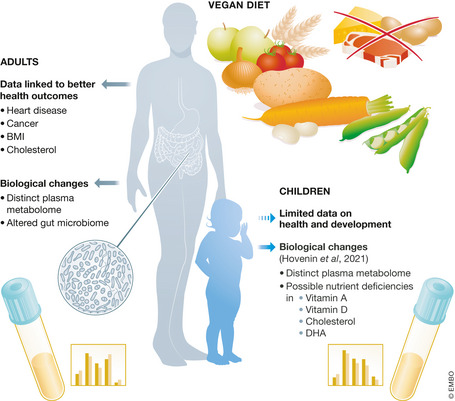
Vegan diets are defined by their exclusion of animal‐derived foods including meat, eggs, and dairy
In adults, vegan diets have been linked to improved health outcomes and adults consuming a vegan diet show biological changes including distinct alterations in their plasma metabolome and gut microbiome. Less is known about how vegan diets affect children, and to this end, Hovenin et al (2021) explore the metabolic and nutritional effects of vegan diets in children.
Vegan children had lower protein intake calculated as a percentage of daily energy intake (13.5% compared to 16.4% in omnivores) and showed lower levels of circulating leucine/isoleucine, phenylalanine, valine/betaine, and aspartate and higher levels of alanine, arginine, and glycine. These alterations are generally in line with amino acid alterations seen in adult vegans, with the notable exception of unchanged serum methionine in vegan children. It remains to be seen whether consuming differing protein sources versus a lower percentage of energy consumption from protein contributed to the overall pattern of circulating amino acid levels in vegan children. It is also unclear whether the lower levels of several essential amino acids could constitute a deficiency or a health benefit, as to our knowledge there are no guidelines for healthy blood levels of individual amino acids and their effects on metabolism are still in its early stages. Perhaps relevant is the low levels of total cholesterol and high‐and low‐density lipoproteins seen in vegan children along with the indicators that there is not compensatory cholesterol biosynthesis. Blood cholesterol also does not have clearly defined deficiency levels, and as Hovenin et al (2021) note, cholesterol is required for cell membrane synthesis and steroid hormone synthesis among its other roles and may be required at higher levels during development.
Pathway analysis on the untargeted metabolomics data showed bile acid biosynthesis was the largest pathway alteration in vegan children. Pathway alterations included higher levels of unconjugated primary bile acids and a lower taurine to glycine conjugation ratio of bile acids in vegans than in omnivores, and however, authors note that it is unknown how these changes are likely to affect the roles of bile acids in digestion, absorption, endocrine, and gut microbiome–brain interactions.
In conclusion, Hovenin et al (2021) use metabolomics to study the metabolic and nutritional consequences of vegan diets in children and find similarities and differences to what has been previously observed in adults. This leads to many open questions as to how these types of diets might be used to affect specific aspects of metabolism and downstream health consequences such as development. Given the metabolic heterogeneity observed across the population, it’s unlikely that a vegan diet would be beneficial all in all settings. Nevertheless, certain children exhibited specific metabolic profiles that suggest that they could be specifically affected by the vegan diet. More work is needed to know whether such observations have molecular consequences and their generalizability.