 Multiple-to-multiple path analysis model
PLoS ONE


Competing Interests: The authors have declared that no competing interests exist.

- Altmetric
One-to-multiple path analysis model describes the regulation mechanism of multiple independent variables to one dependent variable by dividing the correlation coefficient and the determination coefficient. How to analyse more complex regulation mechanisms of multiple independent variables to multiple dependent variables? Similarly, according to multiple-to-multiple linear regression analysis, multiple-to-multiple path analysis model was proposed in this paper and it demonstrated more complex regulation mechanisms among multiple independent variables and multiple dependent variables by dividing the generalized determination coefficient. Differently, three other types of paths were generated in multiple-to-multiple path analysis model in that the correlation among multiple dependent variables was considered. Then, the decision coefficient of each independent variable was constructed for dependent variables system, and its hypothesis testing statistics were given. Finally, the research example of the wheat breeding rules in arid area demonstrated that the multiple-to-multiple path analysis considering more correlation information can get better results.
1 Introduction
The regression analysis, as one of the most widely used statistical methodologies, focuses on studying the relations between dependent variables and independent variables. However, the regression analysis worries less about the correlation mechanisms that may exist among the independent variables [1]. In 1918–1921, the issue was addressed by the biological geneticist Sewall Wright through developing the path analysis method [2, 3]. Sewall Wright’s path analysis mainly emphasizes decomposing the correlation and total determination in terms of model parameters, and drawing the path diagram. The path diagram is a pictorial representation of a system of simultaneous equations, which presents the picture of the relationships that are assumed and is more clearly than the equations [4]. The concrete decomposition result is to distinguish the three types of effects: direct, indirect and total effects, which can lead to a more comprehensive understanding of the relation between variables. Usually, the indirect effects of a variable are mediated by at least one intervening variable [4]. In fact, the decomposed indirect effects quantify the regulation of variables with correlation. The quantitative expression of regulatory mechanism can make the analysis more thorough and clear. Therefore, the path analysis was later applied in multiple science research fields, such as behavioural science, social science, economics, biology, agriculture, medical science and so on [5–18]. This method seems to be more and more widely used at present.
In terms of methodology research, the path analysis was generalized to the structural equation models (SEMs) through combining the principle of factor analysis and was used to analyse the relations between multivariate blocks of data [19, 20]. The decision coefficient was constructed in the specified path analysis model with no latent variables, which included one dependent variable (as result) and multiple independent variables (as causes), based on the decomposition of total determination coefficient [21]. Here, the specific path analysis model was called one-to-multiple path analysis model with the nature of standard multiple linear regression. The decision coefficient of each independent variable equals to the sum of its direct determination and the correlation indirect determination with the other independent variables. The decision coefficient can express the magnitude and direction of each independent variable influencing the variation of dependent variable. Still further, the importance of each independent variable for dependent variable can be ranked according to the decision coefficient result, which shows that the decision coefficient has the significance of making decisions. Subsequently, the statistical test of the decision coefficient was proposed [22]. The decision coefficient improves the one-to-multiple path analysis model to a certain extent. Later, the one-to-multiple path analysis model was applied in the lint yield of upland cotton research and the KEGG gene pathway regulation mechanisms research [23–25].
However, the causal system including multiple independent variables (as “causes”) and multiple dependent variables (as “results”) are often encountered in practice research. For instance, the different pathways contain the same genes in the KEGG pathway, which demonstrated that the same genes can lead to the different gene functions. Here, multiple identical genes and multiple different gene functions constitute a multiple-to-multiple system. Analysis of the regulatory relationship between genes and gene functions is helpful to the modification and change of gene structure. Similar to this, in breeding field, multiple biological shapes to multiple yield indicators also constitute a multiple-to -multiple system. Determining the importance of multiple biological shapes to multiple yield indicators is helpful to improve the yield and quality of crops. It is assumed that such a causal system does not contain latent variables. Then, the one-to-multiple path analysis model can be used to analyse the importance of each independent variable to one dependent variable and the regulations among multiple independent variables. But, it is frustrating that the results of multiple single one-to-multiple path analysis are often contradictory, so that decision makers feel confused when making decisions. Therefore, it is urgent to find a more suitable model to provide more clear decision-making suggestions for decision-makers in such a more complex system.
In this paper, we attempt to propose the multiple-to-multiple path analysis model according to the multiple-to-multiple linear regression analysis, including multiple independent variables and multiple dependent variables and no latent variables. This model considers the correlation among multiple dependent variables caused by multiple common independent variables on the basis of one-to-multiple path analysis model. The other three types of paths generated besides the two types of paths in one-to-multiple path analysis model. The decomposition of the generalized determination coefficient showed the regulation mechanisms among the multiple independent variables and multiple dependent variables along these five types of paths. And the decision coefficient of each independent variable was used to judge its importance for all dependent variables system. Finally, the effectiveness of the model was verified by an example of the wheat breeding rules in arid area.
2 Method
2.1 Equations and models
The multiple-to-multiple linear regression model is the basis of the multiple-to-multiple path analysis, so it was introduced firstly. Define the following assumptions: the dependent variable of linear regression is Y = (Y1,Y2,⋯,Yp)T and the independent variable is X = (X1,X2,⋯,Xm)T. Suppose the joint distribution of and is:


Among them, ρx, ρxy and ρy are the correlation arrays of X,X and Y,Y respectively. ρ is the correlation matrix of [XT,YT]T. Under the above assumption, the normalized multiple-to-multiple linear regression model is:
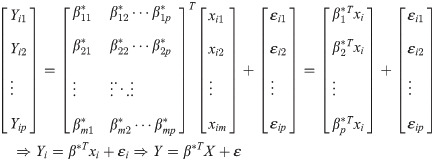
In (3), Yi = [Yi1,Yi2,⋯,Yip]T, xi = [xi1,xi2,⋯,xim]T, β* is the regression parameter of the model, i = 1,2,⋯,n. Let n be the number of observations. We assumed that ε~Np(0,∑e) is the regression residual and has nothing to do with the value of X.
2.2 Regression hypothesis testing
Path analysis can only be carried out when the standardized regression equation is significant. Therefore, we need to perform the following four types of hypothesis tests for regression analysis before path analysis.
2.2.1 Hypothesis testing of generalized complex correlation coefficient rxy
In multiple-to-multiple standardized linear regression equations, the joint distribution of X and Y is showed as formula (2), then the generalized determination coefficient is defined as [26]:

In Eq (4), vxy is the likelihood ratio statistics for testing independence of X and Y. And , , R in |R| is the correlation matrix of X and Y. is the sample linear correlation matrix of X and Y, U is the regression square sum matrix. and are non-zero characteristic roots of B. is the generalized complex correlation coefficient of X and Y. The invalid assumption of rxy is H0:∑xy = 0.When p>2 and m>2, we can use Bartlett’s approximate chi-square test:

2.2.2 Hypothesis testing of regression equation
The invalid hypothesis is and the corresponding F test statistic is:

2.2.3 Hypothesis testing of components in
The invalid hypothesis is and the t test statistic is
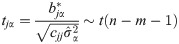
In (7), , is the α-th element on the main diagonal of . cjj is the j-th element on the main diagonal of .
2.2.4 Hypothesis testing of [27]
The invalid hypothesis is . The F test statistic is:

In (8), . After the above four hypothesis tests, if the standardized multiple linear regression equation is significant, it is meaningful to perform path analysis.
2.3 Path analysis of
The first step of multiple-to-multiple path analysis is to conduct one-to-multiple path analysis for each dependent variable and all independent variables. According to the established multiple-to-multiple linear regression equation, the path analysis model is performed. The correlation coefficient of each dependent variable Yα(α = 1,⋯,p) and all independent variables X = (X1,X2,⋯,Xm)T and their determination coefficient were divided following completely the previous one-to-multiple path analysis model on the basis of standardized linear regression equation [25]. Still further, the decision coefficient was constructed using the existing method [21]. According to the theoretical study of multiple linear regression analysis, the system of regular equations Rxxb* = Rxy about the least squares estimation of β* can be rewritten as:



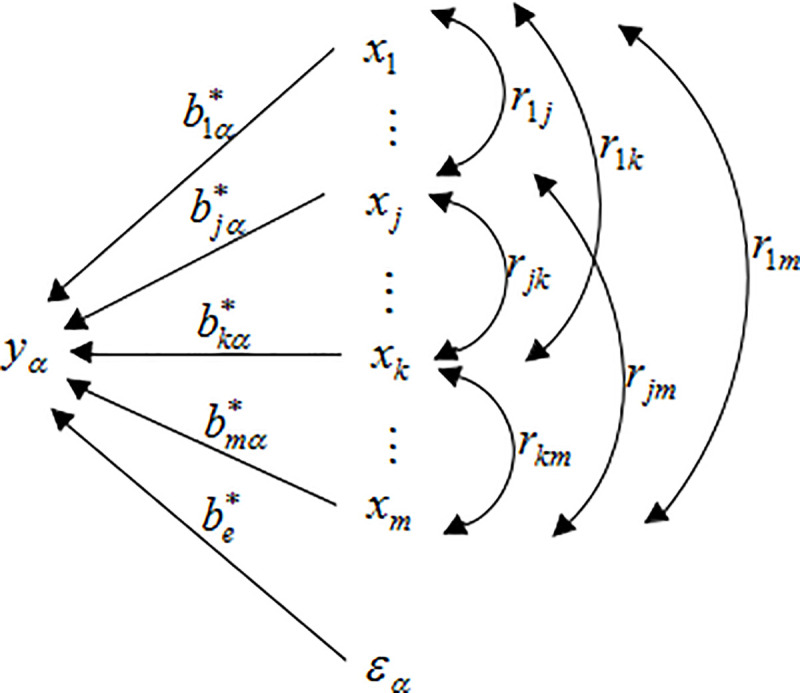
One-to-multiple path analysis diagram.
2.3.1 The division and path of .
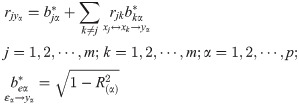
Obviously, the correlation efficient was divided into m terms. There are two types for this m term: is formed by the path yα←xj, so is called the direct effect of xj on yα; and is formed by xj↔xk→yα, which is the effect of xj on yα through the correlation with xk and called the indirect effect. Its magnitude can be obtained by multiplying the path coefficients by the correlation coefficient rjk, including m-1 items. Finally, is the total effect of xj on yα, which is the sum of the direct effect and all the indirect effects.
2.3.2 The division and path of .
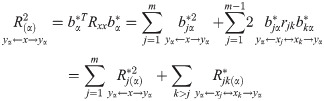
Among (11): is the total coefficient of determination of X for Yα. and its corresponding path is yα←x→yα. It is called the direct determination coefficient of xj to yα.The corresponding path of is yα←xj↔xk→yα. It is called the correlation determination coefficient of xj through the correlation with xk(k≠j) to yα.
2.3.3 The decision coefficient Rα(j) and hypothesis test [22]
The comprehensively determine ability of xj to yα can be represented by the decision coefficient based on the division of . Its specific expression and hypothesis test are:
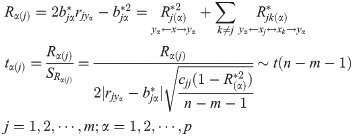
The definition indicates that Rα(j) equals to the sum of the direct determination coefficient and the correlation determination coefficient . In fact, the decision coefficient is the sum of all determination coefficients related to xj. The decision coefficient was used to determine the main decision variables and restrictive variables affecting Yα.
2.4 Multiple-to-multiple path analysis central theorem
The second step is to conduct multiple-to-multiple path analysis. And the innovation is that the correlation between Y caused by the common cause X is considered and three other types of paths are generated. For convenience of observation, let p = 3, m = 3 as an example to make a multiple-to-multiple path analysis diagram as Fig 2. But, the theoretical analysis is based on m independent variables and p dependent variables.
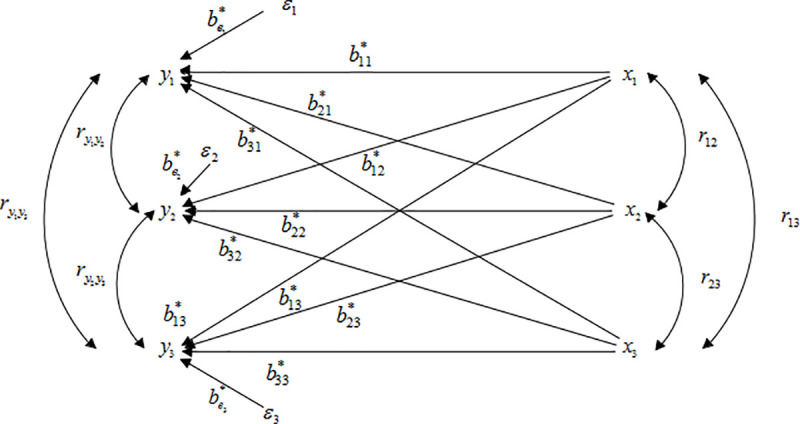
Multiple-to-multiple path analysis diagram.
The multiple-to-multiple path analysis model considered the correlation among different dependent variables compared to the one-to-multiple path analysis model. Accordingly, the central theorem of multiple-to-multiple path analysis is proposed. Based on model (3), for two different Yα and Yt, their models are:

In (13), εα and εt are independent of each other and have nothing to do with the value of X. Since Yα, Yt and X have been standardized, the correlation coefficients of Yα and Yt, and the corresponding path theoretically is:
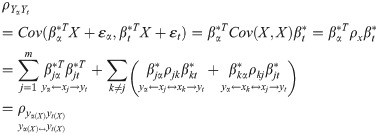
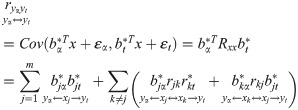
Among them, j = 1,2,⋯,m; k = 1,2,⋯,m; and α = 1,2,⋯,p; t = 1,2,⋯,p. Eq (14) and Eq (15) are called the central theorem of multiple-to-multiple path analysis.
The central theorem demonstrated that , equal to the sum of m2 items composite path coefficient. Wherein, the direct path yα←xj→yt has m items. Due to the correlation among independent variables xj↔xk(k≠j), the two types of indirect paths were formed as yα←xj↔xk→yt, yα←xk↔xj→yt. And xj↔xk(k≠j) has items. So the total composite path number is items. In addition, the central theorem also showed that three other types of paths generated when the correlation between different dependent variables yα and yt was considered, which was caused by the common X. Therefore, there are five types of paths in multiple-to-multiple path analysis, plus the two types of paths in one-to-multiple path analysis.
In fact, the correlation coefficient in the multiple-to-multiple path analysis central theorem is theoretically the regression square sum matrix U in multiple-to-multiple standardized linear regression. Under the least squares estimation, U can be expressed as follows [16]:
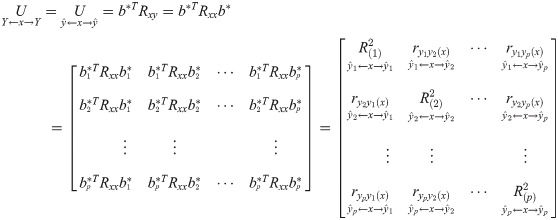
In (16), is the correlation coefficient between yα and yt caused by the common cause X. Here, U is the determination coefficient matrix of X to Y. is the coefficient of determination of X to Yα. is the complex correlation coefficient of X to Yα. And in statistics, is the correlation coefficient of Yα and Yt, and has nothing to do with X in the calculation. is the determining part of Yα and Yt to due to the common cause X.
2.5 The division of R2≈tr(B) and its corresponding path
The generalized determination coefficient has been defined using formula (4) before, which was used to reflect the comprehensive determination of all independent variables to all dependent variables [26]. Because the non-zero eigenvalue of B is small and , the result of is small enough to make R2≈tr(B). In fact, tr(B) is the overestimation of R2 here. According to R2≈tr(B), the generalized determination coefficient R2 was divided as follows:
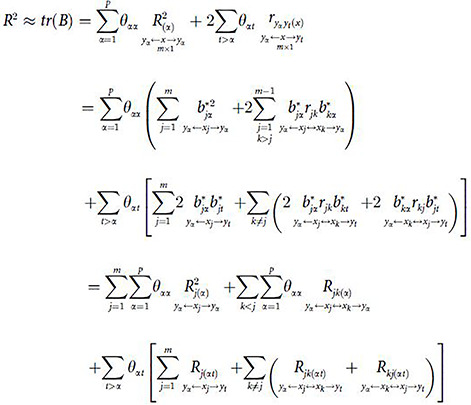
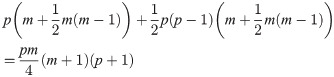
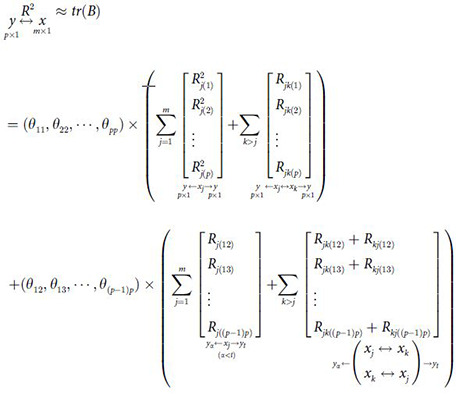
Among (17), θαt is the element in matrix . is the direct determination coefficient of xj on yα, and the effect path is yα←xj→yα, j = 1,2,⋯,m; α = 1,2,⋯,p. is the indirect determination coefficient of xj and xk on yα, the effect path is yα←xj↔xk→yα, jk has items. is the direct determination coefficient of xj on yα and yt, which is caused by the correlation of yα and yt because of the common cause xj. The effect path is yα←xj→yt, j = 1,2,⋯,m, αt has items. is the indirect determination coefficient of xj and xk on yα and yt. The effect path is yα←xj↔xk→yt. When α<t, yα and yt have items; when j≠k, jk has items. is the indirect determination coefficient of xj and xk on yt and yα. The effect path is yα←xk↔xj→yt, when α<t, yα and yt have items; when j≠k, kj has items. Therefore, the total number of items divided is:
Formula (17) demonstrates that the generalized determination coefficient R2 was divided successfully along the five types of paths stated in multiple-to-multiple path analysis central theorem. The specific path vector structure is:
2.6 The generalized decision coefficient Ry(j)
2.6.1 The definition of Ry(j)
In order to describe the comprehensive decision-making ability of xj to Y, the generalized decision coefficient Ry(j) was defined as follows:
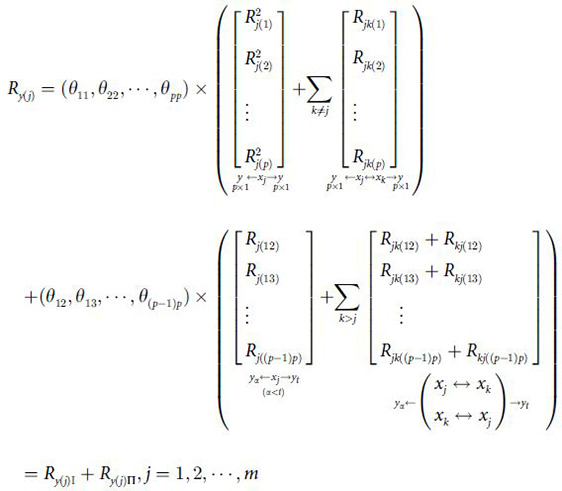
Obviously, the generalized decision coefficient is the sum of the products of , Rjk(α), Rj(αt) and Rjk(αt)+Rkj(αt) related to xj in the division and the corresponding elements in on the basis of R2≈tr(B). In (19), Ry(j) is divided into two parts: Ry(j)I and Ry(j)II. Ry(j)I is the determination part of xj and xj↔xk to Yα. Ry(j)Π is the determination part of xjand xj↔xk to Yα and Yt(α≠t) due to the common X. In a word, the generalized decision coefficient includes not only the direct determination of xj to Yα, Yα and Yt(α≠t), but also the indirect determination of xj↔xk(k≠j) to Yα and Yα and Yt(α≠t). Specially, the indirect determination considers the correlation among the independent variables and the correlation among the dependent variables at the same time. Therefore, the decision coefficient Ry(j) can be used to express the comprehensive decision ability of xj to Y.
2.6.2 The hypothesis testing of Ry(j)
The invalid hypothesis is H0:E(Ry(j)) = 0 and the corresponding t test statistic is:

3 Application
3.1 Datasets
In order to demonstrate the effectiveness of the multiple-to-multiple path analysis, the wheat data in arid areas to explore breeding rules was selected to discuss. In detail, the wheat data included thirty-five varieties. These data were obtained in a completely randomized block test, and each sample was set with three repetitions [28]. In multiple-to-multiple path analysis, three indexes closely related to wheat yield was selected as dependent variables: panicles per plant (y1), grain number per panicle (y2) and 1000-grain weight (y3), and three other indexes were selected as independent variables: bio-mass per plant (x1), single stem grass weight (x2) and economic coefficient (x3). Here, economic coefficient refers to the ratio of economic yield to biological yield of wheat.
3.2 Calculation and results
Firstly, the phenotypic correlation matrix of the sample was calculated and expressed as Eq (21). The number of observations for each variable is n = 105.
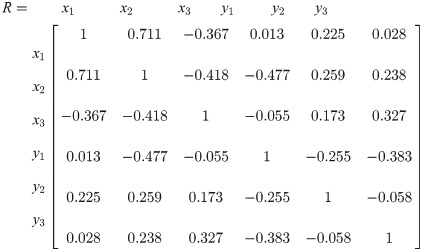
Then, we establish a multiple-to-multiple standardized multiple linear regression equation and calculate the corresponding parameters, the results were written as follow:
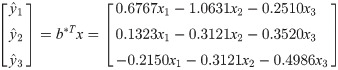
The hypothesis testing of generalized complex correlation coefficient rxy.
Likelihood ratio statistics of X and Y is vxy = 0.2987, so χ2 = 121.4357**>χ2(3×3), and R2 = 1−vxy = 0.7013, . The results showed that the linear regression of Y to X was extremely significant.
The hypothesis testing of regression equation .
The values of F test statistics are F1 = 37.9188**, F2 = 25.394**, F3 = 14.408**, respectively. They were all greater than F0.01(3,101) = 4.007, which showed that each standardized regression equation was extremely significant.
The hypothesis testing of components in
The results of hypothesis testing of components in were listed in Table 1.

| y1 | y2 | y3 | |
|---|---|---|---|
| x1 | 6.8994** | 1.0212 | -1.8092 |
| x2 | -105852** | 2.3527** | 4.9257** |
| x3 | -3.3060** | 3.5101** | 5.4202** |
Among them, except x1 was not significant to y2 and y3, the others were extremely significant.
4The hypothesis testing of
The results are F1 = 8.670**, F2 = 25.394**, F3 = 10.384**, and the test results were all extremely significant.
Except x1 is not significant to y2 and y3, the above test results showed that the established multiple-to-multiple standardized linear regression equations were extremely significant. The path analysis and decision analysis can be performed subsequently.
Secondly, one-to-multiple path analysis of was conducted according to the theory before (Method, Part 2.3). The detailed division results of the correlation coefficient and the determination coefficient were listed in Table 2 and Table 3. The decision analysis was also conducted and the results were also listed in Table 3.
| xj to yα | Direct effect | xj↔yα | Indirect effect | Total effect | |||
|---|---|---|---|---|---|---|---|
| x1 to y1 | 0.6767** | x1↔x2→y1 | -0.7559 | -0.66638(3) | 0.2328(1) | 0.013(1) | |
| x1↔x3→y1 | 0.0921 | ||||||
| 1 | x2 to y1 | -1.0631** | x2↔x1→y1 | 0.4811 | 0.5860(1) | -0.3115(3) | -0.477(3) |
| x2↔x3→y1 | 0.1049 | ||||||
| x3 to y1 | 0.251** | x3↔x1→y1 | -0.2483 | 0.1960(2) | 0.1970(2) | -0.055(2) | |
| x3↔x2→y1 | 0.4444 | ||||||
| x1 to y2 | 0.1323(3) | x1↔x2→y2 | 0.2219 | 0.0927(1) | 0.0455(2) | 0.225(2) | |
| x1↔x3→y2 | -0.1292 | ||||||
| 2 | x2 to y2 | 0.3121(2) | x2↔x1→y2 | 0.0941 | -0.0530(2) | 0.0914(1) | 0.259(1) |
| x2↔x3→y2 | -0.1471 | ||||||
| x3 to y2 | 0.3520(1) | x3↔x1→y2 | -0.0486 | -0.1791(3) | -0.2763(3) | 0.173(3) | |
| x3↔x2→y2 | 0.1305 | ||||||
| x1 to y3 | -0.2150*(3) | x1↔x2→y3 | 0.4262 | 0.2432(1) | -0.074(2) | 0.028(3) | |
| x1↔x3→y3 | -0.1830 | ||||||
| 3 | x2 to y3 | 0.5994**(1) | x2↔x1→y3 | -0.1529 | -0.3613(3) | 0.1757(1) | 0.238(2) |
| x2↔x3→y3 | -0.2084 | ||||||
| x3 to y3 | 0.4986**(2) | x3↔x1→y3 | 0.0789 | -0.1716(2) | -0.3914(3) | 0.327(1) | |
| x3↔x2→y3 | -0.2505 |
| yα←xj→yα | Direct determination | yα←xj↔xk→yα | indirect determination | Decision coefficient | ||
|---|---|---|---|---|---|---|
| y1←x1→y1 | 0.4579 | y1←x1↔x2→y1 | -1.0230 | -0.8983 | -0.4404**(3) | |
| y1←x1↔x3→y1 | 0.1247 | |||||
| 1 | y1←x2→y1 | 1.1302 | y1←x2↔x1→y1 | -1.0230 | -1.2461 | -0.1159(2) |
| y1←x2↔x3→y1 | -0.2231 | |||||
| y1←x3→y1 | 0.0630 | y1←x3↔x1→y1 | 0.1247 | -0.0984 | -0.0354(1) | |
| y1←x3↔x2→y1 | -0.2231 | |||||
| y2←x1→y2 | 0.0175 | y2←x1↔x2→y2 | 0.0587 | 0.0245 | 0.0420*(2) | |
| y2←x1↔x3→y2 | -0.0342 | |||||
| 2 | y2←x2→y2 | 0.0974 | y2←x2↔x1→y2 | 0.0587 | -0.0331 | 0.0643**(1) |
| y2←x2↔x3→y2 | -0.0918 | |||||
| y2←x3↔x1→y2 | -0.0342 | |||||
| y2←x3→y2 | 0.1239 | -0.1260 | -0.0021(3) | |||
| y2←x3↔x2→y2 | -0.0918 | |||||
| y3←x1→y3 | 0.0462 | y3←x1↔x2→y3 | -0.1833 | -0.1046 | -0.0584(2) | |
| y3←x1↔x3→y3 | 0.0787 | |||||
| y3←x2↔x1→y3 | -0.1833 | |||||
| 3 | y3←x2→y3 | 0.3593 | -0.4331 | -0.0738(3) | ||
| y3←x2↔x3→y3 | -0.2498 | |||||
| y3←x3↔x1→y3 | 0.0787 | |||||
| y3←x3→y3 | 0.2486 | -0.1711 | 0.0775*(1) | |||
| y3←x3↔x2→y3 | -0.2498 |
The t test statistics values of decision coefficient hypothesis testing were listed in Table 4.
| y1 | y2 | y3 | |
|---|---|---|---|
| x1 | -3.39774** | 2.3205* | -1.2288 |
| x2 | -0.74458 | 4.5633** | -0.7716 |
| x3 | -0.9793 | -0.0636 | 2.4488* |
In one-to-multiple path analysis, the results of correlation coefficient division showed that the total effect of biomass per plant (x1), single stem grass weight (x2) and economic coefficient (x3) are all positive and the largest to panicles per plant (y1), grain number per pancicle (y2), 1000-grain weight (y3), respectively. Differently, the direct effect of x1 to y1 is the positive and the largest, while the indirect effect is negative and the smallest. The direct effect of x2 to y2, x3 to y3 are not the largest, but the total effect becomes the largest through the correlation regulation by the indirect effect. The results of the determination coefficients division and the decision coefficients showed that for y1, x1 is a very significant restrictive factor; for y2, x2 is a very significant positive factor and x1 is a significant positive factor; for y3, x3 is a significant positive factor. These results meant that single stem grass weight (x2) and economics coefficient (x3) need to be increased in order to increase grain number per pancicle (y2) and 1000-grainweight (y3), but panicles per plant (y1) will decrease according due to the negative correlation x2, x3 and y1. Meanwhile, biomass per plant (x1) should be decreased in order to increase the panicles per plant (y1), but grain number per pancicle (y2) will decrease here. The contradictory decision-making results of different independent variables (xi) to different dependent variables (yi) often lead to the confusion of breeders.
Therefore, after the one-to-multiple path analysis, the multiple-to-multiple path analysis was practiced by taking into account the correlation between the dependent variables. According to formula (17–19), the generalized determination coefficient R2 was divided and the results were listed in Table 5.
| a | yα←xj→yt | direct determination | yα←xj↔xk→yα | |
|---|---|---|---|---|
| y1←x1→y2 | 0.1791 | y1←x1↔x2→y2 | 0.3003 | |
| y1←x1↔x3→y2 | -0.1748 | |||
| 1 | y1←x2→y2 | -0.6636 | y1←x2↔x1→y2 | -0.2000 |
| y1←x2↔x3→y2 | 0.3128 | |||
| y1←x3→y2 | -0.1767 | y1←x3↔x1→y2 | 0.0244 | |
| y1←x3↔x2→y2 | 0.0655 | |||
| y1←x1→y3 | -0.2910 | y1←x1↔x2→y3 | 0.5768 | |
| y1←x1↔x3→y3 | -0.2477 | |||
| 2 | y1←x2→y3 | -1.2744 | y1←x2↔x1→y3 | 0.3253 |
| y1←x2↔x3→y3 | 0.4431 | |||
| y1←x3→y3 | -0.2503 | y1←x3↔x1→y3 | -0.0396 | |
| y1←x3↔x2→y3 | 0.1258 | |||
| y2←x1→y3 | -0.0569 | y2←x1↔x2→y3 | 0.1128 | |
| y2←x1↔x3→y3 | -0.0484 | |||
| 3 | y2←x2→y3 | 0.3741 | y2←x2↔x1→y3 | -0.0955 |
| y2←x2↔x3→y3 | -0.1301 | |||
| y2←x3→y3 | 0.3510 | y2←x3↔x1→y3 | 0.0556 | |
| y2←x3↔x2→y3 | -0.1764 |
The specific calculation of path vector structure is as follows:
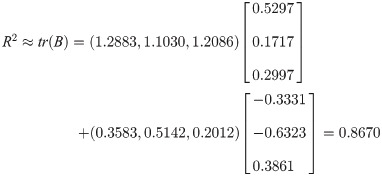
From the previous calculation, we can get tr(B) = 0.8671. The above division of the generalized coefficient of determination is reasonable according to R2≈tr(B). The decision analysis of the model was carried out continually. The decision coefficient of each independent variable to Y = (y1,y2,y3)T was calculated as follows:
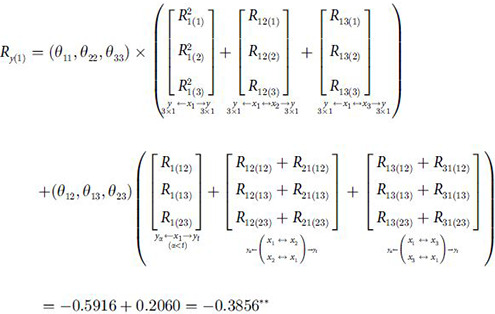
Similar available: Ry(2) = −0.1157, Ry(3) = 0.0906*. According to the decision coefficient, the t test about Ry(j) is further conducted, and the result is t1 = −4.3943**, t2 = 0.9293, t3 = 2.0785**. In addition, it should be noted that the determination coefficients of xj and xj↔xk to yα have been calculated by one-to-multiple path analysis model (Table 3). The comparison of the results of Table 3 and those of Table 5 demonstrated that great changes have taken place in the regulation of xj to Y when the correlation among dependent variables was considered. Firstly, the direct and indirect regulations of xj, xj↔xk to Y also were greatly affected by the correlation among Y because of common X. As shown in Table 3, the direct determination of x2 to y1, y2 were both positive, respectively ( y2←x2→y2). But in Table 5, the direct determination of x2 to y1 and y2 became negative (R12(2) = -0.6636 y1←x2→y2). This change was due to the consideration of the negative and large correlation of y1 and y2 . Similarly, the direct determination of x2 to y2 and y3 was still changed (R23(2) = 0.3741 y2←x2→y3), compared to the previous determination coefficient . Different from the above, this change was small and both were positive. This phenomenon showed that the small correlation of y2 and y3 had little influence on the direct determination of x2 to y2 and y3. The direct determination of x3 to y2 and y3 was exactly like the direct determination of x2 to y2 and y3. The indirect determination due to the correlation of xj↔xk also changed a lot because of consideration of the correlation among Y. For example, the indirect determination of x1↔x2 to y1and y3 was 0.5768(y1←x1↔x2→y3) and 0.3253(y1←x2↔x1→y3). It’s strange that the original indirect determination of x1↔x2to y1, x1↔x2 to y3 were -1.023 (y1←x1↔x2→y1) and 0.1833(y3←x1↔x2→y3), respectively. It is obvious that the strong negative correlation of y1 and y3 led to the change of indirect regulation. These big changes were enough to show the importance of considering the correlation among Y. There were similar changes in the direct determination of x1↔x2 to y1and y2(y1←x1↔x2→y2, y1←x2↔x1→y2) and x2↔x3 to y1 and y3(y1←x2↔x3→y3 y1←x3↔x2→y3). Secondly, the decision coefficients results showed that x1 is the very significant restrictive decision factor of Y = (y1,y2,y3)T (Ry(1) = −0.3856**). But x1 is the significant positive decision factor to y2(Ry2(1) = 0.0420*) and is not significant to y3(Ry3(1) = -0.0584). This phenomena seemed to be caused by the very significant negative decision making effect of x1 to y1, and strong negative correlation between y1 and y2 , y1 and y3 . For x2, there is no point in making a decision. (Ry(2) = −0.1157). And x3 became a significant positive decision factor to . However, x3 is significant only to y3 , and is not significant to y1, y2 in one-to-multiple path analysis. Obviously, the correlation among Y due to common X makes a big difference in the decision making. The results showed that the economic coefficient (x3) should be increased, the biomass per plant (x1) should be appropriately reduced and the single stem grass weight (x2) should remain unchanged in the process of wheat breeding. These results were in accordance with the existing documents results [28]. In short, the consideration of the correlation among Y caused a big change of the direct determination, the indirect determination and the decision analysis results of xj to Y. And the greater the correlation among Y is, the greater the impact on regulation.
4 Discussion
In this article, the multiple-to-multiple path analysis model was proposed based on multivariate linear regression analysis, which can be regarded as a generalization of one-to-multiple path analysis model based on univariate linear regression analysis. The innovation of this model is the multiple-to-multiple path analysis central theorem. The correlation among Y caused by common X was considered in the system analysis including multiple independent variables and multiple dependent variables. As Fig 2 shown, the other three types of paths (yα←xj→yt, yα←xj↔xk→yt, yα←xk↔xj→yt) generated in multiple-to-multiple path analysis model besides the two types of paths (yα←xj→yα, yα←xj↔xk→yα) in one-to-multiple path analysis. Along these five types of paths, the generalized determination coefficient R2 was divided into the direct determination and the indirect determination according to R2≈tr(B). This division can clearly show the complex regulatory mechanisms among variables. Still further, the generalized decision coefficient Ry(j) was constructed by synthesizing all the items related to xj, which was used to express the comprehensive decision-making ability of xj to Y = (Y1,Y2,⋯,Yp)T. In fact, the direct and indirect determinations all were products of corresponding path coefficients. The quantitative expression of the regulation among variables is helpful for decision makers to make more reasonable and optimized decision suggestions for target variables. The analysis results of the wheat data in arid areas strongly confirm this. It is worth mentioning that the path analysis of any closed system can be made according to the multiple-to-multiple path analysis central theorem. However, the application of multiple-to-multiple path analysis model still has some limitations. Firstly, the model is only applicable to the causal relationship analysis among multiple dependent variables and independent variables with correlation. Secondly, the difference between the generalized determination R2 and tr(B) is relatively large when the correlation among variables is very strong in multiple-to-multiple linear regression analysis, that is, the value of the correlation coefficient in correlation matrix is almost 1. Here, the division of the generalized determination coefficient R2 based on R2≈tr(B) is very different from the actual result. Therefore, other division methods need to be further considered.
5 Conclusion
In the multiple-to-multiple path analysis model, the correlation among dependent variables caused by common independent variable is considered, besides the correlation among independent variables. Taking into account more correlation information analysis makes the results more practical and instructive.
References
1
3
4
5
6
7
8
9
10
11
12
13
14
15
16
17
18
19
20
21
22
23
24
25
26
27
28