 Predictors of sexual violence among female students in higher education institutions in Ethiopia: A systematic review and meta-analysis
PLoS ONE


Competing Interests: The authors have declared that no competing interests exist.

- Altmetric
Background
Sexual violence is a profound social and public health problem in Ethiopia. Female students in institutions of higher education are highly vulnerable to sexual violence. Different studies conducted on sexual violence at higher education institutions lack consistency and inclusiveness. Thus, this systematic review and meta-analysis were conducted to estimate the lifetime and twelve-month prevalence, and predictors of sexual violence among female students in institutions of higher education in Ethiopia.
Methods
This study used a systematic review and meta-analysis of studies conducted from January 1, 2000, to June 1, 2020, in Ethiopia. This review followed Preferred Reporting Items for Systematic Reviews and Meta-Analyses (PRISMA) guidelines. Electronic databases including PubMed, Cochrane Library, Hinari, Google Scholar, CINAHL, and Global Health were searched using relevant search terms. Meta-analysis was performed using STATA 14 software. The I2 statistics and Egger’s test were used to assess heterogeneity and publication bias, respectively. Forest plots were used to present the prevalence and odds ratio (OR) with a 95% confidence interval (CI).
Results
This systematic review and meta-analysis included 10 studies, 5790 study participants. The pooled lifetime and twelve-month prevalence of sexual violence among female students in Ethiopia was 49.4% (95%CI: 37.87, 60.96) and 36.02% (95%CI: 26.42, 45.62) respectively. Rural residence (OR = 2.13;95%CI: 1.33, 3.42), alcohol drinking (OR = 2.03; 95%CI: 1.44, 2.87), and ever had a boyfriend (OR = 2.07; 95%CI: 1.32, 3.62) were factors associated with sexual violence.
Conclusions
The lifetime prevalence of sexual violence among female students in institutions of higher education in Ethiopia was high. Place of residence, alcohol drinking, and ever had a boyfriend were statistically significant factors of sexual violence. Life skill training and law enforcement are needed to control alcohol consumption. Additionally, more focused interventions should be done in rural settings.
Registration
This systematic review has been registered in the International Prospective Registry of Systematic Review (PROSPERO) with a specific registration number CRD42020155894.
Introduction
Violence against women is a significant public health problem, as well as a fundamental violation of women’s human rights [1]. Due to its nature, the magnitude of violence against women is frequently “hidden” resulting in a significant underestimation. Globally, about 35% of women have experienced either physical and/or sexual intimate partner violence or non-partner sexual violence [2]. A Systematic Review and Meta-Analysis in Sub-Saharan Africa showed that 26.2% of female youths in educational institutions were victimized by sexual violence [3]. Ethiopian Demographic and Health Survey (EDHS) 2016 reported that 10% of women aged 15–49 in Ethiopia have experienced sexual violence [4].
University students are a great potential resource for a country. However, substantial proportions of female students in institutions of higher education in Ethiopia have been subjected to sexual violence and its consequences due to different reasons [5–7]. Some of these reasons include lack of family control, the need to explore their newly discovered freedom, presence of pimp and pubs surrounding the campus, sexual experimentation, peer pressure, weak institutional administration, lack of comprehensive knowledge on sexual and reproductive health problems, substance use and financial insecurity [8–10].
Various studies revealed that older age [11], age at first sex [12], level of education [5, 6], rural residence [5, 11, 13–15], alcohol drinking [5, 11–13, 16], lack of pocket money [16], witnessed maternal violence [5, 11, 13], ever had a boyfriend [6, 14], ever had sex [17], unmarried parental status [5, 16, 17], non-discussion of sexual issues with family [11, 15] and low level of maternal educational status [7] are factors associated with sexual violence.
Sexual violence has serious short-term and long-term physical, mental, sexual, and reproductive health problems for victims. These include; Human immune-deficiency virus (HIV) and other sexually transmitted infections [18–20], induced abortion [21–23], harmful alcohol use [24, 25], school dropout [26, 27], depression, anxiety, and suicide [28–33], and other fatal and non-fatal injuries [34–37].
Elimination of all forms of violence against women and girls is one of the key Sustainable Development Goals (SDG), target 5.2 [38]. It is also crucial to achieve most of the SDGs particularly Goal 3 and Goal5. Due to this, the prevention of violence against women has long been the focus of attention by several global and national organizations. The government of Ethiopia has also adopted, ratified, and revised various legislation and policies to fight violence against women [39–41]. However, sexual violence has continued to be a major public health problem in Ethiopia.
Determining the magnitude of sexual violence among University students is crucial for designing and implementing effective interventions to reduce the problem. However, the studies conducted in Ethiopia found inconsistent and inconclusive findings regarding the prevalence and its predictors. The lifetime prevalence of sexual violence among female students in institutions of higher education in Ethiopia was varied from 14.3% in Hawassa University [14] to 76.4% in Ambo University [5]. Moreover, the studies showed inconsistent findings regarding factors associated with sexual violence [5–7, 11–17]. Therefore, this review used the evidence of these studies to estimate the pooled lifetime and twelve-month prevalence, and predictors of sexual violence among female students in institutions of higher education in Ethiopia.
Methods
Registration
This systematic review and meta-analysis strictly followed the Preferred Reporting Items for Systematic Review and Meta-Analysis (PRISMA) guidelines [42] (S1 File). It has been registered in the International Prospective Registry of Systematic Review (PROSPERO) with a specific registration number CRD42020155894.
Study design and search strategy
A systematic review and meta-analysis of published and unpublished studies were conducted to assess the pooled prevalence and associated factors of sexual violence among higher education institutions in Ethiopia. The databases used to search for studies were: PubMed, Cochrane Library, Hinari, Google Scholar, CINAHL, and Global Health. The search was made using the following key terms: "prevalence", "magnitude", "proportion", "incidence", "Sexual violence", "sexual abuse", "sexual coercion", "sexual harassment", "sexual assault", "rape", "violence", "gender-based violence", "assault", "factors", "determinants", "predictors", "factors associated", "associated factors", "risk factors", "University", "College", "Higher education institutions", "campus", "students", "undergraduate students", "female", "Ethiopia". All key terms were searched by a combination of Boolean operators “AND” or “OR” as appropriate and the search was done by two authors independently (BK and YD).
Inclusion and exclusion criteria
All available studies conducted from January 1, 2000, to June 1, 2020, were included in this review. This review included published and unpublished studies that were conducted on the prevalence of sexual violence and its determinants in the higher education institutions in Ethiopia. All observational studies with English language publication which measured the prevalence of sexual violence; sexual coercion, sexual harassment, and rape among female students were included in this review. However, pure qualitative studies, studies with poor methodological quality, and those not reporting the outcome of interest were excluded from the review.
Definition of sexual violence
The World Health Organization (WHO) defines sexual violence as “any sexual act, attempt to obtain a sexual act, unwanted sexual comments or advances, or acts to traffic or otherwise directed against a person’s sexuality using coercion, by any person regardless of their relationship to the victim, in any setting, including but not limited to home and work” [43].
Study selection, quality appraisal, and data extraction
All articles identified from selected databases were exported to Endnote X8 and duplicate files were excluded. The remaining articles and abstracts were independently screened by two groups (YD and MA) for inclusion in the full-text appraisal. The difference between reviewers was managed through discussion and disagreement was handled by the third party (BA). The quality of articles that met inclusion criteria were assessed using the Joanna Briggs Institute (JBI) critical appraisal checklist [44]. The tool has a separate appraisal checklist for each type of study design. Two reviewers independently assessed articles before inclusion for review. Articles with quality scores of fifty and above were included in the final review.
Data were extracted using Microsoft excel 2010 sheet. The data extraction tool contains information on the author’s name, year of study, year of publication, study setting (university or college students), response rate, sample size, outcome measured, prevalence, adjusted odds ratio (AOR), and upper and lower confidence interval (CI) of AORs.
Statistical methods and analysis
The analysis was conducted using STATA 14 software. Forest plots were used to show the lifetime and twelve-month (current) prevalence of sexual violence among female students in higher education institutions of Ethiopia. Due to the presence of substantial heterogeneity among studies, the random effect model of analysis was used. The heterogeneity test of included studies was assessed by using the I2 statistics, and it was declared using a p-value of less than 0.05 [45]. Subgroup analyses were also conducted by different study characteristics such as study setting (university or college), region (Amhara, Oromia, southern nations, nationalities, and people’s region (SNNRR)) and study year (before 2015 or 2015 and above). The different factors associated with sexual violence were presented using odds ratios (ORs) with 95% CI. The Egger regression asymmetry test was used to assess publication bias [46, 47]. The presence of publication bias was declared with a p-value of less than 0.05.
Results
Study selection
This systematic review and meta-analysis included both published and unpublished studies conducted on sexual violence among female students at higher education institutions in Ethiopia. A total of 844 records were retrieved through electronic database searching. From these, 82 duplicated records were excluded, and the remaining 740 articles were excluded using their titles and abstracts. Twenty-two full-text articles were assessed for eligibility. From these, 12 full-text articles were excluded for prior criteria, and a total of 10 studies were included in the review (Fig 1).

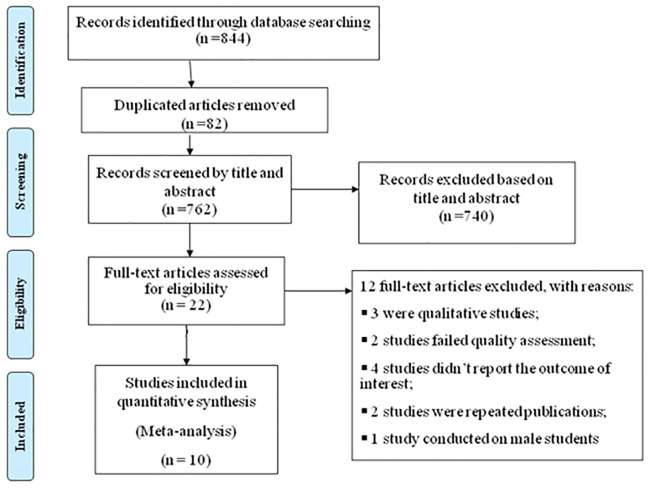
PRISMA flow diagram of the included studies for the systematic review and meta-analysis of sexual violence among female students at a higher education institution in Ethiopia.
Characteristics of included studies
All articles included in this review were cross-sectional studies [5–7, 11–17]. The sample size of studies ranged from a minimum of 336, a study conducted at Hawassa University [14] to a maximum of 1330, another study conducted in colleges of Hawassa city [13]. Overall, this review included a total of 5790 study participants. The studies were conducted from 2006 to2018 in different regions of the country (Table 1).

| Authors and year | Study area | Study design | Sample size | Response rate | Outcome measured | Prevalence | Quality score |
|---|---|---|---|---|---|---|---|
| Henok A etal, 2015 | Mizan-Tepi University | Institutional based cross-sectional | 570 | 94.4 | Sexual harassment | 66.3 | 78% |
| Bekele and Deressa, 2014 | Ambo University | Institutional based cross-sectional | 590 | 98.8 | Sexual coercion | 76.4 | 83% |
| Takele and Setegn, 2014 | Madawalabu University | Institutional based cross-sectional | 397 | 96.6 | Sexual violence | 41.1 | 78% |
| Arnold D et al, 2008 | Hawassa city | Institutional based cross-sectional | 1330 | 100 | Sexual violence | 46.3 | 56% |
| Shimekaw B etal, 2013 | Bahir Dar city | Institutional based cross-sectional | 536 | 99.1 | Sexual violence | 37.3 | 67% |
| Adinew and Hagos, 2017 | Wolaita Sodo University | Institutional based cross-sectional | 462 | 95.4 | Sexual violence | 45.5 | 72% |
| Benti and Teferi, 2015 | Nekemet town | Institutional based cross-sectional | 562 | 99.6 | Sexual coercion | 41.3 | 67% |
| Kassa S etal, 2019 | Wollo University | Institutional based cross-sectional | 402 | 97.8 | sexual coercion | 59.7 | 72% |
| Sendo and Meleku, 2015 | Hawassa University | Institutional based cross-sectional | 336 | 100 | Rape | 14.3 | 61% |
| Bekele T etal, 2015 | Madawalabu University | Institutional based cross-sectional | 605 | 97.9 | Sexual harassment | 66.0 | 72% |
Prevalence of sexual violence
The overall pooled lifetime prevalence of sexual violence among females in higher education institutions in Ethiopia was 49.4% (95%CI: 37.87, 60.96). The highest lifetime prevalence of sexual violence was reported from a study done at Ambo University. The study showed that 76.4% of female students had experienced sexual violence [5]. The lowest prevalence of sexual violence was 14.3% among female students at Hawassa University [14]. Significant heterogeneity was observed among included studies in the meta-analysis, I2 = 98.9%, p < 0.001 (Fig 2). The funnel plot showed a symmetrical appearance (Fig 3). The Egger’s regression asymmetry test also showed non-significant publication bias, p-value = 0.61.
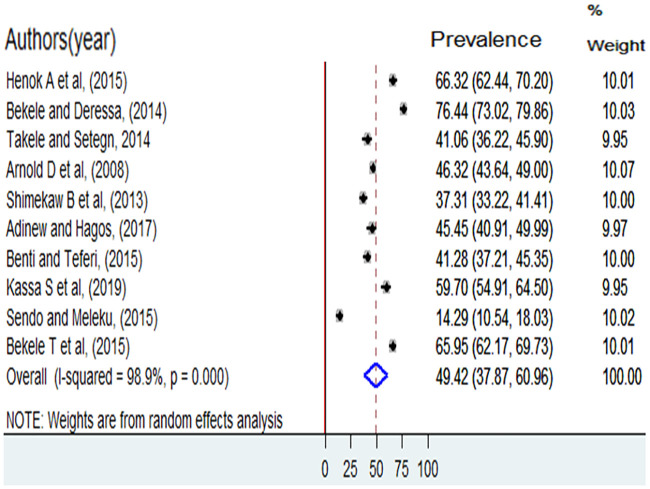
The lifetime prevalence of sexual violence among female students in higher education institution in Ethiopia, 2006 to 2018.
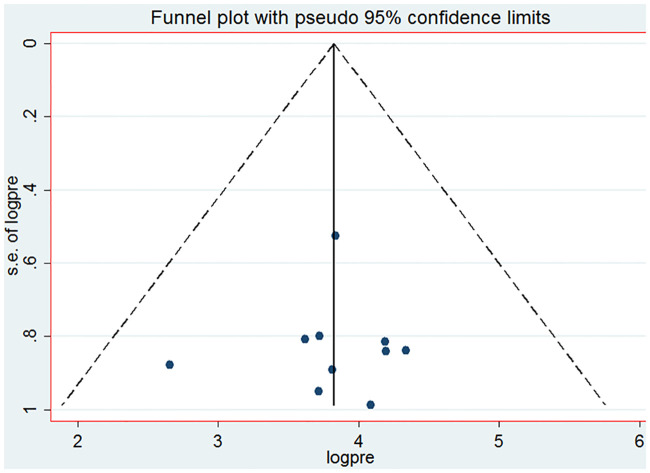
Funnel plot with 95% confidence limit of pooled lifetime prevalence of sexual violence among female students in higher education institution of Ethiopia, 2006 to 2018.
The twelve-month (current) prevalence of sexual violence was reported by seven studies [5, 6, 11–13, 16, 17] and it ranged from 24.46% among female students in Wolaita Sodo University [11] to 63.98% among female students in Ambo University [5] and the pooled twelve-month prevalence of sexual violence was36.02% (95%CI: 26.42, 45.62) (Fig 4). A total of nine studies [5–7, 11, 12, 14–17] were reported prevalence of completed rape. The highest prevalence was 20.82% among college female students in Nekemet, and the lowest prevalence was 6.34% among college female students in Bahir Dar. The pooled prevalence of completed rape was 13.45 (95%CI: 9.96, 16.93) (Fig 5).
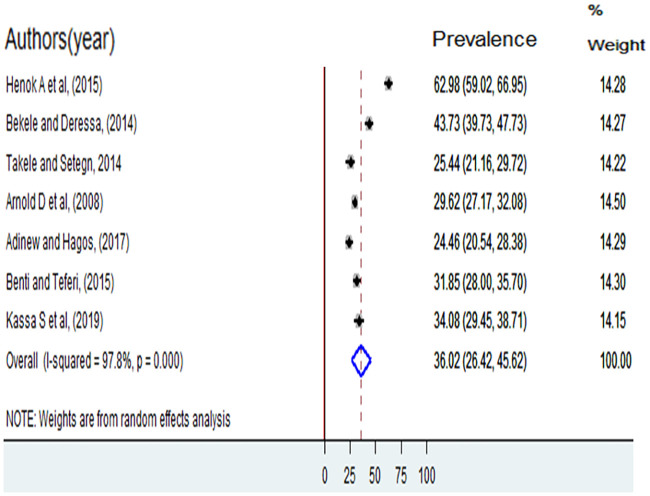
Twelve-month prevalence of sexual violence among female students at a higher education institution in Ethiopia, 2006 to 2018.
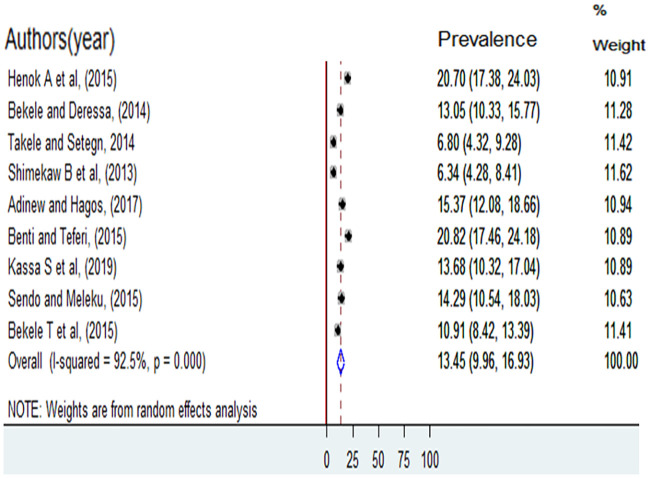
Prevalence of completed rape among female students at higher education institution of Ethiopia, 2012 to 2018.
Sub-group analysis
Subgroup analyses were also conducted by different study characteristics such as study setting, region, and study year to identify the source of heterogeneity however, the heterogeneity still exists. Thus, the heterogeneity may be explained by other factors not included in this review. The lifetime prevalence of sexual violence among college students and university students was 52.75 (95%CI: 35.90, 69.61) and 41.81 (95%CI: 36.34, 47.28) respectively. The lifetime prevalence of sexual violence in the Oromia region was 56.23 (95%CI: 38.53, 73.92) (Table 2).
| Subgroup | Number of studies | Total sample | Prevalence (95%CI) | Heterogeneity | |
|---|---|---|---|---|---|
| I2 | p-value | ||||
| By study setting | |||||
| University | 7 | 3362 | 52.75 (35.90, 69.61) | 99.2 | < 0.001 |
| College | 3 | 2428 | 41.81 (36.34, 47.28) | 85.7 | 0.001 |
| By region | |||||
| Amhara | 2 | 938 | 48.47 (26.53, 70.41) | 97.9 | < 0.001 |
| Oromia | 4 | 2154 | 56.23 (38.53, 73.92) | 98.7 | < 0.001 |
| SNNPR | 4 | 2698 | 43.09 (22.96, 63.22) | 99.2 | < 0.001 |
| By study year | |||||
| Before 2015 | 8 | 4926 | 48.63 (34.73, 62.54) | 99.1 | < 0.001 |
| 2015 and above | 2 | 864 | 52.56 (38.59, 66.52) | 94.4 | < 0.001 |
| Total | 10 | 5790 | 49.42 (37.87, 60.96) | 98.9 | < 0.001 |
SNNPR- southern nations, nationalities, and people’s region.
Predictors of sexual violence
There were five predictors frequently reported by the studies included in the review. These predictors were place of residence, alcohol drinking, ever had a boyfriend, ever witnessed maternal violence, and having multiple sexual partners. Out of these predictors, ever witnessed maternal violence had a positive significant association in all studies [5, 7, 11, 13, 17] reported it. Thus, the factors included in this analysis were the place of residence, alcohol drinking, ever had a boyfriend, and having multiple sexual partners. A separate analysis was conducted for each variable. A total of five articles [5, 11, 13–15] were included to determine the association between place of residence and sexual violence. Four of the included studies found a positive significant association, the rest showed a negative association. The final pooled meta-analysis showed that the odds of experiencing sexual violence among female students who resided in rural areas were 2.1 times higher than female students who lived in urban areas, OR = 2.13 (95%CI: 1.33, 3.42) (Fig 6).
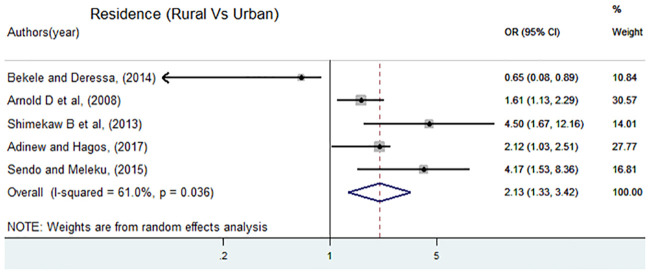
Forest plot of odds ratio for the association of residence and sexual violence in Ethiopia.
A total of six articles [5–7, 11, 12, 17] were included to assess the effect of alcohol drinking and sexual violence. Four of the included studies had a positive significant association and the other two studies showed a non-significant association. The pooled meta-analysis showed that the odds of experiencing sexual violence among female students who drank alcohol were two times higher than female students who were never drinking alcohol, OR = 2.03 (95%CI: 1.44, 2.87) (Fig 7).
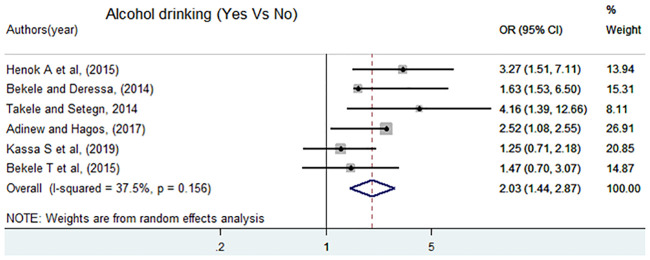
Forest plot of odds ratio for the association of alcohol drinking and sexual violence in Ethiopia.
Similarly, seven studies [5, 7, 11, 12, 14, 16, 17] were included to assess the association of ever had a boyfriend and sexual violence. From these, three studies had a positive significant association with sexual violence, and four studies showed a non-significant association. However, the pooled meta-analysis showed that female students who ever had boyfriend had higher odds of experiencing sexual violence than female students who do not have boyfriends, OR = 2.07 (95%CI: 1.32, 3.62) (Fig 8).
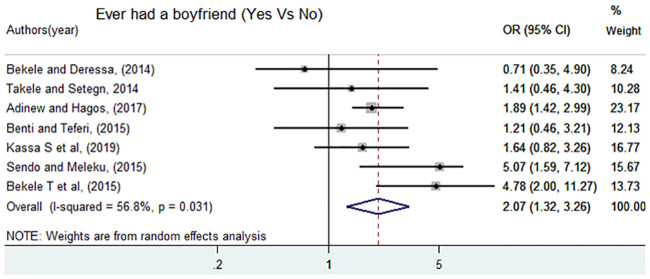
Forest plot of odds ratio for the association of ever had a boyfriend and sexual violence in Ethiopia.
Additionally, three articles [5, 15, 16] were included to assess the association of having multiple sexual partner and sexual violence. Out of these, two studies had a non significant association with sexual violence, and the rest showed a positive significant association. The pooled meta-analysis also showed a non significant association OR = 2.09 (95%CI: 0.95, 4.63) (Fig 9).
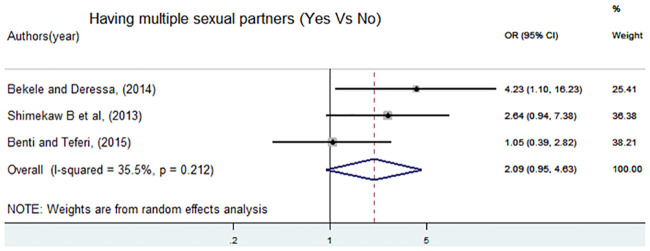
Forest plot of odds ratio for the association of having multiple sexual partner and sexual violence in Ethiopia.
Discussion
This systematic review and meta-analysis were conducted to estimate the prevalence and determinants of sexual violence among female students at higher education institutions in Ethiopia. The pooled lifetime prevalence of sexual violence among higher education institution female students in Ethiopia is 49.4% (95%CI: 37.87, 60.96). This finding is much higher as compared to 26.22% in Sub-Saharan Africa [3], 15.3% in China [48], and 15.0%-19.2% among reviews conducted worldwide [49–51]. This might be due to a difference in the study population. In this review, the study populations are university and college students. However, study populations in the review conducted in Sub-Saharan Africa were secondary school, and college and university students. The study populations among reviews conducted in China and the world were also adolescents less than 18 years old. The other possible reason might be there is weak law enforcement and gender in equality in Ethiopia compared with China and other countries included in the review [52]. The finding of this review shows how much it is too far to achieve global and national commitment to end violence against women [1, 38, 39]. Thus, it urges the government and other concerned bodies to invest their effort to address the problem of sexual violence at higher education institutions.
The lifetime prevalence of sexual violence among university female students was higher than college students. This might be due to university students live in the campus with full independence without family control, but most of the college students live with their family or a town near to their family with close monitoring and support. Furthermore, the presence of night clubs, pubs, pimps, and other substance-related business houses surrounding the universities make female students highly vulnerable to sexual violence compared to female students in the colleges [8].
Female students who reside in rural areas were more likely to experience sexual violence than those who live in urban areas. This finding is similar to a review in Sub-Saharan Africa [3]. This might be due to rampant harmful beliefs and traditions, inadequate legal provisions, inaccessibility of legal services, unequal power relationships, and low level of awareness on sexual violence in rural areas [53–55]. Female students from the rural areas may also live far from their family in the dormitory which increases the possibility of being victimized by sexual violence.
The pooled odds of experiencing sexual violence among female students who drink alcohol were higher than female students who never drink alcohol. Other systematic reviews also found similar findings [3, 25, 56]. The reason for this could be alcohol use can alter the level of consciousness and problem-solving skill. Alcohol also increases one’s willingness to take risks, making individuals less aware of and concerned by the consequences of their behavior [57–59].
Female students who ever had boyfriend had higher odds of experiencing sexual violence than female students who did not have boyfriends. Females who had boyfriend trust their friend and spent much time with them in more risky places such as night clubs, couple houses, and substance houses that make them vulnerable to sexual violence. As evidenced by different studies sexual violence is most frequently perpetrated by intimate partners (boyfriends or husbands) [60]. Moreover, those students whoever had a boyfriend may be influenced by peers to be victimized by sexual violence.
The PRISMA guideline was strictly followed throughout all steps of the systematic review and meta-analysis. However, all articles included in this review were cross-sectional, which limits the causality of predictors on sexual violence. Since variables associated with sexual violence were reported in a few studies; this review assessed only three factors affecting sexual violence. However, sexual violence could be affected by many factors such as behavioral, environmental, institutional, socioeconomic, and cultural factors.
Conclusions
Almost half of the female students had experienced sexual violence in Ethiopia. Being rural residents, alcohol drinking, and ever had a boy friend were found to be associated with sexual violence. The governments and relevant stakeholders should develop and implement effective educational institution based interventions to address sexual violence against female students in higher education institutions. Implementation of laws that control alcohol consumption is also crucial. Moreover, the institutions of higher education curricula should be revised to reflect gender equality. More focused interventions should be given for rural areas. Researchers should also assess other factors (i.e behavioral, environmental, institutional, socioeconomic, and cultural factors) that could affect sexual violence against female university students.
Acknowledgements
The authors would like to acknowledge Wollo University for providing an office and free internet access.
Abbreviations
| AOR | Adjusted Odds Ratio |
| CI | Confidence Interval |
| EDHS | Ethiopian Demographic and Health Survey |
| JBI | Joanna Briggs Institute |
| SDG | Sustainable Development Goal |
| SNNRR | Southern Nations, Nationalities, and People’s Region |
| WHO | World Health Organization |
References
1
2
3
4
5
6
7
8
9
10
11
12
13
14
15
16
17
18
19
20
21
22
23
24
25
26
27
28
29
30
31
32
33
34
35
36
37
38
39
40
41
42
43
44
45
46
47
48
49
50
51
52
53
54
55
56
57
58
59
60