
Competing Interests: The authors have declared that no competing interests exist.
The main goal of the current paper is to contribute to the existing literature of probability distributions. In this paper, a new probability distribution is generated by using the Alpha Power Family of distributions with the aim to model the data with non-monotonic failure rates and provides a better fit. The proposed distribution is called Alpha Power Exponentiated Inverse Rayleigh or in short APEIR distribution. Various statistical properties have been investigated including they are the order statistics, moments, residual life function, mean waiting time, quantiles, entropy, and stress-strength parameter. To estimate the parameters of the proposed distribution, the maximum likelihood method is employed. It has been proved theoretically that the proposed distribution provides a better fit to the data with monotonic as well as non-monotonic hazard rate shapes. Moreover, two real data sets are used to evaluate the significance and flexibility of the proposed distribution as compared to other probability distributions.
In statistical theory, the development of new distributions has become a common practice in recent decades; this is done generally by adding an extra parameter [1] to the baseline distribution, using generators [2, 3], or by combining two distributions [4]. Ramadan and Magdy [5] produced a new probability distribution by applying the Inverse Weibull (IW) to the Alpha Power Family of distribution. Alzaatreh et al. [2] introduced T-X family of continuous distributions by interchanging the probability density function of any continuous random variable with the probability density function of Beta distribution. Lee et al. [3] developed a technique of generating single variable continuous distributions. Jones [6] applied the Beta distribution to the family of distribution presented by Eugene et al. [7].
The main purpose of such an amendment to the existing distributions is to model the real data both with monotonically and non-monotonically hazard rate functions. Secondly, to increase the model flexibility of the complex data structures as compared to existing probability distributions. Because the existing distribution has some limitations so model the complex data structures, for example, Exponential and Weibull distributions fail the real data following a non-monotonic failure rate functions.
In this aim of presenting the paper is to contribute a new probability distribution that will model the data with both monotonically and non-monotonically hazard rate functions. The proposed model will also increase the model flexibility as compared to other models.
In the Recent past, Mahdavi and Kundu [8] suggested a new technique, called Alpha Power Transformation (APT), for including an additional parameter in the life time distributions. The primary purpose of this family was to utilize the non-symmetrical behavior of the parent distribution. The Alpha Power Transformation is defined by
Let X is a continuous random variable with F(x) as Cumulative Distribution Function, the Cumulative Distribution Function of Alpha Power Transformation is as follows;
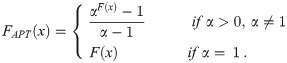
The associated Probability density function is given below
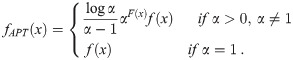
The Alpha Power transformation has been used by many researchers, for example, Dey et.al [9] explored the new probability distributions by applying the Exponential and Rayleigh distribution to the Alpha Power Family of distributions. By using the same Transformation Nassar et al. [10] produced Alpha Power Weibull distribution, Alpha Power Inverse Weibull distribution was produced by Ramadan and Magdy [5], Alpha Power Transformed Extended Exponential distribution by Hassan et al [11].
The main aim of the paper is to produce a new probability distribution by using the Alpha Power family of distribution. In this paper, we considered the Exponentiated Inverse Rayleigh distribution as a baseline distribution presented by Rehman and Sajjad [12]. The Exponentiated Inverse Rayleigh distribution is the extension of the Inverse Rayleigh distribution presented by Voda [13]. He discussed various statistical properties such as moment generating function, survival function, and order statistics. A random variable X is said to be Inverse Rayleigh if it possesses the following Pdf and Cdf
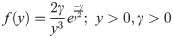

The Exponentiated Inverse Rayleigh (EIR) distribution has the following pdf and cdf;
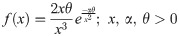

The current study is linked with the introduction of a novel distribution which is stated as Alpha Power Exponentiated Inverse Rayleigh (APEIR) distribution. Various statistical properties of the APEIR distribution are studied such as quantile function, median, mode, moment generating function and rth moment, order statistics, mean residual life function, and stress strength parameter are obtained and discussed. Furthermore, an expression for the Renyi entropy and for the Mean Waiting Time has been explored. The estimation of the parameters is done by using the maximum likelihood. In order to prove the flexibility of the model, we considered the application by using two real data sets as well as simulated data.
By applying the cumulative distribution function of the Exponentiated inverse Rayleigh distribution to the ALPF, we obtained the following Cdf and Pdf for the APEIR and is given by
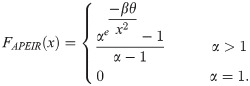
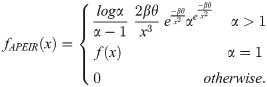
Fig 1 reflects the graphical structure of the CDF of APEIR with various parameter values.

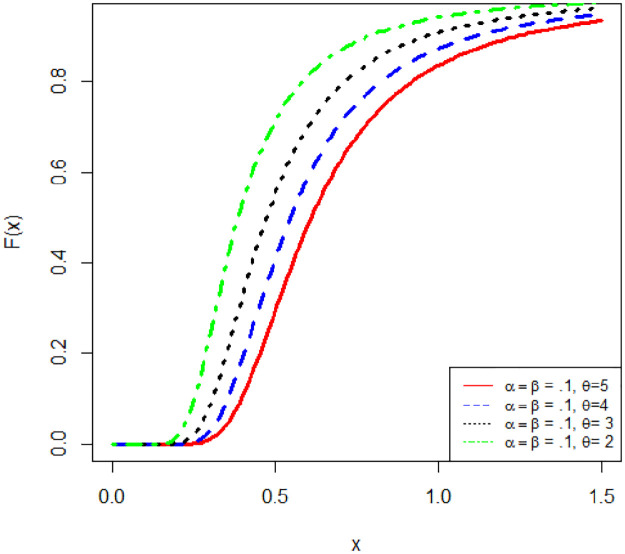
Graph of CDF of APEIR distribution.
The hazard and survival function corresponding to the probability density function are as follows
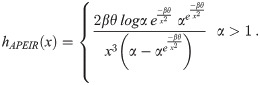
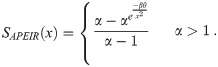
Fig 2 shows the hazard rate function and survival function of APEIR distribution with various values of parameters. Clearly, the hazard rate function of APEIR distribution is unimodal and positively skewed for α > 1.
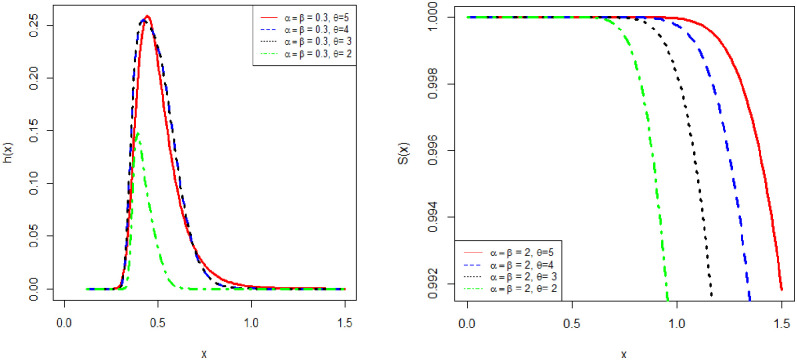
Graph of and hazard rate and survival function of APEIR distribution.
Lemma 1: If α < 1 then f(x) is a decreasing function, this implies that fAPEIR(x) is decreasing function.
Proof: If f(x) is a differentiable function and if its first order derivative or for x in (α, β, θ) then f(x) is a decreasing function and vice versa.
Taking the first derivative of logfAPEIR(x) i.e.

For α < 1, β and θ > 0, which show that
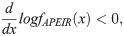
Hence fAPEIR(x) is a decreasing function.
Lemma 2: If α < 1 and f(x) is decreasing function so f(x) is log-convex hence hAPEIR(x) is decreasing function.
Proof: If the second order derivative of f(x) exists and f"(x) > 0 or , then f(x) is said to be log-convex.
Taking second order derivative of Eq (11), we get

0 < α < 1, β and θ > 0
Then .
Therefore fAPEIR(x) is log-convex.
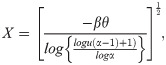
Let X ∼APEIR (α β, θ) then its Quantile function is given below;
where u is uniformly distributed. The Quantile function of APEIR distribution is
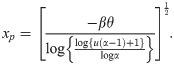
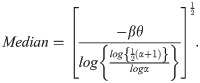
Median of APEIR distribution is obtained by substituting u = 1/2 in Eq (13), we get
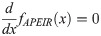
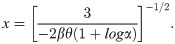
Mode of APEIR distribution is that point by which the distribution reaches its maximum point and it is obtained by solving the following equation
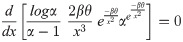
We finally, obtained the result
Let X ∼APEIR (α β, θ), then the expression of its rth moment is as follows;

Using y = x−2 and series notation and , we get the final result as

Let X ~ APEIR(α, β, θ) then the expression for its MGF is as follows;

Using y = x−2, and the series representation in Eq (18).
The MGF of APEIR distribution has the following form

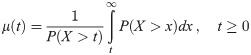
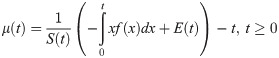
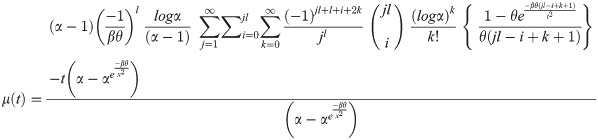
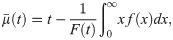
Let X be the survival time of an object having pdf “f(x)” and survival function specified in Eq (10), the mean residual life function is the average remaining lifespan, which is a component survived up to time t. The mean residual life function, say, μ(t) has the following expression.


Let X1, X2, X3, …, Xn be a random sample of size n from APEIR distribution and let X(1) ≤ X(2) ≤ … ≤ X(n) denote the order statistics. Let Xi:n denotes the ith order statistics, then the Probability Density function of Xi:n is given by



For largest order statistic insert i = n in Eq (25), we get

Put i = n /2 in Eq (25), to obtain the distribution of median, we have

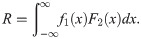
Let X1, X2 are independently and identically distributed variables such that X1 ~ APEIR(α1, θ1, β) and X2 ~ APEIR(α2, θ2, β) then its stress strength parameter has the following expression.


Lemma 3: Let X~ APEIR(α, θ, β), then its Renyi entropy is defined by

Proof: For APEIR distribution, Renyi entropy has the following expression;
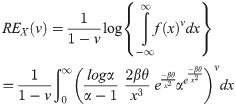
The result can be obtained easily by substituting
Lemma4: The Mean Waiting Time say of APEIR distribution is as follows;

Proof: For APEIR, the mean waiting time is given by
Let we have a random sample of size “n” from APEIR (α, β, θ), then their joint density function is as follows;





By solving (35), (36) and (37) all together, we get the estimates of α, β and θ. We can get the solution of the above equations by using methods like Newton Raphson method or Bisection method. ML Estimators follows asymptotically normally distribution, that is , ∑ is a matrix contains variability measures of the estimated parameters and computed from the following F matrix;
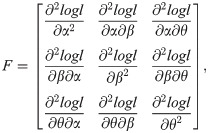



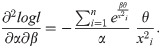
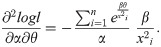

Large sample (1 − ζ)100% confidence interval for the suggested distribution parameters has the following expression;


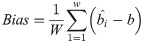
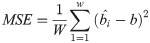
The parameter estimates of APEIR distribution, their Mean Square Error (MSE) as well as the bias measure are computed using a simulation study with 1000 replications each with a sample of size n = 30, 70, 130 and 170. A simulated data is generated from APEIR distribution using the following expression

| Parameter | n | MSE () | MSE () | MSE () | Bias () | Bias () | Bias () |
|---|---|---|---|---|---|---|---|
| α = 0.5 | 30 | 1.600291 | 0.140596 | 0.076240 | 0.296260 | 0.034060 | 0.029888 |
| β = 1.5 | 70 | 0.274669 | 0.080418 | 0.044591 | 0.093877 | 0.014399 | 0.012343 |
| θ = 2 | 130 | 0.148004 | 0.078995 | 0.043825 | 0.060626 | 0.004091 | 0.003544 |
| 170 | 0.079246 | 0.030490 | 0.017141 | 0.042915 | 0.003248 | 0.001590 | |
| α = 1.5 | 30 | 3.781425 | 0.234186 | 0.153185 | 0.367721 | 0.132582 | 0.112368 |
| β = 2 | 70 | 3.080643 | 0.101876 | 0.066932 | 0.338951 | 0.062667 | 0.052157 |
| θ = 2.5 | 130 | 1.926952 | 0.067971 | 0.038254 | 0.278251 | 0.026125 | 0.022521 |
| 170 | 0.741660 | 0.052949 | 0.037985 | 0.115542 | 0.021330 | 0.018270 | |
| α = 0.5 | 30 | 1.088054 | 0.066637 | 0.031088 | 0.231466 | 0.029975 | 0.022030 |
| β = 1 | 70 | 0.459863 | 0.038682 | 0.008550 | 0.104862 | 0.018523 | 0.013168 |
| θ = 1.5 | 130 | 0.180847 | 0.027694 | 0.006936 | 0.063190 | 0.003021 | 0.002425 |
| 170 | 0.163698 | 0.015616 | 0.004694 | 0.049297 | 0.002392 | 0.000973 | |
| α = 0.5 | 30 | 1.614823 | 0.195070 | 0.138455 | 0.306416 | 0.068536 | 0.062257 |
| β = 2.5 | 70 | 0.351019 | 0.114477 | 0.079823 | 0.104602 | 0.032169 | 0.028678 |
| θ = 3 | 130 | 0.179059 | 0.107070 | 0.078002 | 0.064438 | 0.006292 | 0.005975 |
| 170 | 0.163570 | 0.066727 | 0.046419 | 0.051060 | 0.006192 | 0.005712 |
In this section, we provide two applications of the proposed distribution to the lifetime data. The performance of the suggested model is checked by the goodness of fit criteria including they are the AIC, CAIC, BIC, HQIC, and the P-value. For more details of the goodness of fit criteria, we refer to see [14–19]. In general, with fever values of these statistics, a probability model would perform better than others. The proposed model is compared with Exponentiated Inverse Rayleigh distribution by Rehman and Sajjad [12], Weibull Rayleigh distribution by Merovci and Elbatal [20], Generalized Rayleigh distribution by Raqab and Madi [21], two parameter Rayleigh distribution by Dey et.al [22], Transmuted inverse Rayleigh distribution by Afaq et al [23] and modified inverse Rayleigh distribution by Muhammad [24]. The probability functions of these distributions are given by
Exponentiated Inverse Rayleigh Distribution

Weibull Rayleigh (WR) Distribution

Generalized Rayleigh (GR) Distribution

Two Parameter Rayleigh (TPR) Distribution

Modified Inverse Rayleigh Distribution.

Transmuted Inverse Rayleigh Distribution.

Patients receiving an analgesic. The data set is taken from Gross and Clark [25] which consists of 20 observations of patients receiving an analgesic. The values are as follows

Table 2 describes the parameter values of the probability models and also describes the goodness of fit measures. It is evident that the goodness of fit measures has fever values for the proposed model and hence it is concluded that the proposed model increased the flexibility of the model.
| Distribution | MLE | AIC | CAIC | BIC | HQIC | p-value | ||
|---|---|---|---|---|---|---|---|---|
| APEIR | 0.0041 | 0.7964 | 7.8595 | 37.2560 | 38.7560 | 40.2432 | 37.8391 | 0.1205 |
| EIR | 0.8714 | 3.1686 | 46.3650 | 47.0709 | 48.3564 | 46.7537 | 0.1435 | |
| WR | 11.8552 | 1.2364 | 0.0545 | 48.5149 | 50.0149 | 51.5021 | 49.0980 | 0.4597 |
| GR | 3.2748 | 0.6926 | 40.8050 | 41.5109 | 42.7965 | 41.1938 | 0.4630 | |
| TPR | 0.6225 | 0.8352 | 39.6164 | 40.3223 | 41.6078 | 40.0051 | 0.3397 | |
In Fig 4, the histogram represents the theoretical densities of the Alpha Power Exponentiated Inverse Rayleigh (APEIR), Two Parameter Rayleigh (TPR) and Exponentiated Inverse Rayleigh (EIR) by continuous red color line, dotted blue line and dotted green line respectively. It is evident from the above figure that the Alpha Power Exponentiated Inverse Rayleigh (APEIR) is leptokurtic and positively skewed as compared to other densities. Furthermore, the graph suggests that the Alpha Power Exponentiated Inverse Rayleigh (APEIR) distribution is less thick as compared to Two Parameter Rayleigh (TPR) distribution and thicker than Exponentiated Inverse Rayleigh (EIR) in the tail.
If the plot of empirical against the theoretical CDFs is observed, then Alpha Power Exponentiated Inverse Rayleigh (APEIR) provides a better fit as compared to Exponentiated Inverse Rayleigh (EIR) and Two Parameter Rayleigh (TPR). Fig 3 describes the comparison of the proposed against other existing distributions. Fig 4 describes the PP-plot, QQ-plot, empirical and theoretical densities of Alpha Power Exponentiated Inverse Rayleigh (APEIR).
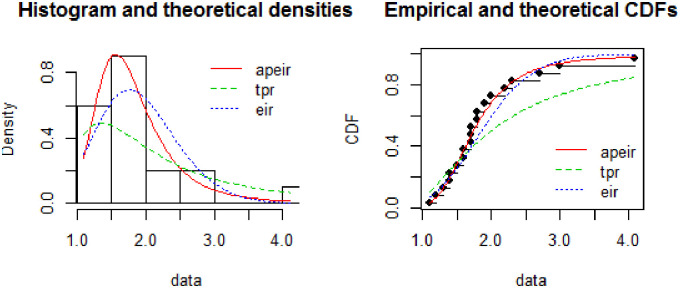
Comparison between fitted distributions for data set 1.
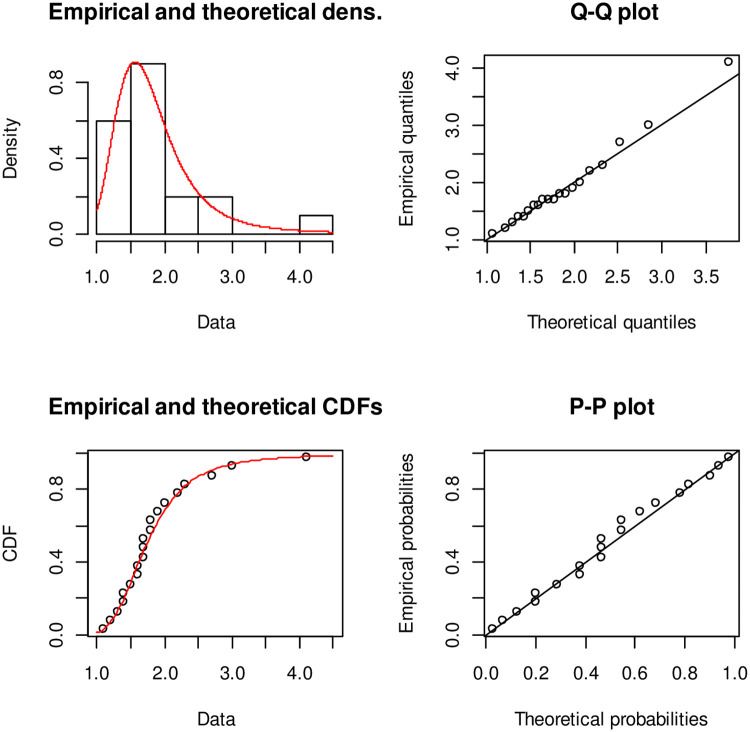
Probability density function, Q-Q plot, distribution function and P-P plot for data set 1.
Rainfall. The second data set consists of thirty observations for the rainfall (in inches) of March in Minneapolis/St Paul [19]. The values are as follows

Table 3 describes the MLE of the probability models and describe the goodness of fit measures. Again, it is concluded that by increasing another parameter, we get a more significant result as compared to others.
| Distribution | MLE | AIC | CAIC | BIC | HQIC | p-value | ||
|---|---|---|---|---|---|---|---|---|
| APEIR | 13.7590 | 7.8802 | 0.0585 | 87.1186 | 88.0417 | 91.3222 | 88.4634 | 0.1031 |
| EIR | 0.7668 | 1.1201 | 92.2730 | 92.7175 | 95.0754 | 93.1695 | 0.0638 | |
| TIR | 0.6306 | 0.6674 | 88.2024 | 88.6469 | 91.0048 | 89.0989 | 0.2779 | |
| MIR | 0.36016 | 0.5895 | 91.2599 | 91.7044 | 94.0624 | 92.15651 | 0.2698 | |
Fig 5 describe the theoretical densities of Alpha Power Exponentiated Inverse Rayleigh (APEIR), Transmuted Inverse Rayleigh (TIR) and Exponentiated Inverse Rayleigh (EIR) by continuous red color line, dotted blue line and dotted green line respectively. Fig 5 clarify that Alpha Power Exponentiated Inverse Rayleigh (APEIR) is positively skewed. Moreover, the empirical and theoretical densities demonstrate that the Alpha Power Exponentiated Inverse Rayleigh (APEIR) provides a better fit to this data. Fig 6 describes the PP-plot, QQ-plot, empirical and theoretical densities of Alpha Power Exponentiated Inverse Rayleigh (APEIR).
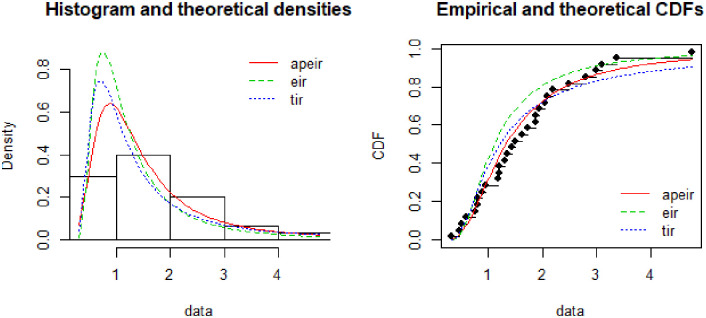
Comparison between fitted distributions for data set 2.
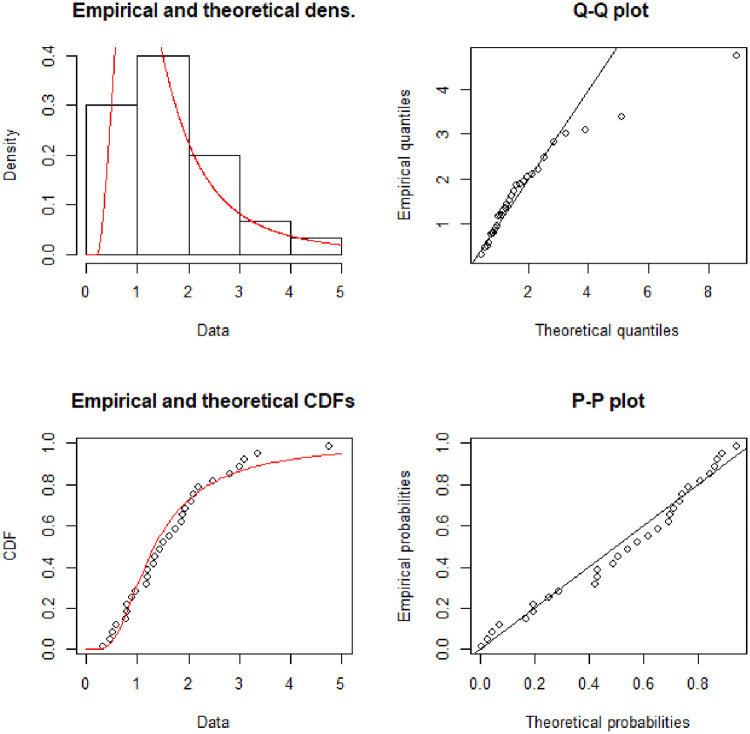
Probability density function, Q-Q plot, distribution function and P-P plot for data set 2.
The paper presents a new probability distribution called Alpha Power Exponentiated Inverse Rayleigh (APEIR) distribution. The objective of the proposed distribution is to model the data with both monotonic and non-monotonic hazard rate shapes. The proposed distribution is of keen interest due its desirable properties. To estimate the parameters of the new distribution, Maximum likelihood estimation procedure is used. Furthermore, to evaluate the performance of the proposed distribution, it was fitted to two real data sets. The results showed that the new distribution provides a better fit to these data sets as compared to other versions of the Rayleigh distributions. Future researchers may derive new flexible distributions by using transmutation technique, or by increasing the scale or shape parameter to the proposed distributions in this paper. Further one can study the Bayesian analysis by choosing informative and non-informative priors.
I would appreciate and thank the referees for their comments and further suggestions so that to improve the paper further.
1
2
3
4
5
6
7
8
9
10
11
12
13
14
15
16
17
18
19
20
21
22
23
24
25
 Alpha-Power Exponentiated Inverse Rayleigh distribution and its applications to real and simulated data
 Facebook
 Twitter
 Linkedin
 Whatsapp

