
Beverly (Bev) Law is a professor emeritus at Oregon State University where she studies terrestrial ecosystem processes and global change ecology. She is a Clarivate Analytics Highly Cited Researcher and served as a Journal Editor for Global Change Biology for 8 years. She received her PhD in forest science at Oregon State University under Dr. Richard Waring.
Multiple influences set me on track to become a scientist—my parents provided an outdoor environment to explore freely and National Geographic for our reading, my grandfather taught us about nature, and I had influential professors in my undergraduate program. My early years were idyllic, living on Lake Minnetonka, Minnesota, and having the freedom to explore the lake and woods for hours on end. My grandfather, Reuben Walter Law, was my mentor. As a self‐made naturalist, superintendent of Minnesota state forests, and a landscape architect, he had the foresight to promote urban parks in the twin cities before it closed in. He designed green spaces for people to enjoy and stay connected to nature. He would take me on walks in his woods, teach me bird sounds and how nutrient cycling and water perpetuated forests in terms that a child could understand. He was an intelligent, deep thinker who lived to 106 and influenced my thinking throughout my life. Our family moved to Florida in the 1960s and I discovered coral reefs. My brother and I sailed, surfed, and went free‐diving together, sitting on the bottom to watch tropical fish, manatees, and sharks. I saw university research boats going to the outer reefs when I was diving, and knew that's what I wanted to do for a living. Marine biology and forest ecology were my interests when I started college, but Kathy Ewel's class on ecological modeling sold me on forest ecology.
I have always been an avid reader, and gravitated toward books and articles related to global change, starting with book authors such as Rachel Carson and Sigurd F. Olson, a friend of my grandfather's. I realized in the 1970s that we had a problem with CO2 emissions. It was reinforced by my research that required development of a homemade conifer chamber for the LiCor photosynthesis system that was designed for agricultural crops when I discovered the ambient CO2 spikes that I was seeing while testing the chamber were due to cars idling at a traffic light. During my PhD, I started out in ecophysiology and used models, satellite data, and observations to estimate forest productivity in response to environment. I wanted to lead a research organization, and felt that if I could build a dynamite group, we could answer many of the pressing global change questions that were arising about what it is going to be like in the future if we don't change, and how we could come up feasible solutions to a achieve a better future.
I've had a lot of ah‐ha moments, I just can't remember them all. They seemed important at the time. The first one was my early experience with the CO2 spikes observed with the LiCor photosynthesis system. Climate change and its impacts keep me awake at night, and I am constantly looking for solutions. A recent ah‐ha moment was I think we need to establish a National Strategic Carbon Reserve in mature and old forests to continue to store massive amounts of carbon and benefit biodiversity and watersheds for climate resilience.
Figure out who you want to be and what you want to do, and go for it. Know what tools you need to do it and take the classes you need to master them, even if they aren't required, and find other learning opportunities to fill out skills. Think out of the box and think big. Because the outdoors was my world, I was usually the only woman with a group of guys on trips in the outback. As a competitive swimmer, I was the only woman swimming with the boy's team and I was the captain of our women's water polo team where my role was to call the shots. I was and still am quite comfortable being outnumbered, and haven't let it stop me from pursuing my goals. Don't let the fact that you are different stop you from being what you want to be and doing what you want to do. Realize you have a contribution to make to the world and this is your chance. Times get tough, but keep charging ahead. When that passes, you realize it really wasn't such a big deal. Don't let your own mind betray your dreams and goals. When challenged by those who aim to undermine you, take the moral high ground and don't give up. If you say you are going to do something, follow through and don't leave people hanging. Your integrity and respectfulness are some of your most important characteristics that you need to be mindful of throughout your career, starting now.
My favorite article from our TERRA‐PNW (Terrestrial Ecosystem Research and Regional Analysis—Pacific Northwest) research group at Oregon State University is the recent one lead by my former post‐doc, Polly Buotte (Buotte et al., 2019). It was a key study that combined observations and land system modeling to determine where forests are most vulnerable to mortality from drought and fire under future climate conditions in the lower 48 western US states. We found a way to push the model as far as possible for regional applications with our observation‐driven modeling and modifications. It is a critical step for identifying appropriate climate mitigation and adaptation strategies, depending on future response of different forests to climate.
I frequently cite many other Global Change Biology papers on biodiversity, forests, carbon, and climate change, such as Reichstein et al.'s, 2007 joint flux tower, remote sensing, and modeling analysis and Baldocchi's, 2003 pioneering paper on the eddy covariance method.
Just one? John Muir. I would love to have been around the campfire when his conversations with Teddy Roosevelt prompted TDR to conserve America's forests and its wilderness areas, as they were beginning to disappear. That was unimaginable to many at the time. In the few (well, 6+) decades of my life, I have seen great changes, having lived close to nature most of my life—ocean reefs, birds, and butterflies disappearing, and noticeable increase in human population (2.8 billion when I was born to 7.8 billion now). Some of John Muir's quotes are worth hearing in person.
I have spent a lot of time in the wilderness, not just staring at a computer. I took month‐long ski‐camping trips into Yellowstone, the Rockies and Bitterroots, and month‐long canoe trips from northern Minnesota into the Quetico in autumn. I dove on many reefs around the world, and my work took me to places I only dreamed of visiting. Those long trips are enlightening and humbling experiences. You learn a lot about animal behavior when you are staying still watching them for hours and days. Memorable experiences include the sound of a bison peeing on my tent in Yellowstone, and an African sunset in a bird blind hearing a lion's roar that made my whole body vibrate and hair stand on end thinking “I'm prey.” And the joy of about 50 dolphin swirling around me as I was coming up from a deep free‐dive in a New Zealand bay. Seeing these first hand is special, but just knowing they are there is enough. I have great reverence and respect for nature and that is what drives me to protect it. I hope the next generation of PhDs will hold many who will join me and carry the torch.
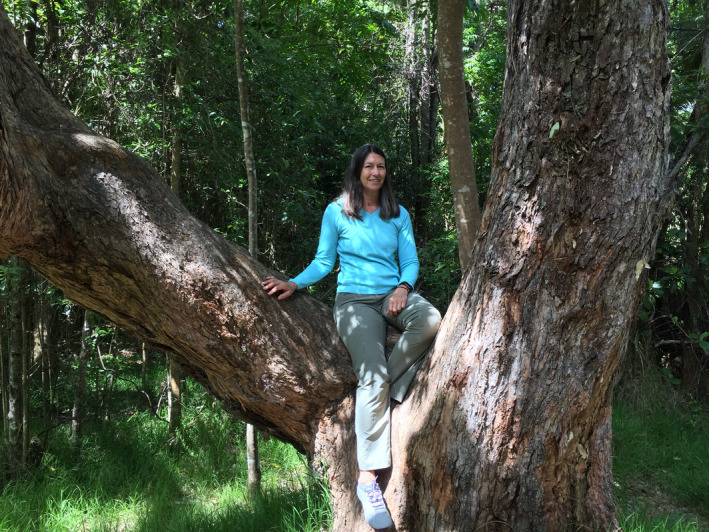
Image: Bev sits atop a huge Koa tree on the Island of Hawaii.
There is no data available.
 Researcher profile: Beverly Law
 Facebook
 Twitter
 Linkedin
 Whatsapp

