 Few Fixed Variants between Trophic Specialist Pupfish Species Reveal Candidate Cis-Regulatory Alleles Underlying Rapid Craniofacial Divergence
Molecular Biology and Evolution



- Altmetric
Investigating closely related species that rapidly evolved divergent feeding morphology is a powerful approach to identify genetic variation underlying variation in complex traits. This can also lead to the discovery of novel candidate genes influencing natural and clinical variation in human craniofacial phenotypes. We combined whole-genome resequencing of 258 individuals with 50 transcriptomes to identify candidate cis-acting genetic variation underlying rapidly evolving craniofacial phenotypes within an adaptive radiation of Cyprinodon pupfishes. This radiation consists of a dietary generalist species and two derived trophic niche specialists—a molluscivore and a scale-eating species. Despite extensive morphological divergence, these species only diverged 10 kya and produce fertile hybrids in the laboratory. Out of 9.3 million genome-wide SNPs and 80,012 structural variants, we found very few alleles fixed between species—only 157 SNPs and 87 deletions. Comparing gene expression across 38 purebred F1 offspring sampled at three early developmental stages, we identified 17 fixed variants within 10 kb of 12 genes that were highly differentially expressed between species. By measuring allele-specific expression in F1 hybrids from multiple crosses, we found that the majority of expression divergence between species was explained by trans-regulatory mechanisms. We also found strong evidence for two cis-regulatory alleles affecting expression divergence of two genes with putative effects on skeletal development (dync2li1 and pycr3). These results suggest that SNPs and structural variants contribute to the evolution of novel traits and highlight the utility of the San Salvador Island pupfish system as an evolutionary model for craniofacial development.
Introduction
Developing a mechanistic understanding of genetic variation contributing to variation in complex craniofacial traits is a major goal of both basic and translational research. This involves identifying genetic variants influencing natural morphological diversity as well as craniofacial anomalies, which account for approximately one-third of all birth defects (Gorlin et al. 1990). It is now understood that much of the natural and clinical variation in complex traits like craniofacial morphology results from interactions among hundreds to thousands of loci across the genome (Boyle et al. 2017; Sella and Barton 2019). Genome-wide association studies (GWAS) have shown that the vast majority of genetic variants affecting complex traits and diseases are within noncoding regions, highlighting the importance of gene regulation influencing trait variation (Hindorff et al. 2009; Maurano et al. 2012; Schaub et al. 2012). However, much of what is currently known about the developmental genetic basis of craniofacial diversity comes from mutagenesis screens and loss of function experiments in model organisms. These types of experiments are biased to detect alleles within protein-coding regions that severely disrupt gene function and are likely to cause lethality at early developmental stages (Nguyen and Xu 2008; Hall 2009). Thus, complementary approaches to mutagenesis screens are necessary to identify genes that influence craniofacial phenotypes at later stages in development though changes in gene regulation rather than gene function.
One such approach is to harness naturally occurring genetic variation between “evolutionary mutants”—closely related species exhibiting divergent phenotypes that mimic human disease phenotypes (Albertson et al. 2008). Several fish systems have been particularly useful as models for craniofacial developmental disorders because closely related species are often distinguished by differences in morphological traits important for trophic niche specialization, such as the shape and dynamics of jaws and pharyngeal elements (Albertson et al. 2008; Schartl 2014; Powder and Albertson 2016). The process of identifying candidate genes and validating their effect on phenotypic divergence in evolutionary mutants typically involves population genomic analyses, gene expression analyses, GWAS, and functional validation experiments (Bono et al. 2015; Kratochwil and Meyer 2015). Using a combination of these approaches, research in fish systems has shown that the evolution of adaptive craniofacial traits often involve orthologs of genes implicated in human disorders (Albertson et al. 2005; Helms et al. 2005; Roberts et al. 2011; Ahi et al. 2014; Cleves et al. 2014; Lencer et al. 2017; Erickson et al. 2018; Gross and Powers 2018; Martin et al. 2019). Therefore, candidate genes identified in evolutionary mutant models that have orthologs with uncharacterized functions in humans warrant further study into their relationship with development and disease.
Measuring relative and absolute genetic differentiation (estimated as Fst and Dxy) between species can reveal diverged regions of the genome that may influence trait development, but these statistics alone are insufficient to identify genetic mechanisms underlying evolutionary mutant phenotypes (Nachman and Payseur 2012; Cruickshank and Hahn 2014). RNA sequencing across multiple developmental stages and tissue types can provide further evidence that differentiated regions influence phenotypic divergence if genes near genetic variants are differentially expressed between species (Bernatchez et al. 2010; Poelstra et al. 2014; McGirr and Martin 2018; Verta and Jones 2019). However, this assumes that linked genetic variation within cis-acting regulatory elements affects proximal gene expression levels, and does not rule out the possibility of unlinked trans-acting regulatory variation binding regulatory regions to influence expression levels (Wittkopp and Kalay 2012; Signor and Nuzhdin 2018).
It is possible to use RNAseq to identify mechanisms of gene expression divergence between parental species by bringing cis elements from both parents together in the same trans environment in F1 hybrids and quantifying allele-specific expression (ASE) of parental alleles at heterozygous sites (Cowles et al. 2002; Wittkopp et al. 2004; Signor and Nuzhdin 2018). Determining whether a candidate gene is differentially expressed due to cis- or trans-regulatory divergence is important to identify putatively causal alleles that can be further validated by genome editing or transgenesis experiments. Furthermore, this type of analysis can reveal the relative contribution of cis- and trans- variation influencing genome-wide patterns of expression divergence. Some studies have found a larger contribution of cis-regulatory variation underlying expression divergence between species (Graze et al. 2009; Shi et al. 2012; Schaefke et al. 2013; Davidson and Balakrishnan 2016; Mack and Nachman 2017), whereas others have shown expression patterns dominated by trans-acting variation (Streisfeld and Rausher 2009; McManus et al. 2010; Hart et al. 2018). Overall, cis-acting alleles are generally thought to contribute more to interspecific divergence and show mostly additive inheritance, while trans-acting alleles are often more pleiotropic, contribute more to intraspecific divergence, and show nonadditive inheritance (Prud’homme et al. 2007; Lemos et al. 2008; Signor and Nuzhdin 2018).
Here, we combine whole-genome resequencing, RNAseq, and F1 hybrid ASE analyses to identify regulatory mechanisms influencing rapidly evolving craniofacial phenotypes within an adaptive radiation of Cyprinodon pupfishes on San Salvador Island, Bahamas (fig. 1). This sympatric radiation consists of a dietary generalist species (C. variegatus) and two endemic specialist species adapted to novel trophic niches—a molluscivore (C. brontotheroides) and a scale-eater (C. desquamator; Martin and Wainwright 2013a). Nearly all 49 pupfish species in the genus Cyprinodon distributed across North America and the Caribbean are dietary generalists with similar craniofacial morphology that is used for consuming algae and small invertebrates (fig. 1A; Martin and Wainwright 2011, 2013b). The molluscivore evolved short, thick oral jaws stabilized by a nearly immobile maxilla allowing it to specialize on hard-shelled prey including ostracods and gastropods (fig. 1B). This morphology results in a larger in-lever to out-lever ratio compared with generalists, increasing mechanical advantage for strong biting (Hernandez et al. 2018). The molluscivore is also characterized by a prominent maxillary anteriodorsal protrusion that may be used as a wedge for extracting snails from their shells (Martin et al. 2017; St. John et al. 2020a). The scale-eater is a predator that evolved to bite scales and protein-rich mucus removed from other pupfish species during rapid feeding strikes (fig. 1C;St. John et al. 2020b). Scale-eaters have greatly enlarged oral jaws, larger adductor mandibulae muscles, darker breeding coloration, and a more elongated body compared with the generalist and molluscivore species (Martin and Wainwright 2013a).

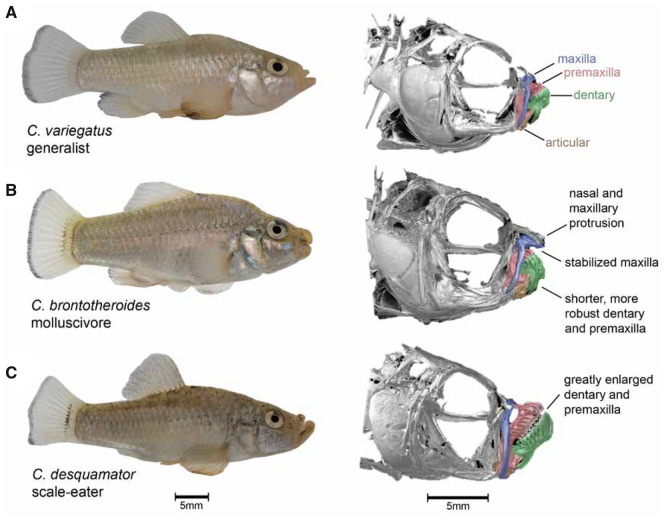
San Salvador Island pupfishes exhibit exceptional craniofacial divergence despite recent divergence times. (A) Cyprinodon variegatus (generalist), (B) C. brontotheroides (molluscivore), (C) C. desquamator (scale-eater). µCT scans modified from (Hernandez et al. 2018) show major craniofacial skeletal structures diverged among species including the maxilla (blue), premaxilla (red), dentary (green), and articular (brown).
Exceptional craniofacial divergence despite extremely recent divergence times and low genetic differentiation between molluscivores and scale-eaters make this system a compelling evolutionary model for human craniofacial developmental disorders. These trophic specialist species rapidly diverged from an ancestral generalist phenotype within the last 10–15 k years (Turner et al. 2008; Martin and Feinstein 2014). Molluscivores and scale-eaters readily hybridize in the laboratory to produce fertile F1 offspring with approximately intermediate craniofacial phenotypes between the parents and no obvious sex ratio distortion (Martin and Wainwright 2013b; Martin and Feinstein 2014). These species show evidence of premating isolation in the laboratory (West and Kodric-Brown 2015) and are genetically differentiated in sympatry (genome-wide mean Fst = 0.14 across 12 million SNPs; McGirr and Martin 2017).
We previously identified 31 genomic regions (20 kb) that contained SNPs fixed between species (Fst = 1), showed signs of a hard selective sweep, and were significantly associated with oral jaw size using multiple genome-wide association mapping approaches (McGirr and Martin 2017). A subset of these fixed SNPs fell within significant QTL explaining 15% of variation in oral jaw size and were near genes annotated for effects on skeletal system development (Martin et al. 2017). Here, we use complementary approaches to identify candidate causal variants putatively influencing craniofacial divergence by 1) incorporating transcriptomic data from 122 individuals sampled at three developmental stages (McGirr and Martin 2018, 2019), 2) applying genome divergence scans to a much larger sample of whole genomes from San Salvador Island and surrounding Caribbean outgroup populations (increasing n = 37–258) aligned to a new high-quality de novo genome assembly (Richards et al. 2020), 3) identifying structural variation fixed between species for the first time in this system, and 4) inferring cis- and trans-regulatory mechanisms underlying gene expression divergence between species using 12 F1 hybrid transcriptomes. Overall, we found that trans-regulatory divergence was responsible for more expression divergence between species than cis-regulatory mechanisms. We also identified two genes showing cis-regulatory divergence that were near just one fixed variant each: a deletion upstream of a gene known to influence skeletal development (dync2li1) and a SNP downstream of a novel skeletal candidate gene (pycr3). Our results highlight the utility of using these closely related species replicated across isolated lake populations as an evolutionary model for craniofacial development and provide highly promising candidate variants for future functional validation experiments.
Results
Few Fixed Variants between Young Species Showing Drastic Craniofacial Divergence
We analyzed whole-genome resequencing samples for 258 Cyprinodon pupfishes (median coverage = 8×; Richards et al. 2020). This included 114 individuals from multiple isolated lake populations on San Salvador Island (33 generalists, 46 molluscivores, and 35 scale-eaters) and 140 outgroup generalist pupfishes from across the Caribbean and North America. Libraries for 150PE Illumina sequencing were generated from DNA extracted from muscle tissue and the resulting reads were mapped to the C. brontotheroides reference genome (v 1.0; total sequence length = 1,162,855,435 bp; number of scaffolds = 15,698, scaffold N50, = 32,000,000 bp; L50 = 15 scaffolds; Richards et al. 2020). Variants were called using the Genome Analysis Toolkit (GATK v 3.5; DePristo et al. 2011) and filtered to include SNPs with a minor allele frequency above 0.05, genotype quality above 20, and sites with greater than 50% genotyping rate across all individuals.
Out of 9.3 million SNPs identified in our data set, we found a mere 157 SNPs fixed between molluscivore and scale-eater specialist species showing Fst = 1 (fig. 2A; mean genome-wide Fst = 0.076). Of these 157 variants, 46 were within 10 kb of 27 genes and none were in coding regions. These 27 genes were enriched for 27 biological processes (P < 0.05), including several ontologies describing neuronal development and activity of cell types within bone marrow (fig. 2B andsupplementary table S1, Supplementary Material online).
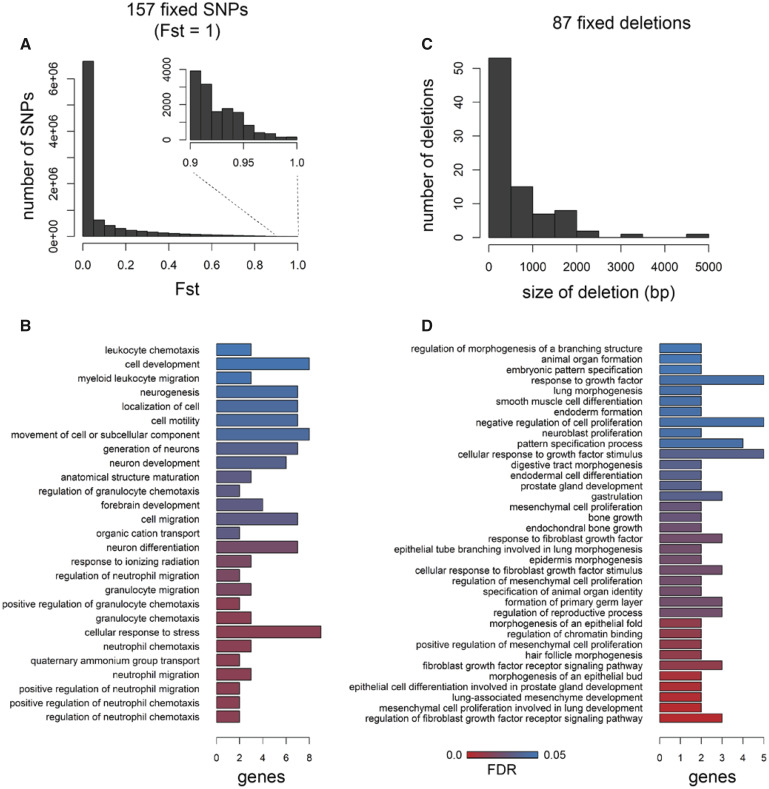
Very few SNPs and structural variants are fixed between trophic specialists. (A) Distribution of Weir and Cockerham Fst values across 9.3 million SNPs; 157 were fixed between species (Fst = 1). (B) Forty-six of the 157 SNPs were located near 27 genes that were enriched for 27 biological processes (FDR < 0.05). (C) Size distribution of the 87 deletions is fixed between species out of 80,012 structural variants. (D) Thirty-four of the 87 fixed deletions were within 10 kb of 34 genes that were enriched for 36 biological processes.
Structural variants (including insertions, deletions, inversions, translocations, and copy number variants) have been traditionally difficult to detect in nonmodel systems and ignored by many early whole-genome comparative studies (Stapley et al. 2010; Ho et al. 2019; Wellenreuther et al. 2019). We identified 80,012 structural variants across eight molluscivore and scale-eater individuals using a method that calls variants based on combined evidence from paired-end clustering and split read analysis (Rausch et al. 2012). Just 87 structural variants were fixed between species and, strikingly, all structural variants were deletions fixed in scale-eaters. This may reflect differences in the position of fitness optima between scale-eaters and molluscivores relative to the putative ancestral optimum. We expect larger effect mutations, such as deletions, to be more likely to fix in scale-eaters than molluscivores due to the more distant position of the fitness optimum for scale-eating (Martin et al. 2017). Differences in population size may also explain why all deletions are fixed in scale-eaters, which have a smaller effective population size than molluscivores (Richards and Martin 2017; Richards et al. 2020). These deletions ranged in size between 55 and 4,703 bp (fig. 2C). Of these, 34 fixed deletions were near 34 genes (supplementary table S1, Supplementary Material online). Only a single fixed deletion (1,256 bp) was found within a protein coding region, spanning the entire fifth exon of gpa33 (fig. 3). The 34 genes near fixed deletions were enriched for 36 biological processes (P < 0.05), including ontologies describing bone development, mesenchyme development, fibroblast growth, and digestive tract development (fig. 2D).
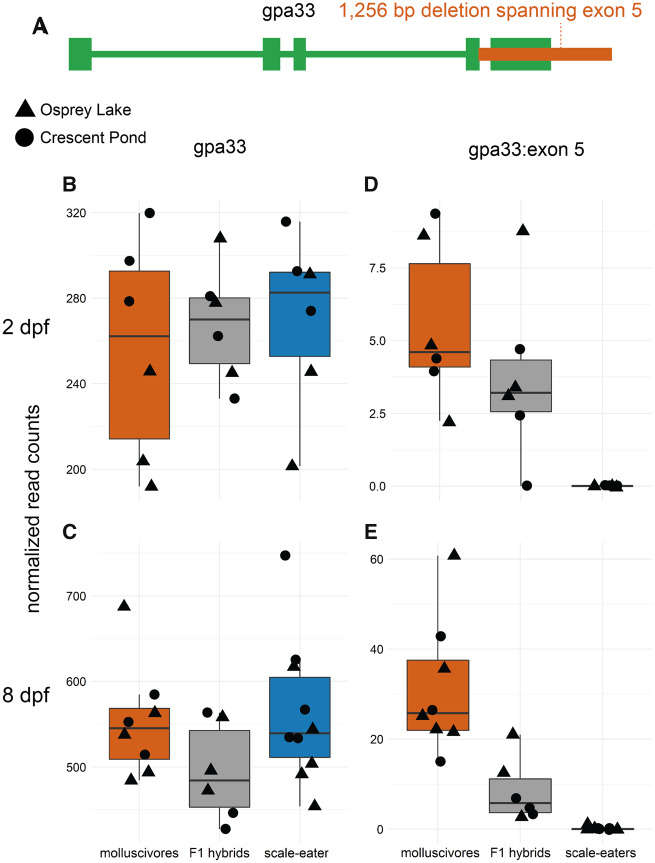
The only fixed variant within a protein coding region is an exon deletion of gpa33. (A) A 1,256 bp deletion (red) identified by DELLY spans the entire fifth exon of gpa33 and is fixed in scale-eaters. (B and C) The gene is not significantly differentially expressed between molluscivores (red) and scale-eaters (blue) at 2 or 8 dpf when considering read counts across all exons (P > 0.05). (D and E) However, when only considering the fifth exon, scale-eaters show no expression and F1 hybrids (gray) show reduced expression, supporting evidence for the deletion.
Including SNPs and deletions, we found a total of 80 fixed variants within 10 kb of 59 genes (supplementary table S1, Supplementary Material online). Encouragingly, 41 of these genes (70%) also showed high between population nucleotide divergence (Dxy > 0.0083; genome-wide 90th percentile), strengthening evidence for adaptive divergence at these loci. Variants with larger effect sizes are predicted to fix faster than variants with smaller effects (Griswold 2006; Yeaman and Whitlock 2011; Stetter et al. 2018). However, there are likely many alleles contributing to craniofacial divergence that are segregating between populations of molluscivores and scale-eaters. We also identified genes near SNPs showing lower values of Fst that were still highly differentiated between species (Fst > 0.72; genome-wide 99th percentile and Dxy > 0.0083; genome-wide 90th percentile) and within 20 kb of a gene. Using these thresholds, we found 63,542 SNPs near 1,940 genes. This gene set was enriched for 420 biological processes (P < 0.01), including embryonic cranial skeleton morphogenesis, bone mineralization, muscle structure development, and forebrain development (supplementary table S2, Supplementary Material online).
Genes near Fixed Variants Are Differentially Expressed throughout Development
All but 1 of the 80 variants fixed between species were in noncoding regions, suggesting that these variants may affect species-specific phenotypes through regulation of nearby genes. To identify patterns of gene expression divergence between species, we combined two previous transcriptomic data sets spanning three developmental stages and three San Salvador Island lake populations (McGirr and Martin 2018, 2019). F1 offspring were sampled at 2, 8, and 20 days postfertilization (dpf). RNA was extracted from whole body tissue at 2 and 8 dpf; whereas 20 dpf samples were dissected to only extract RNA from craniofacial tissues (supplementary table S3, Supplementary Material online). The earlier developmental stages are described as stage 23 (2 dpf) and 34 (8 dpf) in a recent embryonic staging series of C. variegatus (Lencer and McCune 2018). The 2 dpf stage is comparable with the Early Pharyngula Period of zebrafish, when multipotent neural crest cells have begun migrating to pharyngeal arches that will form the oral jaws and most other craniofacial structures (Schilling and Kimmel 1994; Furutani-Seiki and Wittbrodt 2004; Lencer et al. 2017). Embryos usually hatch 6–10 dpf, with similar variation in hatch times among species (Lencer et al. 2017; McGirr and Martin 2018). While some cranial elements are ossified prior to hatching, the skull is largely cartilaginous at 8 dpf and ossified by 20 dpf (Lencer and McCune 2018).
We used DEseq2 (Love et al. 2014) to contrast gene expression in pairwise comparisons between species grouped by developmental stage (sample sizes for comparisons [molluscivores vs. scale-eaters]: 2 dpf = 6 vs. 6, 8 dpf = 8 vs. 10, 20 dpf = 6 vs. 2). Out of 19,304 genes annotated for the C. brontotheroides reference genome, we found 770 (5.93%) significantly differentially expressed at 2 dpf, 1,277 (9.48%) at 8 dpf, and 312 (2.50%) at 20 dpf (fig. 4A–D). The lower number of genes differentially expressed at 20 dpf likely reflects reduced power to detect expression differences due to the small scale-eater sample size. Nonetheless, we found four genes differentially expressed throughout development at all three stages (filip1, c1galt1, klhl24, and oit3) and 248 genes were differentially expressed during two of the three stages examined. Of the 59 genes within 10 kb of SNPs or deletions fixed between species, we found 12 differentially expressed during at least one developmental stage (table 1 and fig. 4E). Two of these genes (dync2li1 and pycr3) were differentially expressed at 2 and 8 dpf.
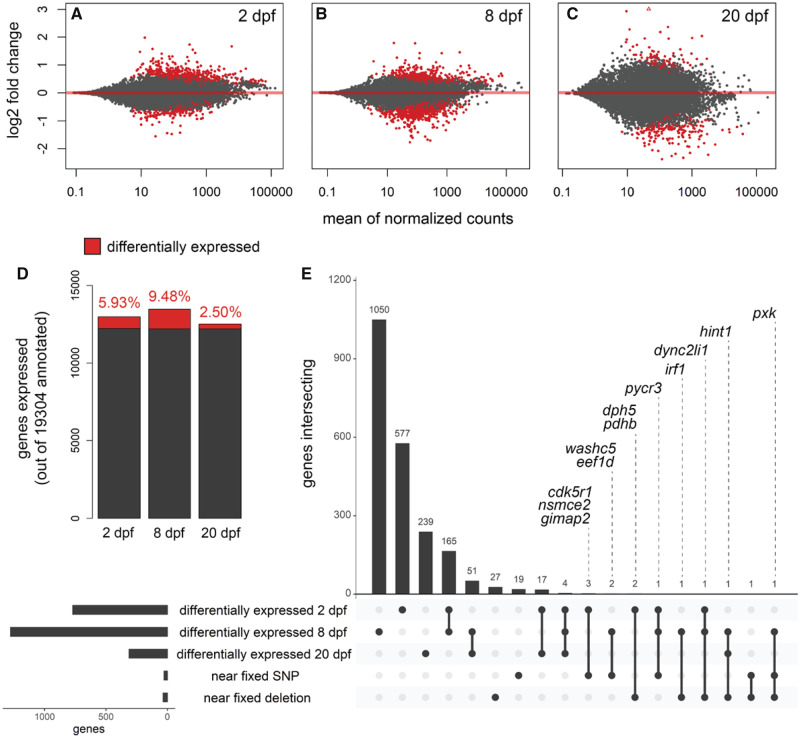
Genes near fixed variants are differentially expressed between species across three developmental stages. Genes differentially expressed (red; P < 0.01) between molluscivores and scale-eaters at (A) 2dpf, (B) 8 dpf, and (C) 20 dpf. Positive log2 fold changes indicate higher expression in scale-eaters relative to molluscivores. (D) Proportion of genes differentially expressed out of the total number of genes expressed across three stages. (E) UpSet plot (Conway et al. 2017) showing intersection across five sets: genes differentially expressed at each of the three stages, genes within 10 kb of fixed SNPs, and genes within 10 kb of fixed deletions. The 12 labeled genes were differentially expressed during at least one stage and within 10 kb of fixed variants.

| Gene | 2 dpf | 8 dpf | 20 dpf | ||||||
|---|---|---|---|---|---|---|---|---|---|
| MNC | LFC | P | MNC | LFC | P | MNC | LFC | P | |
| dync2li1 | 96.09 | −0.70 | 3.7E−05 | 34.05 | −1.05 | 5.2E−05 | 23.83 | −1.10 | 1.2E−01 |
| pycr3 | 221.91 | 0.49 | 2.5E−03 | 56.19 | 1.09 | 1.5E−08 | 38.16 | 0.13 | 8.9E−01 |
| eef1d | 1984.23 | 0.18 | 1.3E−01 | 1076.82 | 0.51 | 8.8E−07 | 1265.39 | 0.08 | 8.9E−01 |
| washc5 | 293.53 | −0.14 | 5.0E−01 | 141.55 | −0.40 | 9.2E−04 | 143.95 | −0.03 | 9.6E−01 |
| pxk | 205.36 | 0.19 | 2.9E−01 | 183.15 | 0.67 | 1.9E−04 | 120.35 | 0.65 | 7.3E−02 |
| hint1 | 1719.70 | 0.28 | 2.6E−01 | 824.17 | 0.46 | 9.4E−03 | 336.79 | −1.03 | 9.7E−03 |
| nsmce2 | 260.89 | −0.48 | 1.4E−04 | 79.51 | −0.44 | 1.5E−02 | 82.97 | −0.80 | 6.1E−02 |
| gimap2 | 17.46 | 2.14 | 5.5E−04 | 46.44 | 0.04 | 9.5E−01 | 57.94 | 1.89 | 1.6E−02 |
| cdk5r1 | 106.52 | −0.59 | 3.7E−03 | 292.02 | 0.31 | 9.2E−02 | 7.22 | −1.18 | 3.6E−01 |
| dph5 | 344.39 | 0.51 | 2.8E−03 | 108.03 | 0.20 | 2.9E−01 | 63.25 | −0.28 | 6.4E−01 |
| pdhb | 662.23 | 0.41 | 6.9E−03 | 2359.84 | 0.06 | 8.1E−01 | 680.86 | −0.29 | 5.8E−01 |
| irf1 | 5.62 | 0.32 | 7.6E−01 | 142.62 | −1.19 | 2.9E−04 | 360.24 | 1.17 | 1.0E−01 |
Note.—LFC, log2 fold change in expression (positive values indicate higher expression in scale-eaters than molluscivores); MNC, mean normalized counts across all samples; P, adjusted P value for differential expression (DESeq2).
Since this is a young radiation, many other candidate adaptive loci are likely segregating between species due to incomplete hard sweeps or because multiple adaptive haplotypes exist causing signatures of soft sweeps. We also evaluated whether highly differentiated variants that were not fixed between species may influence expression divergence. Of the 1,940 genes within 20 kb of highly differentiated SNPs (Fst > 0.72 and Dxy > 0.0083), 384 were differentially expressed during at least one developmental stage (supplementary fig. S1, Supplementary Material online). This gene set was enriched for 87 biological processes, including pigment accumulation, vasculature development, lipid localization, and regulation of keratinocyte differentiation (P < 0.05; supplementary tables S4 and S5, Supplementary Material online).
Regulatory Mechanisms Underlying Expression Divergence between Species
Despite overall low genetic differentiation observed between species (genome-wide mean Fst = 0.076), we identified thousands of genes expressed in F1 hybrids containing heterozygous sites that were alternately homozygous between parental populations (ranging between 18.5% and 28.5% of all genes expressed in F1 hybrids; supplementary table S6, Supplementary Material online). We measured ASE for these genes using MBASED (Mayba et al. 2014) and inferred mechanisms of regulatory divergence by comparing the ratio of maternal and paternal allelic expression in F1 hybrids with the ratio of molluscivore and scale-eater gene expression in purebred F1 offspring (fig. 5; Cowles et al. 2002; Wittkopp et al. 2004; McManus et al. 2010; Mack et al. 2016).
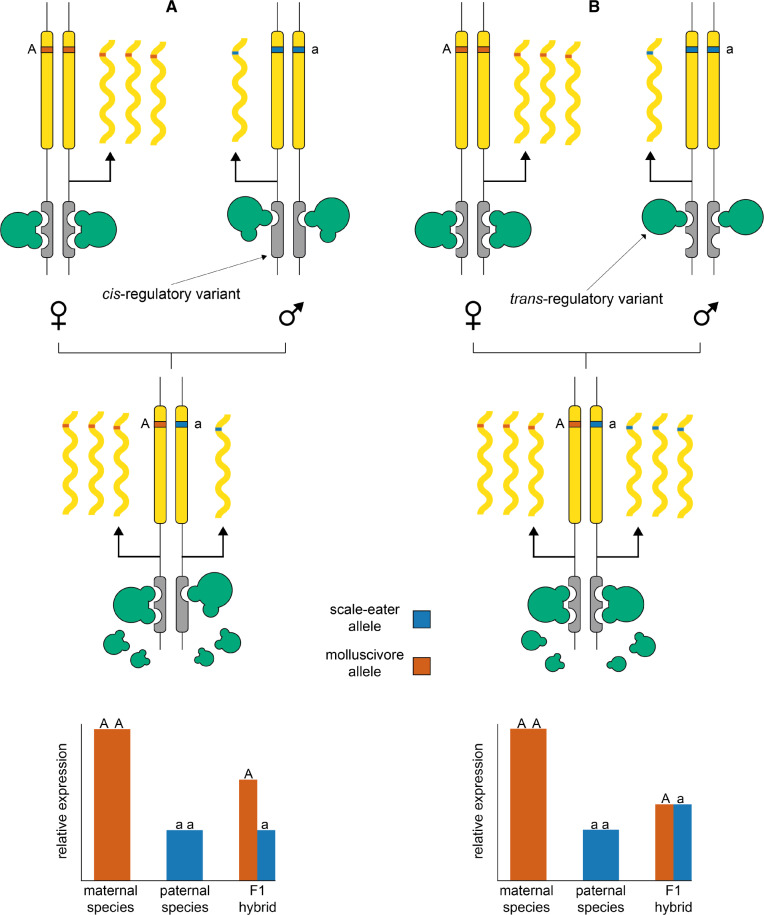
Deciphering between cis- and trans-regulatory divergence influencing gene expression. Diagrams show protein coding gene regions (yellow) regulated by linked cis-acting elements (gray) and trans-acting-binding proteins (green). In the examples, a female molluscivore is crossed with a male scale-eater to produce an F1 hybrid. The two species are alternatively homozygous for an allele within the coding region of a gene that shows higher expression in the molluscivore than the scale-eater. (A) A cis-acting variant causing reduced expression results in low expression of the scale-eater allele in the F1 hybrid. (B) Lower expression in the scale-eater is caused by a trans-acting variant, resulting in similar expression levels of both parental alleles in the F1 hybrid.
Most genes were expressed at a similar level in each species, as well as in F1 hybrids, indicating conserved regulation (88.46–93.33%; fig. 6). The majority of genes that were differentially expressed between species showed trans-regulatory divergence (3.90–6.21%), which accounted for more than three times the number of genes influenced by cis-regulatory divergence (1.08–1.67%). Trans-regulatory divergence was also more prevalent than expression influenced by a combination of cis and trans effects. The number of genes influenced by cis × trans compensatory changes (0.80–2.25%) was similar to the number of genes influenced by cis + trans reinforcing changes (0.76–2.01%).
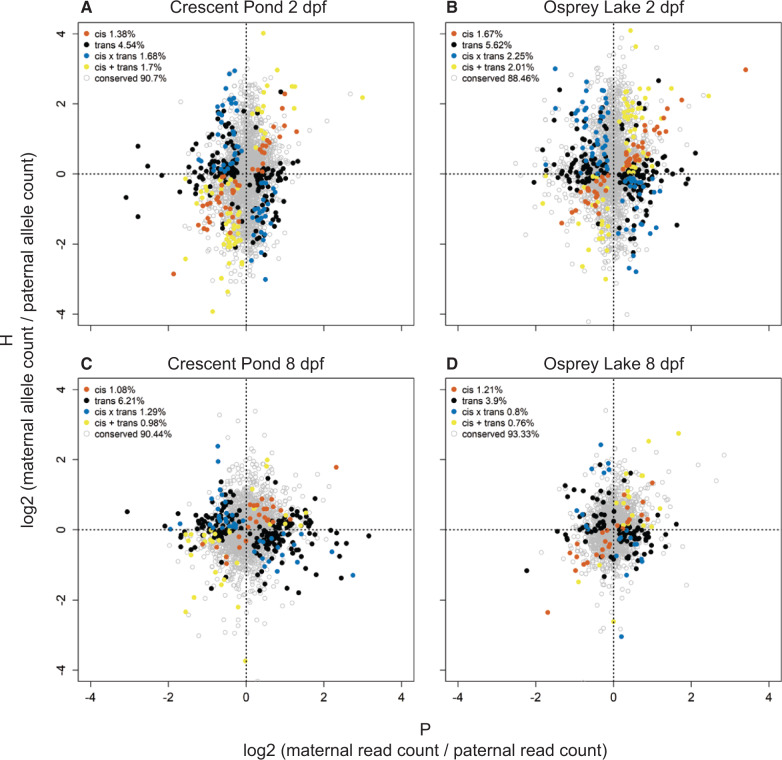
Regulatory mechanisms underlying expression divergence between species. The ratio of maternal and paternal allelic expression in F1 hybrids (H) relative to the ratio of molluscivore and scale-eater gene expression in purebred F1 offspring (P) for genes containing heterozygous sites. Left panels show expression in Crescent Pond samples and right panels show Osprey Lake samples. Red = cis (significant ASE in F1 hybrids, significant differential expression between species, and no significant trans- contribution), black = trans (significant ASE in hybrids, significant differential expression between species, and significant trans-contribution), blue = cis × trans (cis and trans effects show opposing signs, significant ASE, no significant differential expression between species, significant trans-contribution), yellow = cis + trans (cis and trans effects show the same sign, significant ASE, no significant differential expression between species, significant trans-contribution), gray = conserved (no differential expression between species and no ASE).
Cis-regulatory variants are expected to contribute to additive inheritance of gene expression in F1 hybrids, whereas trans-regulatory variants are expected to influence patterns of dominance (Prud’homme et al. 2007; Lemos et al. 2008; Signor and Nuzhdin 2018). Furthermore, cis × trans compensatory changes can result in transgressive gene expression, where expression is significantly higher or lower in F1 hybrids compared with parental populations (Landry et al. 2005, 2007; Mack et al. 2016; McGirr and Martin 2019). We found additive, dominant, and transgressive patterns of gene expression inheritance in F1 hybrids at both developmental stages. Despite the overall lower contribution of cis-regulatory divergence compared with trans-regulatory divergence, we found that slightly more genes showed additive inheritance than dominant inheritance (supplementary fig. S2, Supplementary Material online; 2 dpf: additive = 4.49% dominant = 1.90%; 8 dpf: additive = 5.84% dominant = 3.85%).
Fixed Variants near Genes Showing Cis-Regulatory Divergence
Although most differential expression between species was explained by trans-regulatory divergence, it is difficult to identify the downstream targets of trans-acting alleles because they are necessarily unlinked from the genes they regulate. Furthermore, it is unknown whether the predominance of trans-regulatory divergence was driven by few alleles with numerous effects or many alleles distributed throughout the genome. Thus, to identify candidate variation causing differences in gene expression between molluscivores and scale-eaters, we examined genes in highly differentiated regions of the genome that were differentially expressed due to cis-regulatory divergence. We found a total of 148 genes showing cis-regulatory divergence among all four F1 hybrid crosses (fig. 6). We identified 37 of these genes (25%) within the set of 384 genes that were differentially expressed between species and within 20 kb of highly differentiated SNPs (Fst > 0.72 and Dxy > 0.0083; supplementary table S7, Supplementary Material online).
We also found differentially expressed genes showing cis-regulatory divergence that were near the most highly differentiated regions of the genome containing variants fixed between species. Of the 12 genes that were within 10 kb of fixed variants, five contained heterozygous sites that could be used to measure ASE (fig. 7 and supplementary fig. S3, Supplementary Material online). Three of these (eef1d, washc5, and pxk) showed trans-regulatory divergence (supplementary fig. S3, Supplementary Material online). The other two genes which were differentially expressed at 2 and 8 dpf (dync2li1 and pycr3) showed cis-regulatory divergence (fig. 7). This provided strong evidence that differential regulation of these genes was influenced by genetic divergence within putative cis-regulatory elements.
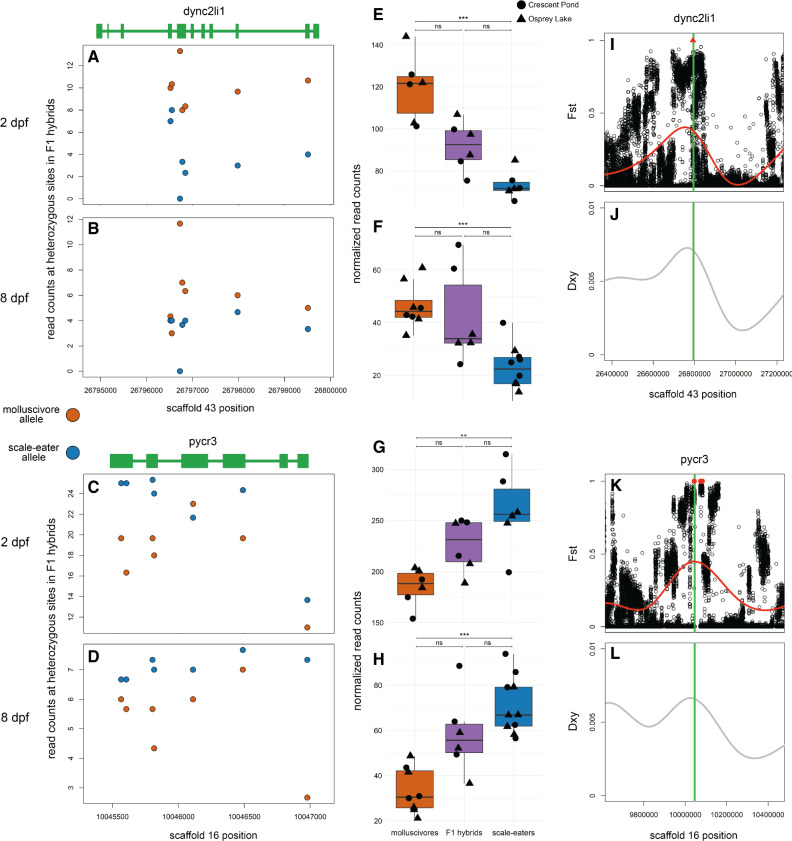
Two genes near fixed variants show cis-regulatory divergence between trophic specialists. (A–D) Mean counts for reads spanning dync2li1 and pycr3 that match parental alleles at heterozygous sites are shown for crosses between Crescent Pond molluscivores (red) and scale-eaters (blue) at 2 dpf (A and C) and 8 dpf (B and D). (E–H) Normalized read counts for F1 offspring from Crescent Pond (circles) and Osprey Lake (triangles) crosses. Both genes are differentially expressed between molluscivores (red) and scale-eaters (blue) at both developmental stages and show additive inheritance in F1 hybrids (gray; P < 0.01*, 0.001**, 0.0001***, P > 0.01 ns). For both genes, F1 hybrids show higher expression of alleles derived from the parental species that shows higher gene expression in purebred F1 offspring (MBASED P < 0.05) and show cis-regulatory divergence between species. (I–L) Both genes (green lines) are within regions showing high relative genetic differentiation (Fst; I and K) and high absolute genetic divergence (Dxy; J and L). Red triangle shows fixed deletion. Red points show fixed SNPs (Fst = 1).
These two genes showing cis-regulatory divergence were near just one fixed variant each: a 91 bp deletion located 7,384 bp upstream of dync2li1 and an A-to-C transversion 1,808 bp downstream of pycr3 (fig. 7). The next closest fixed variants were separated by greater than 600 kb and 31 kb, respectively. We searched the JASPAR database (Fornes et al. 2019) to identify potential transcription factor-binding sites that could be altered by these candidate cis-acting variants. The 91 bp deletion near dync2li1 contained binding motifs corresponding to seven transcription factors (nfia, nfix, nfic, znf384, hoxa5, gata1, myb; supplementary table S8, Supplementary Material online). Two binding motifs spanned the pycr3 SNP region (gata2, mzf1), one of which, mfz1, was altered by the alternate allele in scale-eaters. The scale-eater allele created a new potential-binding motif matching the transcription factor plagl2. Sanger sequencing confirmed the A-to-C transversion near pycr3 in four additional individuals not included in the whole-genome resequencing data set (fig. 8).
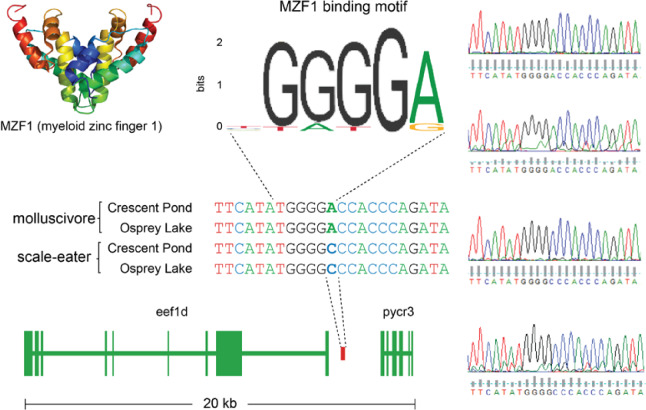
Sanger sequencing confirms fixed SNP that could alter transcription factor binding near pycr3. Chromatograms on the right confirm the A-to-C transversion fixed in scale-eaters that falls between eef1d (supplementary fig. S3, Supplementary Material online) and pycr3 (fig. 7). The myeloid zinc finger transcription factor binds a motif that matches the molluscivore (JASPAR database matrix ID: MA0056.1), however, the scale-eater allele alters this motif.
Discussion
Understanding the developmental genetic basis of complex traits by investigating natural variation among closely related species is a powerful complementary approach to traditional genetic screens in model systems. The San Salvador Island Cyprinodon pupfish system is a useful evolutionary model for understanding the genetic basis of craniofacial defects and natural diversity given extensive morphological divergence between these young species (fig. 1). We found thousands of genetic variants that were highly differentiated between molluscivore and scale-eater species that were near genes that were differentially expressed at multiple developmental stages. Just 244 variants were fixed between species across 9.3 million SNPs and 80,012 structural variants (fig. 2A and C). Almost all fixed variants were in noncoding regions, with the exception of an exon-spanning deletion (fig. 3). In support of these variants affecting divergent adaptive phenotypes, 80 variants were near 59 genes that were enriched for developmental functions related to divergent specialist traits (fig. 2B and D). Furthermore, 12 of these genes were highly differentially expressed between species across three developmental stages (fig. 4E). By measuring ASE in F1 hybrids from multiple crosses between species, we found that trans-regulatory divergence explained most patterns of expression divergence. We also identified two highly differentiated variants that may act as cis-regulatory alleles affecting expression divergence between species: a fixed deletion near dync2li1 and a fixed SNP near pycr3 (fig. 7).
Gene Regulatory Divergence during Rapid Speciation
Other studies investigating cis- and trans-regulatory mechanisms have found that cis-acting alleles contribute more to interspecific divergence, whereas trans-acting alleles contribute more to intraspecific divergence (Prud’homme et al. 2007; Lemos et al. 2008; Signor and Nuzhdin 2018). Importantly, many of the studies supporting this pattern examine interspecific hybrids generated by species pairs with much greater divergence times (Graze et al. 2009: Drosophila melanogaster and D. simulans diverged 2.5 Ma; Tirosh et al. 2009: Saccharomyces cerevisiae and S. paradoxus diverged 5 Ma; Shi et al. 2012: Arabidopsis thaliana and A. arenosa diverged 5.3 Ma). Given that molluscivores and scale-eaters rapidly diverged within the past 10,000 years and are known to hybridize in the wild, we may see trans-effects dominating for the same reasons trans-effects are thought to contribute more to intraspecific divergence. This is because, both within species and between young species pairs, the larger mutational target of trans-regulatory factors results in the observed excess of trans-effects (Wittkopp et al. 2008; Emerson et al. 2010; Suvorov et al. 2013).
Similar to other studies, we found predominately additive patterns of gene inheritance in F1 hybrids (Hughes et al. 2006; Rottscheidt and Harr 2007; Davidson and Balakrishnan 2016). However, this contrasts with our finding of wide-spread trans-regulatory divergence, which is expected to contribute to dominant and recessive patterns of inheritance (Lemos et al. 2008; Signor and Nuzhdin 2018). Since genes were required to contain heterozygous sites in F1 hybrids for ASE analyses, we were only able to classify mechanisms of regulatory divergence for a subset of genes used to classify modes of inheritance (supplementary table S6, Supplementary Material online). It is possible that heterozygous genes were biased to show trans-regulatory divergence. It is also possible that we underestimated the number of genes showing cis-regulatory divergence between species. We required that genes show ASE across the entire coding region to assign cis-regulatory divergence, which ignored the possibility of alleles affecting the expression of specific transcript isoforms.
Fixed Genetic Variation Influencing Trophic Specialization
In a previous analysis of SNPs from a smaller whole-genome data set, dync2li1 was one of 30 candidate genes that showed signs of a hard selective sweep and was significantly associated with variation in jaw size between molluscivores and scale-eaters using multiple genome-wide association mapping approaches (McGirr and Martin 2017). Here, we show that a fixed deletion near dync2li1 may influence expression divergence between species through cis-acting regulatory mechanisms. This gene (dynein cytoplasmic 2 light intermediate chain 1) is known to influence skeletal morphology in humans (Kessler et al. 2015; Taylor et al. 2015; Niceta et al. 2018). It is a component of the cytoplasmic dynein 2 complex which is important for intraflagellar transport—the movement of protein particles along the length of eukaryotic cilia (Cole 2003; Pfister et al. 2006). Due to the vital role that cilia play in the transduction of signals in the hedgehog pathway and other pathways important for skeletal development, disruptions in dynein complexes cause a variety of skeletal dysplasias collectively termed skeletal ciliopathies (Huber and Cormier-Daire 2012; Taylor et al. 2015). Mutations in dync2li1 have been linked with ciliopathies that result from abnormal cilia shape and function including Ellis-van Creveld syndrome, Jeune syndrome, and short rib polydactyly syndrome (Kessler et al. 2015; Taylor et al. 2015; Niceta et al. 2018). These disorders are characterized by variable craniofacial malformations including micrognathia (small jaw), hypodontia (tooth absence), and cleft palate (Brueton et al. 1990; Ruiz-Perez and Goodship 2009; Taylor et al. 2015). The discovery of dync2li1 as a candidate gene influencing differences in oral jaw length between molluscivores and scale-eaters suggests that this system is particularly well-suited as an evolutionary mutant model for clinical phenotypes involving jaw size, such as micrognathia and macrognathia.
We also identified a fixed SNP near the gene pycr3 (pyrroline-5-carboxylate reductase 3; also denoted pycrl) which showed cis-regulatory divergence. This gene is not currently known to influence craniofacial phenotypes in humans or other model systems. However, one study investigating gene expression divergence between beef and dairy breed bulls found that pycr3 was one of the most highly differentially expressed genes in skeletal muscle tissues. The authors found nearly a 3-fold difference in expression of pycr3 between the two bull breeds that are primarily characterized by differences in muscle anatomy (Sadkowski et al. 2009). Similarly, expression changes in this gene may influence skeletal muscle development in specialists species, which differ in the size of their adductor mandibulae muscles (Martin and Wainwright 2011; Hernandez et al. 2018). The A-to-C transversion near pycr3 could influence differences in expression by altering transcription factor binding. We found that the molluscivore allele matches the binding motif of mzf1 (myeloid zinc finger 1; fig. 8), a transcription factor known to influence cell proliferation (Gaboli et al. 2001), whereas the scale-eater allele alters this motif. This type of binding motif analysis has a high sensitivity (mzf1 is known to bind this motif) but extremely low selectivity (mzf1 does not bind nearly every occurrence of this motif, which appears 1,430,540 times in the molluscivore reference genome).
Although oral jaw size is the primary axis of phenotypic divergence in the San Salvador Island pupfish system, adaptation to divergent niches required changes in a suite of morphological and behavioral phenotypes (St. John et al. 2019; St. John et al. 2020b). Most genes differentially expressed between species were found within whole embryo tissues (fig. 4A–D), suggesting we should find candidate genes influencing the development of craniofacial phenotypes and other divergent traits. Of the 244 variants fixed between species, the only coding variant was a 1,256 bp deletion that spanned the fifth exon of gpa33 (glycoprotein A33), which is expressed exclusively in intestinal epithelium (fig. 3). Knockouts of this gene in mice cause increased hypersensitivity to food allergens and susceptibility to a range of related inflammatory intestinal pathologies (Williams et al. 2015). The gut contents of wild-caught scale-eaters comprised 40–51% scales (Martin and Wainwright 2013c). The exon deletion of gpa33 may play a metabolic role in this unique adaptation that allows scale-eaters to occupy a higher trophic level than molluscivores. Future studies in this system will benefit from sequencing and analyses that target-specific tissues and cell types to determine whether candidate variants affect a single phenotype or have pleiotropic effects.
The Effectiveness of Cyprinodon Pupfishes for Identifying Candidate Cis-Regulatory Variants
One major advantage of investigating the genetic basis of craniofacial divergence between molluscivores and scale-eaters is the low amount of genetic divergence between species. Species-specific phenotypes are replicated across multiple isolated lake populations that exhibit substantial ongoing gene flow. This has resulted in small regions of the genome showing strong genetic differentiation (63,542 SNPs showing Fst > 0.72 and Dxy > 0.0083), with some regions containing just a single variant fixed between species. The low number of fixed variants dispersed across the genome makes this system relatively unique compared with other systems with similar divergence times (Bernatchez et al. 2010; Jones et al. 2012; Martin et al. 2019).
A previous study found a significant QTL explaining 15% of variation in oral jaw size and three more potential moderate-effect QTL, suggesting that we may expect to find variants with moderate effects on craniofacial divergence. Variants with larger effect sizes are predicted to fix faster than variants with smaller effects, especially given short divergence times (Griswold 2006; Yeaman and Whitlock 2011; Stetter et al. 2018), which may suggest that the fixed variants near dync2li1 and pycr3 have larger effects than segregating candidate alleles. However, these fixed alleles are tightly linked with other highly differentiated alleles and may affect phenotypic divergence through combined small effects with many closely clustered variants. Furthermore, the fixation rate of mutations is not only dependent on effect size, but also dominance, which is an important mode of gene expression inheritance in this system (supplementary fig. S2, Supplementary Material online) and other systems (Gibson et al. 2004; Lemos et al. 2008; Signor and Nuzhdin 2018). While the fixed variants near dync2li1 and pycr3 represent promising candidate alleles, adaptive differences in craniofacial morphology are likely influenced by many loci, similar to polygenic traits studied in other systems (Bergland et al. 2014; Boyle et al. 2017; Barghi et al. 2019; Sella et al. 2019).
Conclusions
Overall, our results highlight the utility of the San Salvador Island pupfish system as an evolutionary mutant model for natural and clinical variation in human craniofacial phenotypes. Similar rapid speciation replicated across many environments can be found in other adaptive radiations (Martin et al. 2019; Martin and Richards 2019; Levin et al. 2020), which could also prove useful as evolutionary models for a variety of other human traits. We found that a combination of structural variant likely contributes to the evolution of highly divergent craniofacial morphology, and that trans-regulatory mechanisms dominate patterns of expression divergence between these young species. Future studies will attempt to validate the effect of candidate variation on gene expression and craniofacial development in vivo.
Materials and Methods
Identifying Genomic Variation Fixed between Specialists
To identify SNPs fixed between molluscivores and scale-eaters, we analyzed whole-genome resequencing samples for 258 individuals from across the Caribbean (median coverage = 8×; Richards et al. 2020). Briefly, 114 pupfishes from 15 isolated hypersaline lakes and one estuary on San Salvador Island were collected using hand and seine nets between 2011 and 2018. This included 33 generalists, 46 molluscivores, and 35 scale-eaters. Eight of these individuals were bred to generate F1 offspring sampled for RNA sequencing (supplementary table S3, Supplementary Material online). This data set also included 140 outgroup generalist pupfishes from across the Caribbean and North America, including two individuals belonging to the pupfish radiation in Lake Chichancanab, Mexico, and two individuals from the most closely related outgroups to Cyprinodon (Megupsilon aporus and Cualac tessellatus; Echelle et al. 2005). Libraries for 150PE Illumina sequencing were generated from DNA extracted from muscle tissue and the resulting reads were mapped to the C. brontotheroides reference genome (v 1.0; total sequence length = 1,162,855,435 bp; number of scaffolds = 15,698, scaffold N50, = 32,000,000 bp; L50 = 15 scaffolds; Richards et al. 2020). Variants were called using the HaplotypeCaller function of the Genome Analysis Toolkit (GATK v 3.5; DePristo et al. 2011). The GATK best practices workflow suggests using high-quality known variants to act as a reference to recalibrate variant quality scores. Due to the lack of a high confidence variant call set for this system, SNPs were filtered using conservative hard-filtering parameters (DePristo et al. 2011; Richards and Martin 2020). SNPs were further filtered to include SNPs with a minor allele frequency above 0.05, genotype quality above 20, and sites with greater than 50% genotyping rate across all individuals, resulting in 9.3 million SNPs.
Measuring relative genetic differentiation (Fst) between species can point to regions of the genome containing variation affecting divergent phenotypes (Jones et al. 2012; Poelstra et al. 2014; Lamichhaney et al. 2015). However, Fst is dependent on the many potential forces acting to reduce within-population nucleotide diversity, including selective sweeps, purifying selection, background selection, and low recombination rates (Noor and Bennett 2009; Cruickshank and Hahn 2014). Measuring between-population divergence (Dxy) can help distinguish between these possibilities because nucleotide divergence between species increases at loci under different selective regimes (Nachman and Payseur 2012; Cruickshank and Hahn 2014; Irwin et al. 2016). We measured Fst between species with vcftools (v. 0.1.15; weir-fst-pop function) and identified fixed SNPs (Fst = 1). We also measured Fst and Dxy in 10 and 20 kb windows using the python script popGenWindows.py created by Simon Martin (github.com/simonhmartin/genomics_general; Martin et al. 2013).
We identified structural variation (insertions, deletions, inversions, translocations, and copy number variants) fixed between specialist species with DELLY (v 0.8.1; Rausch et al. 2012). Unlike GATK HaplotypeCaller which is limited to identifying structural variants smaller than half the length of read size (DePristo et al. 2011), DELLY can identify small variants in addition to variants larger than 300 bp using paired-end clustering and split read analysis. We used DELLY to identify structural variants across eight whole genomes from the breeding pairs used to generate F1 hybrid RNA samples (four scale-eaters from two lake populations and four molluscivores from the same two lake populations; supplementary table S3, Supplementary Material online). First, we trimmed reads using Trim Galore (v. 4.4, Babraham Bioinformatics), aligned them to the C. brontotheroides reference genome with the Burrows–Wheeler Alignment Tool (v 0.7.12; Li and Durbin 2011), and removed duplicate reads from the resulting .bam files with Picard MarkDuplicates (broadinstitute.github.io/picard). Second, we called variants with DELLY by comparing an individual of one species with all individuals of the other species, resulting in eight variant call files. Third, we identified structural variants fixed between species that were shared across all eight files, in which all molluscivores showed the reference allele and all scale-eaters showed the same alternate allele.
Transcriptomic Sequencing, Alignment, and Variant Discovery
Our transcriptomic data set included 50 libraries from 122 individuals sampled across three early developmental stages (supplementary table S3, Supplementary Material online; McGirr and Martin 2018, 2019). Breeding pairs used to generate F1 hybrids and purebred F1 offspring were collected from three hypersaline lakes on San Salvador Island: Crescent Pond, Osprey Lake, and Little Lake. For purebred crosses, we collected F1 embryos from breeding tanks containing multiple breeding pairs from a single lake population. For F1 hybrid samples, we crossed a single individual of one species with a single individual of another species from the same lake population.
RNA was extracted from samples collected 2 days after fertilization (2 dpf) 8 days after fertilization (8 dpf), and 17–20 days after fertilization (20 dpf) using RNeasy Mini Kits (Qiagen catalog no. 74104). For samples collected at 2 dpf, we pooled 5 embryos together and pulverized them in a 1.5 ml Eppendorf tube using a plastic pestle washed with RNase Away (Molecular BioProducts). We used the same extraction method for samples collected at 8 dpf but did not pool larvae and prepared a library for each individual separately. We dissected samples collected at 20 dpf to isolate tissues from the anterior craniofacial region containing the dentary, angular articular, maxilla, premaxilla, palatine, and associated craniofacial connective tissues using fine-tipped tweezers washed with RNase AWAY. All samples were reared in breeding tanks at 25–27 °C, 10–15 ppt salinity, pH 8.3, and fed a mix of commercial pellet foods and frozen foods.
Methods for total mRNA sequencing were previously described (McGirr and Martin 2018, 2019). Briefly, 2 and 8 dpf libraries were prepared using TruSeq stranded mRNA kits and sequenced on 3 lanes of Illumina 150 PE Hiseq4000 at the Vincent J. Coates Genomic Sequencing Center (McGirr and Martin 2019). All 20 dpf libraries were prepared using the KAPA stranded mRNA-seq kit at the High Throughput Genomic Sequencing Facility at UNC Chapel Hill and sequenced on one lane of Illumina 150PE Hiseq4000 (McGirr and Martin 2018). We filtered raw reads using Trim Galore (v. 4.4, Babraham Bioinformatics) to remove Illumina adaptors and low-quality reads (mean Phred score < 20) and mapped 122,090,823 filtered reads to the C. brontotheroides reference genome (Richards et al. 2020) using the RNAseq aligner STAR with default parameters (v. 2.5; Dobin et al. 2013). We assessed mapping and read quality using MultiQC (Ewels et al. 2016) and quantified the number of duplicate reads and the median percent GC content of mapped reads for each sample using RSeQC (Wang et al. 2012). Although all reads were mapped to a molluscivore reference genome, we did not find a significant difference between species in the proportion of reads uniquely mapped with STAR (supplementary fig. S4A, Supplementary Material online; Student’s t-test, P = 0.061). In addition, we did not find a difference between species in the proportion of multimapped reads, GC content of reads, or number of duplicate reads (supplementary fig. S4B–D, Supplementary Material online; Student’s t-test, P > 0.05).
We used GATK HaplotypeCaller function to call SNPs across 50 quality filtered transcriptomes. We refined SNPs using the allele-specific software WASP (v. 0.3.3) to correct for potential mapping biases that would influence tests of ASE (Van De Geijn et al. 2015). WASP identified reads that overlapped SNPs in the initial .bam files and remapped those reads after swapping the genotype for the alternate allele. Reads that failed to map to exactly the same location were discarded. We remapped unbiased reads to create our final .bam files used for differential expression analyses. Finally, we recalled SNPs using unbiased .bam files for ASE analyses.
Differential Expression Analyses
We used the featureCounts function of the Rsubread package (Liao et al. 2014) requiring paired-end and reverse stranded options to generate read counts across 19,304 genes and 156,743 exons annotated for the molluscivore (C. brontotheroides) reference genome (Richards et al. 2020). We used DESeq2 (v. 3.5; Love et al. 2014) to normalize raw read counts for library size and perform principal component analyses, and identify differentially expressed genes. DESeq2 fits negative binomial generalized linear models for each gene across samples to test the null hypothesis that the fold change in gene expression between two groups is zero. Significant differential expression between groups was determined with Wald tests by comparing normalized posterior log fold change estimates and correcting for multiple testing using the Benjamini–Hochberg procedure with a false discovery rate of 0.01 (Benjamini and Hochberg 1995).
We constructed a DESeqDataSet object in R using a multifactor design that accounted for variance in F1 read counts influenced by parental population origin and sequencing date (design = ∼sequencing_date + parental_breeding_pair_populations). Next, we used a variance stabilizing transformation on normalized counts and performed a principal component analysis to visualize the major axes of variation in 2, 8, and 20 dpf samples (supplementary fig. S5, Supplementary Material online). We contrasted gene expression in pairwise comparisons between species grouped by developmental stage (sample sizes for comparisons [molluscivores vs. scale-eaters]: 2 dpf = 6 vs. 6, 8 dpf = 8 vs. 10, 20 dpf = 6 vs. 2).
We used plyranges (v. 1.6.5; Lee et al. 2019) to identify genetic variants overlapping with gene regions. For each gene we identified variants within 10 kb of the start of the first exon and within 10 kb of the end of the last exon. We also searched within 20 kb of genes, which is the distance at which linkage disequilibrium decays to background levels (McGirr and Martin 2017). Using these window sizes, we were only able to identify differentiated regions of the genome as candidate cis-regulatory regions that may influence expression levels of linked genes. This approach does not take into account the action of distal regulatory regions acting at longer ranges.
Allele-Specific Expression Analyses
Our SNP data set included every parent used to generate F1 hybrids between populations (n = 8). We used the GATK VariantsToTable function (DePristo et al. 2011) to output genotypes across 9.3 million SNPs for each parent and overlapped these sites with the variant sites identified in F1 hybrid transcriptomes. We used python scripts (github.com/joemcgirr/fishfASE) to identify SNPs that were alternatively homozygous in breeding pairs and heterozygous in their F1 offspring. We counted reads across heterozygous sites using ASEReadCounter (–minDepth 20 –minMappingQuality 10 –minBaseQuality 20 –drf DuplicateRead) and matched read counts to maternal and paternal alleles.
We identified significant ASE using a beta-binomial test comparing the maternal and paternal counts at each gene with the R package MBASED (Mayba et al. 2014). For each F1 hybrid sample, we performed a 1-sample analysis with MBASED using default parameters run for 1,000,000 simulations to determine whether genes showed significant ASE in hybrids (P < 0.05). To test whether certain types of genes were disproportionally included or excluded from ASE analyses due to the requirement that a gene contain heterozygous sites in F1 hybrids, we determined how many of these genes were annotated for effects on cranial skeletal system development (GO:1904888) and skeletal system development (GO:0048705). We performed Fisher’s exact tests for each cross, testing the null hypothesis that the proportion of heterozygous genes within an ontology was equal to the proportion of noninformative genes within an ontology. We did not find that genes involved in skeletal development were disproportionally excluded from ASE analyses due to the requirement that a gene contain heterozygous sites (Fisher’s exact test, P > 0.05; supplementary table S9, Supplementary Material online).
Classifying Regulatory Mechanisms and Inheritance in F1 Hybrids
It is possible to identify mechanisms of gene expression divergence between parental species by bringing cis elements from both parents together in the same trans environment in F1 hybrids and quantifying ASE of parental alleles at heterozygous sites (fig. 5; Cowles et al. 2002; Wittkopp et al. 2004). A gene that is differentially expressed between parental species that also shows ASE biased toward one parental allele is expected to result from cis-regulatory divergence. A gene that is differentially expressed between parental species that does not show ASE in F1 hybrids is expected to result from trans-regulatory divergence.
To determine regulatory mechanisms controlling expression divergence between parental species, a gene had to be included in differential expression analyses and ASE analyses. We required that genes had at least two informative SNPs with ≥10× coverage to assign regulatory mechanisms. We calculated H—the ratio of maternal allele counts compared with the number of paternal allele counts in F1 hybrids, and P—the ratio of normalized read counts in purebred F1 offspring from the maternal population compared with read counts in purebred F1 offspring from the paternal population. We performed a Fisher’s exact test using H and P to determine whether there was a significant trans- contribution to expression divergence (T), testing the null hypothesis that the ratio of read counts in the parental populations was equal to the ratio of parental allele counts in hybrids (Wittkopp et al. 2004; McManus et al. 2010; Goncalves et al. 2012; Mack et al. 2016).
For each lake population at each developmental stage, we classified expression divergence due to cis-regulation if a gene showed significant ASE in all F1 hybrids, significant differential expression between parental populations of purebred F1 offspring, and no significant T. We identified expression divergence due to trans-regulation if genes did not show ASE, were differentially expressed between parental populations, and showed significant T. We defined cis- × trans-regulatory divergence if a gene showed H and P with opposing signs (cis- and trans-regulatory factors had opposing effects on expression), significant ASE, significant T, and was not differentially expressed between parental populations. We defined cis- + trans-regulatory divergence if a gene showed H and P with the same sign (cis- and trans-regulatory factors had the same effect on expression), significant ASE, significant T, and was not differentially expressed between parental populations (McManus et al. 2010; Coolon et al. 2014; Mack et al. 2016).
For each developmental stage, we grouped species and F1 hybrids by lake population and compared expression in F1 hybrids to expression in purebred offspring to determine whether genes showed additive, dominant, or transgressive patterns of inheritance in hybrids. We conducted four pairwise differential expression tests with DESeq2: 1) molluscivores versus scale-eaters, 2) molluscivores versus F1 hybrids, 3) scale-eaters versus F1 hybrids, 4) molluscivores and scale-eaters versus F1 hybrids. Hybrid inheritance was considered additive if hybrid gene expression was intermediate between parental populations and significantly different between parental populations. Inheritance was dominant if hybrid expression was significantly different from one parental population but not the other. Genes showing misexpression in hybrids showed transgressive inheritance, meaning hybrid gene expression was significantly higher (overdominant) or lower (underdominant) than both parental species.
Gene Ontology Enrichment and Transcription Factor-Binding Site Analyses
We performed gene ontology (GO) enrichment analyses for genes near candidate adaptive variants using ShinyGo v.0.51 (Ge et al. 2020). The C. brontotheroides reference genome was annotated using MAKER, a genome annotation pipeline that annotates genes, transcripts, and proteins (Cantarel et al. 2007). Gene symbols for orthologs identified by this pipeline largely match human gene symbols. Thus, we searched for enrichment across biological process ontologies curated for human gene functions.
We searched the JASPAR database (Fornes et al. 2019) to identify whether fixed variation near genes showing cis-regulatory divergence altered potential transcription factor-binding sites. We generated fasta sequences for the molluscivore containing the variant site and 20 bp on either end of the site and searched across all 1,011 predicted vertebrate-binding motifs in the database using a 95% relative profile score threshold. We then preformed the same analysis for scale-eater fasta sequences containing the alternate allele.
Genotyping Fixed Variants
To confirm the genotypes of putative cis-acting variants, we performed Sanger sequencing on four additional individuals that were not included in our whole-genome data set. We extracted DNA from muscle tissue using DNeasy Blood and Tissue kits (Qiagen, Inc.) from two molluscivores and two scale-eaters (wild samples were collected from Crescent Pond and Osprey Lake for both species). We designed primers targeting the regions containing variation fixed between species near the two genes showing evidence for cis-regulatory divergence (pycr3 and dync2li1) using the NCBI primer design tool (Ye et al. 2012). We designed primers targeting a 446 bp region containing the SNP fixed between species (scaffold: HiC_scaffold_16; position: 10,043,644) that was 1,808 bp downstream of pycr3 (forward: 5′‐ACCATTCCAGAAGACAAAAAGCG‐3′; reverse: 5′‐GGCCCTATATATGGGATGCACAA‐3′). Sequences were amplified with PCR using New England BioLabs Taq polymerase (no. 0141705) and dNTP solution (no. 0861609) and Sanger sequencing was performed at Eton Bioscience, Inc. (Research Triangle Park, NC). Aligning the resulting sequences using the Clustal Omega Multiple Sequence Alignment Tool (Madeira et al. 2019) confirmed the A-to-C transversion in scale-eaters (fig. 8). We designed two additional primer sets targeting the deletion region near dync2li1 (scaffold: HiC_scaffold_43; position: 26,792,380–26,792,471). Although both primer sets amplified the sequence in molluscivore samples (not shown), we were unable to amplify this region in scale-eaters, potentially due to high polymorphism in this region.
Acknowledgments
This study was funded by the University of North Carolina at Chapel Hill, the University of California, Berkeley, NSF CAREER Award 1749764, and NIH/NIDCR R01 DE027052 to C.H.M. and a Graduate Research Fellowship from the Triangle Center for Evolutionary Medicine and an SSE Rosemary Grant Travel Award to J.A.M. We thank Daniel Matute, Emilie Richards, Michelle St. John, Bryan Reatini, and Sara Suzuki for valuable discussion; The Vincent J. Coates Genomics Sequencing Laboratory at the University of California, Berkeley for performing RNA library prep and Illumina sequencing; the Gerace Research Centre for logistics; and the Bahamian government BEST Commission for permission to conduct this research.
Author Contributions
J.A.M. wrote the manuscript, extracted the RNA samples, and conducted all bioinformatic and population genetic analyses. Both authors contributed to the conception and development of the ideas and revision of the manuscript.
Data Accessibility
All transcriptomic raw sequence reads are available as zipped fastq files on the NCBI BioProject database. Accession: PRJNA391309. Title: Craniofacial divergence in Caribbean Pupfishes. All R and Python scripts used for pipelines are available on Github (github.com/joemcgirr/fishfASE).