 Enhanced nonlinear interaction of polaritons via excitonic Rydberg states in monolayer WSe2
Nature Communications



- Altmetric
Strong optical nonlinearities play a central role in realizing quantum photonic technologies. Exciton-polaritons, which result from the hybridization of material excitations and cavity photons, are an attractive candidate to realize such nonlinearities. While the interaction between ground state excitons generates a notable optical nonlinearity, the strength of such interactions is generally not sufficient to reach the regime of quantum nonlinear optics. Excited states, however, feature enhanced interactions and therefore hold promise for accessing the quantum domain of single-photon nonlinearities. Here we demonstrate the formation of exciton-polaritons using excited excitonic states in monolayer tungsten diselenide (WSe2) embedded in a microcavity. The realized excited-state polaritons exhibit an enhanced nonlinear response ∼gpol−pol2s~46.4±13.9μeVμm2
Here, the authors show the formation of exciton-polaritons with enhanced nonlinear response using excited excitonic Rydberg states in monolayer WSe2 embedded in a microcavity.
Introduction
Exciton-polaritons, quasiparticles arising from the strong coupling between cavity photons and excitons in semiconductors, allow for the observation of exotic physical phenomena such as condensation1–3, superfluidity4, and quantized vortices5, can be engineered to emulate systems such as atomic lattices for potential applications as quantum simulators6, as well as for optoelectronic applications such as low energy switches7, transistors8, and interferometers9. This array of rich physical phenomena and the associated applications stem from the half-light half-matter make up of these quasiparticles. The photonic component lends the properties such as long-range propagation, small effective mass, and spatial coherence while the matter (exciton) component provides the interactions, spin-selectivity and nonlinearity10–14. The strength of this interaction depends on the fraction of the excitonic component present in the polaritons. In inorganic semiconductors that host Wannier–Mott excitons which can be described by a hydrogenic model, where the hole plays the role of the proton, the interaction strength is proportional to the exciton binding energy and the square of the exciton Bohr radius12,15. Systems such as monolayer transition metal dichalcogenides (TMDs) that have large ground state (1 s) exciton binding energies and also reasonable exciton radius (1 nm) have therefore become attractive platforms for exploring polariton physics and devices at elevated temperatures16–21. However, even in TMDs the exciton Bohr radius has been an impediment to realizing large exciton–exciton interaction strengths for the 1 s excitons22,23. This suggests the use of excited-state excitons as a potential approach to enhance polariton interactions and optical nonlinearities24 by exploiting their larger Bohr radius.
Excited states of excitons have been studied in variety of materials such as Cu2O, GaAs, TMDs, and halide perovskites25–34. Strong coupling of cavity photons to excited exciton states has been demonstrated in the GaAs and the perovskite systems recently35,36. However, the main motivation to go to excited states—to enhance the interaction strength—is yet to be convincingly demonstrated in any system. Here, we report the realization of strong cavity coupling to excited-state excitons and the formation of 2 s exciton polaritons in an archetypical two-dimensional TMD, WSe2, embedded in a monolithic microcavity. We provide the experimental evidence for strong nonlinear interaction arising from the larger Bohr radius excited state excitons resulting in a blockade-like process. The associated interaction strength of 2 s exciton-polaritons is shown to be ∼4.6 times larger than that of the 1 s exciton-polaritons in similar TMD systems, an enhancement that agrees with the scaling of the Bohr radius37.
Results
Reflection spectrum of WSe2 on DBR
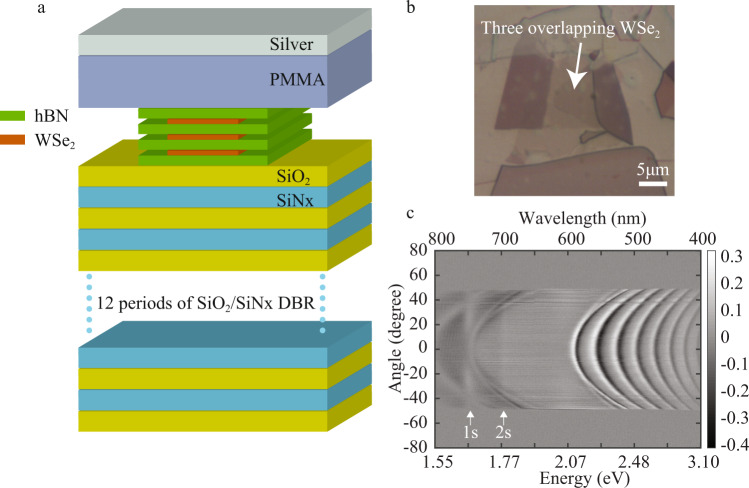
The sample structure is shown in Fig. 1a, where a 12-period silicon nitride (SiNx)/ silicon dioxide (SiO2) distributed Bragg reflector (DBR) was first grown on silicon substrate via plasma enhanced chemical vapor deposition. Three layers of hexagonal boron nitride (hBN) encapsulated WSe2 were then transferred on top of the DBR followed by spin coating 212 nm Poly (methyl methacrylate) (PMMA). A 40 nm silver layer was deposited to form the top mirror of the cavity. A similar approach was used to fabricate the WS2 monolayer embedded cavity to study the 1 s excitons. The WS2 monolayer was also encapsulated between the hBN layers and the cavity consisted of a similar bottom DBR mirror as used above for the WSe2 cavity. The details of the devices’ information can be found in “Methods”, Supplymentary Fig. 3, and Supplymentary Fig. 4. Three layers of WSe2 were used in these experiments due to the weaker oscillator strength (5–10 times) of the excited exciton state (2 s) compared with the ground state exciton (1 s) in TMDs (Supplementary Fig. 5). Typically, the Rabi splitting for monolayer 1 s exciton polaritons in TMDs is on the order of few tens of meV38. Since the total exciton-photon interaction strength is proportional to the square root of number of monolayers21, more layers can be used to reach a larger Rabi splitting for the 2 s states. Figure 1b is an optical microscope image showing the three layers of WSe2 after transfer onto the bottom DBR. To confirm the observation of the 2 s state, we performed a room temperature angle resolved white light reflection contrast measurement directly after the multilayer stack was transferred onto the bottom DBR. The reflection contrast is defined as , where and are reflected intensities from the sample area and a bare DBR area, respectively. Here a positive contrast indicates absorption in the sample. Both 1 s exciton (1.655 eV) and 2 s excitonic (1.780 eV) absorption features can be seen in Fig. 1c and their spectral positions are labeled by the white arrows. The parabolic features in Fig. 1c arise from the DBR side band.

Reflection spectrum of WSe2 on DBR.
a Schematic illustration of the sample structure. b Optical image after the multilayer hBN-WSe2 stacking was transferred on top of the DBR. The area where three WSe2 layers overlap is marked with the white arrow. c Angle resolved differential reflection of multilayer structure on DBR at room temperature. Absorption features can be observed at the energies of the 1 s and 2 s exciton and are marked by the white arrows.
Temperauture dependent k-space reflection spectra
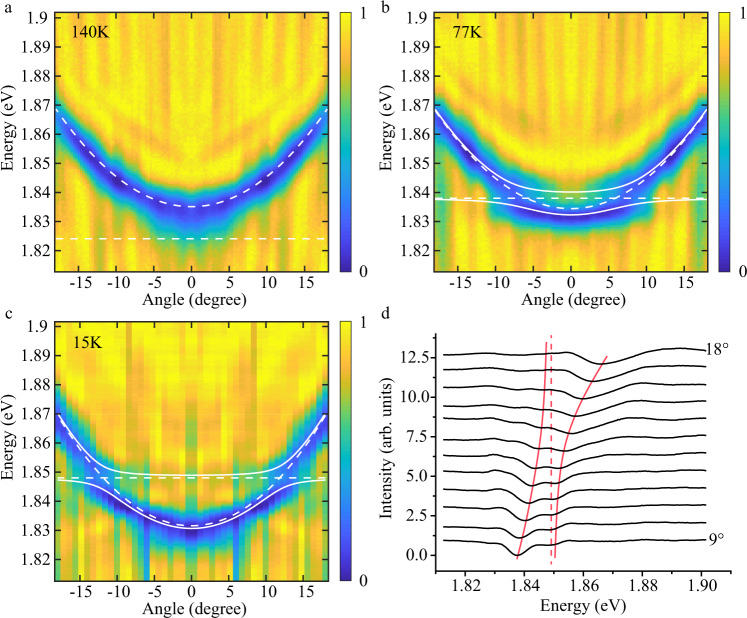
Fourier space (k-space) imaging was carried out to determine the dispersion of the strongly coupled states. Figure 2a–c shows k-space white light reflection at different temperatures (140 K, 77 K, 15 K). The white solid lines are fits simulated using transfer matrix method. The white dashed lines represent the bare 2 s exciton energy () and bare cavity dispersions (). At 140 K (Fig. 2a), the 2 s exciton energy lies below the cavity resonance with a positive detuning of 11 meV and does not show strong coupling. Here detuning is defined as at the angle of zero degree. The exciton energy blue shifts with decreasing temperature (Supplementary Fig. 5). By lowering the temperature (Fig. 2b and c), we can then blue shift the exciton energy across the cavity resonance leading to strong exciton-photon hybridization and clear anticrossing (Fig. 2d) between the upper and lower polariton branches with a measured Rabi splitting of .
Temperature dependent cavity coupling to excited-state excitons.
a–c Angle resolved reflection at different temperatures of 140, 77, and 15 K. The dashed lines indicate the bare cavity and exciton dispersions, while the solid lines correspond to the resulting dispersion relations of the two polaritons induced by the strong coupling between the excitons and the cavity photons. d Line cut from the 15 K data between and . Those data have y axis offset for clarity. A clear anti-crossing is observed (red trend lines). The extracted Rabi splitting is 7.7 meV. The dashed line shows the 2 s exciton energy at 1.848 eV.
White light intensity dependent k-space reflection spectra
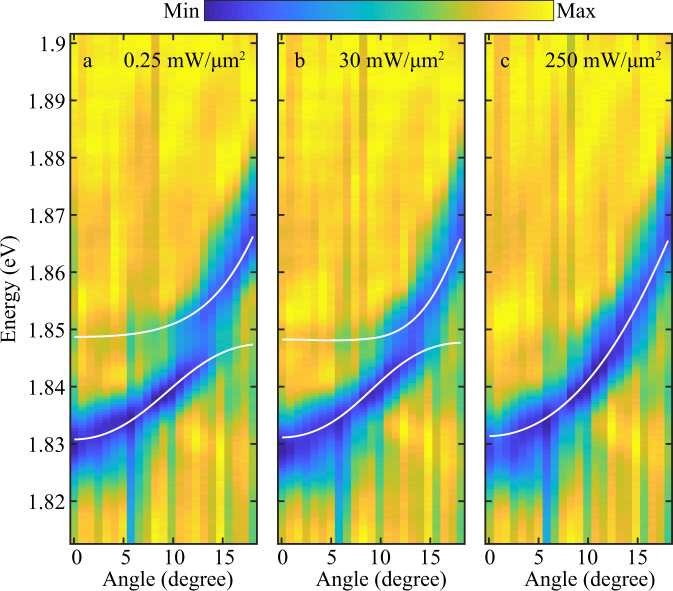
In order to investigate the nonlinear optical response of the excited exciton states, we measured the cavity reflection spectrum for varying intensities of the incident white light (see Methods for details on experiment). Upon increasing the intensity, the energy splitting between the polariton branches gradually decreases as shown in Fig. 3. Similar behavior was observed using the 1 s exciton ground state in WS2 (Supplementary Fig. 6). Note that this behavior differs qualitatively from the effects of an increasing temperature shown in Fig. 2, such that we can exclude white light heating as a potential source for the observed intensity dependence of the cavity response.
White light intensity dependent cavity reflection.
a–c Angle resolved reflection for different incident intensities of (a), (b), and (c). Higher intensities imply a higher density of polaritons, which eventually leads to an excitation blockade induced by the strong interaction between excitons. This polariton blockade reduces the effective coupling to the cavity, observed as a decreasing splitting of the two polariton branches in our experiments. The analysis for nonlinear interacion is carried out below 30 mW/µm2 where the system is well under the strong coupling regime.
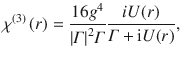
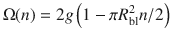
Increasing the intensity can cause both a decrease in Rabi splitting39–41 as well as an overall blue shift10,11 of both polariton branches. The former effect dominates widebandgap materials42 as well as organic systems43 with strong binding energy while the latter effect is usually observed in low binding energy materials such as GaAs. In the limit of strong coupling both of these effects contribute to the overall nonlinear response. In the present experiments with TMDs having large exciton binding energies, the fomer effect dominates the nonlinear response as has been seen in the case of trion-polaritons44,45 as well as for the ground state excitons46. We can understand and describe this behavior quantitatively in terms of phase space filling in momentum space or polariton blockade in real space, whereby the interaction between polaritons prevents their simultaneous generation within a blockade radius and thereby inhibits the formation of polaritons within the distance . Analogous to the emergence of optical nonlinearities in cold atomic Rydberg gases47–49, this mechanism gives rise to a nonlocal optical nonlinearity with a nonlinear kernel (Supplementary Note 2)
Interaction induced nonlinear cavity response
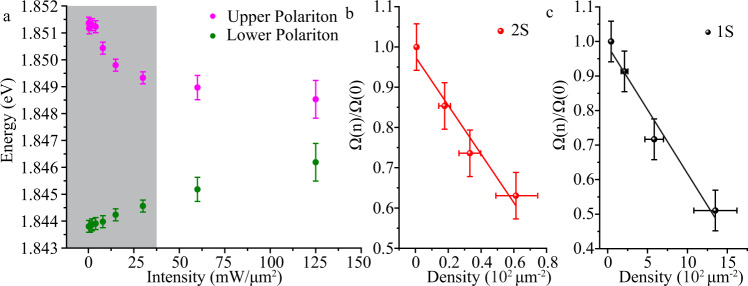
Figure 4a shows the energy of both polariton branches for the 2 s state at their avoided crossing as a function of the input intensity (1 s data is shown in Supplementary Fig. 6). Although the polariton splitting vanishes at the highest intensities, we only consider intensities below 30 mW/μm2, where the system is well in the strong-coupling regime to quantitatively extract the strength of the nonlinearity. By subtracting the lower polariton energy from the upper polariton energy, we obtain the density-dependent Rabi splitting, which is shown in Fig. 4b and c for the excited 2s-exciton and the ground state 1s-exciton, respectively. The observed Rabi splitting indeed decreases linearly for small intensities regime as predicted by Eq. (2). In this regime, we can use the known linear relation between the pump intensity and the polariton density (see Supplementary Note 3) to fit the relation Eq. (2) to our measurements, as shown in Fig. 4b and c. This in turn allows to determine the polariton blockade radius, and yields for the 2 s exciton state corresponding to . In contrast, our analogous measurements for 1 s ground state excitons in WS2 reveal a weaker nonlinearity, and an associated blockade radius of . In fact, the exciton radii have been measured experimentally32,53 to be for the 1 s state in WS2 and for the 2 s state in WSe2, respectively. Therefore, the ratio is indeed close to the enhancement of the blockade radius deduced from our measurements. For phase space filling induced nonlinearity, the polariton–polariton interaction strength is proportional to the square of the Bohr radius and the Rabi splitting, 37. This gives an estimated ratio of , where the experimental Rabi splitting for the 2 s (7.7 meV) and 1 s (27 meV) have been used. This estimated ratio based on the above expression is in reasonable agreement with the ratio obatined experimentally of .
Interaction induced nonlinear cavity response.
a Energies of the upper polariton and lower polariton under different injected intensity at the Rabi splitting angle where exciton and photon component have the same fraction. The shaded region corresponds to the strong coupling regime used to estimate the strength of the nonlinearity. b, c Normalized Rabi splitting as a function of the polariton density for 2 s (b) and 1 s (c). The solid lines show fits of Eq. (2) to our low-density data, yielding blockade radii of and for the 2 s- and 1 s-exciton, respectively. The errors bars represent one standard deviation from fitting the reflectivity at each input power.
Discussion
The enhancement of the exciton blockade radius demonstrated in our experiments corresponds to a 4.6 times enhancement of the polariton–polariton interaction strength. This observed growth of the nonlinearity agrees with the expected scaling of the resulting effective polariton–polariton interaction, due to the increasing range of the exciton interaction with their principal quantum number . This result presents a systematic approach towards the enhancement of polaritonic nonlinearities with the ultimate goal of reaching the regime of nonclassical light13,14 and photon blockade that is reached when a single photon can block all further excitations in the cavity. Realizing stronger cavity coupling and narrower line width combined with higher-lying exciton states (>3 s) would yield larger blockade radii and permit approaching the photon-blockade regime. At high principle quantum numbers, long-ranged direct dipole–dipole interactions are expected to contribute most to the overall exciton interactions, leading to an even stronger scaling with the principle quantum number24. In this regime, additional interaction contributions from the excitons in different layers may lead to an even stronger scaling with n.
Such an enhancement with the increasing excitonic excitation levels together with the demonstrated realization of excited-state exciton-polaritons opens up a promising approach to reach the regime of strong polariton interactions in semiconductor microcavities. In the long term, such enhanced nonlinearities could serve as a mechanism for the generation of nonclassical light and ultimately strongly correlated few-photon quantum states with integrated microcavities.
Methods
Sample fabrication
The cavity consists of van der Waals stack of [hBN-WSe2] x 3 sandwiched between a 12-period bottom SiNx/SiO2 DBR, and top Poly (methyl methacrylate) (PMMA) layer and silver mirror as shown in Fig. 1a. The DBR was grown by plasma-enhanced chemical vapor deposition (PECVD) on a silicon substrate using a combination of nitrous oxide, silane, and ammonia at a temperature of 350 °C. Each SiO2 and SiNx layer is 113 nm, 82.5 nm, with refractive indices 1.46 and 2.03, respectively. The WSe2 monolayers were obtained via direct exfoliation from high-quality WSe2 crystal grown by vapor flux method. The hBN capping layers were obtained through exfoliation from commercially purchased hBN crystal (HQ Graphene). Monolayer WSe2 and different layers of hBN were identified under an optical microscope using their different contrasts on SiO2/Si substrate. The hBN/WSe2/hBN/WSe2/hBN/WSe2/hBN stack was realized by following the poly-propylene carbonate (PPC) pick up technique54. The thickness of each layer can be found in Supplementary Fig. 3. The completed stack was transferred onto the bottom DBR at 120 °C followed by soaking the entire sample in chloroform for 2 h to remove PPC residue. 212 nm thick PMMA (495 A4 from Michrochem, 2020 rpm for 50 sec) was spin coated onto the hBN-WSe2 stack to have the 3λ/2 cavity mode in resonance with exciton energy. After the spin coating, the sample was heated for 2 mins to dry the PMMA. Finally, a 40 nm thick silver top mirror was deposited using electron beam evaporation. A similar approach was used to fabricate the WS2 monolayer embedded cavity. The WS2 monolayer was also encapsulated between the hBN layers and the cavity consisted of a similar bottom DBR mirror as used above for the WSe2 cavity (details of the WS2 sample can be found in Supplymentary Fig. 4). In both cases we use a 3λ/2 thick cavity because it’s difficult to spin coat a uniform PMMA layer that is thinner than the van der Waals stack structure (∼60 nm). Hence, we used a thicker PMMA capping layer, resulting in a 3λ/2 thick cavity. The mode distributions are shown in Supplementary Fig. 3 and Supplementary Fig. 4 for WSe2 and WS2 cavity structures, respectively, where one can see that the monolayers are placed near the second maxima of the cavity field. These heterostructure samples have inhomogenities arising from air bubbles trapped during the fabrication process. However, we have carried out our measurements using a laser spot size (1 µm2) that is far smaller than the uniform area on the sample (∼20 µm2) as shown by the white dashed circle in Supplementary Fig. 2.
We have studied the 1 s state of WS2 and 2 s state of WSe2, since they lie in a similar spectral range and therefore permit to use nearly identical cavity structures, which minimizes potential effects that may otherwise arise from different cavity fabrication procedures for the two exciton states.
Optical measurements
The angle-dependent reflection measurements were taken using Fourier space imaging technique. A super continuum pulsed light source (NKT Photoincs, repetation rate 1.98–80 MHz, pusle duration 20 ps) passing through a long pass filter at 650 nm (550 nm) and a short pass filter at 750 nm (650 nm) was used to selectively excite the 2 s (1 s) exciton state in WSe2 (WS2). The single pulse averaged power was used in the maintext. The setup is coupled with Princeton Instruments monochromator with a PIXIS: 256 EMCCD camera. The spot size of the laser was 1 µm2 and ensured that we were probing a uniform area of the sample (∼20 µm2).
Supplementary information
The online version contains supplementary material available at 10.1038/s41467-021-22537-x.
Acknowledgements
Work at City College of New York—CUNY was supported by the National Science Foundation through the MRSEC program DMR—2011738 (J.G), and the ARO MURI program (W911NF-17-1-0312) (V.M.M). Sample growth at Columbia was supported by MRSEC program DMR—2011738. Spectroscopy studies at Stanford were supported by the National Science Foundation through grant DMR-1708457, by the Gordon and Betty Moore Foundation’s EPiQS Initiative through grant GBMF9462, and by a fellowship from the Alexander von Humboldt Foundation (LW). A.R. gratefully acknowledges support through the Laboratory Directed Research and Development Program of Lawrence Berkeley National Laboratory under U.S. Department of Energy Contract No. DE-AC02-05CH11231. S.K.C. acknowledges support from the NSERC Discovery Grant Program and the Canada Research Chairs. Work at Aarhus was supported by the Carlsberg Foundation through the “Semper Ardens” Research Project QCooL, by the DFG through the SPP1929, by the European Commission through the H2020-FETOPEN project ErBeStA (No. 800942), and by the Danish National Research Foundation through the Center of Excellence “CCQ” (Grant agreement no.: DNRF156). The authors also acknowledge the use of the Nanofabrication Facility at the CUNY Advanced Science Research Center for the fabrication of the devices.
Author contributions
V.M.M., T.F.H., J.G. conceived the experiments. J.G. fabricated the devices. D.R., J.C.H. grew the bulk WSe2 crystal. J.G., L.W., performed the measurements with input from A.R. J.G. performed data analysis. T.P., S.K.C., V.W. did the theoretical modeling. V.M.M supervised the project. All authors contributed to write the paper and discuss the results.
Data availability
Data are available from the authors upon reasonable request.
Code availability
Code are available from the authors upon reasonable request.
Competing interests
The authors declare no competing interests.
References
1.
2.
3.
4.
5.
6.
7.
8.
9.
10.
11.
12.
13.
14.
15.
16.
17.
18.
19.
20.
21.
22.
23.
24.
25.
26.
27.
28.
29.
30.
31.
32.
33.
34.
35.
36.
37.
38.
39.
40.
41.
42.
43.
44.
45.
46.
47.
48.
49.
50.
51.
52.
53.
54.