
Given two quantum channels, we examine the task of determining whether they are compatible—meaning that one can perform both channels simultaneously but, in the future, choose exactly one channel whose output is desired (while forfeiting the output of the other channel). Here, we present several results concerning this task. First, we show it is equivalent to the quantum state marginal problem, i.e., every quantum state marginal problem can be recast as the compatibility of two channels, and vice versa. Second, we show that compatible measure-and-prepare channels (i.e., entanglement-breaking channels) do not necessarily have a measure-and-prepare compatibilizing channel. Third, we extend the notion of the Jordan product of matrices to quantum channels and present sufficient conditions for channel compatibility. These Jordan products and their generalizations might be of independent interest. Last, we formulate the different notions of compatibility as semidefinite programs and numerically test when families of partially dephasing-depolarizing channels are compatible.
Establishing whether two quantum channels are compatible is a fundamental problem in quantum information. Here, the authors prove its equivalence to the quantum state marginal problem, introduce an efficient way to solve both, and draw further connection to the measurement compatibility problem.
There are several different settings for the compatibility of states, measurements, and channels that are considered in this paper. The interested reader is referred to the reviews in refs. 1–4 for further discussions on these topics.
The quantum state marginal problem 5–8 is one of the most fundamental problems in quantum theory and quantum chemistry. One version of this problem is the following problem. Given a collection of systems and a collection of density operators ρ1, …, ρm—each acting on some respective subset of subsystems —determine whether there exists a state ρ on which is consistent with every density operator ρ1, …, ρm. For example, if ρ1 acts on S1, then ρ must satisfy

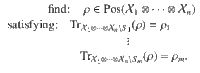
Note that the condition that ρ has unit trace is already enforced by the constraints. In the case where the systems and density operators σ: = ρ2 = ⋯ = ρn are identical (where we omit ρ1 for indexing convenience), we remark that, for the choice of subsystems for each i ∈ {2, …, n}, one obtains the so-called (n − 1)-symmetric-extendibility condition for σ. This is closely related to separability testing 11.
There is an analogous task for quantum measurements called the measurement compatibility problem (see 12,13 for POVMs (positive operator-valued measures) and 14,15 for the special case of qubits). This task can be stated as follows. Two POVMs {M1, …, Mm} and {N1, …, Nn} are said to be compatible if there exists a choice of POVM {Pi,j: i ∈ {1, …, m}, j ∈ {1, …, n}} that satisfies
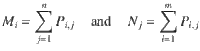
Determining the compatibility of the two POVMs above can be solved via the following semidefinite programming feasibility problem:
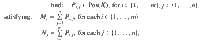
This notion of compatibility for measurements generalizes the concept for commuting measurements. Indeed, if [Mi, Nj] = 0 holds for each choice of indices i and j then the measurement operators Pi,j defined as Pi,j = MiNj form a compatibilizing POVM. This does not hold generally, as the operators MiNj need not even be Hermitian if Mi and Nj do not commute. Nevertheless, one can study Hermitian versions of these matrices using Jordan products, as is discussed below.
The Jordan product of two square operators A and B is defined as
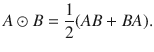
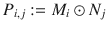
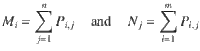
This is Hermitian whenever both A and B are Hermitian. The Jordan product can be used to study the compatibility of measurements (see 24,25). In particular, for POVMs {M1, …, Mm} and {N1, …, Nn}, note that the operators defined as
Before discussing the quantum channel marginal problem, we take a slight detour and discuss the no-broadcasting theorem. A quantum broadcaster for a quantum state is a channel that acts on the subsystem of σ and outputs a state that satisfies

The task of determining compatibility of quantum channels, which has been studied recently (see, e.g. 31–35), can be stated as follows. Given two quantum channels, Φ1 from to and Φ2 from to , one determines if there exists another channel Φ from to that satisfies

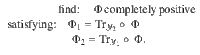
The condition that Φ is trace-preserving follows from the constraints. The channel compatibility problem (in either the no-broadcasting formulation or in the general form given in Eq. (10)) is an essential component of research in quantum cryptography. For example, if two parties, say Alice and Bob, decide to communicate via some channel Φ1, an eavesdropper Eve may use any channel Φ2 compatible with Φ1 to obtain partial information about the communication between Alice and Bob.
To see how the channel and state versions of the marginal problem are generalizations of each other, we may consider the Choi representations of the channels. It is not hard to see 32,36 that the conditions for the compatibility of Φ1 and Φ2 is equivalent to the following conditions on the Choi matrices:

To see how the channel compatibility problem is a generalization of the measurement compatibility problem, consider the following reduction. For the POVMs {M1, …, Mm} and {N1, …, Nn}, define the channels

The result above also holds in more general settings. In particular, a similar result holds for measure-and-prepare channels in the case when the choice of state preparations are distinguishable. However, if the preparations are chosen in a general way, then this equivalence breaks down. To be precise, consider the channels defined as

Another notion of channel compatibility that we consider in this paper concerns the case when Φ1 = Φ2 = Φ for some fixed channel Φ (i.e., when the channels are the same). A channel Φ that is compatible with itself is said to be self-compatible.
One may also consider—for some other positive integer k > 2—whether some choice of k channels Φ1, …, Φk are compatible. If k copies of some fixed channel are compatible—i.e., Φ1 = ⋯ = Φk = Φ are all equal to some fixed channel Φ—then we say that Φ is k-self-compatible.
In this work, we prove several results about channel compatibility. First, we show that the channel compatibility problem is equivalent to the quantum state marginal problem, i.e., every quantum state marginal problem can be recast as the compatibility of two channels, and vice versa. Second, we show that compatible measure-and-prepare channels (i.e., entanglement-breaking channels) do not necessarily have a measure-and-prepare compatibilizing channel. Third, we extend the notion of the Jordan product of matrices to quantum channels and present sufficient conditions for channel compatibility. These Jordan products and their generalizations might be of independent interest. Lastly, we formulate the different notions of compatibility as semidefinite programs and numerically test when families of partially dephasing-depolarizing channels are compatible.
We examine the quantum channel marginal/compatibility problem using several different perspectives. Here we provide an overview of our results, which are stated in an informal manner. Precise definitions and theorem statements can be found in Supplementary information.
As is remarked above, the compatibility of channels is equivalent to the compatibility of their normalized Choi representations as quantum states. That is, the problem of determining the compatibility of channels can be reduced to solving the state marginal problem for a certain choice of states. We show that the quantum channel marginal problem also generalizes the state marginal problem. Recently, a somewhat weaker version of this result was proved in 36, where it was shown that the marginal problem for quantum states with invertible marginals is equivalent to the compatibility of channels. By using a different method to prove the result, we bypass the need for invertible marginals.
Result 1 (Informal, see Supplementary Note 2 for a formal statement.) Every quantum state marginal problem is equivalent to the compatibility of a particular choice of quantum channels.
We first note that every measure-and-prepare (i.e., entanglement-breaking) channel is self-compatible. Indeed, for measure-and-prepare channel Φ there exists a POVM {M1, …, Mm} and a collection of density matrices ρ1, …, ρn such that
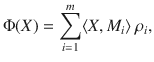
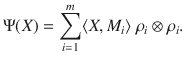
This channel clearly compatibilizes two copies of Φ. (Moreover, one can easily modify Ψ above such that it compatibilizes k copies of Φ. Hence every measure-and-prepare channel is also k-self-compatible for all k.)
The task of determining whether two distinct measure-and-prepare channels Φ1 and Φ2 are compatible, however, is not so straightforward. From the discussion in the previous paragraph, if Φ1 and Φ2 are expressed as measure-and-prepare channels such that the prepared states are distinct computational basis states, it can be seen that the notion of channel compatibility is equivalent to that of measurement compatibility. However, this is not the case for all measure-and-prepare channels. For instance, there may be multiple ways to express the measurements and/or preparations for a particular measure-and-prepare channel. One might guess that any channel which compatibilizes two measure-and-prepare channels must also be measure-and-prepare and can only exist if all three sets of measurements satisfy some conditions. However, we show that this is not the case, as described below. Note that similar result was also recently obtained in a different context in 37.
Result 2 (See Supplementary Note 3 for details.) There exists a pair of compatible measure-and-prepare channels with no measure-and-prepare compatibilizer.
The two channels were found using semidefinite programming formulations of channel compatibility and the notion of positive partial transpose (PPT).
The Jordan product of two channels, Φ1 from system to system and Φ2 from to , is the linear map Φ1 ⊙ Φ2 from the system to the system whose Choi representation is given by


It is known that for projection-valued measures (PVMs)—that is POVMs where every operator is a projection—the Jordan product provides a necessary and sufficient condition for the compatibility of a PVM with any POVM 26. It is therefore natural to consider whether the Jordan product of channels similarly provides necessary and sufficient conditions for a PVM-measurement channel to be compatible with another arbitrary channel. Namely, for a PVM {Π1, …, Πm}, let ΔΠ be the corresponding measurement channel defined as
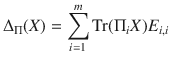
Result 3 (Informal, see Supplementary Note 4 for a formal statement.) ΔΠ is compatible with Φ if and only if ΔΠ ⊙ Φ is completely positive.
To tackle more general cases, we describe how to relax the sufficient condition that the Jordan product be completely positive. Note that the Choi representation of the Jordan product as provided in Eq. (16) can be expressed as


Result 4 (Informal, see Supplementary Note 4 for a formal statement.) If the channels Φ1 and Φ2 are invertible as linear maps, then they are compatible if and only if they are Jordan compatible. (Note that the inverses do not have to be quantum channels themselves.)
The requirement that both channels are invertible is not too restrictive, as indicated by the following result.
Result 5 (Informal, see Supplementary Note 5 for a formal statement.) The set of Jordan-compatible pairs of channels has full measure as a subset of all compatible pairs.
The task of determining whether two channels Φ1 and Φ2 are compatible can be formulated as the following semidefinite programming feasibility problem:

This formulation can be found by using the Choi representations of each channel and their compatibilizer (where X is the Choi representation of the desired compatibilizer).
The Jordan-compatibility of two channels can be similarly determined via the following semidefinite programming feasibility problem:
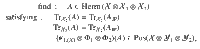
The formulation in Eq. (21) has the advantage of being linear in the Choi representations of the channels—one could therefore keep them as variables and impose affine constraints on the channels. As a concrete example, one may ask whether there exist two qubit-to-qubit channels that are compatible and both unital. (We know that two identity channels do not satisfy these two conditions, but an identity channel and a completely depolarizing channel does.)
We use duality theory to show a few theorems of the alternative for the cases of compatibility and Jordan compatibility. For an example, we present one of the two versions for compatibility, below.
Result 6 (Informal, see Supplementary Note 6 for a formal statement.) Φ1 and Φ2 are compatible if and only if there does not exist Z1 and Z2 such that

We test various notions of compatibility for certain classes of qubit-to-qubit channels using the semidefinite programming formulations shown above. The family of channels that we consider are the partially dephasing-depolarizing channels defined as


We investigate the values (p, q) ∈ [0, 1] × [0, 1] for which the channel Ξp,q is k-self-compatible for k ∈ {1, …, 10} ∪ {∞}. (Recall that the condition that Ξp,q is measure-and-prepare is equivalent to the condition that it is k-self-compatible for all k.)
We also examine the values of (p, q) ∈ [0, 1] × [0, 1] for which Ξp,q ⊙ Ξp,q is completely positive. This region turns out to be marginally smaller than the region where Ξp,q is self-compatible, thus reinforcing the need for our generalization of the Jordan product. In fact, the channel Ξp,q is invertible when p, q > 0 satisfies p + q < 1, so self-compatibility for this channel can be examined using (generalized) Jordan products for almost all values of p and q.
Finally, we investigate the region of values (q0, q1) ∈ [0, 1] × [0, 1] for which the pairs of channels are compatible and when the Jordan product is completely positive. It turns out that the values of (q0, q1) for which is completely positive contains some nontrivial instances while simultaneously missing other trivial instances of compatible pairs. This illustrates that the (standard) Jordan product provides an interesting sufficient condition for compatibility.
In this work, we studied the quantum channel marginal problem (i.e., the channel compatibility problem)—which is the task of determining whether two channels can be executed simultaneously, in the sense that afterwards, one can choose which channel’s output to obtain. We showed how to decide this via semidefinite programming and presented several other key properties such as its equivalence to the quantum state marginal problem.
We also studied a generalization of the Jordan product to quantum channels, and in turn, generalized it further such that it captures the compatibility of invertible channels. This Jordan product may be of independent interest.
There are many open problems concerning the compatibility of channels. We briefly mention a few which we think are interesting.
One immediate open problem is the question of whether compatibility and Jordan compatibility are equivalent. We conjecture that they are equivalent based on the fact that the set of pairs of compatible channels that are not Jordan compatible must have zero measure when the output and input spaces have the same dimension. On this note, it would be interesting to see if the resolution to this conjecture depends on the dimensions of the input and output spaces.
Another interesting problem is to examine the computational complexity of determining compatibility for a given pair of channels. Since it is equivalent to the quantum state marginal problem, we suspect that there are versions of this problem which are QMA-hard (although the equivalence is a mathematical one, and may or may not translate into efficient algorithmic reductions).
Another open problem is whether one can extend this work to study the compatibility of other quantum objects, such as quantum strategies 39–41, combs 42,43, or even channels in other generalized probabilistic theories.
Lastly, there might be a relationship between channel compatibility and cryptography. For example, symmetric extendibility is closely related to quantum key distribution, since you do not want Alice to be just as correlated/entangled with Bob and she is with Eve. Since quantum channel compatibility generalizes symmetric extendibility, perhaps there is another cryptographic setting in which the notion of channel compatibility translates into (in)security.
4/27/2021
In the original version of this Article, the Supplementary Information file was inadvertently updated in its LaTex version. This file has now been replaced by its PDF version.
The online version contains supplementary material available at 10.1038/s41467-021-22275-0.
We thank John Watrous for helpful discussions and for coining the term “compatibilizer”. J.S. also thanks Anurag Anshu and Daniel Gottesman for interesting discussions about the capacity of compatibilizing channels. M.P. is thankful to Teiko Heinosaari for discussing the Jordan product of channels and the compatibility of measure-and-prepare channels. M.G. is supported by the Natural Sciences and Engineering Research Council (NSERC) of Canada, the Canadian Institute for Advanced Research (CIFAR), and through funding provided to IQC by the Government of Canada. M.P. is thankful for the support by Grant VEGA 2/0142/20, by the grant of the Slovak Research and Development Agency under Contract No. APVV-16-0073, by the Deutsche Forschungsgemeinschaft (DFG, German Research Foundation - 447948357) and by the ERC (Consolidator Grant 683107/TempoQ). J.S. is supported in part by the Natural Sciences and Engineering Research Council (NSERC) of Canada. Research at Perimeter Institute is supported in part by the Government of Canada through the Department of Innovation, Science and Economic Development Canada and by the Province of Ontario through the Ministry of Colleges and Universities.
M.G., M.P., and J.S. have made substantial, direct and intellectual contribution to the work, and approved it for publication.
Open Access funding enabled and organized by Projekt DEAL.
Data sharing is not applicable to this article as no datasets were generated or analyzed during the current study.
Code used to generate Supplementary Figs. 1 and 2 is available at https://github.com/markwgirard/Channel-Compatibility.
The authors declare no competing interests.
1.
2.
3.
4.
5.
6.
7.
8.
9.
10.
11.
12.
13.
14.
15.
16.
17.
18.
19.
20.
21.
22.
23.
24.
25.
26.
27.
28.
29.
30.
31.
32.
33.
34.
35.
36.
37.
38.
39.
40.
41.
42.
43.
 Jordan products of quantum channels and their compatibility
 Facebook
 Twitter
 Linkedin
 Whatsapp

