
The stacking sequence of hexagonal close-packed and related crystals typically results in steps on vicinal {0001} surfaces that have alternating A and B structures with different growth kinetics. However, because it is difficult to experimentally identify which step has the A or B structure, it has not been possible to determine which has faster adatom attachment kinetics. Here we show that in situ microbeam surface X-ray scattering can determine whether A or B steps have faster kinetics under specific growth conditions. We demonstrate this for organo-metallic vapor phase epitaxy of (0001) GaN. X-ray measurements performed during growth find that the average width of terraces above A steps increases with growth rate, indicating that attachment rate constants are higher for A steps, in contrast to most predictions. Our results have direct implications for understanding the atomic-scale mechanisms of GaN growth and can be applied to a wide variety of related crystals.
The basal-plane surfaces of hexagonal close-packed crystals typically exhibit an alternating sequence of A and B steps with different atomic structures and growth kinetics. Here the authors demonstrate a method to determine whether A or B steps have faster kinetics under specific growth conditions.
Our understanding of crystal growth is built on a powerful paradigm quantified by Burton, Cabrera, and Frank (BCF)1–3, in which atoms are added to the growing crystal surface by attachment at the steps forming the edges of each exposed atomic layer, or terrace. The BCF model was originally developed for crystals with step heights of a full unit-cell and step properties that are identical from step to step for a given step direction. However, from the beginning4 it was recognized that there could be more complex situations. When the space group of the crystal includes screw axes or glide planes, the growth behavior can be fundamentally different on facets perpendicular to one of these symmetry elements5. In this case, the terraces can still all have the same atomic arrangement, but now have different in-plane orientations of their top layer. The fractional-unit-cell-height steps that separate these terraces have structures and properties that can vary from step to step, even for a fixed step direction. Thus, surface morphologies with alternating terrace widths can arise that depend upon the deposition or evaporation conditions, as indicated in Fig. 1. The inequivalent kinetics at steps affects not only surface morphology but also the incorporation of alloying elements during crystal growth6,7.

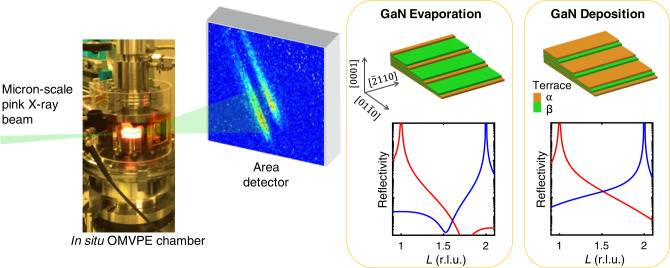
Schematic of microbeam surface X-ray scattering during organo-metallic vapor phase epitaxy (OMVPE) growth.
Crystal truncation rod (CTR) measurements are sensitive to the α or β terrace fraction changes that occur on vicinal {0001} surfaces of HCP-type crystals during deposition or evaporation. Calculated reflectivities are shown for the CTRs from the and Bragg peaks (red and blue curves, respectively) with α terrace fractions fα = 0.1 and 0.9 typical for evaporation and deposition of GaN by OMVPE, as will be shown below.
A ubiquitous but subtle version of this effect occurs on the basal-plane {0001}-type surfaces of crystals having hexagonal close-packed (HCP) or related structures, which are normal to a 63 screw axis. Such crystals are made up of closely packed layers with 3-fold symmetry that alternate between opposite orientations, as shown by the α and β terrace structures in Fig. 2c. On a vicinal surface, the αβαβ stacking sequence typically results in half-unit-cell-height steps. The lowest energy steps are normal to -type directions, and have alternating structures conventionally labeled A and B8,9 as shown in Fig. 2a, b. When the in-plane azimuth of a step changes by 60°, for example, from to , its structure changes from A to B or B to A.
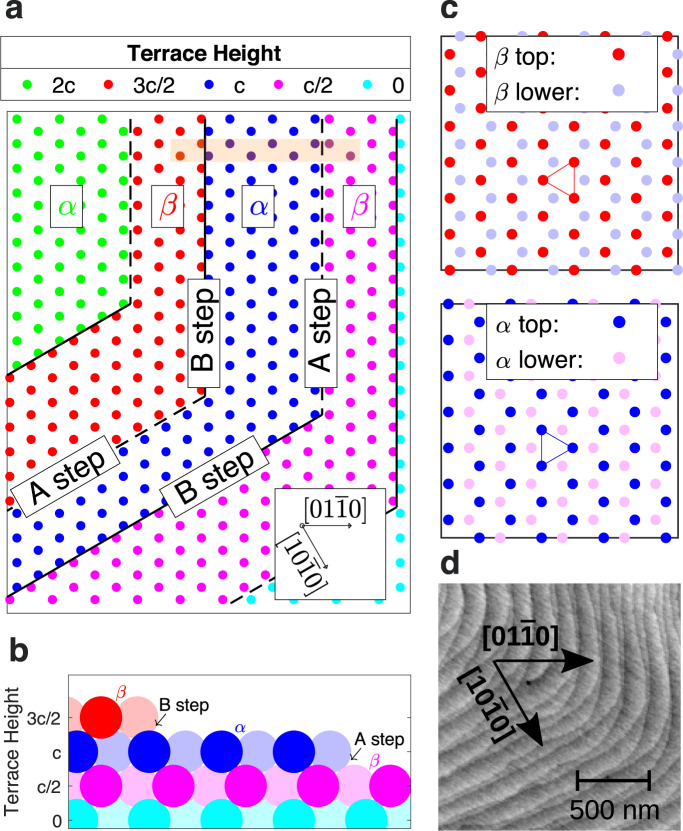
Terrace and step structure of vicinal (0001) surface of an HCP-type crystal.
For GaN, only Ga atoms are shown. a Circles show top-layer sites on each terrace, with color indicating height. Steps typically have lowest edge energy when they are normal to , , or . Steps in a sequence have alternating structures, A and B, which swap when step azimuth changes by 60°. b Cross-section of the A and B step structures in the region marked by an orange rectangle in a. Lighter and darker colors indicate atoms in different rows. c Detail of α and β terrace structures. Orientation of triangle of top-layer atoms around 63 screw axis shows difference between layers. d AFM height image of GaN (0001) surface typical of films grown on sapphire substrates by OMVPE, showing regions of alternating step spacings and interlacing at corners where the step azimuth changes. Step heights are c/2 = 2.6 Å.
The alternating nature of the steps on such surfaces has been imaged in several systems, including SiC4, GaN6,8,10–13, AlN14, and ZnO15. These systems typically show a tendency for local pairing of steps (i.e., alternating step spacings), and an interlaced structure in which the step pairs switch partners at corners where their azimuth changes by 60°, as shown in Fig. 2d. These features are consistent with predictions that A and B steps have significantly different attachment kinetics6,8,12,16–22 that lead to unequal local fractions of α and β terraces during growth. However, it has not been possible to experimentally distinguish the terrace orientation or step structure, and thus to determine whether A or B steps have faster kinetics.
In particular, the properties of A and B steps on GaN (0001) surfaces have been a matter of some disagreement. A seminal study8 of molecular beam epitaxy (MBE) of GaN observed alternating step shapes and proposed that the kinetic coefficients for adatom attachment are higher for A steps than B steps, that is, A steps grow faster for a given supersaturation. The support for this highly cited prediction is based on an argument regarding the difference in dangling bonds between A and B steps, and a comparison with experimental results on GaAs (111)23,24. (Such face-centered cubic materials have A- and B-type steps that do not alternate between successive terraces and thus can be distinguished by their orientation9.) In contrast, several subsequent theoretical studies of GaN (0001) organo-metallic vapor phase epitaxy (OMVPE) and MBE have consistently predicted that A steps have smaller adatom attachment coefficients than B steps. Kinetic Monte Carlo (KMC) studies of GaN (0001) growth under OMVPE conditions found step pairing17 driven by faster kinetics at B steps than A steps16. The standard bond-counting energetics used in a KMC study of growth on an HCP lattice19 result in a much lower Ehrlich–Schwoebel (ES) barrier at B steps than at A steps, when only nearest-neighbor jumps are allowed. A recent KMC study of GaN (0001) growth under MBE conditions18 found triangular islands that close analysis reveals are bounded by A steps, indicating faster growth of B steps. An analysis of InGaN (0001) growth by MBE6 concluded that adatom attachment at B steps is faster, converting them into crenelated edges terminated by A steps.
The difference between the kinetics at A and B steps is a reflection of the chemical states of the adatoms, steps, and terraces that affect the dynamics of A and B steps. Studies of islands on the FCC Pt (111) surface25,26 have found that A steps have a higher growth rate than B steps, but that this relationship is reversed by the presence of adsorbates such as CO. An experimental study of AlN (0001) surfaces grown by OMVPE14 found a change in the terrace fraction as a function of the V/III ratio used during growth. Ab initio calculations of kinetic barriers on GaN and AlN (0001) under MBE and OMVPE conditions20–22 found that the barriers and adsorption energies at A and B steps depend in detail on the surface reconstruction induced by the environment. Thus, to properly understand, model, and control (0001) surface morphology in HCP-type systems, there is a need for an in situ experimental method that can distinguish adatom attachment kinetics at A and B steps in the relevant growth environment.
Here, we show that in situ surface X-ray scattering can distinguish the fraction of the surface covered by α or β terraces during growth, unambiguously determining differences in the attachment kinetics at A and B steps. X-rays are an ideal probe since they are sensitive to atomic-scale structure and can penetrate the growth environment. This method is enabled by using a micron-scale X-ray beam that illuminates a surface region of a high-quality single crystal having a uniform step azimuth, as shown in Fig. 1. We demonstrate this for OMVPE of (0001) GaN, with measurements of crystal truncation rods (CTRs) carried out in situ during growth. CTRs are streaks of intensity extending in reciprocal space away from every Bragg peak in the direction normal to the crystal surface, which are sensitive to the surface structure27. We fit calculated CTRs from a model structure to these measurements to obtain the variation of the steady state α terrace fraction fα as a function of growth conditions, as well as the relaxation times trel of fα upon changing conditions. These results are compared to calculated dynamics based on a BCF model for a system with alternating step types to quantify the differences in the attachment rates at A and B steps.
We present calculations showing how the intensity distribution along the CTRs is sensitive to the fraction of the surface covered by α or β terraces. Our calculations include the effect of surface reconstruction, using relaxed atomic coordinates that have been obtained previously28. For a vicinal surface, the CTRs are tilted away from the crystal axes, so that the CTRs from different Bragg peaks do not overlap. The X-ray reflectivity along the CTRs can be calculated by adding the complex amplitudes from the substrate crystal and the reconstructed overlayers, with proper phase relationships29–31. Details of our calculations are given in a separate paper32.
Figure 3a shows calculated intensity distributions along and CTRs for the GaN (0001) surface, demonstrating how their L-dependences vary with fα. Bragg peak locations have integer indices H0K0L0 in reciprocal lattice units; these indices identify the CTR associated with each peak. For this comparison, we use the 3H(T1) surface reconstruction28 and a fixed surface roughness, independent of fα, as discussed in the “Methods” section below and Supplementary Discussion 1. The same qualitative behavior is obtained using other surface reconstructions. For fα = 0 and fα = 1, the regions between the Bragg peaks have alternating stronger and weaker intensities, with the alternation being opposite for and . For fα = 0.5, the intensities between all Bragg peaks are about the same, and there is no difference between the and CTRs. As required by symmetry, the CTRs with fα = X are identical to the CTRs with fα = 1 − X, for any value X. Figure 3b shows calculations of the reflectivity as a function of fα at positions near L = 1.6 on the and CTRs. The variation in reflectivity is almost monotonic in fα at these positions. These curves are used below to extract fα(t) during dynamic transitions.
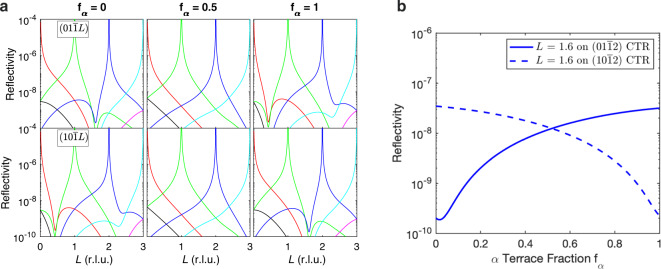
Calculated CTR intensities for a vicinal GaN (0001) surface.
a Top and bottom rows show the families of CTRs along and , respectively. Black, red, green, blue, cyan, and magenta curves are for CTRs from the L0 = −1 to 4 Bragg peaks, respectively. Values of fα for each column are given at the top. b Reflectivity of selected CTRs as a function of terrace fraction fα for fixed values of L = 1.6.
We studied four OMVPE conditions having different net growth rates at the same temperature 1076 ± 5 K, summarized in Table 1 (see “Methods” for further details). The substrate used was a GaN single crystal. Figure 4a shows its initial surface morphology determined by ex situ atomic force microscopy (AFM). One can see straight steps almost perpendicular to the y or direction over large areas. An analysis of the step spacing shows a slight tendency towards pairing, with one of the two alternating terrace types having an area fraction of 0.47. AFM is insensitive to whether this fraction corresponds to the α or β terraces. We also characterized the miscut angle by measuring the splitting of the CTRs. Figure 4b shows a transverse cut through the CTRs in the Qy direction near (000L) at L = 0.9. Both the AFM and X-ray measurements give a double-step spacing of w = 573 Å corresponding to a miscut angle of 0.52°. To relate the α terrace fraction to the behavior of A and B steps, it is critical to determine the sign of the step azimuth. By making measurements as a function of L, we verified that the peak at high Qy is the CTR coming from (0000), while the peak at low Qy is the (0002) CTR. This confirms that the downstairs direction of the vicinal surface is in the +y direction, as drawn in Fig. 1. It is also useful to know the precise angle of the step azimuth with respect to the crystal planes, which determines the minimum kink density and thus the predicted values of some kinetic coefficients. X-ray measurements found this to be 5° off of the direction towards , which gives a maximum kink spacing of 33 Å. The kink spacing could be smaller due to thermally generated kinks1, as discussed in Supplementary Discussion 2. With this low-dislocation-density substrate and the low growth rates used, the previously reported instability to step bunching during growth33 was not observed.

| Growth condition index | TEGa flow (μmol min−1) | H2 frac. in carrier (%) | Net growth rate G (monolayer s−1) | Measured values from CTR fits | Best fit from BCF model | |
|---|---|---|---|---|---|---|
| 1 | 0.000 | 50 | −0.0018 | 0.111 ± 0.013 | 0.136 | |
| 2 | 0.000 | 0 | 0.0000 | 0.461 ± 0.018 | 0.440 | |
| 3 | 0.033 | 50 | 0.0109 | 0.811 ± 0.014 | 0.836 | |
| 4 | 0.033 | 0 | 0.0127 | 0.868 ± 0.011 | 0.847 | |
| 1–2 | trel | 2200 ± 200 s | 2478 | |||
| 2–4 | trel | 340 ± 30 s | 331 |
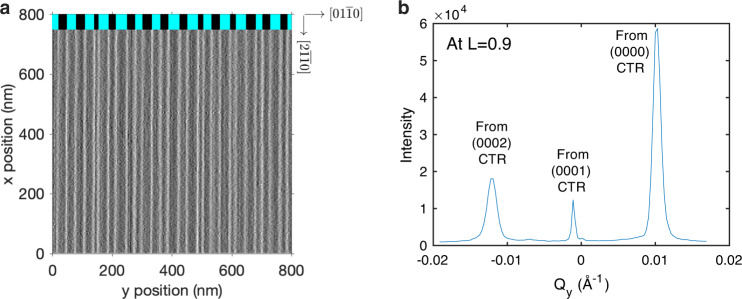
Imaging and scattering from steps.
a AFM image of steps of height c/2 (2.6 Å) on the vicinal GaN substrate used in X-ray measurements. To emphasize the positions of steps, we plot the amplitude error signal, which is proportional to the height gradient in the scan direction (y). Image was obtained ex situ at room T after an anneal for 300 s at 1118 K in zero-growth conditions (0% H2, 0 TEGa). Average fraction over a 2 × 2 μm2 area of terrace family marked black at top is 0.47. The average double-step spacing of w = 573 Å corresponds to a miscut angle of . b Profile of split CTRs from the vicinal surface, measured at T = 1170 K during growth at 0.053 μmol min−1 TEGa and 50% H2. The splitting of the CTRs ΔQy = 0.0110 Å−1 corresponds to a miscut angle of , in agreement with the AFM result.
Figure 5 shows the measured steady state CTR intensities as a function of L, for both the and CTRs and at all four conditions. The qualitative behavior agrees with that expected from a variation in fα shown in Fig. 3a, with alternating higher and lower intensities between the Bragg peaks under some conditions, and opposite behavior of the two CTRs.
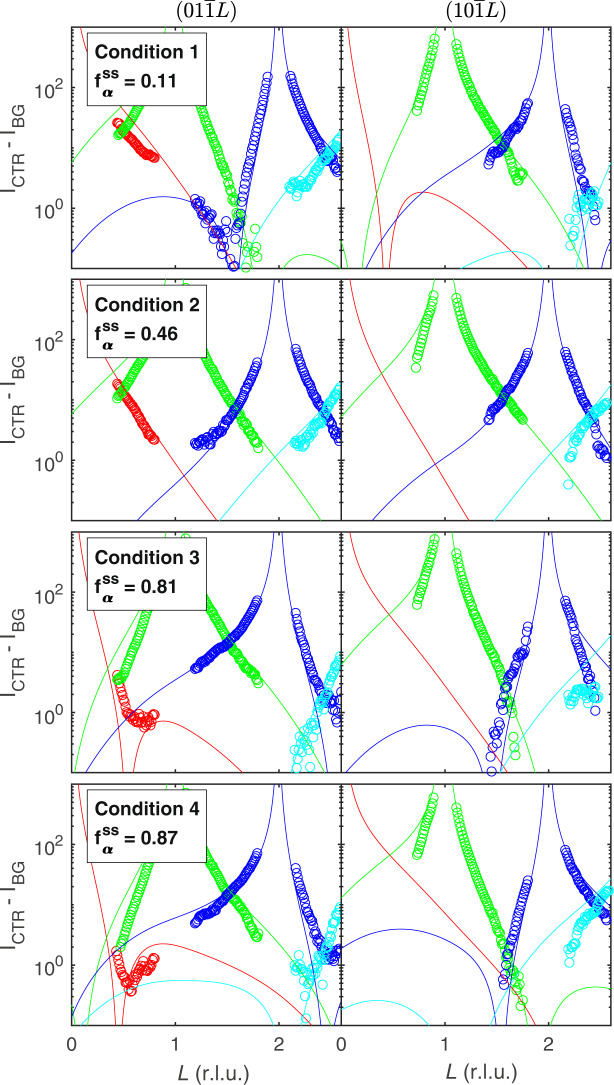
Measured and calculated crystal truncation rods.
Symbols show measured net intensities of the CTRs and the CTRs families (left and right) for CTRs from the L0 = 0, 1, 2, and 3 Bragg peaks at each of four conditions. Curves show fits of all CTRs to obtain steady state α terrace fraction at each condition.
To obtain values of the steady state terrace fraction for each of the four conditions, we fit calculated CTR intensities to the measured profiles. We performed fits using different possible surface reconstructions (see “Methods” for further details). While the 3H(T1) reconstruction gives the best fit to all conditions, similar values are obtained using alternative reconstructions. For each condition, both the and CTRs were simultaneously fit. The values of obtained as a function of net growth rate G are given in Table 1. The marked increase in as G is increased reveals the qualitative difference between the kinetics at A and B steps during OMVPE of GaN: adatom attachment coefficients for A steps are larger. Thus, a surface with initially balanced α and β terrace fractions at zero net growth rate will evolve to one with higher during positive net growth, because of the initially higher adatom attachment rate at the A steps. Likewise, during evaporation the initially higher detachment rate at A steps will give a lower .
We also observed the dynamics of the change in fα by recording the intensity at a fixed detector position as a function of time before and after an abrupt change between conditions, as shown in Fig. 6a. We chose positions near L = 1.6 where the X-ray reflectivity R changes almost monotonically with fα, as shown in Fig. 3b. It is thus straightforward to obtain fα(t) from the intensity evolution using the calculated R(fα), as shown in Fig. 6b. The characteristic 1/e relaxation times trel were 2200 ± 200 and 340 ± 30 s for the transitions from conditions 1 to 2 and 2 to 4, respectively.
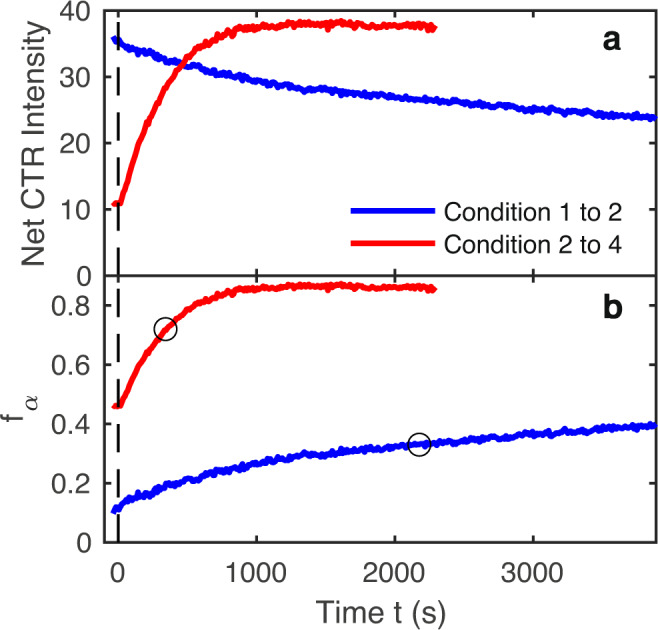
Dynamics following a change of condition at t = 0.
a Measured CTR intensities. b Calculated terrace fractions fα. Blue curves: conditions 1–2 on the CTR at L = 1.627. Red curves: conditions 2–4 on the CTR at L = 1.603. Circles show 1/e relaxation times trel of 2200 ± 200 and 340 ± 30 s, respectively.
To quantitatively relate the behavior of the terrace fraction to the kinetic properties of A and B steps, we have developed a model34 based on BCF theory. Such models have been used extensively to understand growth behavior such as the step-bunching instability35, pairing of steps36, and competitive adsorption37, typically where all steps in a sequence are equivalent. In our model, we consider an alternating sequence of two types of terraces, α and β, and two types of steps, A and B, with properties that can differ, as shown in Fig. 7. Related BCF models with an alternating step or terrace properties have appeared previously12,16,17,38–40. We include the effects of step transparency41 (i.e., adatom transmission across steps) and step–step repulsion2.
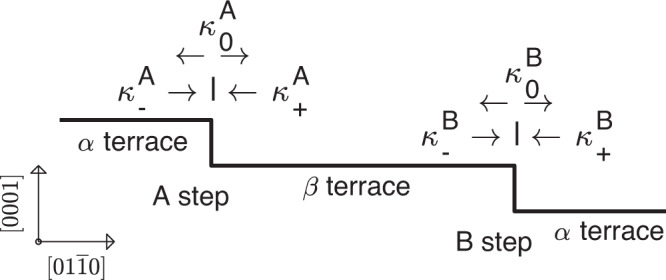
Schematic of alternating terraces and steps for the BCF model.
Vicinal {0001} surfaces of HCP crystals have alternating α and β terraces separated by A and B steps. Notations are indicated for the kinetic coefficients for adatom attachment from below and above and for adatom transmission. Schematic of alternating terraces and steps of BCF model for HCP basal-plane surfaces, showing kinetic coefficients for the A and B steps.
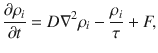
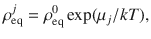
The rate of change in the adatom density per unit area ρi on terrace type i = α or β is written as





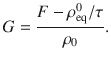
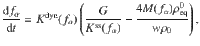
To solve this model, we develop a quasi-steady state expression for the dynamics of the terrace fraction fα. Under fairly general assumptions34, the behavior of fα can be written as a function of the net growth rate,
The full steady state dfα/dt = 0 is obtained at a growth rate of
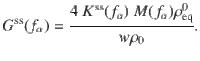
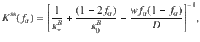
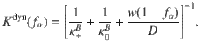
To calculate BCF model results to compare with the experimental conditions, we make three assumptions: (1) the only parameter affected by the TEGa supply rate is the deposition flux F; (2) the only parameter affected by the carrier gas composition (0 or 50% H2) is the adatom lifetime τ; and (3) F and τ enter only through the net growth rate G given by Eq. (8), listed in Table 1 for each condition. We use the known values m−2 and m, where a = 3.20 × 10⁻¹⁰ m and c = 5.20 × 10⁻¹⁰ m are the lattice parameters of GaN at the growth temperature42. We performed fits to the measured quantities (four and two trel) using the general expressions for Kss(fα) and Kdyn(fα)34. The relaxation times for the model were calculated by integrating Eq. (9) to obtain fα(t), and then extracting the relaxation time with the same normalization procedure used for the experimental data. The best fit, shown in Fig. 8, was obtained in the limit in which the coefficient is large, while the , , and coefficients approach zero. In this case, Kss(fα) and Kdyn(fα) can be written as34
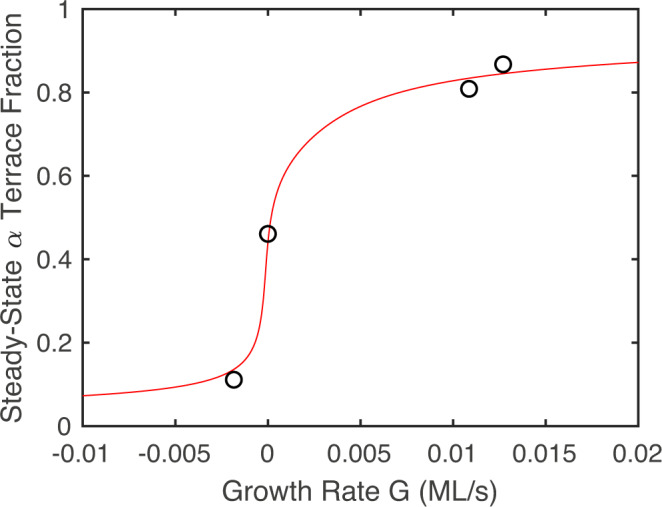
Steady state α terrace fraction as a function of growth rate G.
Circles are experimental values given in Table 1, showing monotonic increase of with increasing G. Curve is best-fit BCF model calculation; also fit simultaneously with these four points were the two relaxation times trel given in Table 1.
To interpret the combined parameters obtained from the fits, it is useful to estimate the adatom diffusivity D and equilibrium adatom density . Ab initio calculations of the activation energy for Ga diffusion on the Ga-terminated (0001) surface have given values of ΔHm = 0.443 and 0.5 eV44, and similar values have been obtained for 3d transition metal adatoms45. If we estimate the diffusivity from the ab initio calculations using 46, with a = 3.2 × 10⁻¹⁰ m, ν = 1013 s−1, ΔSm = 0, and ΔHm = 0.4 eV, we obtain D = 1.4 × 10⁻⁸ m2 s−1 at T = 1073 K. An analysis of spatial correlations in surface morphology of GaN films47 indicated a cross-over at T = 1073 K from surface diffusion transport to evaporation/condensation transport at a length scale of λ = 1.5 × 10⁻⁶ m for OMVPE growth with H2 present in the carrier gas. Thus, the adatom lifetime τ can be estimated as τ = λ2/D = 1.7 × 10⁻⁴ s under these conditions. Using our observed negative net growth rate for F = 0 of ML s−1, this gives a value for the equilibrium adatom density of m−2. Using these estimates for D and , the parameters obtained from the mixed kinetics fit imply kinetic coefficients of m s−1 and m s−1, and a step repulsion length of ℓ = 9 × 10⁻¹⁰ m.
Although it has not been possible to use scanning-probe microscopy to observe the orientation difference of α and β terraces on vicinal basal-plane surfaces of HCP-type systems, our results show that this difference is robustly revealed by surface X-ray scattering. In situ X-ray measurements during growth can determine the fraction covered by each terrace, and thus distinguish the dynamics of A and B steps. While the CTR calculations presented here are for wurtzite-structure GaN, this method applies to many other HCP-type systems with a 63 screw axis, including other compound semiconductors, as well as one-third of the crystalline elements and many more complex crystals.
The BCF model presented here makes predictions for the behavior of the α terrace fraction fα at steady state and during transients, in terms of surface properties such as the adatom diffusivity D and step kinetic coefficients . In particular, the steady state fraction is predicted to depend only on the net growth rate , rather than individually on the deposition rate F or the adatom lifetime τ. The positive or negative slope of is determined by the sign of a combined kinetic parameter Kss.
Our primary experimental result, the positive slope of , determines the basic nature of the adatom attachment kinetics at A and B steps for GaN (0001) OMVPE. In general, this positive slope implies that A steps have faster kinetics than B steps, that is, the attachment coefficients are larger than the . While a similar general shape of is produced by many combinations of the parameters in the BCF model that have faster A than B step kinetics34, the best fit to our measurements is obtained in the specific limit of Eqs. (11) and (12)). In this limit, the A step has much faster attachment kinetics than the B step, with . This limit also indicates that both A and B steps have standard positive ES barriers, with adatom attachment from below significantly faster than from above for the same supersaturation, and that the A step is nontransparent. We find that differs only slightly from the symmetrical value of 1/2.
In comparing the observed values of the step kinetic coefficients to predictions, the 5° rotation of the step azimuth away from is potentially important, since it determines the minimum average kink spacing on the steps to be 33 Å1, as discussed in Supplementary Discussion 2. We expect that this relatively small kink spacing will tend to produce higher predicted values of the attachment coefficients and and lower values of the transmission coefficients , since attachment occurs when adatoms at a step diffuse along it to find a kink, while transmission occurs when the adatom detaches from the step onto the opposite terrace before it finds a kink48. Because the transmitted adatom must traverse the barriers on both sides of the step independent of whether it arrives from above or below, does not depend on the direction.
Our conclusion that A steps on GaN (0001) have higher attachment coefficients than B steps agrees with the original qualitative prediction8, and motivates further quantitative theory development beyond that carried out to date. In several previous studies6,16–22, various assumptions can lead to the opposite conclusion, as described below. Both the predicted and observed step behavior can depend upon the chemical environment (e.g., OMVPE vs. MBE) and how it passivates the step edges. For example, arguments regarding dangling bonds at steps6,8 depend on the effects of very high or low V/III ratios14 and the presence of NH3 or H2. Likewise, KMC studies16–19 typically make assumptions about bonding that determine the rates of atomic-scale processes at steps. Detailed ab initio predictions of kinetic barriers and adsorption energies at steps under MBE and OMVPE conditions20–22 show that they depend strongly on the chemical environment and resulting surface reconstruction. To date, these calculations have been carried out for the Ga(T4), NH(H3) + H(T1), and NH(H3) + NH2(T1) reconstructions. In future theoretical work, it would be useful to consider the specific step-edge structures associated with the 3H(T1) reconstruction found here and in recent calculations for the OMVPE environment49. Having an accurate model for atomic incorporation at steps can have important practical implications for advanced GaN devices, for example, laser diodes and white LEDs, by allowing control of interface morphology and incorporation of alloying elements such as In6,7.
We have demonstrated this method using a micron-scale X-ray beam to satisfy the requirement that the illuminated surface region has a well-defined step azimuth. With current synchrotron X-ray sources, it is convenient to increase the signal rate using a wide-energy-bandwidth pink beam. The higher brightness synchrotron sources soon to come online worldwide will make it possible to perform this type of experiment with highly monochromatic beams, greatly increasing the in-plane resolution of the CTR measurements.
Derivation of the CTR calculations for miscut surfaces with alternating terrace terminations is provided in a separate paper32. As described in Supplementary Discussion 1, in fits shown in Table 2, and in recent predictions49, we expect that the GaN surface under OMVPE conditions has a 3H(T1) reconstruction, in which 3 of every 4 Ga atoms in top-layer sites shown in Fig. 2 are bonded to an adsorbed hydrogen. The calculations in Fig. 3a include the effect of this reconstruction, with equal fractions of all reconstruction domains on both terraces. Since no fractional-order diffraction peaks from long-range-ordered reconstructions are observed in experiments, we expect that the domain structure has a short correlation length and all domains are present. We use a surface roughness of σR = 0.74 Å to match the experimental fits described below.
| Growth condition index | Reconstruction | σR | χ2 | |
|---|---|---|---|---|
| 1 | 3H(T1) | 0.111 | 0.75 | 106 |
| Ga(T4) | 0.144 | 1.26 | 130 | |
| NH(H3) + H(T1) | 0.098 | 0.94 | 187 | |
| NH(H3) + NH2(T1) | 0.106 | 0.88 | 200 | |
| NH(H3) | 0.095 | 0.91 | 167 | |
| 2 | 3H(T1) | 0.461 | 0.93 | 57 |
| Ga(T4) | 0.476 | 1.26 | 81 | |
| NH(H3) + H(T1) | 0.460 | 1.15 | 76 | |
| NH(H3) + NH2(T1) | 0.460 | 1.11 | 67 | |
| NH(H3) | 0.459 | 1.13 | 99 | |
| 3 | 3H(T1) | 0.811 | 0.85 | 118 |
| Ga(T4) | 0.670 | 1.46 | 218 | |
| NH(H3) + H(T1) | 0.876 | 1.19 | 205 | |
| NH(H3) + NH2(T1) | 0.869 | 1.15 | 248 | |
| NH(H3) | 0.869 | 1.16 | 168 | |
| 4 | 3H(T1) | 0.868 | 0.47 | 80 |
| Ga(T4) | 0.942 | 1.06 | 112 | |
| NH(H3) + H(T1) | 0.892 | 0.90 | 174 | |
| NH(H3) + NH2(T1) | 0.879 | 0.85 | 220 | |
| NH(H3) | 0.891 | 0.87 | 135 |
We performed in situ measurements of the CTRs in the OMVPE environment at the Advanced Photon Source beamline 12ID-D50. At an incidence angle of 2°, the 10 μm X-ray beam illuminated an area of 10 × 300 μm. To obtain sufficient signal, we used a wide-bandwidth pink beam setup51,52. Details of the measurements and data analysis are given in Supplementary Methods 1. Two types of measurements were performed. We determined the steady state terrace fractions under four different growth/evaporation conditions by scanning the detector along the and CTRs while continuously maintaining steady state growth or evaporation. We also observed the dynamics of fα after an abrupt change in conditions.
Under the conditions studied, deposition is transport limited, with the deposition rate proportional to the supply of the Ga precursor (triethylgallium, TEGa), with a large excess of the N precursor (NH3) constantly supplied. We investigated conditions of zero deposition (no supply of TEGa) as well as deposition at a TEGa supply of 0.033 μmol min−1. The NH3 flow in both cases was 2.7 s.l.p.m. or 0.12 mol min−1, and the total pressure was 267 mbar. The V/III ratio during deposition was thus 3.6 × 10⁶. For both of these conditions, we studied two carrier gas compositions: 50% H2 + 50% N2 and 0% H2 + 100% N2. The addition of H2 to the carrier gas enhances evaporation of GaN, so that the net growth rate (deposition rate minus evaporation rate) is slightly lower; at zero deposition rate, the net growth rate is negative. We determined the net growth rate for all four conditions as described in Supplementary Methods 2. These values are given in Table 1. Substrate temperatures were calibrated to within ±5 K using laser interferometry from a standard sapphire substrate50. While we used the same heater temperature for all conditions, the calibration indicates that the substrate temperature was slightly higher in 50% H2 (1080 K) than in 0% H2 (1073 K). Based on an expected activation energy of ~ 0.4 eV for surface kinetics, this temperature difference produces a negligible (few percent) change in kinetic coefficients.
For each growth condition, fits were performed of the calculated CTR intensities to the measured profiles of the and CTRs. In addition to a single value of fα, parameters varied in the fit included a single surface roughness σR and two intensity scale factors, one for each CTR. We fit to with equal weighting of all points. Fits were done using different possible surface reconstructions. Supplementary Fig. 10 shows the calculated reconstruction phase diagram for the GaN (0001) surface in the OMVPE environment28, as a function of Ga and NH3 chemical potentials. Based on the chemical potential values that correspond to our experimental conditions estimated in Supplementary Discussion 1, shown by the green rectangle, we considered the five reconstructions highlighted in Supplementary Fig. 10. (The estimate for ΔμGa has a large uncertainty because it depends on the nitrogen potential produced by decomposition of NH3.) Table 2 shows the values of steady state terrace fraction , surface roughness σR, and the goodness-of-fit parameter χ2 from fits to reflectivity at four conditions for each of five reconstructions. The qualitative results for the variation of with growth condition are independent of which reconstruction is assumed: increases monotonically as the net growth rate G increases. The 3H(T1) reconstruction gives the best fit (minimum χ2) of the five potential reconstructions, for all four conditions. This is consistent with recent results on GaN (0001) reconstructions in the OMVPE environment49, which found a phase stability region for the 3H(T1) structure even larger than that shown in Supplementary Fig. 10. Figure 5 compares the fits with the 3H(T1) reconstruction to the measured CTR intensities.
We first convert the intensity evolution near L = 1.6 to reflectivity R(t) by normalizing it to match the predicted change in reflectivity for the transition in . We then invert the R(fα) relation calculated for the experimental L value, shown in Fig. 3b, to obtain fα(t). For simplicity, we assume the surface roughness is not a function of growth condition, and use the average value of σR = 0.74 Å from the 3H(T1) fits to calculate R(fα). If the surface roughness were to vary with condition by the amounts shown in Table 2, this would explain only a small fraction of the observed changes (decrease of 7% out of 40% for the transition from conditions 1 to 2, and increase of 16% out of 350% for the transition from conditions 2 to 4). The resulting fα(t) are shown in Fig. 6b. To extract a characteristic relaxation time for each transition, we interpolate the normalized the change [fα(t) − fα(∞)]/[fα(0) − fα(∞)] to obtain the time at which it equals 1/e.
The general expressions for Kss(fα) and Kdyn(fα)34 involve nine unknown quantities (D, , , and the six ) to be determined or constrained by the measurements. This is a challenge because there are only six measured quantities (four steady state α terrace fractions at different growth rates G, and two relaxation times for transitions in G.) The best fit allowing all nine parameters to vary was first determined by a numerical Levenberg–Marquardt nonlinear regression search algorithm. This minimized the goodness-of-fit parameter , where the yi and σi are the six measured quantities and their uncertainties. To estimate the uncertainties in the , we multiplied those obtained in the fits to the 3H(T1) reconstruction by a factor of 4, to account for the uncertainties in the atomic coordinates used. We estimated the uncertainty in the trel to be 10%.
This initial fit found that the minimum χ2 occurs in the region of parameter space in which the coefficient is large, while the , , and coefficients approach zero. In this case, the limiting expressions (Eqs. (11) and (12)) for Kss(fα) and Kdyn(fα) involve only the four unknown quantities , , , and . A final fit using Eqs. (11) and (12)) allowing only these four parameters to vary gave the same solution as the nine parameter fit.
The online version contains supplementary material available at 10.1038/s41467-021-21927-5.
This work was supported by the US Department of Energy (DOE), Office of Science, Office of Basic Energy Sciences, Materials Science and Engineering Division. Experiments were performed at the Advanced Photon Source beamline 12ID-D, a DOE Office of Science user facility operated by Argonne National Laboratory.
All authors contributed to initial discussions motivating the experiments and analysis. G.J., C.T., M.J.H., J.A.E., and G.B.S. developed the microbeam surface X-ray scattering method and carried out the measurements. W.W. provided calculated atomic coordinates for the various surface reconstructions. D.X., C.T., P.Z., and G.B.S. developed the CTR and BCF expressions used in the analysis. G.J. and G.B.S. analyzed the results. All coauthors contributed to drafting and editing the manuscript.
Data supporting the findings of this study are available within the article and its Supplementary Information file and are available in electronic form from the corresponding author on reasonable request.
The authors declare no competing interests.
1.
2.
3.
4.
5.
6.
7.
8.
9.
10.
11.
12.
13.
14.
15.
16.
17.
18.
19.
20.
21.
22.
23.
24.
25.
26.
27.
28.
29.
30.
31.
32.
33.
34.
35.
36.
37.
38.
39.
40.
41.
42.
43.
44.
45.
46.
47.
48.
49.
50.
51.
52.
 In situ microbeam surface X-ray scattering reveals alternating step kinetics during crystal growth
 Facebook
 Twitter
 Linkedin
 Whatsapp

