Nature Communications
Home NiH-catalyzed asymmetric hydroarylation of N-acyl enamines to chiral benzylamines
NiH-catalyzed asymmetric hydroarylation of <i>N</i>-acyl enamines to chiral benzylamines
NiH-catalyzed asymmetric hydroarylation of N-acyl enamines to chiral benzylamines

Article Type: research-article Article History
Abstract

Enantiomerically pure chiral amines and related amide derivatives are privilege motifs in many pharmacologically active molecules. In comparison to the well-established hydroamination, the transition metal-catalysed asymmetric hydrofunctionalization of enamines provides a complementary approach for their construction. Here we report a NiH-catalysed enantio- and regioselective reductive hydroarylation of N-acyl enamines, allowing for the practical access to a broad range of structurally diverse, enantioenriched benzylamines under mild, operationally simple reaction conditions.

Chiral benzylamines are found in many pharmacologically active molecules. Here, the authors report an enantio- and regio-selective reductive hydroarylation of N-acyl enamines with a NiH/chiral bis-imidazoline catalytic system affording a range of enantioenriched benzylamines.

Keywords
He,Song,Chen,and Zhu: NiH-catalyzed asymmetric hydroarylation of N-acyl enamines to chiral benzylamines

Introduction

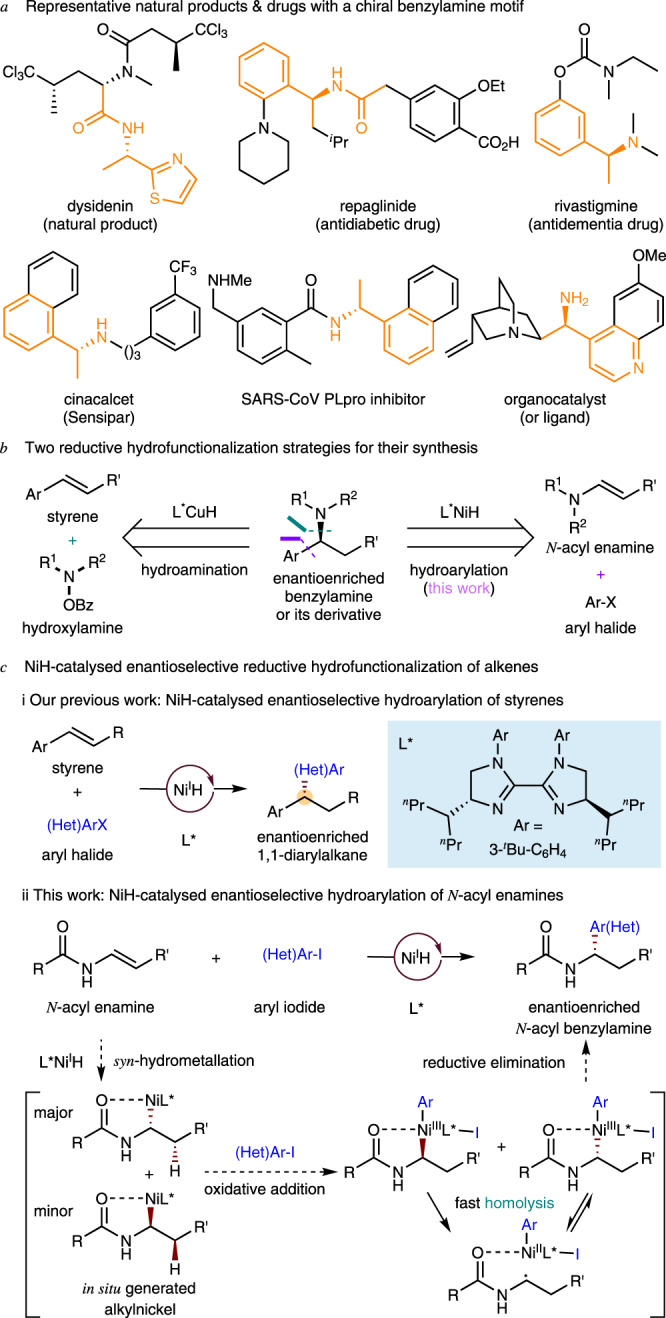
As a privileged structural motif, benzylamines and related amide derivatives are found in many natural products, pharmaceuticals, agrochemicals, and other chemicals (Fig. 1a), and efficient strategies for their catalytic, enantioselective synthesis have long been sought15. Metal hydride69 catalyzed reductive hydrofunctionalization from readily available alkene starting materials is a particularly appealing approach to the synthesis of benzylamines. Previously, starting from styrene and an electrophilic amination reagent, Buchwald10 and Miura and Hirano11 have independently developed an enantioselective reductive CuH-catalyzed hydroamination method (Fig. 1b, left). We recognized that if asymmetric hydroarylation of enamines could be achieved, enantioenriched benzylamines would become accessible (Fig. 1b, right).

Asymmetric hydroarylation of N-acyl enamines to access chiral benzylamines.
Fig. 1

Asymmetric hydroarylation of N-acyl enamines to access chiral benzylamines.

a Representative natural products & drugs with a chiral benzylamine motif. b Two reductive hydrofunctionalization strategies for their synthesis. c NiH-catalyzed enantioselective reductive hydrofunctionalization of alkenes.

Benefiting from the economical and facile chain-walking and cross-coupling1214, and use of simple ligands, NiH catalysis has emerged in recent years as an efficient means of achieving enantioselective C–C bond formation1558. In these general synthetic processes: (1) both of the starting alkenes and aryl halides/alkyl halides are commercially or synthetically available; (2) no prior generation of organometallic reagents is necessary; and (3) the newly formed sp3-hybridized stereocenters could potentially be enantioselectively controlled at the carbons originating in the achiral olefins3943 or at the carbons from racemic alkyl electrophiles3538. Recently, we reported the enantioselective hydroarylation of styrenes using a novel chiral nickel-bis(imidazoline) catalyst (Fig. 1c, i)40. In this process, an asymmetric center was generated and controlled at the carbon derived from the olefin. To demonstrate the wide-ranging applicability of this reductive NiH5458 catalysis, we have explored the feasibility of asymmetric hydroarylation with electron-rich alkenes, for example N-acyl enamines, which are generally less reactive than styrenes (Fig. 1c, ii).

As shown in Fig. 1c, ii, the syn-hydrometallation of an L*NiH species into an N-acyl enamine would generate two alkyl-nickel enantiomers. These could undergo oxidative addition with an aryl iodide, affording two high-valent Ar-Ni(III)-alkyl enantiomers, which would experience rapid homolysis and sequential stereoselective radical recombination prior to a selective reductive elimination5970. In the presence of a suitable chiral ligand, the radical recombination process could be enantioselectively controlled and deliver a single Ar-Ni(III)-alkyl enantiomer in an enantioconvergent fashion. Subsequent reductive elimination would deliver the enantiopure arylation product69. Notably, the amide group in the enamine substrate would also play a key role, enhancing both the regio- and the enantioselectivity. Here we describe the successful execution of this strategy, which allows for the practical access to a broad scope of chiral benzylamines under mild, operationally simple reaction conditions. During the preparation of this report, similar work was reported by Nevado et al.42,43.

Results

Reaction design and optimization

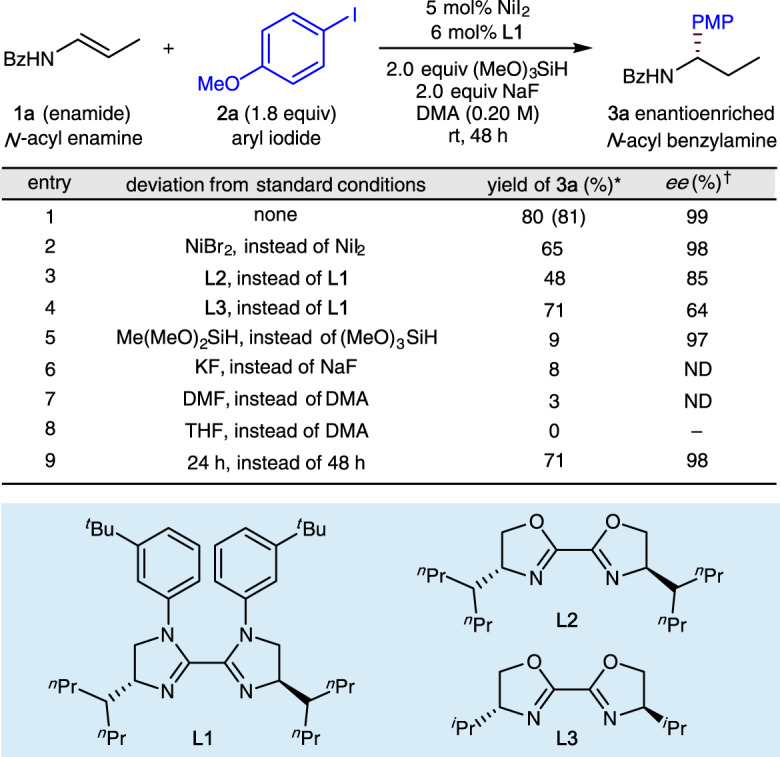
Our initial studies focused on the enantioselective hydroarylation of enamide (1a) with 4-iodoanisole (2a), and obtained the results summarized in Fig. 2 (see Supplementary Tables 1, 2 for details). After extensive examination of nickel sources, ligands, silanes, bases, and solvents, we found that NiI2 and chiral bis-imidazoline ligand (L1) can provide the desired hydroarylation product in good yield as a single regioisomer with high enantioselectivity (99% ee, entry 1). Other nickel sources such as NiBr2 led to lower yields with almost no change in ee (entry 2). Evaluation of ligands showed that both the imidazoline skeleton (entry 3 vs entry 1) and the remote steric effects of the substituent on the imidazoline skeleton (entry 4 vs entry 3) have a marked influence on the enantioselectivity70. Dimethoxymethylsilane was shown to be an unsuitable silane (entry 5) and KF was shown to be an unsuitable base (entry 6). Use of DMF as solvent also led to a significantly lower yield (entry 7) and use of the less-polar THF as solvent produced no desired arylation product (entry 8). Reducing the reaction time from 48 h to 24 h led simply to incomplete conversion (entry 9).
Variation of reaction parameters.
Fig. 2

Variation of reaction parameters.

*Yields determined by crude 1H NMR using 1,1,2,2-tetrachloroethane as the internal standard, the yield in parentheses is the isolated yield. Enantioselectivity was determined by chiral HPLC analysis. Bz benzoyl, PMP p-methoxyphenyl, DMA N,N-dimethylacetamide, DMF N,N-dimethylformamide.

Substrate scope

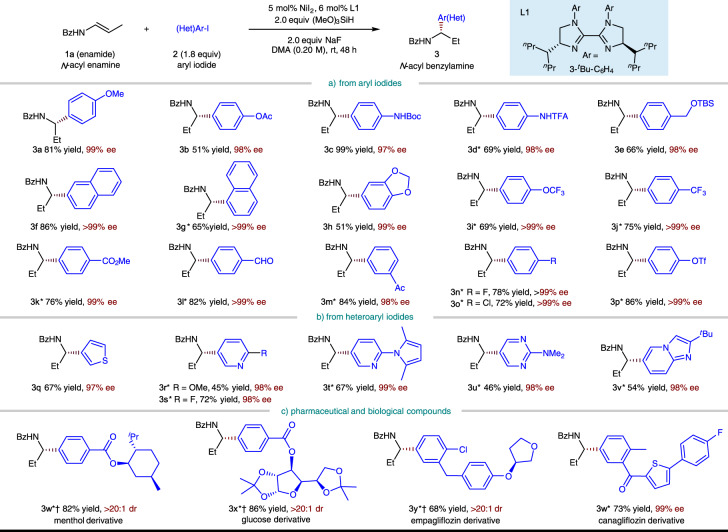
Having established the optimal conditions, we explored the scope of the aryl iodide coupling partner (Fig. 3) and found that a wide range of aryl and heteroaryl iodides are tolerated. The aryl substituent can be substituted at the ortho, meta, or para position (2a2p), however, aryl iodide with an ortho-substituent is less reactive (2g, see Supplementary Figs. 1, 2 for the details of competition experiment). Substrates with Electron-rich (2a2e) as well as electron-withdrawing (2h2p, 2w2z) aryl iodides work well in the reaction. In case of the latter, Ni(ClO4)2∙6H2O was found to be a superior catalyst and only 1.5 equiv of aryl iodide was needed. A variety of functional groups, including ethers (2a, 2e, 2h, 2i, and 2y), esters (2b, 2k, 2w, and 2x), a carbamate (2c), an amide (2d), a trifluoromethyl group (2j), aryl fluorides (2n, 2z), as well as a ketal (2x), are all readily accommodated. Notably, sensitive functional groups such as an easily reduced aldehyde (2l) and ketone (2m, 2z), a chloride (2o, 2y), and a triflate (2p) commonly used for subsequent cross-coupling all remained unchanged under the exceptionally mild reaction conditions of the reaction. Compounds containing heterocycles such as thiophene (2q, 2z), pyridine (2r, 2s, and 2t), pyrrole (2t), pyrimidine (2u), and imidazopyridine (2v) are also competent coupling partners. With this protocol, several core structures of bioactive and pharmaceutical molecules, such as L-menthol (2w), glucose (2x), empagliflozin (2y), and canagliflozin (2z), could be readily introduced in an enantioselective fashion, irrespective of the existing chiral centers and complex structures.
Substrate scope of aryl iodide component.
Fig. 3

Substrate scope of aryl iodide component.

Yield under each product refers to the isolated yield of purified product (0.20 mmol scale, average of two runs), >95:5 regioisomeric ratio (rr) unless otherwise noted. Enantioselectivities were determined by chiral HPLC analysis. *5 mol% Ni(ClO4)2∙6H2O, DMA (0.10 M), 1.5 equiv ArI. Diastereoisomeric ratio (dr) was determined by crude 1H NMR analysis. TBS, tert-butyldimethylsilyl.

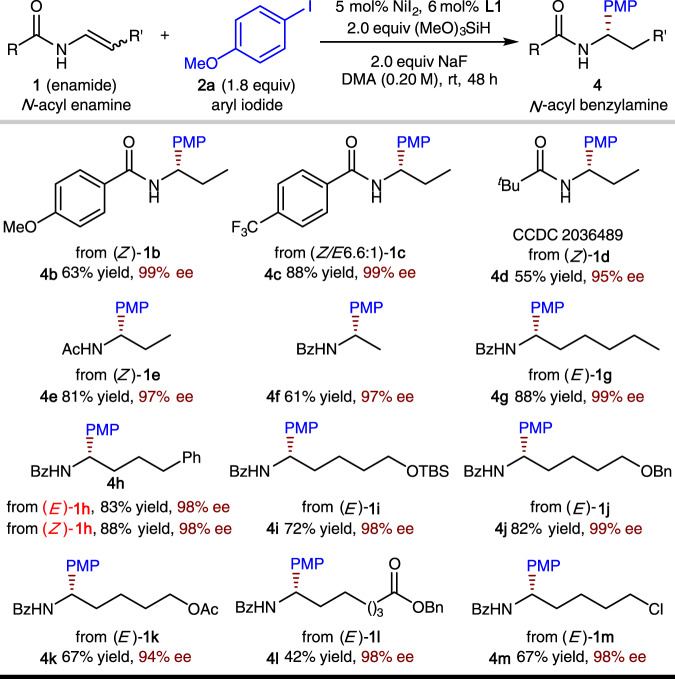
As shown in Fig. 4, the scope of the enamide is also fairly broad. In general, high levels of enantioselectivity are delivered by the reaction. For N-benzoyl enamine substates, an electron-deficient substituent on the aromatic ring of the benzoyl group led to a higher yield than electron-rich substituents (1c vs 1b). The less sterically hindered N-acetyl enamine (1e) was more reactive than N-pivaloyl enamine (1d, see also Supplementary Fig. 3 for X-ray structure of 4d). The β-unsubstituted enamide (1d) was also shown to be a viable substrate. Enamides with a range of different functionalized alkyl substituents at the β-position underwent asymmetric hydroarylation smoothly (1h1m). A diverse spectrum of functional groups were compatible, including ethers (1i, 1j), esters (1k, 1l), and an alkyl chloride (1m). In addition, both E and Z isomers of the enamide substrates produced the same enantiomeric product with the same level of enantioselectivity ((E)-1h vs (Z)-1h).
Substrate scope of the N-acyl enamine component.
Fig. 4

Substrate scope of the N-acyl enamine component.

Yield and ee are as defined in Fig. 3 legend. Ac acetyl.

Discussion

The robustness and synthetic utility of this catalytic system were further demonstrated by gram-scale synthesis and subsequent derivatization of the product (Fig. 5a). A 5 mmol-scale hydroarylation was performed successfully and the product (3a) was readily converted into the tertiary amine (5a) without racemization. To shed light on the hydrometallation process, deuterium-labeling experiments were carried out with deuteropinacolborane (Fig. 5b). From both E and Z isomers of the enamide substrates, a diastereomeric mixture of deuterated products were obtained with an opposite dr ratio. If the syn-hydrometallation of NiD to N-acyl enamine is the enantio-determining step, then a diastereomerically pure 4h-D should be formed. The observed formation of both diastereoisomers in each case indicates that the NiD insertion is not the enantio-determining step (As shown in Supplementary Figs. 49, we could observe the isomerization of E olefinic substrate to Z isomer during the reaction process. In contrast, the isomerization of Z olefinic substrate to E isomer is very slow.). On the other hand, the same level of enantioselectivity for deuterated products in both cases of E and Z olefinic substrates (Fig. 5b) is consistent with a mechanism in which rapid homolysis of Ni(III) to Ni(II) and the subsequent enantioselective radical recombination serves as an enantio-determining step (Fig. 1c, ii).
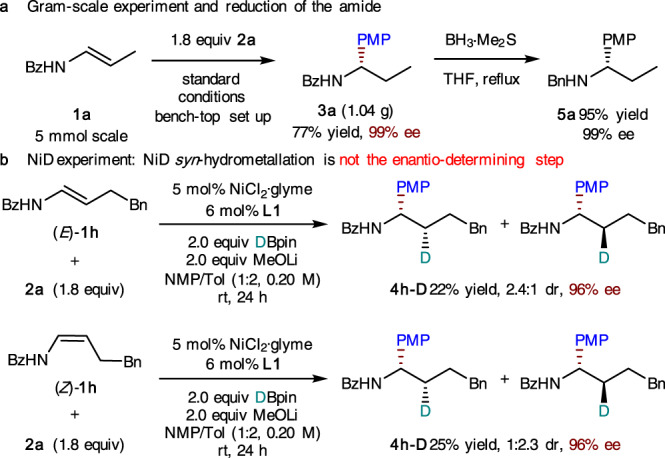
Gram-scale, derivatization, and deuterium-labeling experiments.
Fig. 5

Gram-scale, derivatization, and deuterium-labeling experiments.

a Gram-scale experiment and reduction of the amide. b NiD experiment: NiD syn-hydrometallation is not the enantio-determining step.

In conclusion, we have developed an enantioselective hydroarylation of N-acyl enamines, which provides access to an array of enantioenriched benzylamines, a biologically active pharmacophore. This reaction is based on a reductive NiH catalysis strategy. A wide range of functional groups on both the N-acyl enamine and aryl iodide components are well-tolerated. Preliminary studies of the mechanism suggest that the hydrometallation of NiH is not the enantio-determining step. Development of a migratory version of this transformation and investigations of the mechanism are currently in progress.

Methods

General procedure for NiH-catalyzed asymmetric hydroarylation of N-acyl enamines

In a nitrogen-filled glove box, to an oven-dried 8 mL screw-cap vial equipped with a magnetic stir bar was added NiI2 (3.1 mg, 5.0 mol%), L1 (7.2 mg, 6.0 mol%), NaF (16.8 mg, 2.0 equiv), and anhydrous DMA (1.0 mL). The mixture was stirred for 20 min at room temperature, at which time (E)-N-(prop-1-en-1-yl)benzamide (1a) (32.2 mg, 0.20 mmol, 1.0 equiv), 4-iodoanisole (84.0 mg, 0.36 mmol, 1.8 equiv), and (MeO)3SiH (51.0 μL, 0.40 mmol, 2.0 equiv) were added to the resulting mixture in this order. The tube was sealed with a teflon-lined screw cap, removed from the glove box and the reaction was stirred at rt (22~26 °C) for up to 48 h (the mixture was stirred at 750 rpm, ensuring that the base was uniformly suspended). After the reaction was complete, the reaction mixture was directly filtered through a short pad of silica gel (using EtOAc in Petroleum ether) to give the crude product. 1,1,2,2-Tetrachloroethane (26 μL, 41 mg, 0.25 mmol) was added as internal standard for 1H NMR analysis of the crude material. The product was purified by chromatography on silica gel for each substrate. The yields reported are the average of at least two experiments, unless otherwise indicated. The enantiomeric excesses (% ee) were determined by high-performance liquid chromatography analysis using chiral stationary phases.

Peer review information: Nature Communications thanks Zhenhua Gu and the other, anonymous, reviewer(s) for their contribution to the peer review of this work. Peer reviewer reports are available.
Publisher’s note: Springer Nature remains neutral with regard to jurisdictional claims in published maps and institutional affiliations.

Supplementary information

Supplementary information The online version contains supplementary material available at 10.1038/s41467-020-20888-5.

Acknowledgements

Research reported in this publication was supported by NSFC (21822105, 21772087, and 22001118), NSF of Jiangsu Province (BK20200300, BK20201245), programs for high-level entrepreneurial and innovative talents introduction of Jiangsu Province (group program), and Fundamental Research Funds for the Central Universities (020514380182). The authors thank Zouhong Xu (professor Yi Lu and professor Weiyin Sun group) and Penglong Wang (professor Congqing Zhu group) for assistance with X-ray structure determination.

Author contributions

Y.H. and S.Z. designed the project. Y.H., H.S., J.C., and S.Z. co-wrote the manuscript, analyzed the data, discussed the results, and commented on the manuscript. Y.H., H.S., and J.C. performed the experiments. All authors contributed to discussions.

Data availability

The authors declare that the main data supporting the findings of this study, including experimental procedures and compound characterization, are available within the article and its supplementary information files, or from the corresponding author upon reasonable request. CCDC 2036489 contains the supplementary crystallographic data for 4d. These data can be obtained free of charge from The Cambridge Crystallographic Data Centre via www.ccdc.cam.ac.uk/data_request/cif.

Competing interests

The authors declare no competing interests.

References

1. 

Nugent, T. C. Chiral Amine Synthesis: Methods, Developments and Applications (Wiley-VCH, Weinheim, 2010).

2. 

    Xie J-H, Zhu S-F, Zhou Q-L. Transition metal-catalyzed enantioselective hydrogenation of enamines and imines. Chem. Rev.2011. 111: 1713-1760 doi: 10.1021/cr100218m

3. 

    Afanasyev OI, Kuchuk E, Usanov DL, Chusov D. Reductive amination in the synthesis of pharmaceuticals. Chem. Rev.2019. 119: 11857-11911 doi: 10.1021/acs.chemrev.9b00383

4. 

    Trowbridge A, Walton SM, Gaunt MJ. New strategies for the transition-metal catalyzed synthesis of aliphatic amines. Chem. Rev.2020. 120: 2613-2692 doi: 10.1021/acs.chemrev.9b00462

5. 

    Yin Q, Shi Y, Wang J, Zhang X. Direct catalytic asymmetric synthesis of α-chiral primary amines. Chem. Soc. Rev.2020. 49: 6141-6153 doi: 10.1039/C9CS00921C

6. 

    Pirnot MT, Wang Y-M, Buchwald SL. Copper hydride catalyzed hydroamination of alkenes and alkynes. Angew. Chem. Int. Ed.2016. 55: 48-57 doi: 10.1002/anie.201507594

7. 

8. 

    Crossley SWM, Obradors C, Martinez RM, Shenvi RA. Mn-, Fe-, and Co-catalyzed radical hydrofunctionalizations of olefins. Chem. Rev.2016. 116: 8912-9000 doi: 10.1021/acs.chemrev.6b00334

9. 

    Larionov E, Li H, Mazet C. Well-defined transition metal hydrides in catalytic isomerizations. Chem. Commun.2014. 50: 9816-9826 doi: 10.1039/C4CC02399D

10. 

    Zhu S, Niljianskul N, Buchwald SL. Enantio- and regioselective CuH-catalyzed hydroamination of alkenes. J. Am. Chem. Soc.2013. 135: 15746-15749 doi: 10.1021/ja4092819

11. 

    Hirano Y, Miki K, Satoh T, Miura M. Copper-catalyzed intermolecular regioselective hydroamination of styrenes with polymethylhydrosiloxane and hydroxylamines. Angew. Chem. Int. Ed.2013. 52: 10830-10834 doi: 10.1002/anie.201304365

12. 

Montgomery, J. Organonickel Chemistry. In Lipshutz, B. H., Ed. Organometallics in Synthesis, pp 319–428 (John Wiley & Sons, Inc.: Hoboken, 2013).

13. 

    Tasker SZ, Standley EA, Jamison TF. Recent advances in homogeneous nickel catalysis. Nature2014. 509: 299-309 doi: 10.1038/nature13274

14. 

Ogoshi, S. Nickel Catalysis in Organic Synthesis (Wiley-VCH, Weinheim, 2020).

15. 

    Busolv I, Becouse J, Mazza S, Montandon-Clerc M, Hu X. Chemoselective alkene hydrosilylation catalyzed by nickel pincer complexes. Angew. Chem. Int. Ed.2015. 54: 14523-14526 doi: 10.1002/anie.201507829

16. 

    Lu X, . Practical carbon–carbon bond formation from olefins through nickel-catalyzed reductive olefin hydrocarbonation. Nat. Commun.2016. 7: 11129-11136 doi: 10.1038/ncomms11129

17. 

    Green SA, Matos JLM, Yagi A, Shenvi RA. Branch-selective hydroarylation: iodoarene-olefin cross-coupling. J. Am. Chem. Soc.2016. 138: 12779-12782 doi: 10.1021/jacs.6b08507

18. 

    He Y, Cai Y, Zhu S. Mild and Regioselective Benzylic C–H Functionalization: Ni-catalyzed reductive arylation of remote and proximal olefins. J. Am. Chem. Soc.2017. 139: 1061-1064 doi: 10.1021/jacs.6b11962

19. 

    Juliá-Hernández F, Moragas T, Cornella J, Martin R. Remote carboxylation of halogenated aliphatic hydrocarbons with carbon dioxide. Nature2017. 545: 84-88 doi: 10.1038/nature22316

20. 

    Gaydou M, Moragas T, Juliá-Hernández F, Martin R. Site-selective catalytic carboxylation of unsaturated hydrocarbons with CO2 and water. J. Am. Chem. Soc.2017. 139: 12161-12164 doi: 10.1021/jacs.7b07637

21. 

    Chen F, . Remote migratory cross-electrophile coupling and olefin hydroarylation reactions enabled by in situ generation of NiH. J. Am. Chem. Soc.2017. 139: 13929-13935 doi: 10.1021/jacs.7b08064

22. 

    Zhou F, Zhu J, Zhang Y, Zhu S. NiH-catalyzed reductive relay hydroalkylation: a strategy for the remote C(sp3)–H alkylation of alkenes. Angew. Chem. Int. Ed.2018. 57: 4058-4062 doi: 10.1002/anie.201712731

23. 

    Xiao J, He Y, Ye F, Zhu S. Remote sp3 C–H amination of alkenes with nitroarenes. Chem2018. 4: 1645-1657 doi: 10.1016/j.chempr.2018.04.008

24. 

    Sun S-Z, Börjesson M, Martin-Montero R, Martin R. Site-selective Ni-catalyzed reductive coupling of α-haloboranes with unactivated olefins. J. Am. Chem. Soc.2018. 140: 12765-12769 doi: 10.1021/jacs.8b09425

25. 

    Zhang Y, Xu X, Zhu S. Nickel-catalysed selective migratory hydrothiolation of alkenes and alkynes with thiols. Nat. Commun.2019. 10: 1752 doi: 10.1038/s41467-019-09783-w

26. 

    Zhou L, Zhu C, Bi P, Feng C. Ni-catalyzed migratory fluoro-alkenylation of unactivated alkyl bromides with gem-difluoroalkenes. Chem. Sci.2019. 10: 1144-1149 doi: 10.1039/C8SC04162H

27. 

    Nguyen J, Chong A, Lalic G. Nickel-catalyzed anti-Markovnikov hydroarylation of alkenes. Chem. Sci.2019. 10: 3231-3236 doi: 10.1039/C8SC05445B

28. 

    Bera S, Hu X. Nickel-catalyzed Regioselective hydroalkylation and hydroarylation of alkenyl boronic esters. Angew. Chem. Int. Ed.2019. 58: 13854-13859 doi: 10.1002/anie.201907045

29. 

    Zhang Y, Han B, Zhu S. Rapid access to highly functionalized alkylboronates via NiH-catalyzed remote hydroarylation of boron-containing alkenes. Angew. Chem. Int. Ed.2019. 58: 13860-13864 doi: 10.1002/anie.201907185

30. 

    Sun S-Z, Romano C, Martin R. Site-selective catalytic deaminative alkylation of unactivated olefins. J. Am. Chem. Soc.2019. 141: 16197-16201 doi: 10.1021/jacs.9b07489

31. 

    Chen F, Xu X, He Y, Huang G, Zhu S. NiH-catalyzed migratory defluorinative olefin cross-coupling: trifluoromethyl-substituted alkenes as acceptor olefins to form gem-difluoroalkenes. Angew. Chem. Int. Ed.2020. 59: 5398-5402 doi: 10.1002/anie.201915840

32. 

    Gao Y, . Visible-light-induced nickel-catalyzed cross-coupling with alkylzirconocenes from unactivated alkenes. Chem2020. 6: 675-688 doi: 10.1016/j.chempr.2019.12.010

33. 

    Kumar GS, . Nickel-catalyzed chain-walking cross-electrophile coupling of alkyl and aryl halides and olefin hydroarylation enabled by electrochemical reduction. Angew. Chem. Int. Ed.2020. 59: 6513-6519 doi: 10.1002/anie.201915418

34. 

    Jiao K-J, . Nickel-catalyzed electrochemical reductive relay cross-coupling of alkyl halides to aryl halides. Angew. Chem. Int. Ed.2020. 59: 6520-6524 doi: 10.1002/anie.201912753

35. 

    Wang Z, Yin H, Fu GC. Catalytic enantioconvergent coupling of secondary and tertiary electrophiles with olefins. Nature2018. 563: 379-383 doi: 10.1038/s41586-018-0669-y

36. 

    Zhou F, Zhang Y, Xu X, Zhu S. NiH-catalyzed remote asymmetric hydroalkylation of alkenes with racemic α-bromo amides. Angew. Chem. Int. Ed.2019. 58: 1754-1758 doi: 10.1002/anie.201813222

37. 

    He S-J, . Nickel-catalyzed enantioconvergent reductive hydroalkylation of olefins with α-heteroatom phosphorus or sulfur alkyl electrophiles. J. Am. Chem. Soc.2020. 142: 214-221 doi: 10.1021/jacs.9b09415

38. 

    Yang Z-P, Fu GC. Convergent catalytic asymmetric synthesis of esters of chiral dialkyl carbinols. J. Am. Chem. Soc.2020. 142: 5870-5875 doi: 10.1021/jacs.0c01324

39. 

Bera, S., Mao, R. & Hu, X. Enantioselective C(sp3)–C(sp3) cross-coupling of non-activated alkyl electrophiles via nickel hydride catalysis. Nat. Chem.10.1038/s41557-020-00576-z (2021).

40. 

    He Y, Liu C, Yu L, Zhu S. Enantio- and regioselective NiH-catalyzed reductive hydroarylation of vinylarenes with aryl iodides. Angew. Chem. Int. Ed.2020. 59: 21530-21534 doi: 10.1002/anie.202010386

41. 

Shi, L., Xing, L.-L., Hu, W.-B. & Shu, W. Regio- and enantioselective Ni-catalyzed formal hydroalkylation, hydrobenzylation and hydropropargylation of acrylamides to α-tertiary amides. Angew. Chem. Int. Ed. 10.1002/anie.202011339 (2020).

42. 

Cuesta-Galisteo, S., Schörgenhumer, J., Wei, X., Merino, E. & Nevado, C. Nickel-catalyzed asymmetric synthesis of α-arylbenzamides. Angew. Chem. Int. Ed. 10.1002/anie.202011342 (2020).

43. 

He, Y., Song, H. & Zhu, S. NiH-Catalyzed asymmetric hydroarylation of N-acyl enamines: practical access to chiral benzylamines. ChemRxiv. Preprint at: 10.26434/chemrxiv.13084946.v1 (2020).

44. 

    Chen Y-G, . Nickel-catalyzed enantioselective hydroarylation and hydroalkenylation of styrenes. J. Am. Chem. Soc.2019. 141: 3395-3399 doi: 10.1021/jacs.8b13524

45. 

    Lv X-Y, Fan C, Xiao L-J, Xie J-H, Zhou Q-L. Ligand-enabled Ni-catalyzed enantioselective hydroarylation of styrenes and 1,3-dienes with arylboronic acids. CCS Chem.2019. 1: 328-334 doi: 10.31635/ccschem.019.20190026

46. 

    Marcum JS, Taylor TR, Meek SJ. Enantioselective synthesis of functionalized arenes by nickel-catalyzed site-selective hydroarylation of 1,3-dienes with aryl boronates. Angew. Chem. Int. Ed.2020. 59: 14070-14075 doi: 10.1002/anie.202004982

47. 

    Yu R, Rajasekar S, Fang X. Enantioselective nickel‐catalyzed migratory hydrocyanation of nonconjugated dienes. Angew. Chem. Int. Ed.2020. 59: 21436-21441 doi: 10.1002/anie.202008854

48. 

    Gligorich KM, Cummings SA, Sigman MS. Palladium-catalyzed reductive coupling of styrenes and organostannanes under aerobic conditions. J. Am. Chem. Soc.2007. 129: 14193-14195 doi: 10.1021/ja076746f

49. 

    Semba K, . Reductive cross-coupling of conjugated arylalkenes and aryl bromides with hydrosilanes by cooperative palladium/copper catalysis. Angew. Chem. Int. Ed.2016. 55: 6275-6279 doi: 10.1002/anie.201511975

50. 

    Friis SD, Pirnot MT, Buchwald SL. Asymmetric hydroarylation of vinylarenes using a synergistic combination of CuH and Pd catalysis. J. Am. Chem. Soc.2016. 138: 8372-8375 doi: 10.1021/jacs.6b04566

51. 

    Friis SD, Pirnot MT, Dupuis LN, Buchwald SL. A dual palladium and copper hydride catalyzed approach for alkyl–aryl cross-coupling of aryl halides and olefins. Angew. Chem. Int. Ed.2017. 56: 7242-7246 doi: 10.1002/anie.201703400

52. 

    Armstrong MK, Lalic G. Differential dihydrofunctionalization of terminal alkynes: synthesis of benzylic alkyl boronates through reductive three-component coupling. J. Am. Chem. Soc.2019. 141: 6173-6179 doi: 10.1021/jacs.9b02372

53. 

    Oxtoby LJ, . A Transient-directing-group strategy enables enantioselective reductive heck hydroarylation of alkenes. Angew. Chem. Int. Ed.2020. 59: 8885-8890 doi: 10.1002/anie.202001069

54. 

    Binder JT, Cordier CJ, Fu GC. Catalytic enantioselective cross-couplings of secondary alkyl electrophiles with secondary alkylmetal nucleophiles: Negishi reactions of racemic benzylic bromides with achiral alkylzinc reagents. J. Am. Chem. Soc.2012. 134: 17003-17006 doi: 10.1021/ja308460z

55. 

    Cornella J, Gómez-Bengoa E, Martin R. Combined experimental and theoretical study on the reductive cleavage of inert C–O bonds with silanes: ruling out a classical Ni(0)/Ni(II) catalytic couple and evidence for Ni(I) intermediates. J. Am. Chem. Soc.2013. 135: 1997-2009 doi: 10.1021/ja311940s

56. 

    Cordier CJ, Lundgren RJ, Fu GC. Enantioconvergent cross-couplings of racemic alkylmetal reagents with unactivated secondary alkyl electrophiles: catalytic asymmetric Negishi α-alkylations of N-Boc-pyrrolidine. J. Am. Chem. Soc.2013. 135: 10946-10949 doi: 10.1021/ja4054114

57. 

    Pappas I, Treacy S, Chirik PJ. Alkene hydrosilylation using tertiary silanes with α-diimine nickel catalysts redox-active ligands promote a distinct mechanistic pathway from platinum catalysts. ACS Catal.2016. 6: 4105-4109 doi: 10.1021/acscatal.6b01134

58. 

    Kuang Y, . Ni(I)-catalyzed reductive cyclization of 1,6-dienes: mechanism-controlled trans selectivity. Chem2017. 3: 268-280 doi: 10.1016/j.chempr.2017.07.010

59. 

    Do H-Q, Chandrashekar ERR, Fu GC. Nickel/bis(oxazoline)-catalyzed asymmetric Negishi arylations of racemic secondary benzylic electrophiles to generate enantioenriched 1,1-diarylalkanes. J. Am. Chem. Soc.2013. 135: 16288-16291 doi: 10.1021/ja408561b

60. 

    Tellis JC, Primer DN, Molander GA. Single-electron transmetalation in organoboron cross-coupling by photoredox/nickel dual catalysis. Science2014. 345: 433-436 doi: 10.1126/science.1253647

61. 

    Schley ND, Fu GC. Nickel-catalyzed Negishi arylations of propargylic bromides: a mechanistic investigation. J. Am. Chem. Soc.2014. 136: 16588-16593 doi: 10.1021/ja508718m

62. 

    Gutierrez O, Tellis JC, Primer DN, Molander GA, Kozlowski MC. Nickel-catalyzed cross-coupling of photoredox-generated radicals: uncovering a general manifold for stereoconvergence in nickel-catalyzed cross-couplings. J. Am. Chem. Soc.2015. 137: 4896-4899 doi: 10.1021/ja513079r

63. 

    Ackerman LKG, Anka-Lufford LL, Naodovic M, Weix DJ. Cobalt co-catalysis for cross-electrophile coupling: diarylmethanes from benzyl mesylates and aryl halides. Chem. Sci.2015. 6: 1115-1119 doi: 10.1039/C4SC03106G

64. 

    Zuo Z, . Enantioselective decarboxylative arylation of α-amino acids via the merger of photoredox and nickel catalysis. J. Am. Chem. Soc.2016. 138: 1832-1835 doi: 10.1021/jacs.5b13211

65. 

    Poremba KE, Kadunce NT, Suzuki N, Cherney AH, Reisman SE. Nickel-catalyzed asymmetric reductive cross-coupling to access 1,1-diarylalkanes. J. Am. Chem. Soc.2017. 139: 5684-5687 doi: 10.1021/jacs.7b01705

66. 

    Cheng X, Lu H, Lu Z. Enantioselective benzylic C-H arylation via photoredox and nickel dual catalysis. Nat. Commun.2019. 10: 3549 doi: 10.1038/s41467-019-11392-6

67. 

    Anthony D, Lin Q, Baudet J, Diao T. Ni-catalyzed asymmetric reductive diarylation of vinylarenes. Angew. Chem. Int. Ed.2019. 58: 3198-3202 doi: 10.1002/anie.201900228

68. 

    Wei X, Shu W, García-Domínguez A, Merino E, Nevado C. Asymmetric Ni-catalyzed radical relayed reductive coupling. J. Am. Chem. Soc.2020. 142: 13515-13522 doi: 10.1021/jacs.0c05254

69. 

    Rand AW, . Dual catalytic platform for enabling sp3 α C−H arylation andalkylation of benzamides. ACS Catal.2020. 10: 4671-4676 doi: 10.1021/acscatal.0c01318

70. 

    Woods BP, Orlandi M, Huang C-Y, Sigman MS, Doyle AG. Nickel-catalyzed enantioselective reductive cross-coupling of styrenyl aziridines. J. Am. Chem. Soc.2017. 139: 5688-8691 doi: 10.1021/jacs.7b03448